

The best joint supplements for senior dogs contain glucosamine hydrochloride, chondroitin sulfate, and omega-3 fatty acids — the three ingredients with the strongest evidence base for canine joint health. Top vet-recommended picks include Cosequin DS, Nutramax Dasuquin, and Zesty Paws Mobility Bites — all third-party tested and consistently recommended by veterinary orthopedic specialists for dogs with arthritis and age-related joint degeneration.
Joint disease affects approximately 80% of dogs over 8 years of age to some degree. Many owners notice the signs late — a dog that moves more slowly, struggles to stand up, or is reluctant to climb stairs is often already in significant discomfort. Starting joint supplementation before symptoms appear, ideally from 5–6 years in large breeds, is significantly more effective than waiting for visible deterioration.
Joint supplementation is most effective as part of a complete nutritional approach for senior dogs. For the full picture of canine nutrition across every life stage — including fat requirements, senior protein needs, and food type comparisons — our dog nutrition guide covers the foundation before adding any supplement.
(💡 Joint supplements work best when started early—before visible stiffness and mobility loss have taken hold.)
📰 Osteoarthritis prevalence in senior dogs is documented consistently by VCA Animal Hospitals (vcahospitals.com) and the University of Illinois College of Veterinary Medicine (vetmed.illinois.edu), both confirming that OA affects approximately 80% of dogs over 8 years old and at least 20% of dogs over one year old. Because dogs are naturally stoic about pain, many cases go unrecognized by owners until the disease has progressed significantly.
Table of Contents
Understanding Canine Joint Disease
Before choosing a supplement, it helps to understand what is happening in an arthritic joint — because this determines which ingredients actually matter.
Osteoarthritis is the most common joint condition in senior dogs. It is a degenerative disease involving:
- Progressive breakdown of articular cartilage (the protective cushioning between bones).
- Inflammation of the joint capsule.
- New bone formation (osteophytes) at joint margins.
- Reduced synovial fluid (the joint’s natural lubricant).
The result is pain, stiffness, reduced range of motion, and compensatory changes in gait that create secondary muscle problems.
🐕 Which breeds are most affected: Large and giant breeds carry more bodyweight across their joints and are affected earlier and more severely. Breeds with known high joint disease prevalence include Labrador Retrievers, Golden Retrievers, German Shepherds, Rottweilers, and Bernese Mountain Dogs. However, joint disease is not exclusive to large breeds — Dachshunds, Corgis, and other long-backed dogs have high rates of spinal joint disease.
👉🏼 For food recommendations tailored to large and giant breed needs, see our dog food by breed size guide.
❓When to start supplementation:
- Large/giant breeds: From 5–6 years.
- Medium breeds: From 7 years.
- Small breeds: From 8 years.
- Any dog with diagnosed joint disease: Immediately, regardless of age.
(🩺 Vet’s Note: “By the time an owner tells me their dog is ‘slowing down a bit,’ I often find moderate to severe arthritis on X-ray. Dogs are stoic — they adapt to pain rather than showing it dramatically. If your large breed dog is over 6 years old and not yet on joint support, the conversation is overdue”—LovingPetsGuide Veterinary Advisor.)
The Active Ingredients That Actually Work
The supplement market is crowded with products making vague claims. These are the specific ingredients with meaningful clinical evidence behind them.
Glucosamine Hydrochloride
The most studied joint supplement ingredient in veterinary medicine. Glucosamine is an amino sugar that serves as a building block for glycosaminoglycans — the structural components of cartilage.
❔How it works: Provides raw material for cartilage synthesis and may slow cartilage degradation. Also has mild anti-inflammatory properties.
📋 Evidence: Multiple veterinary studies show improvement in mobility and reduction in pain scores in dogs with osteoarthritis. The effect is modest but consistent — and importantly, it is safe for long-term use.
❕Key distinction: Glucosamine hydrochloride has better absorption than glucosamine sulfate. Always check which form your product uses.
💊 Effective dose: 500–1000 mg per 22 kg (49 lb) of body weight daily.
Chondroitin Sulfate
Chondroitin is a glycosaminoglycan that forms part of cartilage matrix. It works synergistically with glucosamine — clinical trials using both together consistently show better results than either alone.
❔How it works: Inhibits cartilage-degrading enzymes, retains water in cartilage tissue (supporting cushioning), and has mild anti-inflammatory effects.
💊 Effective dose: 400–800 mg per 22 kg (49 lb) of body weight daily, always combined with glucosamine.
Omega-3 Fatty Acids (EPA and DHA)
Omega-3s from marine sources address the inflammatory component of joint disease — which glucosamine and chondroitin do not directly target.
❔How it works: EPA directly reduces prostaglandin synthesis — one of the primary drivers of joint inflammation. Multiple studies show improved mobility in arthritic dogs fed fish oil at therapeutic doses.
❔Why it matters: A dog can have excellent cartilage support from glucosamine/chondroitin but still be in pain from joint inflammation. Omega-3s address the pain, not just the structural degeneration.
For standalone omega-3 supplementation and full dosing guidance, see our guide on the best omega-3 supplements for dogs.
MSM (Methylsulfonylmethane)
MSM is an organic sulfur compound with anti-inflammatory and antioxidant properties. Frequently included in combination joint supplements alongside glucosamine and chondroitin.
📋 Evidence: Less robust than glucosamine/ chondroitin but generally positive in combination products. No meaningful safety concerns at recommended doses.
Hyaluronic Acid
A key component of synovial fluid — the joint’s natural lubricant. Oral Hyaluronic Acid supplementation has shown benefit in human joint studies and is increasingly included in veterinary products.
📋 Evidence: Emerging in veterinary medicine — not as well-established as glucosamine/chondroitin but promising for lubrication support.
What Does NOT Have Strong Evidence
| Green-lipped mussel (Perna canaliculus): Popular ingredient with some anti-inflammatory properties. Evidence is mixed — some studies show benefit, others show minimal effect. Not harmful, but not a replacement for glucosamine/chondroitin. |
| Turmeric/Curcumin: Popular in natural pet circles. Bioavailability in dogs is poor without specific formulation. Most commercial turmeric supplements do not deliver therapeutic levels. Not harmful, but not a reliable primary joint supplement. |
| Collagen supplements: Emerging category with limited veterinary evidence at this stage. May be beneficial but lacks the research backing of glucosamine and chondroitin. |
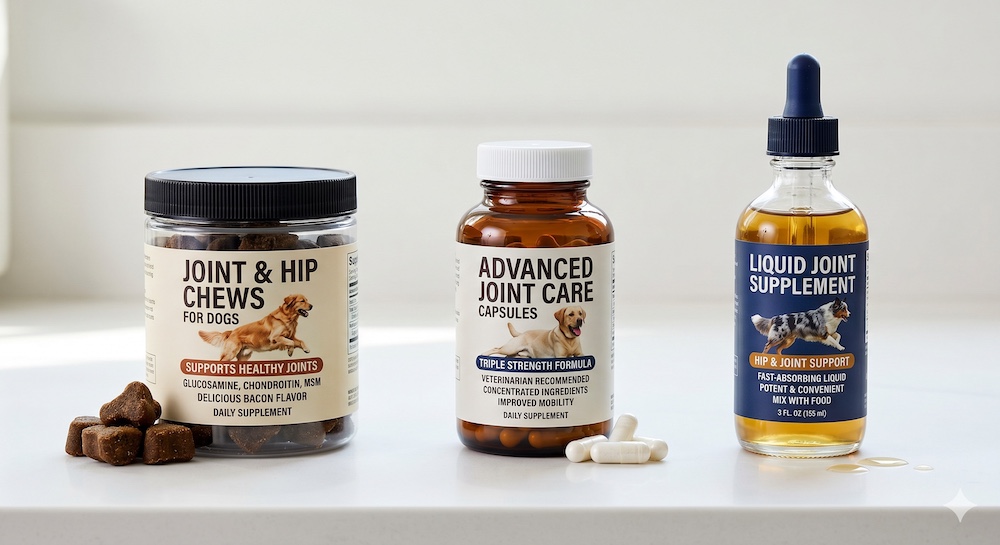
Our Top Picks: Best Joint Supplements for Senior Dogs
Joint supplements are only effective when given consistently every day — which makes format the most practical consideration after ingredient quality. Soft chews have the highest acceptance rate and work well as part of the daily feeding routine, while capsules can be opened and sprinkled over food for dogs that refuse to take them whole.
🥇 Best Overall: Cosequin DS Plus MSM Double Strength Chewable Tablets
Cosequin is the most clinically studied joint supplement brand in veterinary medicine. The DS (Double Strength) Plus MSM formula is the benchmark against which other products are measured — it has been evaluated in multiple university-based veterinary studies with consistent positive results.
Key features:
- Glucosamine HCl 500mg + Chondroitin Sulfate 400mg per tablet (double strength).
- MSM 250mg for additional anti-inflammatory support.
- NASC (National Animal Supplement Council) certified.
- Chicken liver flavoring — high acceptance rate.
- Available in 45, 132, and 250 count bottles.
✅ Most clinically studied joint supplement brand.
✅ Double strength — fewer tablets needed for large breeds.
✅ NASC quality seal — third-party manufacturing standards.
✅ Excellent palatability — most dogs take as treats.
✅ Consistent formula.
❌ Does not include omega-3 — consider adding separately for inflammatory component.
❌ Higher cost per serving than budget options.
🏆 Best for: All breeds as the foundation joint supplement — particularly well-suited for dogs already showing mild to moderate mobility changes.
💊 Dosing (loading phase — first 4–6 weeks):
- Under 11 kg (24 lb): 1 tablet daily.
- 11–22 kg (24–48 lb): 1.5 tablets daily.
- 22–45 kg (48–99 lb): 2 tablets daily.
- Over 45 kg (99 lb): 3 tablets daily.
Maintenance phase (after 4–6 weeks): Half the loading dose.
🥈 Best Premium Option: Dasuquin with MSM Soft Chews
Dasuquin is Cosequin’s premium sibling from the same manufacturer (Nutramax). It adds avocado/soybean unsaponifiables (ASU) — a plant extract that has shown synergistic benefit with glucosamine and chondroitin in multiple clinical trials.
Key features:
- Glucosamine HCl + Chondroitin Sulfate.
- MSM for inflammation.
- ASU (avocado/soybean unsaponifiables) — the key differentiator.
- Soft chew format — easier to give than tablets.
- Large and small dog formulations available.
✅ The most comprehensive formula available.
✅ ASU provides additional evidence-backed benefit.
✅ Soft chew format — high compliance.
✅ Large and small dog specific dosing.
✅ Nutramax quality manufacturing.
❌ Significantly more expensive than Cosequin DS.
❌ Some dogs less enthusiastic about soft chew taste.
🏆 Best for: Dogs with moderate to severe arthritis where maximum evidence-backed ingredients are the priority — and budget allows premium option.
📰 Avocado/soybean unsaponifiables (ASU) as a synergistic addition to glucosamine and chondroitin is supported by veterinary clinical research showing improved outcomes when combined versus either ingredient alone, though the evidence base remains smaller than the extensive body of research behind glucosamine and chondroitin individually.
🥉 Best for Active Senior Dogs: Zesty Paws Mobility Bites
Zesty Paws Mobility Bites provide a broader spectrum formula combining glucosamine, chondroitin, MSM, and hyaluronic acid — targeting both structural support and joint lubrication. The soft chew format has excellent palatability.
Key features:
- Glucosamine HCl 500mg per chew.
- Chondroitin 50mg per chew.
- MSM 200mg per chew.
- Hyaluronic Acid for lubrication support.
- OptiMSM brand MSM (pharmaceutical grade).
- Available in duck or chicken flavor.
✅ Includes hyaluronic acid — uncommon in this tier.
✅ Excellent palatability.
✅ Competitive price.
✅ Good for dogs in early-moderate joint disease.
❌ Lower chondroitin per serving than Cosequin DS.
❌ Less clinical research backing than Nutramax.
🏆 Best for: Active senior dogs in early joint disease stages or as preventive supplementation from middle age onwards.
💰 Best Budget: Cosequin Regular Strength
For owners who want Cosequin’s proven formula at a lower price point, the regular strength version provides the same glucosamine/chondroitin combination at half the concentration — meaning you use twice the tablets but at significantly lower cost per serving.
✅ Same trusted Cosequin formula.
✅ Lower cost per serving.
✅ NASC certified.
❌ More tablets needed — less convenient for large breeds.
❌ No MSM included.
Comparison Table
| Brand | Glucosamine | Chondroitin | MSM | ASU | HA | Rating |
|---|---|---|---|---|---|---|
| Cosequin DS Plus MSM | 500mg | 400mg | 250mg | ❌ | ❌ | ⭐⭐⭐⭐⭐ |
| Dasuquin with MSM | High | High | Yes | ✅ | ❌ | ⭐⭐⭐⭐⭐ |
| Zesty Paws Mobility | 500mg | 50mg | 200mg | ❌ | ✅ | ⭐⭐⭐⭐ |
| Cosequin Regular | 250mg | 200mg | ❌ | ❌ | ❌ | ⭐⭐⭐⭐ |
Dosing and What to Expect
Loading Phase vs Maintenance Phase
Most veterinary joint supplements follow a two-phase protocol:
🪫 Loading phase (first 4–6 weeks): Higher dose to build up tissue levels. This is when most owners see the most noticeable improvement.
🔋 Maintenance phase (ongoing): Reduced dose to maintain benefits. Typically half the loading dose.
Timeline for Results
| Timeframe | What to Expect |
|---|---|
| Week 1–2 | No visible change — too early |
| Week 3–4 | Some dogs begin showing improved movement |
| Week 4–6 | Most dogs show measurable improvement |
| Week 6–12 | Maximum benefit from loading phase |
| Ongoing | Maintenance dose sustains benefits |
The most common reason supplements “don’t work” is stopping after 2–3 weeks. Allow 6–8 weeks before assessing effectiveness.
Pairing With Omega-3 Supplementation
Glucosamine/chondroitin addresses cartilage structure. Omega-3 fatty acids address inflammation. For maximum benefit in a dog with active joint pain, both are recommended.
See our best omega-3 supplements for dogs for dosing and top picks to pair with your joint supplement.
Joint Supplements vs Prescription Medications
Joint supplements are not a replacement for veterinary pain medication in dogs with moderate to severe arthritis. This is one of the most important distinctions to understand.
What supplements do:
- Support cartilage health long-term.
- Reduce mild inflammation.
- May slow disease progression.
- Safe for continuous use.
What supplements do NOT do:
- Provide immediate pain relief.
- Replace NSAIDs (Meloxicam, Carprofen) for dogs in significant pain.
- Reverse existing cartilage damage.
📊 The appropriate combination: Many dogs benefit most from supplements alongside veterinary-prescribed pain management. If your dog is showing clear pain signs — reluctance to move, vocalizing when touched, significant gait changes — a veterinary assessment and pain management plan is the priority before supplements.
(🩺 Vet’s Note: “Supplements are not a reason to delay veterinary assessment for a dog in pain. I see owners buying the most expensive supplement on the market when their dog actually needs prescription NSAIDs and potentially X-rays. Supplements are long-term support — they are not acute pain relief”—LovingPetsGuide Veterinary Advisor.)
Supporting Joint Health Beyond Supplements
Supplements are one tool among several. These additional strategies compound their benefit significantly.
⚖️ Weight management: Every 0.5 kg (1.1 lb) of excess bodyweight adds approximately 2.5 kg (5.5 lb) of force across major joints during movement. Weight loss in an overweight arthritic dog consistently produces more measurable mobility improvement than any supplement alone.
🐕 Low-impact exercise: Gentle, consistent movement maintains muscle mass around joints (which provides support) and keeps synovial fluid circulating. Avoid high-impact activities like jumping and sudden direction changes. Swimming is ideal for arthritic dogs.
🛏️ Appropriate bedding: An orthopedic memory foam bed removes pressure points during rest — when joints are static, poor support accelerates stiffness. Elevated bowls reduce neck and shoulder strain during eating.
🦮 Warm-up before exercise: Arthritic dogs are stiffest after rest. A slow 5-minute walk before more active exercise significantly reduces pain during movement.
Conclusion: Start Early, Stay Consistent
Joint supplements are a long game. They work best when started before significant damage has occurred, maintained consistently through the loading and maintenance phases, and combined with appropriate weight management and exercise.
The dogs that benefit most are those whose owners commit to a 6–8 week assessment period, maintain the supplement through the maintenance phase, and pair joint support with omega-3 supplementation for the inflammatory component.
Key takeaways:
- ✅ Glucosamine HCl + Chondroitin Sulfate is the evidence-based foundation.
- ✅ Start large breeds from 5–6 years — don’t wait for symptoms.
- ✅ Allow 6–8 weeks before assessing effectiveness.
- ✅ Loading phase → maintenance phase protocol.
- ✅ Add omega-3 for the inflammatory component.
- ✅ Supplements do not replace pain medication in moderate to severe arthritis.
- ✅ Weight management produces the most measurable single improvement.
📝 Editor’s Note: Osteoarthritis prevalence statistics were verified against VCA Animal Hospitals and the University of Illinois College of Veterinary Medicine. Ingredient efficacy claims reflect the current body of veterinary clinical research on glucosamine, chondroitin, and related joint support compounds.
👉🏼 Dog Nutrition Guide — complete canine nutrition including senior dog requirements.
👉🏼 Best Omega-3 Supplements for Dogs — the anti-inflammatory pair for joint health.
👉🏼 Dog Nutrition Basics — understanding fat requirements and senior nutritional needs.

🐕 Browse dog food, treats, toys, health products, supplements, grooming and everything else your dog needs 🐾

🐕 Browse raw dog food, freeze-dried meals, chews, bones and natural treats from Indiana farms 🐾

🐕 Browse science-backed dry dog food, wet food, breed-specific formulas, and veterinary diets for your canin 🐾
(This post contains affiliate links. If you purchase through our links, we may earn a small commission at no extra cost to you. This never influences our editorial opinions.)
FAQ: Best Joint Supplements for Senior Dogs
At what age should I start joint supplements for my dog?
For large and giant breeds (expected adult weight over 25 kg / 55 lb), veterinary orthopedic specialists generally recommend starting joint support from 5–6 years — before clinical symptoms appear. For medium breeds, 7 years is a reasonable starting point. For small breeds, 8–9 years. Any dog with a diagnosed joint condition should start immediately regardless of age. Earlier is genuinely better — supplements support existing cartilage, they cannot restore cartilage that has already been lost.
How long does it take for joint supplements to work in dogs?
Most dogs show measurable improvement between weeks 4 and 8 of the loading phase. Some dogs respond faster; some take longer. The most common reason joint supplements are perceived as ineffective is stopping after 2–3 weeks before the loading phase has had time to work. Commit to 6–8 weeks before making a judgment on effectiveness.
Can I give my dog human glucosamine supplements?
Human glucosamine supplements are generally safe for dogs — the same glucosamine hydrochloride ingredient is used in both. However, always check the label carefully: many human joint supplements contain xylitol (highly toxic to dogs), garlic, or other additives that are dangerous for dogs. If the human product contains only glucosamine, chondroitin, and MSM with no added flavors or sweeteners — it is technically safe and often more cost-effective for large breeds. Dog-specific products are formulated for palatability and appropriate dosing.
Should I give joint supplements every day or can I skip days?
Consistency is important — particularly during the loading phase. Daily supplementation maintains tissue levels of glucosamine and chondroitin. Occasional missed doses during the maintenance phase are not a concern, but regular inconsistency reduces effectiveness. Once-daily dosing built into the feeding routine is the most practical approach for long-term compliance.
My dog is already on pain medication from the vet. Can I add supplements?
Yes — joint supplements are generally safe to use alongside veterinary NSAIDs (Meloxicam, Carprofen, Galliprant). They work through different mechanisms and are considered complementary rather than conflicting. However, always inform your veterinarian when adding any supplement to a dog already on prescription medication — they can advise on any considerations specific to your dog’s health profile.
Are there any side effects from joint supplements?
Joint supplements based on glucosamine and chondroitin have an excellent safety profile for long-term use. Occasional GI upset (soft stools, mild vomiting) can occur when starting, particularly at loading doses — giving supplements with food reduces this. There is theoretical concern about glucosamine affecting blood sugar regulation in diabetic dogs — if your dog is diabetic, consult your vet before starting. No other significant safety concerns exist at recommended doses.