
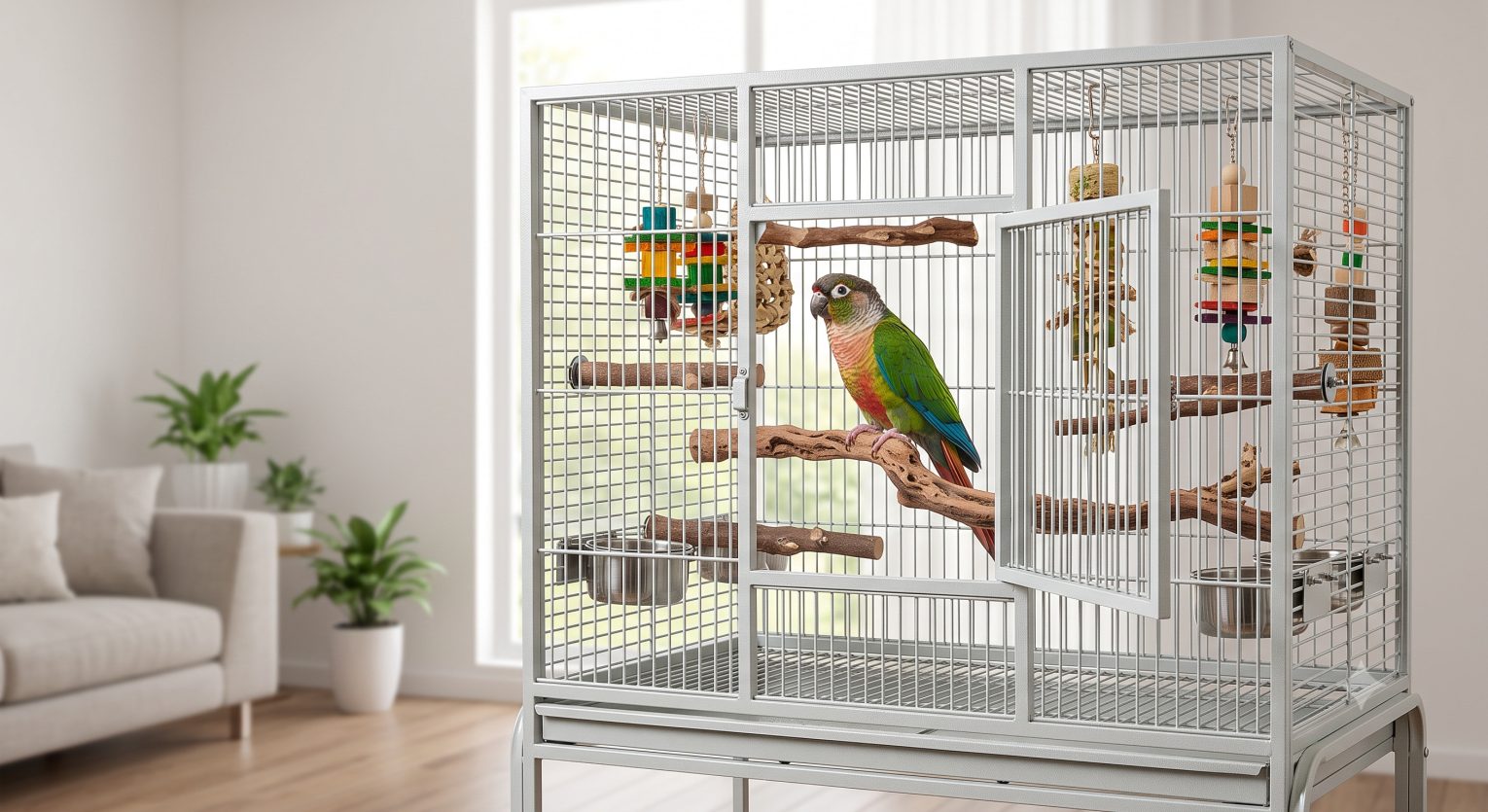
A safe bird cage setup depends on three things: correct bar spacing for your species (too wide risks head or body entrapment), non-toxic materials (powder-coated steel or stainless steel—never galvanized wire, which can cause zinc poisoning), and a variety of perch diameters and materials to support foot health. Width matters more than height, since birds fly horizontally rather than vertically.
Getting cage setup wrong is one of the most common—and most preventable—welfare problems in pet birds. This guide covers exact bar spacing by species size, which cage materials are genuinely safe versus which pose a poisoning risk, and how to set up perches, placement, and safety features correctly from day one.
Cage setup is one part of a much bigger picture covered in our Bird Care Guide—the complete hub for parrots, budgies, cockatiels, and other pet birds. For the household hazards beyond the cage itself, see Toxic Foods and Household Dangers for Pet Birds.
(💡 Correct bar spacing, non-toxic materials, and varied perch diameters are the three foundations of a safe cage setup.)
Table of Contents
Bar Spacing: The Most Critical Safety Measure
Incorrect bar spacing is one of the most common causes of preventable cage injuries. Spacing that is too wide for your bird’s size allows the head, neck, or body to slip partway through the bars— and become trapped when the bird tries to withdraw, sometimes with fatal results.
📏 Bar spacing by species size:
| Bird Size | Species Examples | Bar Spacing |
|---|---|---|
| 🦜 Small | Finches, canaries, budgies, parrotlets, lovebirds | 1/4″–1/2″ (0.6–1.3 cm) |
| 🦜 Medium | Cockatiels, green cheek conures, quakers, caiques | 1/2″–5/8″ (1.3–1.6 cm) |
| 🦜 Medium-Large | Sun conures, Senegals, Pionus | 5/8″–3/4″ (1.6–1.9 cm) |
| 🦜 Large | African greys, Amazons, small cockatoos | 3/4″–1″ (1.9–2.5 cm) |
| 🦜 Largest | Large macaws, large cockatoos | 1″–1.5″ (2.5–3.8 cm) |
When in doubt, choose the narrower spacing. A cage with slightly tighter bars than strictly necessary carries no downside. A cage with bars even slightly too wide for your specific bird is a genuine safety hazard.
(🩺 Vet’s Note: “Head and body entrapment from incorrect bar spacing is one of the most common preventable cage injuries I see. It’s also one of the easiest to avoid entirely—measure the bars before you buy, don’t rely on a cage being labeled ‘for parakeets’ or ‘for cockatiels’ without checking the actual spacing yourself” —LovingPetsGuide Veterinary Advisor.)
📰 Bar spacing standards by species size are consistently documented by avian rescue and sanctuary organizations, including STAR-St. Louis Avian Rescue (staravian.org), which specifies approximately 1/2 inch bar spacing as the minimum requirement for budgies, similar narrow spacing for cockatiels given their hook-billed climbing behavior, and 3/4 to 1 inch spacing for larger species including Amazon parrots and African Greys. The core safety principle—bars narrow enough to prevent head or body entrapment while climbing—is the most frequently cited cage injury prevention measure across avicultural resources.
Bird Cage Size and Shape
Width matters more than height. Birds fly horizontally, not vertically—a wide, long cage provides dramatically more usable flight and movement space than a tall, narrow one of the same total volume.
📏 General minimum floor space guidelines:
- 🦜 Budgies (single): 18″ × 30″ (46 × 76 cm) with room to extend wings fully in both directions.
- 🦜 Cockatiels: 24″ × 24″ (61 × 61 cm) minimum, larger strongly preferred.
- 🦜 Conures: 24″ × 24″ × 30″H (61 × 61 × 76 cm).
- 🦜 Amazons and African Greys: 36″ × 28″ or larger (91 × 71 cm+).
- 🦜 Large Macaws and Cockatoos: Substantially larger still, often exceeding 4 feet (1.2 m) in width.
❗️Long-tailed species need extra height. Cockatiels, macaws, and other long-tailed birds need enough vertical clearance that their tail feathers don’t constantly drag on the cage floor or bend against the bars.
⚠️ A cage should never be the only source of exercise. Even the largest cage cannot replace daily supervised time outside it—see How to Tame Your Bird for building the trust needed to make out-of-cage time safe and enjoyable.
Cage Materials: What’s Actually Safe
This is the area where inexpensive cages create the most hidden risk—and the difference isn’t always obvious just by looking at the cage.
✅ Safe Materials
Stainless steel: The gold standard. Rust-resistant, contains no toxic coating, and can last 50 years or more with proper care. Most commonly used for larger, more determined chewers like macaws and cockatoos.
Powder-coated steel (properly manufactured): The most common safe option for small to medium-sized birds. Look for a smooth, even finish with no visible flaking, chipping, or rough texture.
❌ Materials to Avoid
Galvanized wire (hot-dipped): Coated with zinc through a dipping process. This wire can leach zinc, particularly once it shows any oxidation, pitting, or a dull white residue. Birds prone to chewing or climbing the bars with their beak are at significantly elevated risk.
Powder-coated galvanized wire: A budget manufacturing shortcut where powder coating is applied directly over galvanized wire. The surface preparation required for powder coating often pits the galvanized layer underneath, and the coating frequently peels or flakes as a result—exposing zinc-contaminated material that birds may then ingest.
❓How to check an existing cage: Run a fingernail over the bars. If the coating flakes, feels rough, or shows white or dull gray residue, the cage poses a real ingestion risk and should be replaced or the affected sections addressed.
📰 The risks associated with galvanized and powder-coated-over-galvanized wire are documented in detail by avian veterinarian Fern Van Sant, DVM (forthebirdsdvm.com), whose published clinical reference notes that surface preparation for powder coating can pit galvanized wire, causing the coating to peel and expose zinc-contaminated material underneath. The same source cites a 1992 study published in the Journal of the American Veterinary Medical Association (Howard BR, JAVMA 1992;200:1667-1674) documenting health risks specifically associated with housing small psittacine species in galvanized wire mesh cages. Cage grates are identified as showing degenerative changes first due to constant exposure to droppings and food waste, with birds that chew, mouth, or bite cage bars at meaningfully increased risk of zinc ingestion from any affected surface.
🐾 Bird Cages & Enclosures 🐾
🏠 Powder-Coated & Stainless Steel Cages—Look for a smooth, even powder-coated or stainless steel finish with correct bar spacing for your species. Chewy carries a range of sizes and finishes—always confirm the exact bar spacing in the product details before buying.
Perches: Variety Is the Point
A single, uniform wooden dowel perch—the default in many starter cages—is one of the most common setup mistakes. Constant pressure on the same point of the foot contributes to pressure sores and long-term foot problems.
✅ What a correct perch setup includes:
- ✔️ Varied diameter: Natural branches vary in thickness along their length, which naturally shifts the pressure points on a bird’s feet as they move around. Include at least 2–3 different diameters.
- ✔️ Natural wood over uniform dowel: Untreated natural branches (apple, willow, manzanita) offer texture and diameter variation that manufactured dowels don’t.
- ✔️ A mix of textures: Combining natural wood, rope, and a concrete or cement perch (for one perch only, positioned where it gets regular use for nail maintenance) supports both foot health and nail wear.
- ✔️ Correct placement: Position the highest perch away from food and water dishes to avoid droppings contaminating them, and ensure perches don’t force the bird’s tail to constantly press against cage bars.
⚠️ Never use sandpaper perch covers. Despite being marketed for nail maintenance, they provide insufficient abrasion for actual nail wear while causing genuine irritation and sores on the sole of the foot with constant contact.
Bird Cage Placement in the Home
Where you put the cage matters almost as much as what the cage is made of.
✅ Do:
- Position the cage in a social area of the home (living room, family room) where your bird can see and hear household activity.
- Place it against at least one solid wall, giving a sense of security rather than being surrounded by open space on all sides.
- Keep it away from direct, unfiltered heating or air conditioning vents.
- Ensure a consistent day/night light cycle—birds generally need 10–12 hours of uninterrupted darkness for healthy sleep.
❌ Don’t:
- Place the cage in the kitchen. Overheated non-stick cookware releases fumes that are rapidly fatal to birds—see Toxic Foods and Household Dangers for Pet Birds for the complete household hazards list.
- Position the cage in an isolated room away from all family activity—this can contribute to stress and excessive vocalization, covered in our Why Does My Bird Scream? guide.
- Place it in direct, unfiltered sunlight for extended periods, or in a drafty location near frequently opened doors and windows.
Safety Features Worth Checking
❗️Secure locks: Many parrots are notably capable of manipulating simple slide or hook latches. Choose cages with locking mechanisms specifically designed to prevent birds from opening them—a surprising number of “escaped bird” situations start with a bird simply letting itself out.
❗️No sharp edges or gaps: Check weld points for burrs or rough edges, and ensure there are no gaps where a foot, wing, or head could become caught during normal climbing and movement.
❗️A removable, cleanable grate and tray: Makes daily cleaning practical, which directly supports the hygiene needed to prevent bacterial and fungal growth in droppings and food debris.
Common Cage Setup Mistakes
| ❌ Choosing a “decorative” cage over a functional one: Ornate, narrow, tall cages are frequently marketed for aesthetics rather than the bird’s actual flight and movement needs. A plain cage with correct dimensions and bar spacing always outperforms an attractive one that’s too small or too narrow. |
| ❌ Assuming a cage labeled “for that species” has correct bar spacing: Always measure or confirm the actual spacing yourself rather than trusting marketing language alone. |
| ❌ Using only one perch diameter and material: Covered above, but worth repeating: uniform dowel perches are a leading contributor to foot problems over time. |
| ❌ Placing the cage in or near the kitchen: One of the most dangerous placement mistakes—see Toxic Foods and Household Dangers for Pet Birds for why this matters so much. |
| ❌ Buying a cheap galvanized cage to save money upfront: The cost difference often doesn’t reflect the real long-term risk—a galvanized cage that requires early replacement, or worse, causes a health crisis, is rarely the genuine bargain it appears to be. |
Conclusion
A correctly set up cage is one of the highest- leverage investments in a pet bird’s long-term welfare—get the bar spacing, materials, and perch variety right, and many common health and behavioral problems become far less likely from the start.
Key takeaways:
- ✅ Bar spacing must match your specific bird’s size—when in doubt, go narrower.
- ✅ Stainless steel or properly powder-coated steel are the only genuinely safe materials.
- ✅ Never use galvanized wire cages—zinc poisoning risk is real and well-documented.
- ✅ Width matters more than height—birds fly horizontally.
- ✅ Use at least 2–3 different perch diameters and materials.
- ✅ Keep the cage out of the kitchen entirely.
- ✅ Choose locks a bird can’t manipulate open.
📝 Editor’s Note: Cage material safety information in this guide was verified against a published clinical reference by Fern Van Sant, DVM (forthebirdsdvm.com), including a cited 1992 study in the Journal of the American Veterinary Medical Association on health risks of galvanized wire mesh caging. Bar spacing standards were cross-referenced with STAR-St. Louis Avian Rescue (staravian.org).
👉🏼 Bird Care Guide—complete hub for parrots, budgies, and other pet birds.
👉🏼 Toxic Foods and Household Dangers for Pet Birds—the complete household hazards checklist.
👉🏼 Why Does My Bird Scream? How to Stop Excessive Noise—how cage placement affects vocalization.
👉🏼 How to Tame Your Bird: Building Trust Step by Step—making the most of time outside the cage.
👉🏼 Safe Fruits & Vegetables for Pet Birds— foraging-friendly fresh foods for cage enrichment.

🦜 Browse bird food, cages, perches, toys, supplements and everything else your bird needs 🐾
(This post contains affiliate links. If you purchase through our links, we may earn a small commission at no extra cost to you. This never influences our editorial opinions.)
FAQ: Bird Cage Setup Guide
What bar spacing is safe for a budgie?
Approximately 1/4 to 1/2 inch (0.6–1.3 cm) is the standard safe range for budgies, along with other small species like finches, canaries, and parrotlets. Wider spacing risks head or body entrapment—when in doubt, choose the narrower option.
Is galvanized wire really dangerous for birds?
Yes. Galvanized (zinc-coated) wire can leach zinc, particularly once it shows oxidation, pitting, or a dull white residue. Birds that chew or climb cage bars with their beak—which is most pet birds—are at meaningfully elevated risk of zinc ingestion and toxicity from this material.
How do I know if my current cage is safe?
Run a fingernail over the bars. If the coating flakes, feels rough or brittle, or shows white or dull gray residue, the cage poses a real ingestion risk. Stainless steel or smooth, intact powder-coated steel with no visible damage are the safest confirmed materials.
Do I need more than one type of perch?
Yes. A single uniform dowel perch contributes to repetitive pressure on the same point of the foot over time. Include at least 2–3 different perch diameters and materials—natural wood branches, rope, and one concrete or cement perch for nail maintenance.
Can I put my bird’s cage in the kitchen?
No. Overheated non-stick cookware releases fumes that are rapidly fatal to birds, and even normal cooking activity introduces steam, grease particles, and temperature swings that aren’t appropriate for a bird’s respiratory system. Choose a social living area instead.
Is a taller cage or a wider cage better?
Wider. Birds fly horizontally, not vertically, so a long, wide cage provides significantly more usable flight and movement space than a tall, narrow cage of the same total volume. Height mainly matters for accommodating multiple perch levels and giving long-tailed species like cockatiels enough tail clearance.