
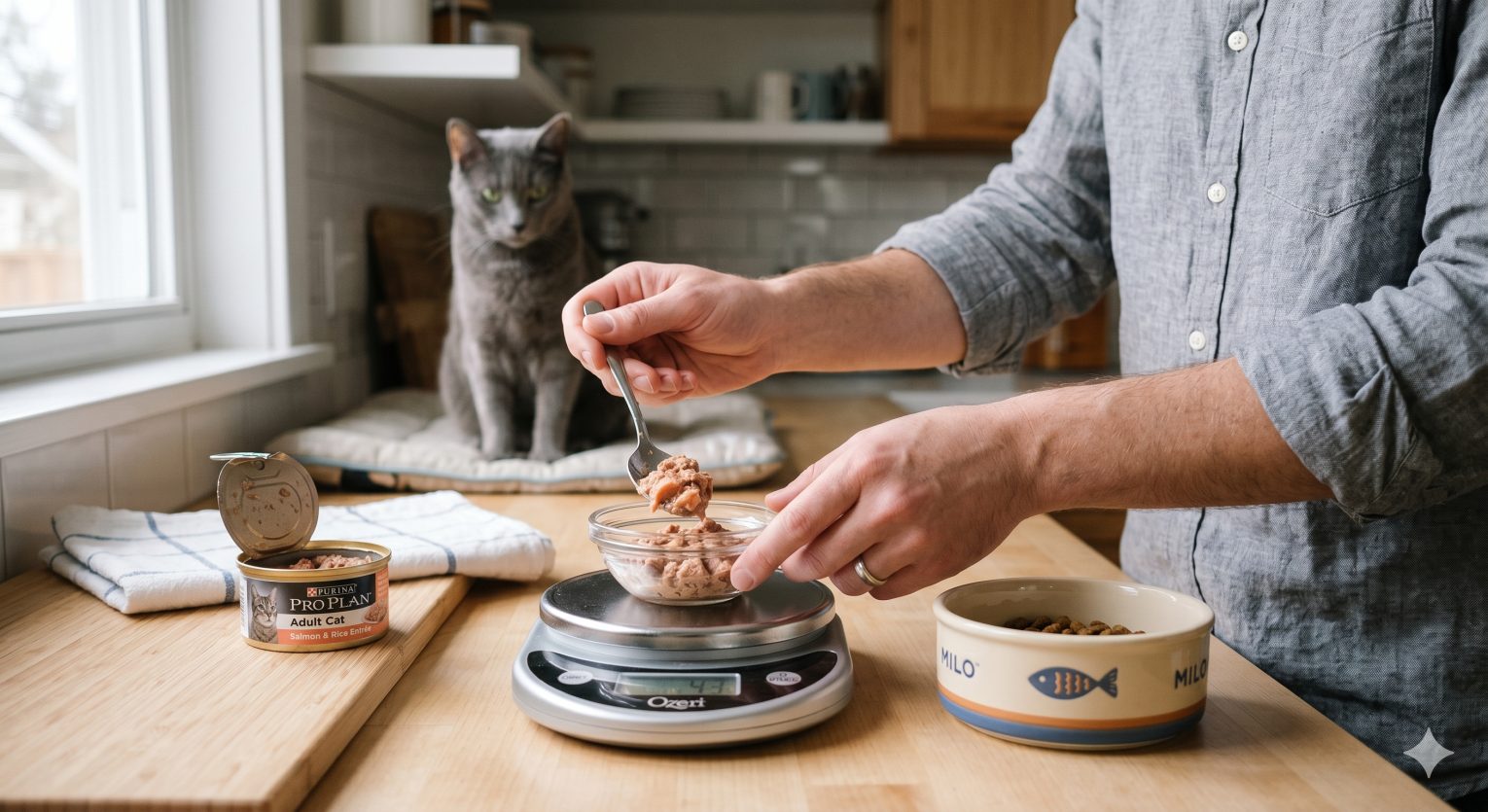
How much to feed a cat depends on four factors: body weight, life stage, activity level, and food type. As a general starting point, most adult cats need approximately 20 calories per pound (44 calories per kg) of body weight per day. A 8.8 lb (4 kg) indoor cat needs roughly 180–200 calories daily—equivalent to approximately 5–5.6 oz (140–160 g) of wet food, or ½ cup of dry kibble, depending on the caloric density of the specific food.
These are starting points, not fixed targets. The feeding guidelines on your cat’s food packaging are formulated for the average cat—your cat may need more or less depending on their metabolism, neutered status, and health. The most reliable guide is your cat’s body condition, not the number on the scale or the cup measure.
Portion control is one piece of a larger nutritional picture. For the complete foundation of feline feeding—from obligate carnivore biology to label reading and life-stage requirements—our cat nutrition guide covers everything you need before and after adjusting portions.
(💡 Weighing food rather than estimating by eye is the single most effective change most cat owners can make for weight management.)
Table of Contents
Why Portion Control Matters for Cats
Feline obesity has reached epidemic proportions in domestic cats—current estimates suggest that 50–60% of pet cats in the US and UK are overweight or obese. Overweight cats face significantly elevated risks of diabetes, hepatic lipidosis, urinary disease, arthritis, and shortened lifespan.
The primary cause is not the food itself—it is overfeeding. Many owners significantly underestimate how calorie-dense cat food is, particularly dry kibble. A single extra tablespoon of kibble per day adds up to meaningful caloric excess over months and years.
Conversely, underfeeding—particularly in kittens, pregnant cats, and seniors with declining appetite—causes malnutrition, muscle wasting, and serious health consequences.
Getting portions right is one of the highest-impact, lowest-cost interventions available to any cat owner.
(🩺 Vet’s Note: “The most common thing I see in overweight cats is owners measuring with a ‘cup’ that is actually 1.5 cups, or pouring until it ‘looks right.’ Cat food is calorie-dense—a small overestimation every day adds up fast. I always recommend a digital kitchen scale for any owner trying to manage their cat’s weight”—LovingPetsGuide Veterinary Advisor.)
📰 Feline obesity prevalence is documented by veterinary weight management research showing that approximately 50–60% of pet cats in the US are overweight or obese, with overfeeding—rather than food quality—identified as the primary driver. Overweight cats face significantly elevated risk of diabetes, hepatic lipidosis, and reduced lifespan, making portion accuracy one of the highest-impact interventions available to owners.
Understanding Calories: The Foundation
Before looking at weights and cups, it helps to understand calories—because all portion recommendations ultimately trace back to caloric need.
Resting Energy Requirement (RER) — The baseline calories a cat needs to maintain basic bodily functions at rest:
RER = 70 × (body weight in kg)^0.75 — to convert your cat’s weight: lb ÷ 2.2 = kg.
Daily Energy Requirement (DER) — RER multiplied by a life stage and activity factor:
| Cat Type | Multiplier | Example (8.8 lb (4 kg) cat) |
|---|---|---|
| Neutered adult, indoor | 1.2 × RER | ~240 kcal/day |
| Intact adult | 1.4 × RER | ~280 kcal/day |
| Inactive / obese prone | 1.0 × RER | ~200 kcal/day |
| Active outdoor cat | 1.6 × RER | ~320 kcal/day |
| Kitten (4 months) | 2.5 × RER | ~500 kcal/day |
| Senior (7+) | 1.1 × RER | ~220 kcal/day |
| Weight loss | 0.8 × RER | ~160 kcal/day |
(⚠️ Important: These are mathematical estimates. Individual metabolism varies significantly. Use them as a starting point and adjust based on body condition over 4–6 weeks.)
General Daily Feeding Guide by Weight
🥣 Wet Food Only
| Cat Weight | Daily Wet Food | Calories (approx) |
|---|---|---|
| 4.4 lb (2 kg) | 3–3.9 oz (85–110 g) | 130–165 kcal |
| 6.6 lb (3 kg) | 4.2–5.3 oz (120–150 g) | 180–225 kcal |
| 8.8 lb (4 kg) | 5.3–6.5 oz (150–185 g) | 225–275 kcal |
| 11 lb (5 kg) | 6.3–7.8 oz (180–220 g) | 270–330 kcal |
| 13.2 lb (6 kg) | 7–8.8 oz (200–250 g) | 300–375 kcal |
| 13.2+ lb (6+ kg) | Consult vet | — |
(Based on average wet food density of ~150 kcal per 3.5 oz (100 g). Check your specific food’s caloric content on the label.)
🥣 Dry Kibble Only
| Cat Weight | Daily Dry Food | Calories (approx) |
|---|---|---|
| 2 kg (4.4 lb) | ¼ cup | 130–165 kcal |
| 3 kg (6.6 lb) | ⅓ cup | 180–225 kcal |
| 4 kg (8.8 lb) | ½ cup | 225–275 kcal |
| 5 kg (11 lb) | ⅔ cup | 270–330 kcal |
| 6 kg (13.2 lb) | ¾ cup | 300–375 kcal |
(Based on average kibble density of ~350–400 kcal per 3.5 oz (100 g). Varies significantly by brand—always check the label.)
❗️ Cup measures are unreliable: The actual volume of a “cup” of kibble varies significantly depending on kibble size and density. Weighing dry food in grams on a kitchen scale is far more accurate than measuring in cups.
Combination Feeding (Wet + Dry)
If feeding both wet and dry food, calculate each component at a proportion of the total daily caloric target.
Example for a 8.8 lb (4 kg) neutered indoor cat (target ~240 kcal/day):
- 50% wet food: 120 kcal = approximately 2.8 oz (80 g) wet food.
- 50% dry food: 120 kcal = approximately 1 oz (30 g) / 3–4 tablespoons dry kibble.
For a complete guide on the benefits and tradeoffs of wet vs dry formats, our wet vs dry cat food guide covers the hydration and nutritional differences in detail.
🐾 Purina Pro Plan Adult Wet Cat Food 🐾
💧 Purina Pro Plan (Wet Cat Food)—More filling per calorie than dry food due to high moisture content—making it the most effective format for weight management and satiety. Reduces total daily gram intake while maintaining caloric targets, and passively supports kidney health through hydration.
Feeding Guide by Life Stage
🐈 Kittens (0–6 Months): Feed Freely
Young kittens under 6 months should not have their food restricted. Their growth rate is extraordinary and their caloric needs per kilogram of body weight are the highest of their entire life.
Feeding approach: 3–4 small meals daily of a kitten-specific formula. Offer as much as they want to eat at each meal—kittens self-regulate well before 6 months and rarely overeat during active growth.
Watch for: A kitten that gains no weight week to week despite eating well warrants a veterinary check.
For detailed kitten nutrition and schedule information, our kitten feeding guide covers the full first year.
🐈 Kittens (6–12 Months): Transition to Structure
From 6 months, caloric needs begin to decrease relative to body weight as growth slows. Post-neuter surgery (typically 5–6 months) further reduces caloric requirements by approximately 20–30%.
Feeding approach: Transition to 2–3 measured meals daily. Begin weighing or measuring portions rather than free-feeding.
Post-neuter adjustment: Reduce daily calories by approximately 20–25% after neutering and monitor weight monthly. Post-neuter weight gain is extremely common and can become difficult to reverse if not managed early.
🐈 Adult Cats (1–7 Years): Precision Maintenance
This is the life stage where overfeeding most commonly occurs—portions creep up, free-feeding becomes the default, and weight gain happens gradually over years.
Feeding approach: Two structured meals daily with measured portions. No free-feeding of dry food.
Caloric target: Approximately 20 calories per pound (44 per kg) of ideal body weight for a neutered indoor cat. Adjust based on body condition score monthly.
How to use ideal body weight, not actual: If your cat is overweight, calculate portions based on their target weight, not their current weight. A 13 lb (6 kg) cat with an ideal weight of 10 lb (4.5 kg) should be fed for 10 lb (4.5 kg)—otherwise you are perpetuating the overfeeding.
🐈 Senior Cats (7+ Years): Monitor Closely
Senior cat nutrition requires the most individualized approach. Some seniors gain weight as metabolism slows. Others lose weight as appetite decreases, digestion efficiency reduces, and health conditions develop.
For overweight seniors: Reduce portions by 10–15% and increase wet food proportion for satiety and hydration.
For underweight seniors: Increase meal frequency (3 small meals daily) and switch to higher caloric density wet food. Warming food slightly increases palatability for cats with declining smell.
Key indicator: Weigh your senior cat monthly. A loss of more than 1.1 lb (0.5 kg) over 4 weeks without a dietary change warrants a veterinary visit—weight loss in senior cats almost always has a medical cause.
For senior-specific food recommendations, our best cat food for senior cats covers kidney-supportive and high-protein formulas for aging cats.
How to Assess Your Cat’s Body Condition
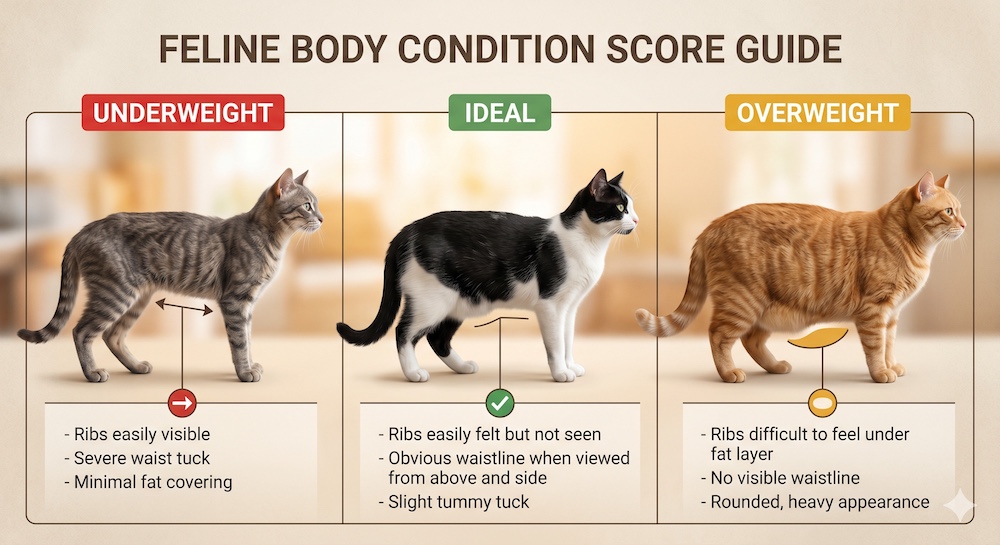
Body Condition Score (BCS) is more reliable than weight alone because ideal weight varies significantly by breed, build, and sex.
(💡 Run your hands along your cat’s ribs weekly—this tells you more than the number on the scale.)
How to Check at Home (30 Seconds)
✅ Rib check: Run your fingers firmly along your cat’s ribcage. You should be able to feel each rib without pressing hard, but the ribs should not be visible through the coat.
✅ Waist check: Look down at your cat from above. There should be a visible narrowing behind the ribs—a recognizable waist shape.
✅ Abdominal tuck: View your cat from the side. The belly should tuck upward slightly behind the ribcage—not hang downward.
Interpreting What You Feel
Ideal (BCS 4–5/9): Ribs easily felt, waist visible from above, slight abdominal tuck. Maintain current portions.
Underweight (BCS 1–3/9): Ribs, spine, and hip bones clearly visible. Increase portions by 10–15% and schedule a vet check to rule out underlying causes.
Overweight (BCS 6–7/9): Ribs felt only with firm pressure. No visible waist. Reduce portions by 10–15% and switch to weight management formula if available.
Obese (BCS 8–9/9): Ribs not palpable. Heavy fat deposits. Obvious abdominal rounding. Consult your vet for a supervised weight loss plan—rapid caloric restriction in obese cats risks hepatic lipidosis.
📰 The risk of hepatic lipidosis from rapid caloric restriction in overweight cats is documented by the Merck Veterinary Manual (merckvetmanual.com), which confirms that sudden, severe calorie reduction forces fat mobilization faster than the liver can safely process—making gradual, supervised weight loss essential for any overweight cat.
Free-Feeding vs Structured Meals
Free-feeding (leaving dry food out all day) is the most common feeding approach for cats—and one of the most significant contributors to feline obesity.
❓ Why free-feeding causes problems:
- No awareness of actual intake.
- Cats tend to eat out of boredom rather than hunger.
- Impossible to detect appetite changes that signal illness.
- Post-neuter cats are especially vulnerable to unlimited caloric access.
❔ Why structured meals work better:
- Precise control over daily intake.
- Appetite changes are immediately noticeable.
- Supports healthy digestion.
- Creates a routine that reduces food-related anxiety.
❕ If you currently free-feed and want to transition to structured meals:
- Begin measuring and logging current intake for one week without changing anything.
- Calculate the target daily amount.
- Divide into two equal meals.
- Remove the food bowl after 20–30 minutes.
- Most cats adjust within 1–2 weeks.
🐾 Automatic Cat Feeders 🐾
⏱️ Timed Automatic Feeders—Dispense precise portions at consistent times without relying on memory or routine. Particularly useful for transitioning from free-feeding to structured meals—the feeder enforces the schedule so your cat adjusts to meal timing rather than continuous access. Chewy carries a wide range across price points.
Practical Tips for Accurate Portioning
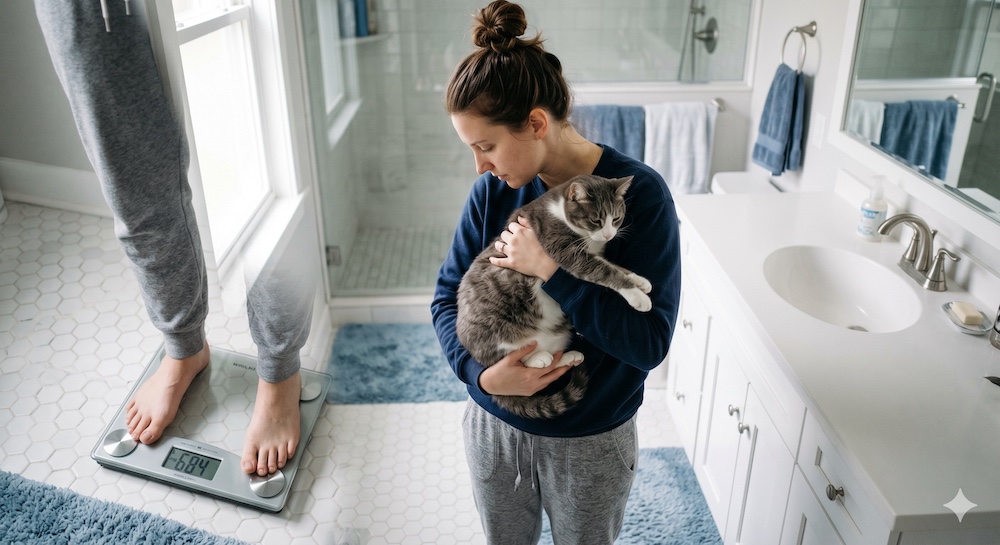
The simplest way to weigh your cat at home requires no special equipment. Step on your bathroom scale alone first, note the number, then step on again holding your cat and subtract the difference. Repeat monthly and log the result—a loss of more than 0.5 kg (1.1 lb) over four weeks without a dietary change always warrants a veterinary visit.
(💡 Monthly weighing catches weight changes before they become problems—a simple habit that takes 30 seconds.)
| Use a digital kitchen scale: Weighing food in grams is significantly more accurate than measuring in cups or tablespoons. A basic kitchen scale costs very little and makes a meaningful difference to weight management. |
| Read the caloric content, not just the weight: Two different wet foods may recommend the same gram amount on the label but have completely different caloric densities. Always check kcal per 100g on the packaging. |
| Account for treats: Treats should not exceed 10% of your cat’s daily caloric intake. If your cat receives treats, subtract those calories from their main meal portions. |
| Measure water intake if feeding dry food: Cats on dry food should drink approximately 1 oz of water per lb (60 ml per kg) of body weight daily. If your cat is not drinking adequately, increase wet food proportion. |
| Weigh your cat monthly: Use a baby scale or step on a human scale holding your cat, then subtract your own weight. Consistent monthly tracking catches weight changes before they become significant. |
🐾 Slow Feeders & Puzzle Bowls for Cats 🐾
🧩 Slow Feeders & Puzzle Bowls—Extend mealtime from 30 seconds to several minutes, reducing gorging, improving satiety, and providing mental enrichment alongside a measured meal. Particularly effective for cats transitioning from free-feeding who eat too quickly when meals are first structured.
When to Adjust Portions
Portion needs are not static—adjust when:
- After neutering: Reduce by 20–25%.
- Seasonal activity changes: Outdoor cats need more in winter, less in summer.
- New food brand: Caloric density varies— recalculate when switching.
- Weight change detected: Adjust by 10% in the appropriate direction and reassess after 4 weeks.
- Health diagnosis: Kidney disease, diabetes, hyperthyroidism all require veterinary dietary guidance.
- Senior transition (7+): Reassess portions and switch to senior formula.
If your cat is consistently refusing their full portion, our why is my cat not eating guide covers the medical and behavioral causes of food refusal.
Conclusion: Body Condition Beats the Cup Measure
The feeding guidelines on your cat’s food packaging are a starting point—not a prescription. Your cat’s body condition score, monthly weight tracking, and energy level are far more reliable indicators than a fixed gram or cup measure.
Start with the guidelines, weigh rather than estimate, adjust based on what you see over 4–6 weeks, and schedule annual vet checks that include weight assessment. That combination keeps most cats at a healthy weight for life.
Key takeaways:
- ✅ Most adult cats need ~20 kcal per pound of ideal body weight per day.
- ✅ Weigh food in grams—cup measures are unreliable.
- ✅ Reduce portions by 20–25% after neutering.
- ✅ Free-feeding causes gradual weight gain in most cats.
- ✅ Body condition score is more reliable than weight alone.
- ✅ Adjust by 10% at a time and reassess after 4 weeks.
- ✅ Senior cats need monthly weight monitoring.
📝 Editor’s Note: Feline obesity prevalence data reflects current veterinary weight management research. Hepatic lipidosis risk from rapid weight loss was verified against the Merck Veterinary Manual. RER/DER formulas and life stage multipliers follow standard veterinary nutritional calculation methods.
👉🏼 Cat Nutrition Guide — complete feline nutrition for every life stage.
👉🏼 Wet vs Dry Cat Food — how food format affects caloric density and hydration.
👉🏼 Kitten Feeding Guide — portion sizes during the critical first year.
👉🏼 Best Cat Food for Senior Cats — senior portions and kidney-supportive formulas.
👉🏼 Why Is My Cat Not Eating — when a cat consistently refuses their portions.

🐈 Browse cat food, treats, toys, health products, supplements, litter and everything else your cat needs 🐾

🐈 Browse raw cat food, freeze-dried meals, toppers and natural treats from Indiana farms 🐾

🐈 Browse cat food, treats, veterinary diets, supplements and everything else your feline needs 🐾
(This post contains affiliate links. If you purchase through our links, we may earn a small commission at no extra cost to you. This never influences our editorial opinions.)
FAQ: How Much to Feed a Cat — Your Questions Answered
How many times a day should I feed my cat?
Most adult cats thrive on two structured meals per day—morning and evening, approximately 10–12 hours apart. Kittens under 6 months need 3–4 smaller meals daily due to their higher caloric needs and smaller stomach capacity. Senior cats with reduced appetite or digestive issues often do better with 3 smaller meals rather than 2 larger ones. Free-feeding dry food all day is generally not recommended as it makes intake impossible to monitor and contributes to obesity.
How do I know if I’m feeding my cat enough?
The most reliable indicators are body condition score and monthly weight. A well-fed cat at ideal weight has ribs that are easily felt but not visible, a recognizable waist when viewed from above, and a slight abdominal tuck from the side. Consistent energy levels, a healthy coat, and normal litter box output also indicate adequate nutrition. If your cat’s ribs become prominent, they are likely underfed—increase portions by 10% and reassess after 4 weeks.
My cat always seems hungry. Are they underfed?
Not necessarily. Cats are skilled at performing hunger even when adequately fed—particularly if they have learned that vocalizing produces food. Confirm your portions are appropriate for their weight and life stage first. If body condition score is ideal and weight is stable, the hunger is behavioral rather than genuine. However, persistent increased appetite alongside weight loss in a senior cat warrants a veterinary check—hyperthyroidism causes exactly this pattern.
How much wet food should I feed my cat per day?
For an average 8.8 lb (4 kg) neutered indoor adult cat, approximately 150–180 grams of wet food per day divided into two meals is a reasonable starting point—but this varies significantly by food brand and caloric density. Always check the kcal per 100g on your specific food’s label and calculate from there rather than using generic portion tables. A kitchen scale is your most reliable portioning tool.
Should I feed more in winter?
For indoor-only cats, seasonal variation in caloric need is minimal as their environment remains temperature-controlled year-round. For outdoor or semi-outdoor cats, caloric needs increase moderately in cold weather as more energy is used for thermoregulation. Monitor body condition monthly rather than adjusting portions based on season—your cat’s body condition is a more reliable guide than the calendar.
How do I reduce my cat’s food without them being miserable?
Reduce portions gradually rather than abruptly— cut by 10% per week rather than immediately dropping to the target amount. Switching from dry to wet food helps significantly because wet food is more filling per calorie due to its water content. Dividing the daily amount into 3 smaller meals rather than 2 larger ones also reduces hunger between meals. Puzzle feeders and slow feeders extend mealtime and increase satisfaction. Never reduce portions rapidly in an overweight cat—the risk of hepatic lipidosis increases with rapid caloric restriction.