
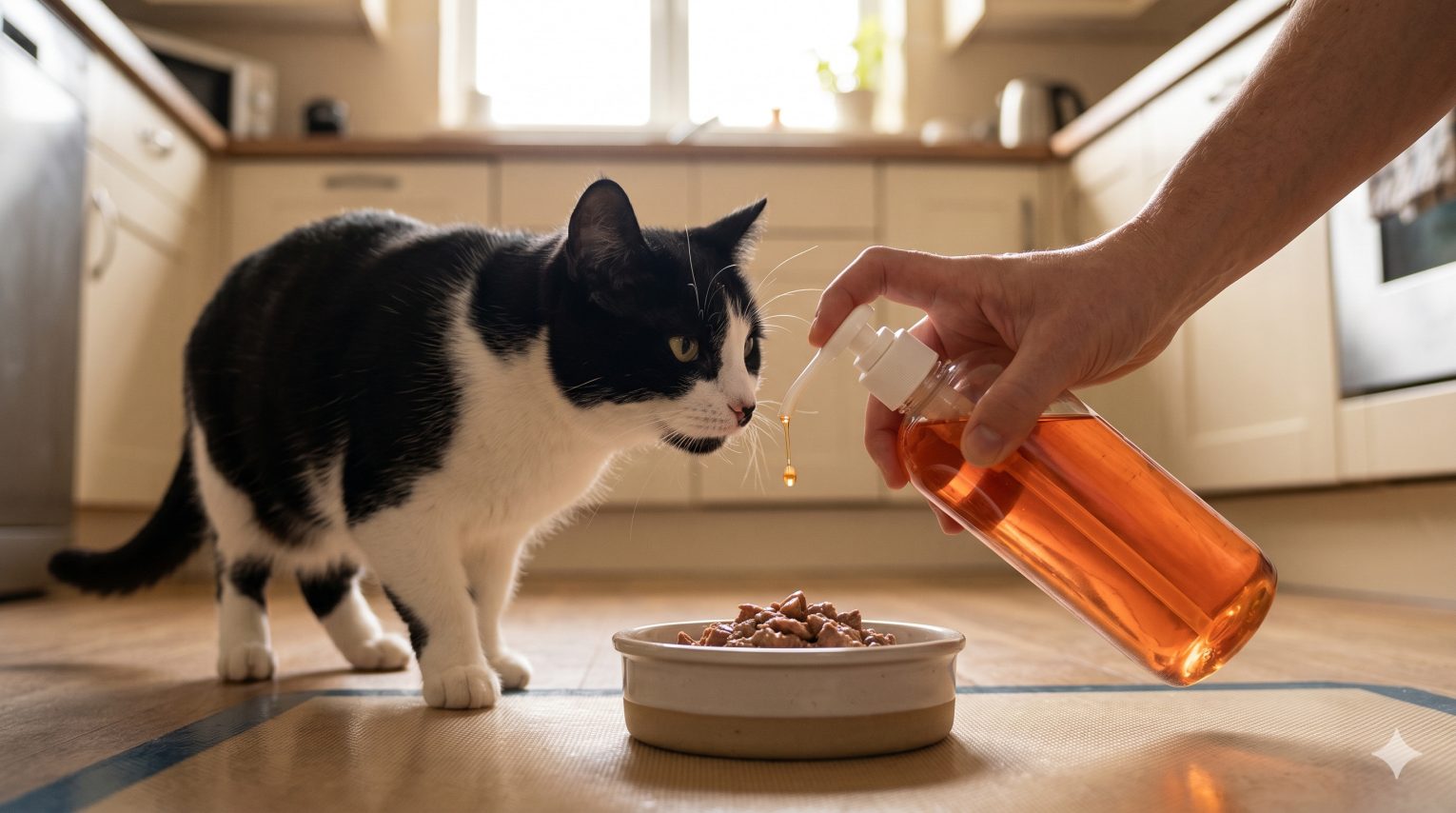
The best omega-3 supplements for cats contain EPA and DHA from marine sources — fish oil or salmon oil — not flaxseed or plant-based ALA. Cats lack the enzyme needed to efficiently convert ALA into the EPA and DHA their bodies actually use, making marine-sourced omega-3 the only form that delivers meaningful benefit. Top vet-recommended picks include Zesty Paws Pure Wild Alaskan Salmon Oil, Nordic Naturals Omega-3 Pet, and Grizzly Omega Health — all third-party tested and appropriate for cats at species-specific doses.
Omega-3 supplementation benefits cats differently than dogs — the priorities are skin and coat health, kidney function support, and inflammation reduction in cats with chronic conditions including arthritis, inflammatory bowel disease, and allergies. Because cats are obligate carnivores with a naturally high-protein, high-fat dietary pattern, omega-3 supplementation fits naturally into their nutritional profile and is well-tolerated even at therapeutic doses.
Omega-3 supplementation makes most sense as part of a complete nutritional picture for cats. For the full foundation of feline nutrition — including fat requirements, hydration, food types, and life stage feeding — our cat nutrition guide covers everything before adding any supplement.
(💡 Marine-sourced omega-3 is one of the few supplements that genuinely benefits most cats — particularly those eating primarily dry kibble.)
Table of Contents
Why Cats Need Omega-3 Supplementation
🟤 The Dry Food Problem
Most commercial dry cat food is relatively deficient in omega-3 fatty acids compared to what cats evolved eating. Wild felid prey — small mammals, birds, fish — contains a balanced omega-6 to omega-3 ratio of approximately 5:1 to 10:1. Standard dry kibble typically runs 15:1 to 25:1, heavily skewed toward omega-6.
This imbalance matters because omega-6 and omega-3 fatty acids compete for the same metabolic pathways. When omega-6 dominates, the result is a chronic pro-inflammatory state that contributes to skin problems, joint inflammation, kidney stress, and accelerated cellular aging.
Wet food cats generally receive more omega-3 from their diet than dry food cats — but even high-quality wet food rarely approaches the marine-rich levels of a fish-based ancestral diet.
🌿 Why Cats Cannot Use Plant-Based Omega-3
This is the most important distinction in feline omega-3 supplementation — and the reason many well-intentioned products deliver no meaningful benefit.
ALA (Alpha-linolenic acid) — the omega-3 found in flaxseed, chia seeds, and hemp oil — can theoretically be converted to EPA and DHA in the body. In dogs, this conversion is inefficient (under 10%). In cats, it is essentially absent.
Cats lack the delta-6-desaturase enzyme activity required to convert ALA into EPA and DHA at any meaningful rate. A cat given flaxseed oil receives omega-3 on the label and essentially nothing functional in their body.
Always choose marine-sourced omega-3: Fish oil, salmon oil, krill oil, or algae oil. Anything else is largely ineffective for cats.
(🩺 Vet’s Note: “I regularly see cats on expensive ‘omega-3 supplements’ that contain only flaxseed oil. Owners are spending money on a product that does nothing for their cat because cats cannot convert ALA. If the label doesn’t say EPA and DHA with specific amounts from a marine source — it is not working”—LovingPetsGuide Veterinary Advisor.)
What EPA and DHA Do for Cats
🐾 Skin and Coat Health
The most visibly measurable benefit of omega-3 supplementation in cats. EPA reduces inflammatory mediators that drive skin conditions — seborrhea, excessive dandruff, chronic over-grooming, and allergic skin disease. DHA supports cell membrane integrity throughout the skin barrier.
Most owners notice coat improvements — increased shine, reduced shedding, softer texture — within 4–8 weeks of consistent supplementation at appropriate doses.
🐾 Kidney Health Support
This is the most clinically significant benefit for cats specifically. Chronic kidney disease (CKD) affects a substantial proportion of cats over 10 years of age. Omega-3 fatty acids — particularly EPA — reduce inflammatory processes in kidney tissue, slow the progression of CKD in affected cats, and are a recommended component of CKD nutritional management by the International Renal Interest Society (IRIS).
Cats at risk for kidney disease — senior cats, cats with a family history, or cats on long-term dry food diets — benefit most from proactive omega-3 supplementation.
🐾 Joint Health and Arthritis
Feline osteoarthritis is more prevalent than most owners realize — studies suggest it affects the majority of cats over 10 years of age. Like in dogs, EPA directly reduces prostaglandin synthesis, addressing the inflammatory component of joint pain. Combined with appropriate veterinary management, omega-3 supplementation meaningfully improves mobility in arthritic cats.
🐾 Inflammatory Bowel Disease (IBD)
IBD is common in middle-aged and senior cats. Omega-3’s anti-inflammatory properties reduce intestinal inflammation and have been shown to improve clinical signs in cats with IBD — reduced vomiting frequency, improved stool consistency, and improved appetite in supplemented cats.
🐾 Cognitive Function in Senior Cats
DHA is a structural component of brain tissue. Supplementation in senior cats supports brain cell membrane function and has been associated with maintained cognitive function and reduced cognitive dysfunction syndrome (feline dementia) progression.
What to Look for in a Cat Omega-3 Supplement
❌ Red Flags
- Rancid smell (excessive fishiness beyond normal).
- Flaxseed oil as the only or primary source.
- No specific EPA and DHA amounts listed.
- “Omega-3 blend” without marine source specification.
- Artificial flavors or sweeteners.
- Dog-specific formulas given to cats at dog doses.
✅ Non-Negotiables
EPA and DHA listed separately with amounts: The label must show specific EPA and DHA values — not just “total omega-3” or “fish oil Xmg.” A supplement listing 500mg fish oil without specifying EPA and DHA tells you nothing useful.
Marine source explicitly stated: Fish oil, salmon oil, krill oil, or algae oil. Never flaxseed, hemp, or canola as the primary source.
Third-party testing or certificate of analysis: Fish oil quality varies enormously between products. Heavy metal contamination (mercury, lead) and oxidation (rancidity) are real concerns. Choose brands that publish third-party purity testing.
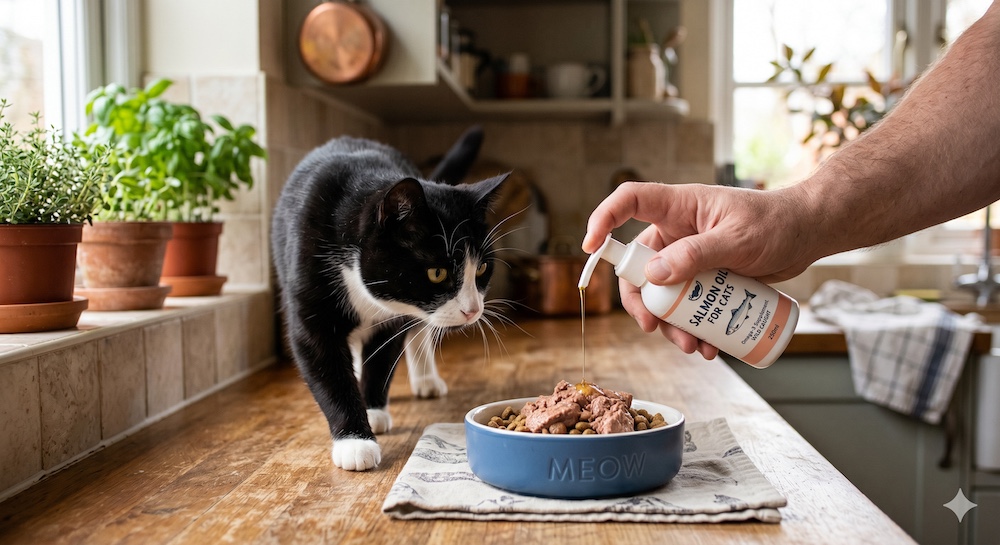
Cat-appropriate form: Liquid oils are easiest to dose for cats — they mix invisibly into wet food with no palatability issues for most cats. Soft gels can be punctured and squeezed. Avoid soft chews formulated for dogs — often contain ingredients or flavorings inappropriate for cats.
(💡 Liquid salmon oil mixes directly into wet or dry food—most cats cannot detect the addition and eat normally within the first serving.)
Our Top Picks: Best Omega-3 Supplements for Cats
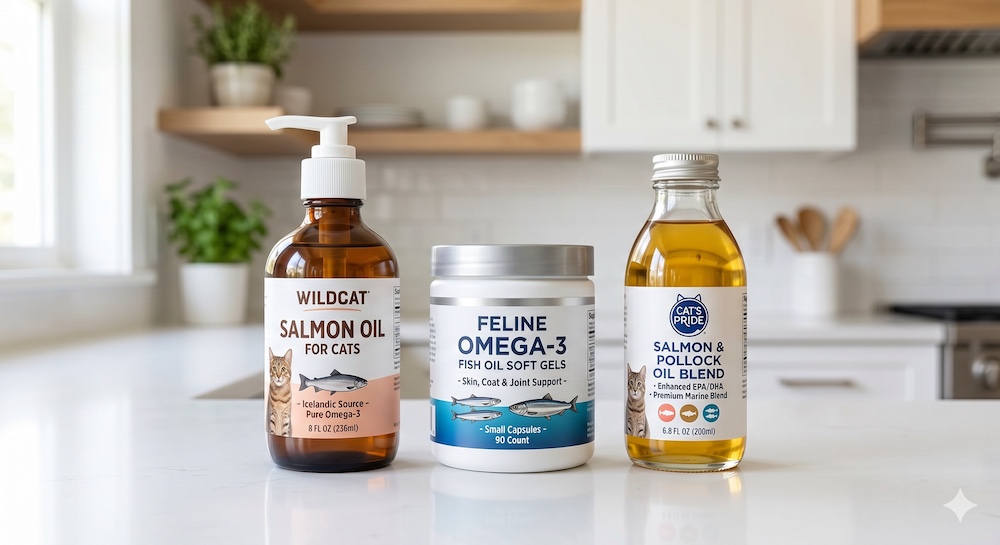
Not all omega-3 supplements deliver what the label promises—the format, source, and whether EPA and DHA are listed separately determine whether your cat actually benefits.
The three picks below are the only formats worth considering: liquid salmon oil for daily simplicity, soft gels for maximum bioavailability, and a milder pollock blend for cats that refuse standard fish oil.
(💡 Three formats, one goal — choose based on your cat’s weight, pickiness, and whether they eat wet or dry food.)
🥇 Best Overall: Zesty Paws Pure Wild Alaskan Salmon Oil
Zesty Paws Salmon Oil is the most versatile omega-3 supplement for both cats and dogs — the liquid format allows precise dose adjustment for cats’ smaller body weight, it mixes invisibly into wet food, and the Wild Alaskan source provides high-quality EPA and DHA without heavy metal concerns.
Key features:
- Wild Alaskan salmon source.
- High EPA and DHA concentration per pump.
- Liquid format — easy dose adjustment.
- No additives or artificial ingredients.
- Pump dispenser for mess-free serving.
- Third-party tested.
✅ Wild-caught, sustainable source.
✅ Easy dose adjustment for cats’ smaller weight.
✅ Mixes into wet or dry food invisibly.
✅ Most cats accept salmon oil readily.
✅ Competitive price per serving.
❌ Requires refrigeration after opening.
❌ Liquid can be messy without the pump.
🏆 Best for: Most cats — particularly those eating primarily dry kibble where omega-3 is most deficient.
🐾 Zesty Paws Pure Wild Alaskan Salmon Oil 🐾
💊 Supplement — Liquid Omega-3 — Wild Alaskan salmon source with high EPA and DHA concentration — pump dispenser mixes directly into wet or dry food with no palatability issues for most cats. Our top overall pick for daily omega-3 supplementation.
🥈 Best Soft Gel: Nordic Naturals Omega-3 Pet
Nordic Naturals Omega-3 Pet is produced to the same human-grade quality standards as their human supplement line — making it the highest bioavailability option available in the pet supplement category.
Key features:
- 180mg EPA + 120mg DHA per soft gel.
- Triglyceride form — superior absorption vs ethyl ester form in most budget products.
- Wild-caught, sustainably sourced fish.
- Third-party tested for heavy metals and oxidation.
- Unflavored — puncture and squeeze onto food.
- No artificial additives.
✅ Highest bioavailability (triglyceride form).
✅ Rigorous third-party testing.
✅ Human-grade quality standards.
✅ Precise per-capsule dosing — ideal for cats.
✅ No fishy smell — clean, fresh oil.
❌ More expensive per serving.
❌ Capsule puncturing required for cats.
🏆 Best for: Senior cats with kidney disease, IBD, or arthritis where maximum EPA/DHA absorption is the clinical priority.
🐾 Nordic Naturals Omega-3 Pet Soft Gels 🐾
💊 Supplement — Soft Gel, Triglyceride Form — The highest bioavailability omega-3 available — triglyceride form absorbs significantly better than the ethyl ester form in most budget products. Puncture and squeeze onto food. Our top pick for cats with CKD, IBD, or arthritis.
🥉 Best for Picky Cats: Grizzly Omega Health Salmon + Pollock Oil
The pollock combination gives Grizzly Omega Health a milder aroma profile than straight salmon oil — making it the preferred option for cats that refuse standard fish oil products.
Key features:
- Wild Alaskan salmon + pollock combination.
- High EPA and DHA per serving.
- Liquid with pump dispenser.
- No artificial ingredients.
- Third-party tested.
✅ Dual-source oil — milder aroma for picky cats.
✅ Pump dispenser for easy serving.
✅ Good EPA and DHA concentration.
✅ Well-accepted by cats that refuse straight salmon oil.
❌ Requires refrigeration after opening.
❌ Slightly lower EPA+DHA concentration than Nordic Naturals.
🏆 Best for: Cats that have refused other fish oil products — the pollock combination has a milder aroma that many finicky cats accept when straight salmon oil has been rejected.
🐾 Grizzly Omega Health Salmon & Pollock Oil 🐾
💊 Supplement — Liquid Oil, Mild Aroma — The best option for cats that refuse standard salmon oil — the pollock combination produces a milder aroma that most finicky cats accept without hesitation. Pump dispenser included.
Comparison Table
| Brand | Source | Form | EPA+DHA per serving | Third-party | Rating |
|---|---|---|---|---|---|
| Zesty Paws Salmon Oil | Wild Alaskan Salmon | Liquid | High | ✅ | ⭐⭐⭐⭐⭐ |
| Nordic Naturals Omega-3 Pet | Wild Fish | Soft gel | Very High | ✅ | ⭐⭐⭐⭐⭐ |
| Grizzly Omega Health | Salmon + Pollock | Liquid | High | ✅ | ⭐⭐⭐⭐ |
Cat-Specific Omega-3 Dosing Guide
Cats require significantly lower absolute doses than dogs due to their smaller body weight — but the mg per kg (lb) dosing is similar.
General veterinary guidelines for EPA+DHA combined:
| Cat Weight | Daily EPA+DHA (maintenance) | Daily EPA+DHA (therapeutic) |
|---|---|---|
| 2–3 kg (4–7 lb) | 100–200 mg | 200–400 mg |
| 3–5 kg (7–11 lb) | 150–300 mg | 300–600 mg |
| 5–7 kg (11–15 lb) | 200–400 mg | 400–800 mg |
| 7+ kg (15+ lb) | 300–500 mg | 500–1000 mg |
(Therapeutic doses are for cats with diagnosed conditions — CKD, IBD, arthritis, allergic skin disease. Always consult your vet before using therapeutic doses.)
How to calculate from your supplement label: Look for the combined EPA + DHA value per serving — not total omega-3 or total fish oil. For liquid supplements, this is typically per pump or per ml.
Example: 4 kg (9 lb) adult cat on maintenance dose = 150–300mg EPA+DHA daily. If your supplement has 150mg EPA+DHA per pump → 1 pump per day mixed into food.
⚠️ Important: Cat-Specific Dosing Caution
Cats are more sensitive to nutrient excesses than dogs. At very high doses, omega-3 supplementation can interfere with Vitamin E metabolism — cats on long-term high-dose omega-3 may need Vitamin E monitoring. This is only relevant at doses significantly above the therapeutic range above — standard maintenance and therapeutic doses are well-established as safe.
How to Give Omega-3 to Cats
| Liquid oil on wet food: The most effective delivery method. Add the appropriate number of pumps or ml directly to wet food and mix. Most cats cannot detect the addition and eat normally. |
| Liquid oil on dry food: Drizzle over dry kibble and mix thoroughly. Less effective than wet food because the oil does not bind as well — and palatability may vary. |
| Soft gel punctured onto food: Use a pin to puncture the soft gel and squeeze the contents onto food. Allows very precise dosing for small cats. |
| With or without food: Always give with food to maximize absorption and reduce the small chance of GI upset. Fat-soluble nutrients absorb significantly better in the presence of dietary fat. |
| Starting dose: Begin at half the target dose for the first week to allow digestive adjustment. Most cats show no issues, but occasional loose stools in the first few days are normal and resolve quickly. |
What Results to Expect and When
| Coat and skin (🗓️ 4–8 weeks): The most visibly noticeable benefit. Coat becomes shinier, shedding reduces, and dry skin or dandruff improves within 4–8 weeks of consistent supplementation. |
| Skin inflammation and allergies (🗓️ 6–12 weeks): Omega-3 reduces inflammation — it does not address the underlying allergen. Improvement in skin conditions typically takes 6–12 weeks and works alongside, not instead of, allergen identification and management. |
| Joint mobility in arthritic cats (🗓️ 8–12 weeks): Reduced stiffness and improved movement in cats with arthritis. Results accumulate over 8–12 weeks of consistent supplementation — not an acute pain relief tool. |
| CKD progression (♻️ ongoing): Benefits to kidney function accumulate over months and are most relevant as a preventive measure and long-term disease management tool. Not a cure — a management support. |
| Cognitive support (♻️ ongoing): DHA supports brain health — effects accumulate over months rather than appearing acutely. |
Is Fish Oil Safe for Cats?
Fish oil has an excellent safety profile for cats at appropriate doses. A few practical cautions ⚠️:
Rancidity: Oxidized fish oil creates free radicals rather than reducing inflammation — worse than nothing. Always store in the refrigerator after opening and replace after the recommended period. If the oil smells excessively rancid — discard it.
Vitamin E depletion: Long-term high-dose omega-3 can deplete Vitamin E in cats. For cats on ongoing therapeutic doses, a small amount of Vitamin E alongside the omega-3 is sometimes recommended by veterinary nutritionists. Ask your vet if your cat is on a long-term therapeutic protocol.
Cats on blood thinners: Fish oil has mild anticoagulant properties. Cats on anticoagulant medications should have omega-3 dosing discussed with their vet.
Pre-surgery: Stop omega-3 supplementation 1–2 weeks before any planned surgical procedure.
Conclusion: One of the Few Supplements Worth It
Omega-3 supplementation from marine sources is one of the genuinely evidence-backed additions to a standard feline diet — particularly for cats eating primarily dry kibble. The combination of skin, coat, kidney, joint, and cognitive benefits at a low cost and excellent safety profile makes it the first supplement to consider for almost any cat.
Choose a product with clearly listed EPA and DHA amounts from a marine source, dose appropriately for your cat’s weight, and expect to wait 4–8 weeks for visible coat and skin results.
Key takeaways:
- ✅ Marine sources only — EPA and DHA from fish, not plant-based ALA.
- ✅ Check label for specific EPA and DHA amounts.
- ✅ Third-party tested products only.
- ✅ Dose by weight — cat doses are much smaller than dog doses.
- ✅ Start at half dose for the first week.
- ✅ Refrigerate after opening.
- ✅ Allow 4–8 weeks for coat and skin results.
- ✅ Particularly beneficial for cats with CKD, IBD, arthritis, or skin allergies.
👉🏼 Cat Nutrition Guide — the complete picture of feline fat requirements and food types.
👉🏼 Wet vs Dry Cat Food — why dry food cats need omega-3 supplementation most.
👉🏼 Best Cat Food for Senior Cats — where omega-3 fits in senior cat nutrition.
👉🏼 Why is my Cat Not Eating — when skin and coat issues accompany appetite changes.

🐈 Browse cat food, treats, toys, health products, supplements, litter and everything else your cat needs 🐾

🐈 Browse raw cat food, freeze-dried meals, toppers and natural treats from Indiana farms 🐾

🐈 Browse cat food, treats, veterinary diets, supplements and everything else your feline needs 🐾
(This post contains affiliate links. If you purchase through our links, we may earn a small commission at no extra cost to you. This never influences our editorial opinions.)
FAQ: Best Omega-3 Supplements for Cats
Can I give my cat the same fish oil I take myself?
Human fish oil capsules are generally safe for cats provided they contain only fish oil with no added ingredients — check the label carefully for xylitol, garlic, or flavorings, which are toxic to cats. The dosing calculation is the same — base it on the EPA+DHA content per capsule, not the total fish oil amount. Cat-specific liquid products offer more convenient dosing for cats’ smaller weight requirements.
Is salmon oil the same as fish oil for cats?
Both provide EPA and DHA from marine sources and are equally appropriate for cats. Salmon oil specifically refers to oil extracted from salmon, while generic fish oil is typically from smaller fish (sardines, anchovies, mackerel). Both are effective — focus on the EPA+DHA content and third-party testing rather than the specific fish species.
How do I know if the omega-3 supplement is working?
The first visible sign is coat improvement — increased shine and reduced shedding within 4–8 weeks of consistent supplementation. For cats with skin conditions, reduced itching and improved skin appearance typically follow. For cats with arthritis, improved ease of movement, more willingness to jump, and less stiffness after rest indicate effectiveness — this typically takes 8–12 weeks.
My cat won’t eat food with fish oil added. What can I do?
Try the Grizzly Omega Health salmon and pollock combination, which has a milder aroma than straight salmon oil. Alternatively, start with a much smaller amount than the target dose and increase very gradually over 2–3 weeks — many cats that initially avoid the smell habituate to it at low concentrations. Mixing into strongly-flavored wet food (tuna, salmon pâté) can also mask the oil addition for sensitive cats.
Is omega-3 supplementation safe for cats with kidney disease?
Yes — omega-3 supplementation is actually specifically recommended for cats with CKD by the International Renal Interest Society (IRIS). EPA reduces inflammatory processes in kidney tissue and has been shown to slow CKD progression. The therapeutic dose range above is appropriate for most cats with CKD, but discuss specific dosing with your veterinarian given the individual health context.
Can kittens take omega-3 supplements?
Yes — DHA is particularly important for kitten brain and eye development. Most high-quality kitten foods already include DHA, but if your kitten’s food has limited DHA content, supplementation is appropriate. Use a kitten-weight-appropriate dose from the table above — typically 100–150mg EPA+DHA daily for most kittens. Avoid high doses as kitten digestive systems are more sensitive than adult cats.