
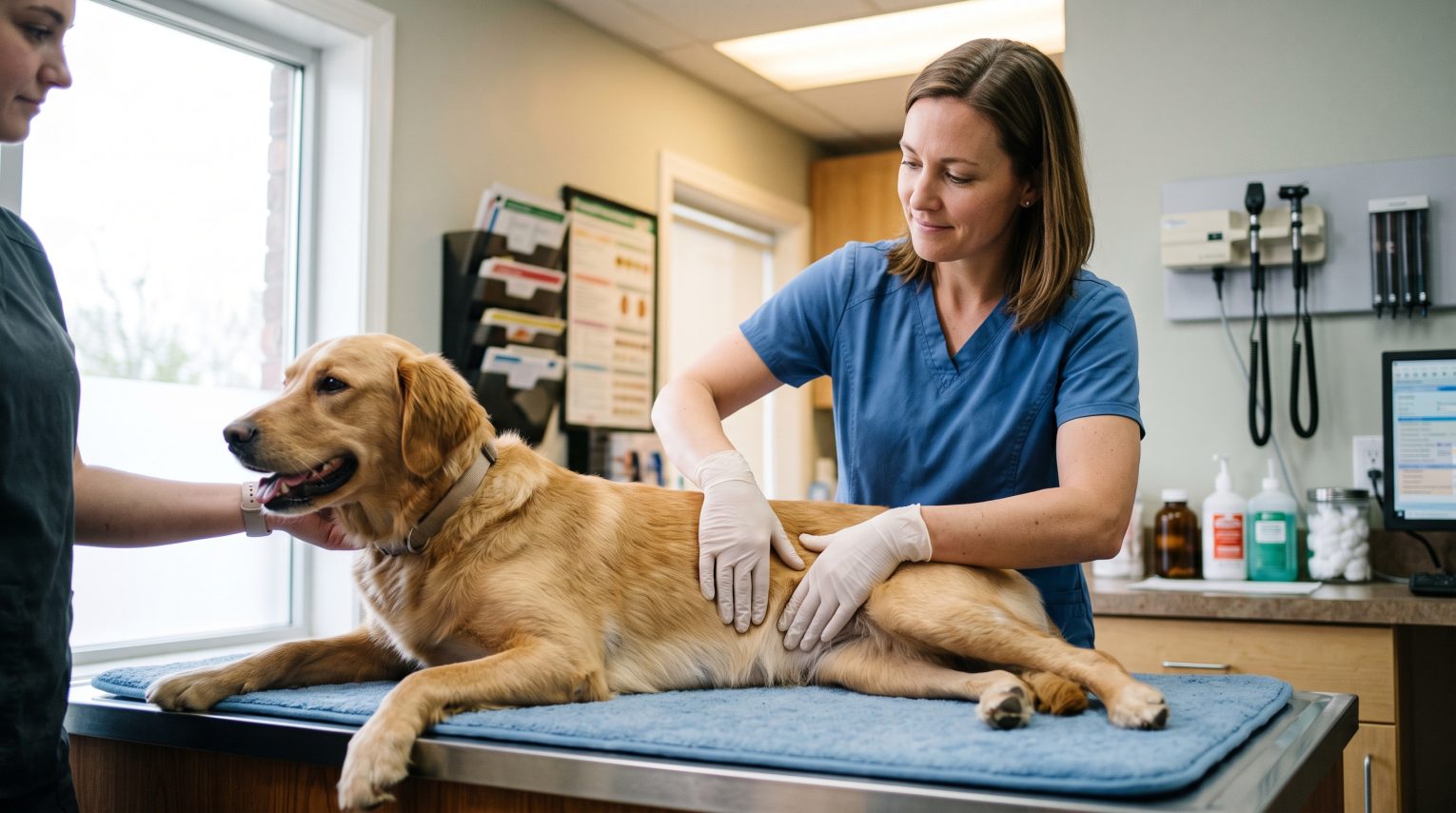
Dog health symptoms fall into three urgency levels: emergency signs requiring immediate care (difficulty breathing, collapse, a visibly distended abdomen, seizures, pale or blue gums), urgent signs needing a vet within 24–48 hours (persistent vomiting or diarrhea, blood in stool or urine, sudden lameness), and signs worth monitoring and scheduling a routine appointment for (gradual weight change, increased thirst, bad breath). Knowing which category a symptom falls into is often more useful than knowing every possible diagnosis.
One condition deserves special attention: bloat (gastric dilatation-volvulus, or GDV). It’s one of the few genuine “minutes matter” emergencies in dog ownership, can affect any dog, and progresses from first signs to life-threatening within hours. This guide covers the complete symptom checklist by urgency level, with bloat covered in depth given how often its early signs go unrecognized.
Recognizing symptoms early complements the nutritional and training foundation covered in our Dog Nutrition Guide and Dog Training Guide— together, these three areas cover the core of responsible dog ownership.
(💡 Knowing which symptoms need immediate care versus a scheduled appointment can meaningfully change outcomes for serious conditions.)
Table of Contents
Why Dogs Hide Illness
Dogs are far more likely to mask pain and illness than most owners expect—a survival instinct inherited from wild canine ancestors, for whom visible weakness meant vulnerability to predators or exclusion from the pack. This means by the time a dog is obviously acting sick, an underlying problem has often been developing for longer than it appears.
❗️This is exactly why symptom literacy matters more than symptom memorization. You don’t need to diagnose your dog—you need to recognize when a symptom’s urgency level demands immediate action versus when it’s reasonable to monitor and schedule a routine visit.
(🩺 Vet’s Note: “The question I get most often isn’t ‘what does this mean’—it’s ‘should I go to the ER tonight or wait for my regular vet tomorrow.’ Having a clear framework for that decision, before you’re in the stressful moment of actually needing it, makes a real difference.”—LovingPetsGuide Veterinary Advisor)
Emergency: Seek Immediate Veterinary Care
These signs warrant an emergency clinic visit the same day—don’t wait to see if they resolve on their own.
- A visibly distended or bloated abdomen, especially combined with unproductive retching (see the dedicated bloat section below).
- Difficulty breathing or persistent rapid breathing.
- Collapse or sudden inability to stand.
- Seizures.
- Pale, white, or blue-tinged gums—a sign of circulation or oxygenation problems.
- Straining to urinate with little or no output, particularly in male dogs—can indicate a urinary blockage, a genuine emergency.
- Facial swelling, hives, or sudden vomiting and diarrhea together, especially after a new food, medication, or insect sting—signs of a possible allergic reaction (anaphylaxis).
- Severe, sudden lethargy that seems disproportionate to any obvious cause.
📰 VCA Animal Hospitals (vcahospitals.com) identifies gastric dilatation-volvulus, acute hemorrhagic diarrhea syndrome, and anaphylaxis among the most serious common veterinary emergencies in dogs, confirming that acute hemorrhagic diarrhea syndrome presents with severe bloody diarrhea, vomiting, and weakness or collapse, and that anaphylaxis often begins with facial or muzzle swelling and skin hives before progressing rapidly to breathing difficulty and collapse if untreated.
Bloat (GDV): The Emergency Most Owners Underestimate
This gets its own section because it’s genuinely different from most conditions on this list—not just serious, but a race against time in a way few other common dog health problems are.
❓What it is: The stomach fills with gas, fluid, or food and can rotate on itself (volvulus), trapping the gas inside and cutting off blood flow to the stomach and surrounding organs.
❗️Early warning signs (can be subtle and easy to dismiss as simple indigestion):
- Restlessness, pacing, or inability to get comfortable.
- Unproductive retching—trying to vomit without producing anything.
- A swollen or distended abdomen, particularly on the left side behind the ribcage.
- Excessive drooling.
- Pain or discomfort when the abdomen is touched.
🚨 As it progresses:
- Standing with legs spread apart.
- Labored breathing.
- Pale gums, weakness, eventual collapse.
⚠️ Bloat cannot be managed at home and cannot resolve on its own. It requires emergency surgery, and the condition can progress from first signs to a fatal outcome within hours. If you suspect bloat, call the emergency clinic while you’re on your way— don’t wait to see if symptoms improve.
❓Who’s at higher risk: Large, deep-chested breeds —including Great Danes, Saint Bernards, Weimaraners, Irish Setters, Gordon Setters, Standard Poodles, Basset Hounds, Doberman Pinschers, and Old English Sheepdogs—but any dog can bloat, including small breeds. Dogs weighing over 100 lb (45 kg) carry roughly a 20% lifetime risk. Bloat most commonly occurs shortly after eating a large meal, though it can happen at any time.
✅ Practical prevention steps:
- Feed two or more smaller meals daily instead of one large one ✔️
- Use a slow-feeder or puzzle bowl to discourage rapid eating ✔️
- Allow time for digestion before and after vigorous activity or play ✔️
- Avoid raised food bowls unless specifically recommended by your veterinarian ✔️
- Ask your vet whether prophylactic gastropexy (a preventive surgical procedure) makes sense if your dog is a high-risk breed ✔️
📰 Gastric dilatation-volvulus is documented by VCA Animal Hospitals (vcahospitals.com) as requiring immediate veterinary intervention within minutes to a few hours to save a dog’s life, with large, deep-chested breeds identified as predisposed—though any dog, including smaller breeds, can be affected— and dogs over 100 lb carrying approximately a 20% lifetime risk. The American Animal Hospital Association (aaha.org) confirms that GDV cannot resolve on its own or be treated at home, and that early signs frequently mimic less serious digestive upset, making familiarity with a dog’s normal behavior—and taking any suspicious change seriously—critical to early detection.
🐾 Slow Feeder & Puzzle Bowls for Dogs 🐾
🥣 Slow Feeder & Puzzle Bowls — One of the most practical, everyday bloat-prevention tools, particularly for large or deep-chested breeds prone to rapid eating. Slows meal pace and reduces air gulping compared to a standard bowl.
Urgent: Vet Visit Within 24–48 Hours
These signs are serious enough to warrant prompt attention but generally allow time to schedule a same-day or next-day appointment rather than an emergency room visit—use your judgment on severity and trust your instincts if something feels more urgent.
- Persistent vomiting or diarrhea lasting more than 24 hours, or occurring repeatedly.
- Blood in stool or urine.
- Sudden lameness or reluctance to bear weight on a limb.
- Significant, sudden appetite loss lasting more than a day.
- Noticeable behavior changes—unusual aggression, hiding, or disorientation.
Monitor and Schedule a Routine Visit
These signs are worth a conversation with your vet but rarely require rushing in immediately—though persistence or worsening over days to weeks should prompt a sooner appointment.
- Gradual weight gain or loss over weeks.
- Increased thirst and urination—can indicate diabetes, kidney disease, or Cushing’s disease, all of which are manageable when caught early. See [Senior Dog Care Guide] for age-related risk factors.
- Persistent bad breath—often a dental disease indicator. See Dental Care for Dogs for the complete picture.
- Dull, thinning, or excessively shedding coat.
- Persistent cough, particularly in senior or small-breed dogs, which can sometimes indicate heart-related changes worth investigating.
Common Mistakes in Symptom Recognition
| ❌ Waiting to see if bloat symptoms improve on their own. They won’t, and every hour of delay reduces survival odds. Call the emergency clinic immediately if bloat is suspected. |
| ❌ Assuming senior dogs are “just slowing down”. Gradual changes attributed to normal aging are sometimes actually treatable conditions—see [Senior Dog Care Guide: Health, Diet & Mobility] for what’s genuinely age-related versus what deserves investigation. |
| ❌ Not knowing your dog’s normal baseline. Recognizing a meaningful change requires knowing what’s typical for your specific dog—appetite, energy level, water intake, and bathroom habits all vary between individuals. |
| ❌ Treating “urgent” symptoms as “emergency” or vice versa. Both under- and over-reacting have costs—persistent diarrhea generally doesn’t need an ER visit at 2am, but a distended abdomen with retching always does. |
| ❌ Skipping routine veterinary checkups because nothing seems wrong. Many of the conditions covered in this hub—dental disease, early kidney changes, weight-related issues—are far easier to address when caught during a routine exam than after symptoms become obvious. |
Staying current on core vaccines is one of the most effective preventive steps—see Dog Vaccination Schedule: Complete Year-Round Guide.
Conclusion
Most dog owners don’t need to memorize every possible diagnosis—they need a clear framework for deciding how urgently a given symptom needs attention. Bloat is the one condition worth remembering in detail, given how quickly it progresses and how often its early signs are mistaken for simple indigestion.
Key takeaways:
- ✅ A distended abdomen with unproductive retching is always an emergency—call immediately, don’t wait.
- ✅ Dogs over 100 lb carry roughly 20% lifetime bloat risk, but any dog can be affected.
- ✅ Pale/blue gums, collapse, seizures, and breathing difficulty all warrant same-day emergency care.
- ✅ Persistent vomiting, diarrhea, or blood in stool/urine need attention within 24–48 hours.
- ✅ Gradual changes in thirst, weight, or coat are worth monitoring and scheduling a routine visit.
- ✅ Slow-feeder bowls and smaller, more frequent meals are practical, everyday bloat-prevention steps.
- ✅ Knowing your dog’s normal baseline makes meaningful changes easier to recognize early.
👉🏼 Dog Nutrition Guide—the nutritional foundation for long-term health.
👉🏼 Dog Training Guide—the training foundation for confident, well-adjusted dogs.
👉🏼 [Senior Dog Care Guide: Health, Diet & Mobility]—age-specific health considerations.
👉🏼 Dental Care for Dogs: Why Brushing Is Non-Negotiable—the dental disease connection to overall health.
👉🏼 [Dog Weight Management: Is Your Dog Overweight?]—recognizing and addressing gradual weight changes.
📝 Editor’s Note: Emergency symptom categorization and bloat (GDV) information in this guide were verified against VCA Animal Hospitals (vcahospitals.com) and the American Animal Hospital Association (aaha.org). This article is educational and does not replace professional veterinary diagnosis—when in doubt about symptom severity, contact a veterinarian directly.

🐕 Browse dog food, treats, toys, health products, supplements, grooming and everything else your dog needs 🐾

🐕 Browse raw dog food, freeze-dried meals, chews, bones and natural treats from Indiana farms 🐾

🐕 Browse science-backed dry dog food, wet food, breed-specific formulas, and veterinary diets for your canin 🐾
(This post contains affiliate links. If you purchase through our links, we may earn a small commission at no extra cost to you. This never influences our editorial opinions.)
FAQ: Common Dog Health Problems
What are the first signs of bloat in dogs?
Early signs include restlessness, pacing, excessive drooling, unproductive retching (trying to vomit without producing anything), and a swollen abdomen, particularly on the left side behind the ribcage. These can be subtle and easy to mistake for simple indigestion—any suspicion warrants an immediate call to an emergency vet.
How fast does bloat progress in dogs?
Very fast—bloat can progress from initial subtle signs to a life-threatening emergency within hours. This is one of the few dog health conditions where minutes genuinely matter; never wait to see if symptoms resolve on their own.
Which dog breeds are most at risk for bloat?
Large, deep-chested breeds face the highest risk, including Great Danes, Saint Bernards, Weimaraners, Irish Setters, Standard Poodles, and Doberman Pinschers. However, any dog can bloat, including small breeds like dachshunds and chihuahuas—breed risk affects likelihood, not immunity.
What color should a healthy dog’s gums be?
Healthy gums are typically a consistent pink. Pale, white, or blue-tinged gums indicate a circulation or oxygenation problem and warrant immediate veterinary attention regardless of the underlying cause.
When should I take my dog to an emergency vet versus waiting for a regular appointment?
Emergency-level signs include a distended abdomen with retching, difficulty breathing, collapse, seizures, pale/blue gums, and straining to urinate with no output—these need same-day care. Persistent vomiting or diarrhea, blood in stool or urine, and sudden lameness generally allow time for a next-day appointment, though trust your judgment if something feels more urgent.
Can bloat be prevented?
Not entirely, but real risk-reduction steps exist: feeding smaller, more frequent meals, using a slow-feeder bowl, avoiding vigorous activity immediately before or after eating, and—for high-risk breeds—discussing prophylactic gastropexy with your veterinarian.