
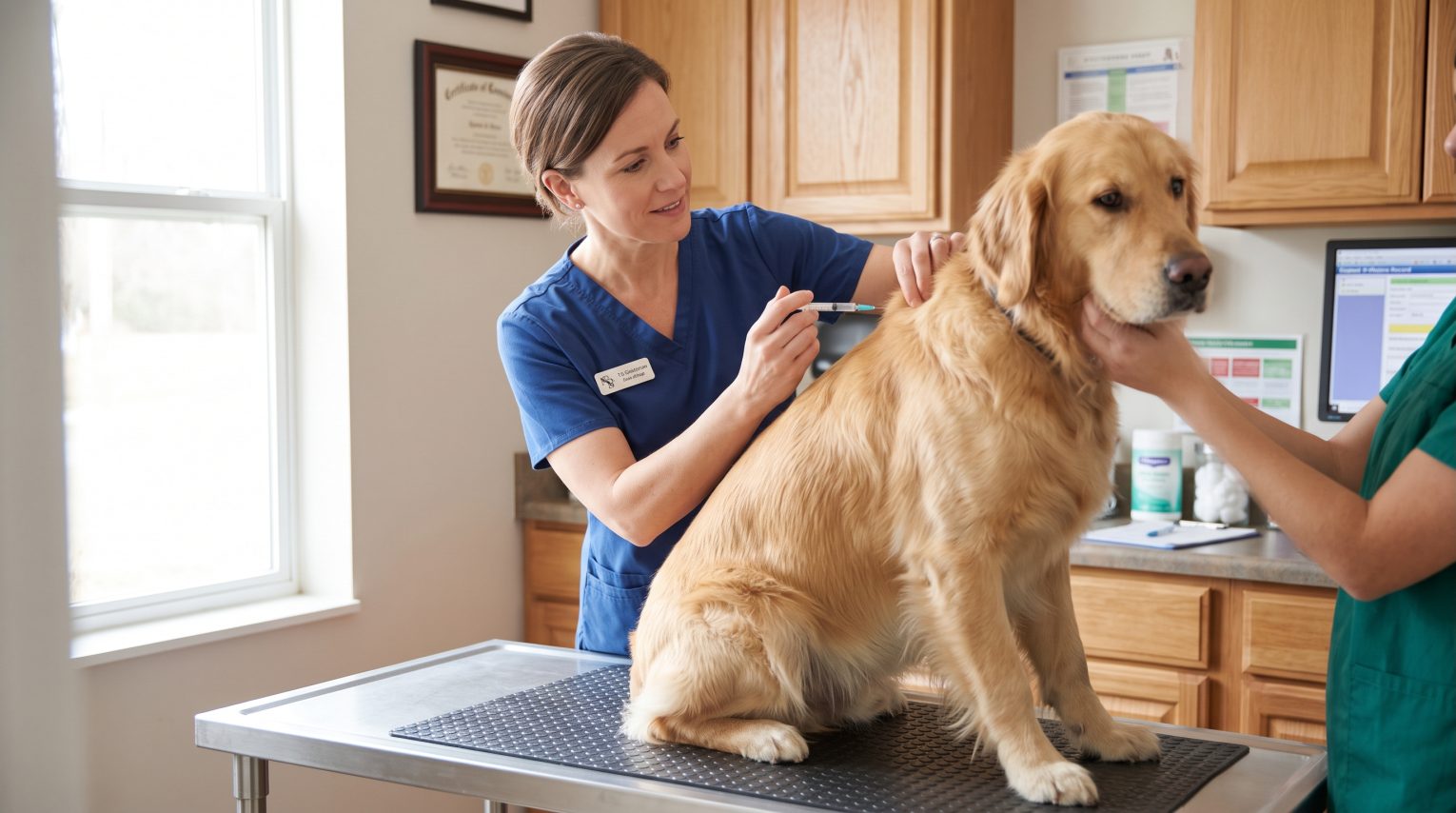
Core vaccines—distemper, parvovirus, adenovirus, and rabies—are recommended for every dog regardless of lifestyle, with adult boosters typically needed every three years rather than annually. Non-core vaccines like Bordetella (kennel cough), Lyme disease, and canine influenza are recommended based on your dog’s specific lifestyle, geographic location, and exposure risk, usually on an annual schedule. Puppies need a series of core vaccine doses—not just one shot—because maternal antibodies inherited from their mother can block a vaccine from working, and exactly when those antibodies fade varies from puppy to puppy.
This guide covers the complete schedule for both puppies and adult dogs, the reasoning behind the core/non-core distinction, and what’s actually required by law versus recommended based on risk.
Vaccination is one part of the preventive health foundation covered alongside our Dog Nutrition Guide and Dog Training Guide. For a broader symptom checklist covering what to watch for between vet visits, see Common Dog Health Problems: Symptoms to Never Ignore.
(💡 Core vaccines protect against several of the most serious, and most preventable, canine diseases.)
Table of Contents
Core vs Non-Core: The Framework That Matters
Rather than treating every vaccine as equally mandatory, veterinary guidelines organize canine vaccines into two categories—understanding this distinction explains most of the “why” behind a typical vaccination schedule.
Core vaccines are recommended for every dog, regardless of lifestyle, unless there’s a specific medical reason not to vaccinate. These protect against diseases that are highly contagious, potentially fatal, or both.
- 💉 Canine Distemper Virus (CDV).
- 💉 Canine Adenovirus-2 (CAV-2).
- 💉 Canine Parvovirus (CPV).
- 💉 Rabies (also legally required in nearly every U.S. jurisdiction).
Non-core vaccines are recommended based on your specific dog’s lifestyle, geographic location, and realistic exposure risk—not automatically needed by every dog.
- 💉 Bordetella (kennel cough).
- 💉 Lyme disease.
- 💉 Canine influenza.
- 💉 Leptospirosis in some regions.
⚠️ A genuine nuance worth knowing: Leptospirosis has traditionally been classified as non-core, but current veterinary guidelines increasingly treat it as core in many practices given its expanding geographic prevalence—even standing water and wildlife exposure in suburban yards can pose a risk. Ask your veterinarian whether this applies in your area.
(🩺 Vet’s Note: “The core/non-core framework isn’t about some vaccines mattering and others not—it’s about which risks apply to literally every dog versus which depend on where you live and how your dog spends their time. A dog that never leaves a fenced yard still needs core vaccines; whether they need Lyme or Bordetella depends on real, specific exposure risk.”—LovingPetsGuide Veterinary Advisor)
📰 The core and non-core vaccine classification system is documented in the 2022 AAHA Canine Vaccination Guidelines (2024 update), published by the American Animal Hospital Association (aaha.org)—the peer-reviewed industry standard reference for canine vaccination protocols. AAHA identifies canine distemper virus, canine adenovirus-2, canine parvovirus, and rabies as core vaccines recommended for all dogs, with Bordetella, Lyme disease, and canine influenza classified as non-core, recommended based on individual lifestyle and geographic risk assessment.
Why Puppies Need a Series, Not a Single Shot
This is one of the most commonly misunderstood parts of vaccination—new owners sometimes assume one early shot provides full protection.
❕Maternal antibodies are the reason. Puppies receive some disease immunity from their mother before birth and through early nursing. These maternal antibodies protect young puppies naturally—but they also block a vaccine from triggering the puppy’s own immune response while still present in significant levels.
❗️The problem: nobody knows exactly when maternal antibodies fade for a specific puppy. It varies meaningfully between individual puppies, even within the same litter. This is why puppies receive a series of doses rather than one shot at a fixed age— each dose in the series gives another opportunity to “catch” the window once maternal antibodies have dropped low enough for the vaccine to actually work.
Standard puppy core vaccine schedule:
| Age | Vaccine Action |
|---|---|
| 6–8 weeks | 💉 First dose in the series |
| Every 2–4 weeks after | 💉 Booster doses continue |
| No earlier than 16 weeks | 💉 Final dose in the series |
| Per state law (typically 12–16 weeks) | 💉 Rabies vaccine |
❔Why the final dose timing matters specifically: Even if earlier doses in the series were given on schedule, a final booster given too early—before 16 weeks—risks missing the window where maternal antibodies have fully cleared, potentially leaving a gap in protection despite a “complete” series on paper.
📰 The puppy core vaccine schedule—beginning as early as 6 weeks of age, boostered every 2 to 4 weeks, with the final dose administered no earlier than 16 weeks—is documented in the 2022 AAHA Canine Vaccination Guidelines (aaha.org). This timing directly addresses maternal antibody interference, since the exact age at which a given puppy’s maternal antibodies decline enough for a vaccine to successfully trigger immunity varies between individual puppies.
Adult Dog Booster Schedule
This is the second most common point of confusion— many owners assume every vaccine needs an annual booster.
💉 Core vaccines: typically every 3 years. After the initial puppy series and a one-year booster, most core vaccines (distemper, adenovirus, parvovirus) move to a three-year revaccination schedule for healthy adult dogs—not annual.
💉 Rabies: follows state law, not a universal standard. Depending on your state and the specific vaccine product used, rabies revaccination may be required annually or every three years. Check your local requirements directly, since this is a legal matter, not just a medical recommendation.
💉 Non-core vaccines: typically annual. Bordetella, Lyme disease, and canine influenza generally follow a yearly schedule when your dog’s lifestyle and risk factors warrant them.
🩺 An alternative some owners discuss with their vet: titers. A titer is a blood test measuring existing antibody levels for a specific disease. Rather than automatically revaccinating a core vaccine on schedule, some veterinarians offer titer testing to check whether adequate immunity is already present. This isn’t appropriate for every situation—titers don’t apply to rabies (which remains legally mandated regardless of measured antibody levels in nearly all jurisdictions)—but it’s worth discussing with your vet if you’re specifically interested in this option for core, non-rabies vaccines.
📰 The shift from annual to triennial revaccination for core canine vaccines in healthy adult dogs is documented in the 2022 AAHA Canine Vaccination Guidelines (aaha.org), which distinguish this three-year schedule for core vaccines from the typically annual schedule maintained for non-core vaccines like Bordetella. Rabies vaccination timing is separately governed by state law rather than these medical guidelines alone, meaning local legal requirements should be confirmed directly rather than assumed.
Common Vaccination Myths
| ❌ “My dog is indoor-only, so they don’t need vaccines”. Core vaccines protect against diseases that don’t require extensive outdoor exposure to transmit—and rabies vaccination is legally required in nearly every U.S. jurisdiction regardless of how much time a dog spends outside. |
| ❌ “Vaccinating every year is always safest”. For core vaccines specifically, current guidelines support a three-year schedule for healthy adults after the initial series—more frequent revaccination isn’t automatically better and isn’t what current veterinary guidelines recommend. |
| ❌ “Titers can replace all vaccines, including rabies”. Titers can be a reasonable option to discuss for some core, non-rabies vaccines, but rabies vaccination remains a legal requirement in nearly all jurisdictions regardless of measured antibody levels. |
| ❌ “Puppies just need one shot to be protected”. Covered in detail above—a single early dose can be blocked by maternal antibodies still present in the puppy’s system, which is exactly why a series matters. |
Talking to Your Vet About Your Dog’s Specific Schedule
❔Questions worth asking:
- Does my region’s leptospirosis risk mean this should be treated as core for my dog?
- Given my dog’s lifestyle (boarding, dog parks, hiking, travel), which non-core vaccines make sense?
- What does my state require for rabies revaccination timing specifically?
- Is titer testing a reasonable option for my dog’s core vaccine boosters?
Every dog’s actual risk profile differs based on geography, lifestyle, and health history—this guide covers the general framework, but your veterinarian tailors the specific schedule to your individual dog.
Conclusion
Vaccination doesn’t need to be confusing once the core/non-core framework and the reasoning behind puppy series scheduling make sense. Core vaccines protect every dog regardless of lifestyle and typically move to a three-year adult schedule; non-core vaccines depend on your specific dog’s real-world exposure risk and generally follow an annual schedule when needed.
Key takeaways:
- ✅ Core vaccines (distemper, adenovirus, parvovirus, rabies) are recommended for every dog.
- ✅ Puppies need a series of doses because maternal antibodies block vaccines until they naturally decline—timing varies by individual puppy.
- ✅ The final puppy booster should never be given earlier than 16 weeks of age.
- ✅ Adult core vaccines typically move to a three-year schedule, not annual.
- ✅ Rabies revaccination timing follows state law, not a universal medical standard.
- ✅ Non-core vaccines (Bordetella, Lyme, influenza) depend on lifestyle and geographic risk, usually on an annual schedule.
- ✅ Leptospirosis is increasingly treated as core in many regions given rising prevalence.
👉🏼 Dog Nutrition Guide—the nutritional foundation for long-term health.
👉🏼 Dog Training Guide—the training foundation for confident, well-adjusted dogs.
👉🏼 Common Dog Health Problems: Symptoms to Never Ignore—recognizing issues between scheduled vet visits.
👉🏼 Dental Care for Dogs: Why Brushing Is Non-Negotiable—another preventive care essential.
👉🏼 [Senior Dog Care Guide: Health, Diet & Mobility]—how care needs shift with age.
📝 Editor’s Note: Vaccine classification, puppy series timing, and adult booster schedules in this guide were verified against the 2022 AAHA Canine Vaccination Guidelines (2024 update) (aaha.org), published by the American Animal Hospital Association (aaha.org). Rabies-specific requirements vary by state; confirm local law directly rather than relying on general guidance alone. This article is educational and does not replace an individualized vaccination protocol from your veterinarian.

🐕 Browse dog food, treats, toys, health products, supplements, grooming and everything else your dog needs 🐾

🐕 Browse raw dog food, freeze-dried meals, chews, bones and natural treats from Indiana farms 🐾

🐕 Browse science-backed dry dog food, wet food, breed-specific formulas, and veterinary diets for your canin 🐾
(This post contains affiliate links. If you purchase through our links, we may earn a small commission at no extra cost to you. This never influences our editorial opinions.)
FAQ: Dog Vaccination Schedule
What vaccines does every dog need?
Core vaccines—canine distemper virus, canine adenovirus-2, canine parvovirus, and rabies—are recommended for every dog regardless of lifestyle, according to AAHA guidelines. Rabies is also legally required in nearly every U.S. jurisdiction.
How often do adult dogs actually need vaccine boosters?
Core vaccines typically move to a three-year schedule for healthy adult dogs after the initial puppy series and one-year booster—not annually. Non-core vaccines like Bordetella generally remain on an annual schedule. Rabies timing depends on state law and the specific vaccine product used.
Why does my puppy need multiple rounds of the same vaccine?
Maternal antibodies inherited from the mother can block a vaccine from working while still present in the puppy’s system, and the exact age they decline varies between individual puppies. A series of doses, with the final one given no earlier than 16 weeks, ensures the vaccine has a chance to work once maternal antibody interference has cleared.
Does my indoor dog still need core vaccines?
Yes. Core vaccines protect against diseases that don’t require extensive outdoor exposure to transmit, and rabies vaccination is legally required in nearly all U.S. jurisdictions regardless of how much time a dog spends outdoors.
What is a titer test, and can it replace vaccination?
A titer is a blood test measuring existing antibody levels for a specific disease, sometimes used as an alternative to automatic revaccination for core, non-rabies vaccines if adequate immunity is already present. It’s worth discussing with your veterinarian, but titers don’t apply to rabies, which remains a legal requirement regardless of measured antibody levels in nearly all jurisdictions.
Is leptospirosis vaccine necessary for my dog?
It depends on your region. Leptospirosis has traditionally been classified as non-core, but current guidelines increasingly treat it as core in many areas given its expanding geographic prevalence—even suburban yards with standing water or wildlife exposure can carry risk. Ask your veterinarian whether this applies where you live.