
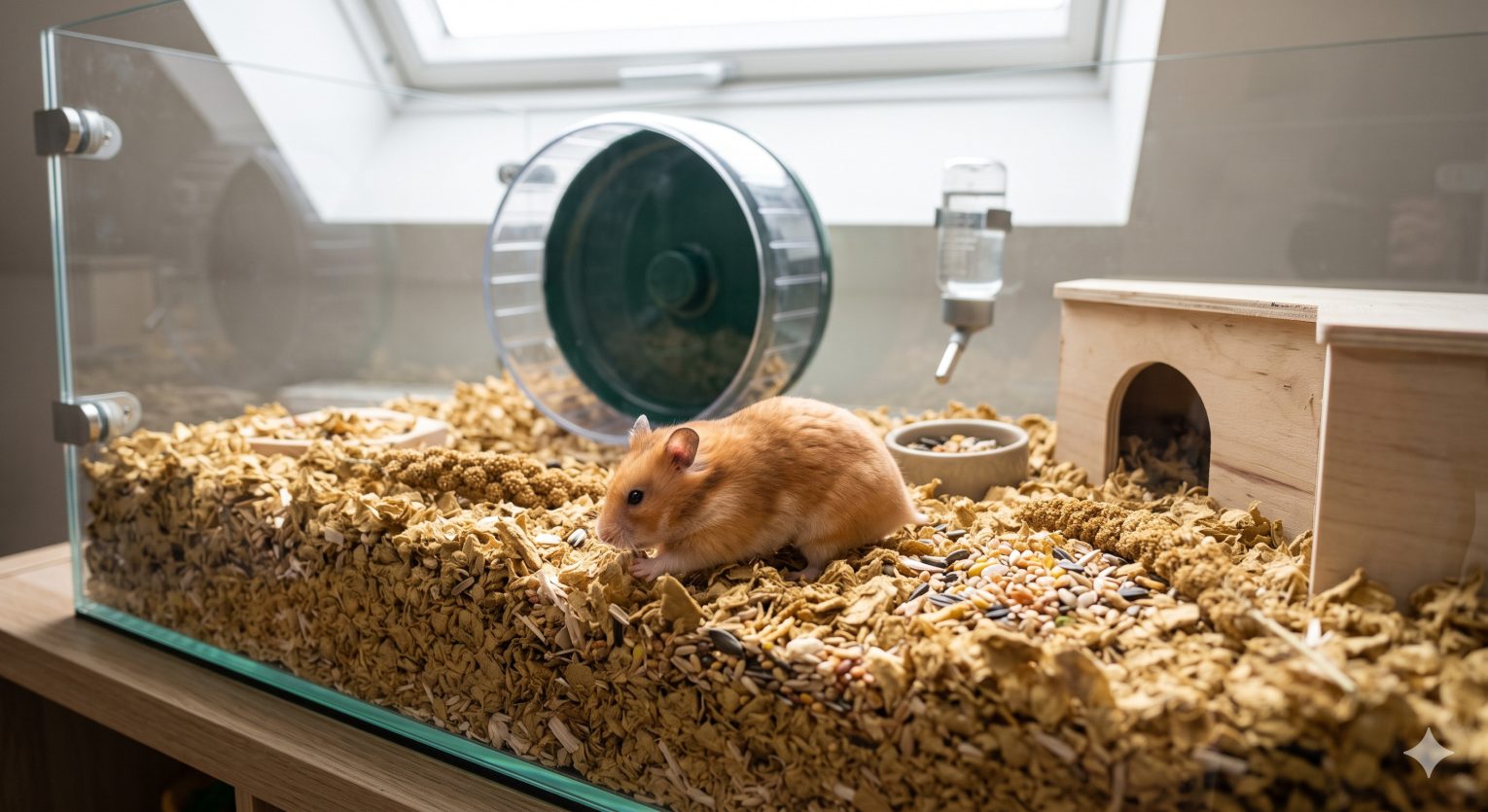
A healthy hamster needs four things above all else: a cage large enough to run, explore, and burrow (minimum 80 × 50 cm / 31 × 20 in floor space), deep substrate of at least 15–20 cm (6–8 in) for burrowing, a silent running wheel of at least 28 cm (11 in) in diameter, and—critically—to be housed alone. Hamsters are solitary animals that become severely stressed and aggressive when forced to share a cage, even with their own species.
Most hamster health and behavior problems trace directly to three avoidable mistakes: a cage that is too small, a wheel that is too small or makes noise during the night, and insufficient bedding depth that prevents the natural burrowing behavior hamsters rely on for psychological wellbeing. This guide covers the correct setup, diet, handling, and health essentials that give a hamster the best possible quality of life.
Hamster care is one of three small pet species covered in our Small Pet Care Guide—the complete hub for rabbits, guinea pigs, and hamsters covering nutrition, housing, health, and species-specific needs in one place. For a comparison with rabbit and guinea pig care requirements, see our Rabbit Care Guide and Guinea Pig Care Guide.
(💡 A proper hamster setup has three non-negotiables: a large enough cage, deep enough bedding, and a silent wheel—most commercial starter cages fail on all three counts.)
Table of Contents
What Makes Hamsters Different
Before covering setup specifics, two biological facts drive almost every hamster care decision:
1. Hamsters are strictly solitary: Syrian hamsters (the most common pet species) are highly territorial and must always be housed alone—no exceptions. Two Syrian hamsters in the same cage will fight, often to the death. Some dwarf hamster species (Roborovski, Winter White) are occasionally kept in same-sex pairs if introduced as juveniles, but even then, aggression is common and separation must always be possible. Never assume companionship is beneficial for hamsters—it is not.
2. Hamsters are nocturnal: Hamsters sleep for most of the day and are active primarily between dusk and dawn. Waking a hamster during the day causes significant stress and increases the risk of a defensive bite—not because the hamster is aggressive, but because it is genuinely disoriented and frightened. Always interact with hamsters in the evening when they have naturally woken up.
🐹 Common hamster species:
- Syrian (Golden) Hamster: Largest, most common, strictly solitary. Lifespan: 2–3 years.
- Roborovski Dwarf: Smallest and fastest. Often kept in pairs but not guaranteed. Lifespan: 3–3.5 years.
- Winter White Dwarf: Compact, active. Occasional same-sex pairs possible. Lifespan: 1.5–2 years.
- Campbell’s Dwarf: Similar to Winter White. High diabetes risk. Lifespan: 1.5–2 years.
- Chinese Hamster: Slim build, semi-prehensile tail. Solitary in practice. Lifespan: 2–3 years.
(🩺 Vet’s Note: “The two most common causes of stress-related illness I see in hamsters are co-housing—always a mistake in Syrians—and owners handling them during daylight hours. A stressed hamster is a sick hamster. Their lifespan is short enough that welfare decisions in the first weeks of ownership have a meaningful impact on how long they live”—LovingPetsGuide Veterinary Advisor.)
Part 1: Cage Setup
🐾 Minimum Size Requirements
The most common hamster care mistake—by a significant margin—is using a cage that is too small. Most cages marketed specifically as “hamster cages” in pet stores fall well below the minimum welfare standard.
Minimum floor space guidelines:
| Species | Minimum Floor Space | Recommended |
|---|---|---|
| Syrian Hamster | 80 × 50 cm (31 × 20 in) | 100 × 60 cm + (40 x 24 in +) |
| Dwarf Hamsters | 70 × 40 cm (28 × 16 in) | 80 × 50 cm + (32 x 20 in +) |
Floor area is more important than height for hamsters—they are ground-dwelling animals that need horizontal space to patrol, forage, and run.
In the wild, Syrian hamsters travel up to 9 km (5.6 miles) per night. A running wheel addresses some of this need, but cage floor area remains critical for mental and physical wellbeing.
📰 Minimum enclosure size recommendations for Syrian hamsters are consistently documented across US-based exotic animal veterinary resources. The Merck Veterinary Manual at merckvetmanual.com and VCA Animal Hospitals at vcahospitals.com both identify inadequate cage size as a primary welfare concern in captive hamsters and associate undersized housing with stereotypic behavior including bar-chewing. These standards were cross-referenced with Chewy’s veterinary-reviewed small pet care content at chewy.com/education.
🐾 Hamster Cages & Enclosures 🐾
🏠 Hamster Cages & Enclosures—Most starter cages sold for hamsters are too small. Chewy carries larger options from Kaytee, Prevue, MidWest, and more—worth browsing by dimensions to find an enclosure that meets the 80 × 50 cm (31 × 20 in) minimum before purchasing.
🐾 The Silent Wheel: Non-Negotiable
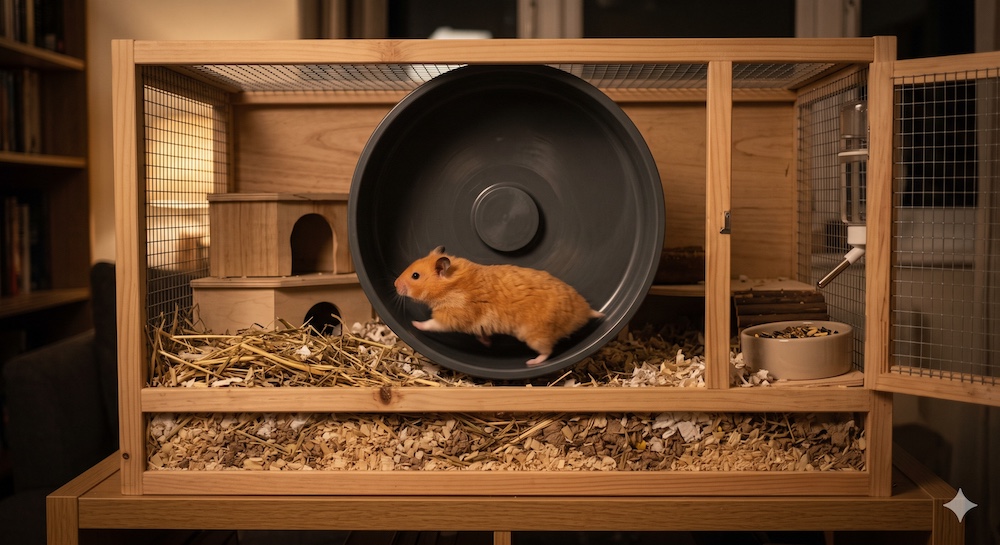
A running wheel is not enrichment for a hamster—it is a biological requirement. A hamster without adequate running opportunity will pace, bar-chew, and develop stereotypic behavior indicating chronic stress.
(💡 The wheel must be large enough that the hamster’s back remains straight while running—a hamster arching upward on a too-small wheel is developing spinal problems.)
🎡 Wheel requirements:
- Minimum diameter: 28 cm (11 in) for Syrian hamsters, 20 cm (8 in) for dwarf species.
- Surface: Solid (no rungs or mesh)—wire wheels cause leg and foot injuries (bumblefoot).
- Sound: Silent—hamsters run for hours through the night. A squeaking wheel disrupts both the hamster and the household.
- Freestanding or attached: Both are acceptable as long as the above requirements are met.
🐾 Silent Hamster Wheels 🐾
🎡 Silent Running Wheels—Niteangel and Wodent Wheel are well-regarded starting points for silent, appropriately sized wheels. Chewy carries multiple silent solid-surface wheels—always check the diameter (minimum 28 cm / 11 in for Syrians) and confirm solid running surface before buying.
🐾 Bedding Depth: The Most Overlooked Requirement
Hamsters are burrowing animals. In the wild, Syrian hamsters excavate tunnel systems up to 1 metre (3 ft) deep. In captivity, they need deep substrate to express this natural behavior—and without it, they show clear signs of frustration and stress.
📏 Minimum bedding depth: 15–20 cm (6–8 in) — 📏 Ideal depth: 25–30 cm (10–12 in) in at least one area of the cage.
✅ Safe bedding options:
- Paper-based bedding (Carefresh, Kaytee Clean & Cozy)—the most widely available and safe option.
- Hemp bedding—excellent odor control, soft texture.
- Aspen shavings—safe, natural.
❌ Unsafe bedding—avoid completely:
- Cedar and pine shavings—aromatic oils are toxic to hamsters and cause respiratory disease.
- Scented or dyed bedding of any kind.
- Cotton wool or fluffy bedding—causes intestinal impaction when swallowed and limb entanglement.
🐾 Hamster Bedding & Substrate 🐾
🪵 Paper-Based & Natural Bedding—Carefresh and Kaytee Clean & Cozy are reliable paper-based options. You need significantly more than a standard bag suggests—aim for enough to fill the cage to 15–20 cm (6–8 in) depth, replacing fully every 2–3 weeks. Chewy carries large volume bags for better value.
🐾 Additional Cage Essentials
Hideout/nest box: Every hamster needs at least one enclosed sleeping area where they can nest undisturbed during the day. Wooden hideouts are preferred over plastic—better for chewing enrichment and temperature regulation.
Sand bath: A shallow dish filled with chinchilla sand (not dust) allows hamsters to clean their coat. This is not optional enrichment—it is a hygiene behavior they perform instinctively. Do not use water baths—hamsters can develop hypothermia.
Scatter feeding: Instead of placing food in a bowl, scatter seeds and pellets through the bedding. This encourages foraging behavior and dramatically increases activity and mental stimulation.
For a step-by-step bioactive hamster enclosure setup that maximizes burrowing, foraging, and natural behavior, see Bioactive Hamster Enclosure— the most enriched setup approach available for pet hamsters.
Part 2: Hamster Diet
Hamsters are omnivores—in the wild they eat seeds, grains, roots, plants, and occasional insects. A healthy captive diet reflects this variety.
🐾 The Correct Diet Ratio
🫘 Foundation (70–80%): High-quality commercial hamster mix or pellets—provides the bulk of nutrition. Look for a species-appropriate mix with seeds, grains, and dried vegetables without excess sugar or artificial additives.
🥬 Fresh vegetables (10–15%): Small amounts daily. Variety is important.
🥚 Protein sources (5–10%): Occasional small amounts of cooked egg, mealworms, or plain cooked chicken—particularly important for pregnant, nursing, or young hamsters.
🍎 Treats (< 5%): Small pieces of fruit (no citrus for Campbells—diabetes risk), carrot, or commercial treats.
🐾 Safe and Unsafe Foods
Safe vegetables and foods:
- Broccoli, cauliflower (small amounts).
- Cucumber, zucchini.
- Carrot (limited—high sugar).
- Spinach, kale (limited—high calcium).
- Plain cooked egg, mealworms.
- Pumpkin and sunflower seeds (in commercial mix).
Foods to avoid completely:
- Onions, garlic, leeks—toxic.
- Citrus fruits—highly acidic, causes digestive upset (especially dangerous for Campbell’s dwarfs with diabetes predisposition).
- Grapes and raisins—toxic.
- Almonds (bitter)—contain cyanide compounds.
- Chocolate—toxic.
- Iceberg lettuce—causes diarrhea.
- Anything sticky—can get stuck in cheek pouches.
💧 Water: Fresh water must always be available. A sipper bottle is preferable to an open bowl— bowls get soiled quickly and increase bacterial risk. Check the sipper mechanism daily to ensure it is dispensing correctly.
For the complete A–Z safe foods list covering rabbits, guinea pigs, and hamsters, see Safe Vegetables for Small Pets.
🐾 Hamster Food & Seed Mixes 🐾
🌾 Hamster Food & Seed Mixes—Oxbow Essentials and Supreme Science Selective are well-regarded pellet-based options. Chewy carries a range of hamster foods from pellet-only to mixed formats—look for species-specific formulas without excess sugar or artificial additives.
Part 3: Handling and Behavior
🐾 Taming a New Hamster
A newly acquired hamster needs 3–5 days to settle into their new environment before any handling attempts. During this period, speak softly near the cage and allow the hamster to become accustomed to your scent and presence without forced interaction.
🗓️ Taming process:
- Days 1–3: Leave the hamster alone to settle. Change food and water quietly without disturbing the bedding more than necessary.
- Days 3–5: Begin placing your hand flat in the cage without attempting to pick up. Let the hamster approach and investigate voluntarily.
- Day 5+: Offer a treat from your flat palm. Reward any voluntary contact with the hand.
- Week 2: Gently scoop rather than grasp— never grab from above (predator approach). Cup both hands beneath the hamster and allow them to sit in your palms.
Always handle at dusk or later when the hamster is naturally awake. Waking a sleeping hamster causes disorientation and significantly increases bite risk.
🐾 Understanding Hamster Behavior
- Cheek pouching: 🟢 Normal—hamsters store food in cheek pouches to carry to a food cache. 🔴 Swollen cheeks that remain full for more than a day warrant a vet check (pouch impaction).
- Burrowing under bedding: 🟢 Normal and healthy—do not disturb.
- Bar chewing / cage biting: 🟠 A stress signal indicating the cage is too small or lacks adequate enrichment, not a personality trait—it is a welfare problem.
- Freezing when touched: 🟢 Normal initial response. 🟠 Consistent freezing after handling is established indicates ongoing stress.
- Wheel running all night: 🟢 Completely normal—do not interpret as a sign of distress.
📰 Bar-chewing (also called stereotypic behavior) in hamsters is documented in peer-reviewed animal welfare literature as a reliable indicator of inadequate cage size and environmental enrichment. A 2020 study in Applied Animal Behaviour Science found that hamsters housed in larger enclosures with deeper substrate showed significantly reduced stereotypic behavior compared to those in standard commercial cages. VCA Animal Hospitals at vcahospitals.com and the Merck Veterinary Manual at merckvetmanual.com both identify environmental inadequacy—particularly undersized housing—as a primary driver of stereotypic behavior in captive small mammals. Chewy’s veterinary-reviewed small pet care content at chewy.com/education is consistent with these findings.
Part 4: Health Essentials
🐾 Finding a Hamster-Savvy Vet
As with all exotic small pets, hamsters require a vet experienced in small mammal or exotic animal practice. A standard dog-and-cat vet without small mammal experience may miss critical symptoms or apply incorrect medication dosing for a 100g animal.
🩺 Register with a hamster-savvy vet before a health problem arises—emergencies move quickly in animals this small.
🐾 Wet Tail (Proliferative Ileitis)
Wet tail is the most serious and most common health emergency in hamsters, particularly in Syrian hamsters under 12 weeks old. It is a bacterial infection of the intestinal tract causing severe, watery diarrhea, lethargy, hunched posture, and a wet, matted tail region.
🚨 Wet tail is a veterinary emergency. A hamster with wet tail can die within 24–48 hours without treatment. Do not wait to see if it resolves—contact a vet the same day.
❗️Triggers: Stress (new environment, transport, temperature changes), poor hygiene, overcrowding.
❕Prevention: Allow new hamsters to settle undisturbed for at least 3–5 days, maintain clean housing, and avoid stressful handling during the first weeks.
🐾 Other Common Health Issues
Diabetes (especially Campbell’s Dwarf): Campbell’s dwarfs have a genetic predisposition to diabetes. Signs include increased drinking, urination, and weight loss. Avoid high-sugar foods—no fruit at all for Campbell’s hamsters.
Dental problems: Hamster incisors grow continuously. Provide wooden chews and appropriate hard foods to maintain wear. Overgrown teeth cause drooling, weight loss, and food dropping.
Cheek pouch impaction: Sticky foods can get lodged in cheek pouches. Signs include a persistently swollen cheek on one side for more than 24 hours. Requires veterinary emptying—never attempt to clear it yourself.
Respiratory infections: Signs include wheezing, nasal discharge, and labored breathing. Can deteriorate rapidly given the hamster’s small body mass—vet visit same day.
🐾 Signs of a Healthy Hamster
| Area | Healthy | Concern |
|---|---|---|
| Eyes | Bright, round, clear | Sunken, discharge, half-closed |
| Coat | Smooth, clean | Dull, patchy, matted |
| Weight | Consistent | Visible weight loss |
| Activity | Active at night | Lethargic even when awake |
| Tail area | Dry and clean | Wet or soiled |
| Breathing | Quiet | Wheezing or labored |
| Teeth | Even, short | Overgrown or misaligned |
The 5 Most Common Hamster Care Mistakes
| ❌ Cage too small: The single most impactful mistake. A hamster in an undersized cage will bar-chew, pace, and show chronic stress regardless of how much handling and attention they receive. Size the cage correctly before any other purchase. See the minimum dimensions above. |
| ❌ Wire or mesh wheel: Wire wheels cause bumblefoot—painful sores on the feet from repetitive contact with the rungs. Always use a solid-surface wheel of appropriate diameter. |
| ❌ Insufficient bedding depth: A 5 cm (2 in) bedding layer is not enough. Hamsters that cannot burrow will show stress behavior. Fill to at least 15–20 cm (6–8 in) and ideally deeper in one area. |
| ❌ Disturbing the hamster during the day: Hamsters sleep deeply and disoriented when woken. Consistent daytime disturbance causes chronic stress and significantly increases bite risk. Interact only in the evening. |
| ❌ Using fluffy/cotton wool bedding: Marketed as nesting material, cotton wool and synthetic fluffy bedding cause impaction when ingested and can entangle and amputate limbs. Use plain paper-based bedding only. |
Conclusion
Hamsters are small, relatively affordable pets with care requirements that are specific and non-negotiable. The three investments that matter most—a large enough cage, deep enough bedding, and a silent solid wheel—are all one-time purchases that determine quality of life for the hamster’s entire 2–3 year lifespan.
Key takeaways:
- ✅ Cage minimum: 80 × 50 cm (31 × 20 in) for Syrians—most commercial cages are too small.
- ✅ Bedding minimum: 15–20 cm (6–8 in) depth.
- ✅ Wheel: silent, solid-surface, minimum 28 cm (11 in) for Syrians.
- ✅ Never house Syrians together—always solitary.
- ✅ Handle only in the evening—never wake a sleeping hamster.
- ✅ Wet tail is a veterinary emergency— act within hours, not days.
- ✅ No cotton wool / fluffy bedding—ever.
- ✅ No citrus for Campbell’s dwarfs—diabetes risk.
👉🏼 Small Pet Care Guide—complete hub for rabbits, guinea pigs, and hamsters.
👉🏼 Rabbit Care Guide—compare hamster vs rabbit care requirements.
👉🏼 Guinea Pig Care Guide—another popular small pet with very different social needs.
👉🏼 Bioactive Hamster Enclosure—step-by-step setup for the most enriched hamster habitat.
👉🏼 Safe Vegetables for Small Pets—complete A–Z safe and unsafe food list for all three species.
📝 Editor’s Note: Cage size minimums in this guide were cross-referenced with VCA Animal Hospitals at vcahospitals.com, the Merck Veterinary Manual at merckvetmanual.com, and peer-reviewed animal welfare research (Applied Animal Behaviour Science 2020). Wet tail emergency guidance was verified against Veterinary Partner VIN at veterinarypartner.vin.com. Unsafe bedding materials were confirmed against small animal veterinary toxicology references in the Merck Veterinary Manual.

🐀 Browse small pet food, bedding, cages, toys, supplements and everything else your small pet needs 🐾
(This post contains affiliate links. If you purchase through our links, we may earn a small commission at no extra cost to you. This never influences our editorial opinions.)
FAQ: Hamster Care
Do hamsters need a companion?
No—Syrian hamsters must always be housed alone. They are highly territorial and will fight to the death if housed together. Some dwarf species (Roborovski, Winter White) can occasionally be kept in same-sex pairs if introduced as young juveniles, but aggression is common even then, and separate housing must always be available. If you see fighting, separate immediately and permanently.
How big should a hamster cage be?
A minimum of 80 × 50 cm (31 × 20 in) floor space for Syrian hamsters—80 × 40 cm for dwarf species. Bigger is always better. Most cages sold in pet stores as “hamster cages” fall well below this minimum. Measure the internal floor space before purchasing—marketing terms like “large” or “deluxe” are not standardized.
How often should I clean a hamster cage?
Spot-clean the toilet corner and remove soiled bedding daily. Full bedding replacement every 2–3 weeks for most setups, or weekly if odor builds faster. Avoid cleaning the entire cage at once—leave some used bedding to preserve the hamster’s scent markers and reduce stress from complete environmental change.
Why is my hamster biting the cage bars?
Bar-chewing in hamsters is a stereotypic stress behavior almost always caused by an inadequate cage size or insufficient enrichment— not a personality trait. The solution is a larger cage with deeper bedding and more foraging enrichment, not behavioral correction. If the cage already meets minimum size requirements, add more scatter feeding, tunnels, and digging opportunities.
What is wet tail and how serious is it?
Wet tail (proliferative ileitis) is a bacterial intestinal infection causing severe watery diarrhea, lethargy, and hunched posture—most common in Syrian hamsters under 12 weeks old. It is fatal within 24–48 hours without treatment. If your hamster has a wet, soiled tail area alongside lethargy or reduced appetite, contact a vet the same day. Do not wait to see if it improves on its own.
How long do hamsters live?
Syrian hamsters typically live 2–3 years. Roborovski dwarfs live slightly longer at 3–3.5 years. Winter White and Campbell’s dwarfs typically live 1.5–2 years. Lifespan is significantly influenced by housing quality, diet, and stress levels—proper care makes a measurable difference even across this relatively short lifespan.