
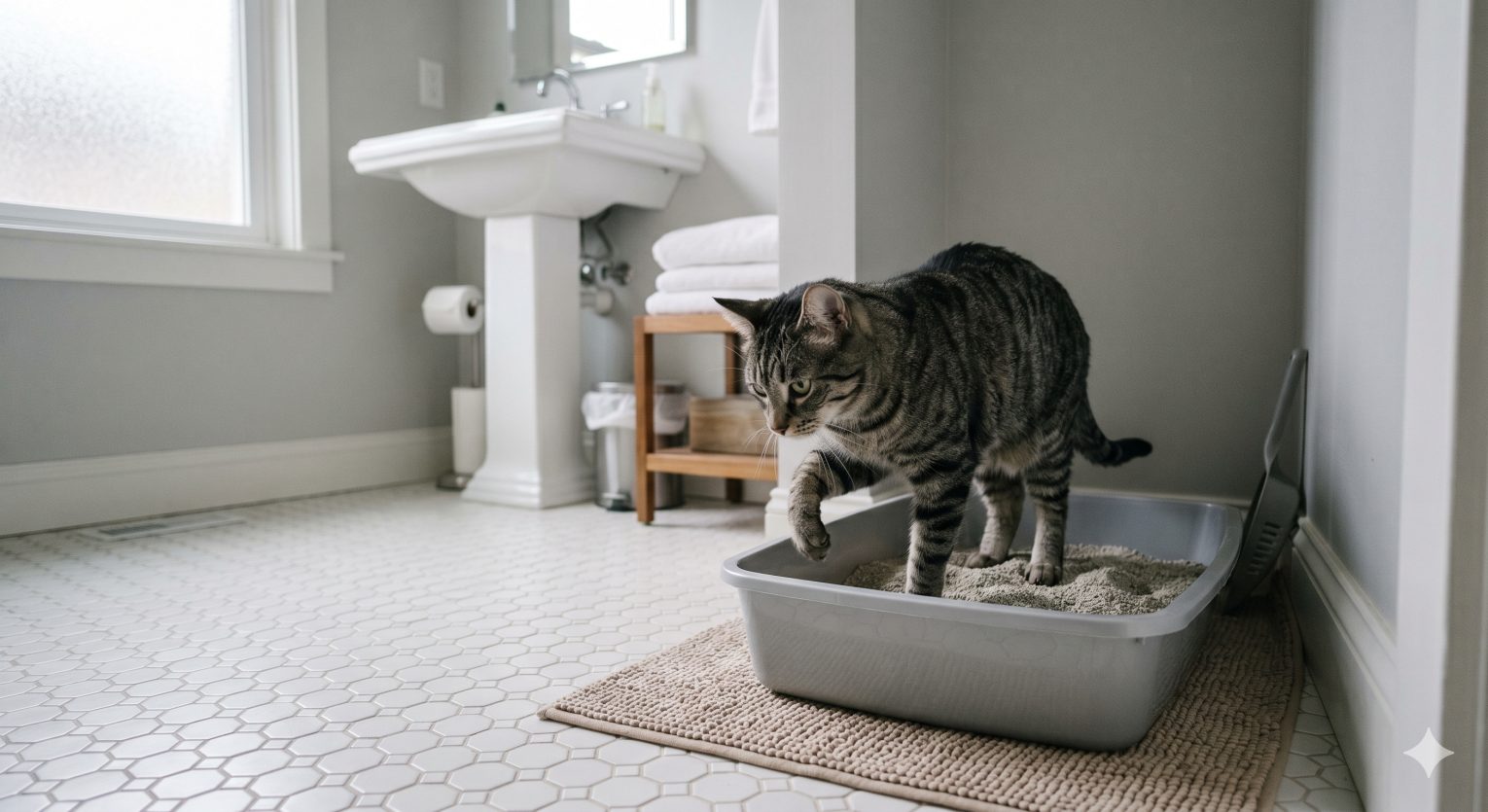
Litter box problems are the most common behavioral reason cats are surrendered to shelters — and the vast majority are entirely preventable and fixable. The most frequent causes are a dirty box, wrong litter type, box in the wrong location, box that is too small, or a medical issue that makes urination or defecation painful. Before assuming a behavioral problem, always rule out a medical cause first — a cat that suddenly stops using the litter box is communicating something, and pain is the most common message.
Cats are instinctively drawn to eliminate in loose substrate and bury their waste — this drive is so strong that most cats train themselves to use a litter box without any formal instruction. When they stop, it is almost never out of spite or stubbornness. Something about the box, the litter, the location, or the cat’s physical health has changed. This guide covers every significant cause and the exact steps to resolve each one.
Litter box behavior is one piece of a larger picture of feline communication and training. For the complete guide to understanding your cat’s behaviors — from body language to positive reinforcement techniques — our cat training guide covers everything before and beyond litter box issues.
Table of Contents
Rule Out Medical Causes First
Before any behavioral intervention, a sudden change in litter box habits always warrants a veterinary assessment. Medical causes are the most frequently overlooked reason for litter box avoidance — and behavioral solutions applied to a medical problem waste time and allow the condition to progress.
🐈 Medical conditions that cause litter box avoidance:
Urinary tract infection (UTI): The most common medical cause. UTIs make urination painful — the cat associates the box with pain and begins avoiding it. Signs: frequent attempts with little output, vocalizing during urination, blood in urine.
Feline idiopathic cystitis (FIC): Inflammation of the bladder without infection. Extremely common in cats and strongly associated with stress. Signs similar to UTI — frequent attempts, straining, blood in urine.
Urinary blockage: A life-threatening emergency — particularly in male cats. A blocked cat will strain repeatedly in the box with no output, become lethargic, and vocalize in pain. (🚨 If your cat is straining with no output, go to the vet immediately — this is an emergency.)
Kidney disease: Increased urination frequency in senior cats. The box may simply not be accessible fast enough, or the cat may associate discomfort with the box.
Arthritis: Senior cats with joint pain may find climbing into a high-sided box painful. The solution is a low-entry box, not behavioral training.
Constipation or intestinal pain: Painful defecation causes the same box avoidance pattern as painful urination.
(🩺 Vet’s Note: “I always ask owners to bring a urine sample when they report litter box problems. In my experience, at least 40–50% of litter box avoidance cases in adult cats have a medical component — particularly urinary tract inflammation. Treating this as a behavioral problem first delays diagnosis and causes unnecessary suffering”—LovingPetsGuide Veterinary Advisor.)
📰 Urinary tract disease as a significant contributor to litter box avoidance is well documented in veterinary behavior literature, with feline idiopathic cystitis specifically identified as both extremely common and strongly stress-linked—reinforcing why a veterinary visit, not behavioral correction, is the appropriate first response to sudden litter box changes.
The Most Common Non-Medical Causes
Once medical causes are ruled out, these are the most frequent behavioral and environmental reasons for litter box avoidance.
1. The Cat Box Is Not Clean Enough 🐾
Cats are fastidiously clean animals. The single most common cause of litter box avoidance is a box that is not cleaned frequently enough for the cat’s standards — which are significantly higher than most owners assume.
The minimum standard:
- Scoop at least once daily — ideally twice.
- Full litter replacement weekly for clumping, more frequently for non-clumping.
- Full box wash with mild, unscented soap monthly — not bleach or strong detergents (the residual smell deters cats).
A cat with two boxes, both scooped daily, will reliably use them. A cat with one box scooped every few days will find alternatives.
❕The N+1 rule: Provide one litter box per cat plus one extra. A two-cat household needs a minimum of three boxes.
2. Wrong Cat Litter Type 🐾
Cats have strong preferences for litter texture and scent. Many owners choose litter based on human preferences (low dust, fragrant) rather than cat preferences.
✅ What most cats prefer:
- Fine-grained, unscented clumping litter.
- Texture similar to sand or fine soil.
- Depth of at least 5 cm (2 inches).
❌ What many cats dislike:
- Heavily scented or perfumed litters (designed for human noses, not cat preferences).
- Large crystal or pellet litters (uncomfortable on paw pads for many cats).
- Very shallow litter depth — cats need enough to dig and cover effectively.
❔How to identify a litter preference: Offer two identical boxes side by side with different litter types and observe which is used more. Most cats will make their preference clear within days.
🐾 Unscented Clumping Cat Litter 🐾
🏝️ Fine-Grained Unscented Clumping Litter — The texture and scent profile most cats consistently prefer. Chewy carries a wide range of unscented clumping options across price points and dust levels.
3. Wrong Box Location 🐾
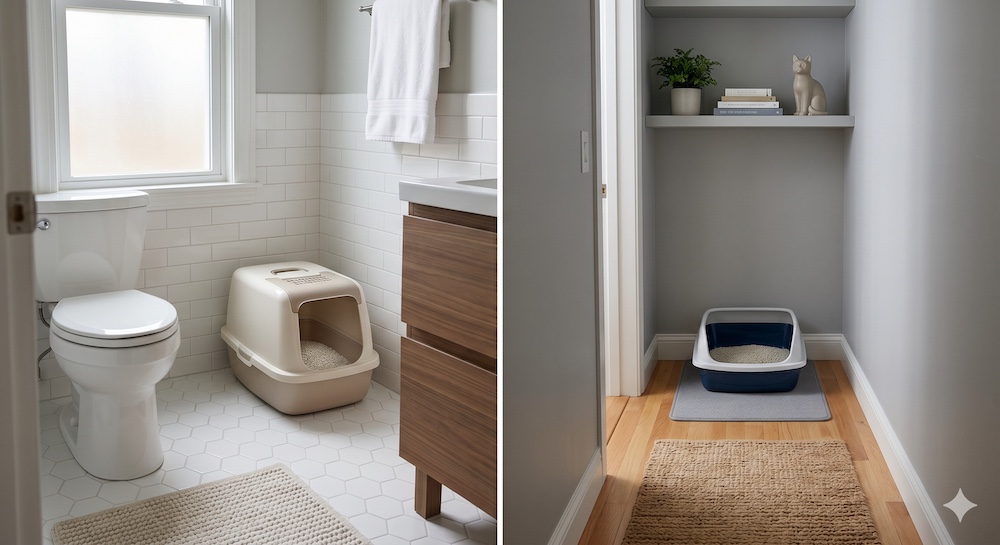
Location is as important as cleanliness. Cats need to feel safe and undisturbed when eliminating — a vulnerable biological moment in a prey animal.
Location problems:
- High-traffic areas: Boxes near washing machines, busy hallways, or areas with sudden loud noises create anxiety around elimination.
- Next to food or water: Cats instinctively avoid eliminating near their food source. Never place the box near the food bowl.
- Too hidden: Boxes placed in closed rooms, basements, or areas the cat rarely visits may simply not be reached in time.
- Too few access points: In multi-story homes, at least one box per floor.
Ideal location: Quiet, low-traffic area with at least two exit routes (so the cat cannot feel trapped). Ground floor accessible without climbing. Away from food and water. Accessible at all times.
4. Cat Box Too Small 🐾
Most commercially available litter boxes are too small for adult cats. A cat must be able to turn around completely and dig comfortably.
❕The size rule: The box should be 1.5 times the length of your cat from nose to tail base. For an average adult cat of 45–50 cm (18–20 in) in body length, the box should be at least 67–75 cm (27–30 in) long.
Many owners solve this problem by using a large plastic storage container (without lid) as a litter box — inexpensive, larger than most commercial options, and easy to clean.
🐾 Large Cat Litter Boxes 🐾
📦 Oversized Litter Boxes — Most commercial boxes fall short of the 1.5× body-length rule. Chewy carries a range of larger and jumbo-sized options built for adult cats who need genuine room to turn and dig.
5. Covered Box Problems 🐾
Covered boxes are popular with owners for odor control and aesthetics. Many cats tolerate them — but many also dislike them for legitimate reasons:
- Odors concentrate inside, making the interior significantly more pungent than an open box to the cat.
- Limited space to turn around and dig.
- Entry/exit limited to one point — cats feel more trapped.
❕Rule of thumb: If you use a covered box and have litter problems, switch to open first and see if the problem resolves.
6. Negative Association with the Box 🐾
A single negative event in or near the box can create a lasting aversion. Common triggers:
- A painful urination or defecation (UTI, constipation) that the cat associates with the box itself.
- Being startled by a noise near the box.
- Being trapped or cornered near the box.
- Another cat ambushing them near the box (common in multi-cat households).
❕Solution: Introduce a new box in a new location and type — fresh start with no negative associations attached.
Solving Specific Cat Litter Box Problems
In a two-cat household, three litter boxes placed in separate locations is the minimum, not a suggestion. Cats that share a single box, or boxes clustered in one area, are far more likely to develop avoidance habits that owners mistakenly attribute to stubbornness rather than resource competition.
(💡 The N+1 rule — one box per cat plus one extra eliminates most multi-cat litter box conflicts.)
🐈 Cat Urinating Outside the Box
Most likely cause: UTI, FIC, box too dirty, or box in a location the cat cannot reach quickly enough.
Steps:
- Veterinary visit first — rule out UTI and FIC.
- Increase scooping frequency to twice daily.
- Add a box closer to where accidents are happening.
- Switch to unscented clumping litter if currently using scented or crystal litter.
🐈 Cat Defecating Outside the Box
Most likely cause: Box not cleaned recently enough (cats often tolerate urine but refuse to defecate in a box that already has feces), box too small, or constipation/intestinal pain.
Steps:
- Scoop immediately after every bowel movement.
- Offer a larger box.
- Veterinary check if straining or reduced frequency is observed.
🐈 Cat Using One Box but Not Another
Most likely cause: Location preference — one location feels safer or more accessible.
Move the underused box to a location more similar to the preferred box. Consider whether the underused box has a location problem (near noise, food, or a single exit point).
🐈 Multi-Cat Household Conflict
Most likely cause: A dominant cat guarding or ambushing another cat near the box — a phenomenon called “litter box bullying.”
Subordinate cat eliminates in unusual locations, is seen waiting near the box anxiously, or avoids entering.
Steps:
- Add more boxes — one per cat plus one extra.
- Place boxes in different areas so no single cat can control access to all of them.
- Ensure each box has multiple exit routes.
- Consider separate feeding areas — reducing competition at resources generally reduces inter-cat tension.
🐈 Kitten Not Using the Litter Box
Most kittens use litter boxes instinctively from 3–4 weeks. A kitten that does not may:
- Need to be shown the box location more frequently — place them in the box after each meal and after waking.
- Have a box with sides too high to climb in — use a shallow entry box or cut a low entry point in one side.
- Simply need more time — kittens under 8 weeks are still developing full bladder control.
🐈 Senior Cat Missing the Box
Most likely cause: Arthritis making box entry painful, cognitive dysfunction causing disorientation, or kidney disease increasing urgency beyond the cat’s ability to reach the box.
Steps:
- Switch to a box with very low entry sides (or cut a low entry point).
- Add boxes closer to sleeping areas.
- Veterinary assessment for arthritis and cognitive function.
- Raised beds and ramps to reduce physical strain throughout the home.
Setting Up for Success: The Complete Cat Litter Box Setup
- Box quantity: One per cat plus one extra ✅
- Box size: 1.5× the cat’s body length ✅
- Litter type: Fine-grained unscented clumping litter ✅
- Litter depth: At least 5 cm (2 in) ✅
- Location: Quiet, multiple exit routes, away from food ✅
- Covered vs open: Open preferred by most cats ✅
- Scooping: Twice daily minimum ✅
- Full clean: Weekly litter replacement, monthly box wash with unscented mild soap ✅
Cleaning Up Accidents: Eliminating the Scent Signal
When a cat eliminates outside the box, the scent acts as a signal to return to the same spot. Incomplete cleaning perpetuates the problem.
What works: Enzyme-based cleaners specifically designed for pet urine. These break down the uric acid crystals that standard cleaners leave behind. Apply generously, allow to soak, and do not rinse too quickly.
What does not work: Bleach and standard household cleaners mask the smell to human noses but do not break down uric acid. The cat can still detect the scent and will return.
❕After cleaning: Place a litter box or a piece of furniture over the spot temporarily — breaking the physical access to the location interrupts the habit while the scent signal fades.
🐾 Enzyme Cleaners for Pet Urine 🐾
🧪 Enzyme-Based Urine Cleaners — Breaks down uric acid crystals at the molecular level, unlike standard cleaners that only mask odor to human noses while leaving the scent signal a cat can still detect.
📰 The chemistry behind repeat-accident marking applies equally to cats. According to the National Library of Medicine’s PubChem database (pubchem.ncbi.nlm.nih.gov), uric acid has very low water solubility and crystallizes into porous surfaces as urine dries—these crystals survive standard mopping and most household cleaning products, reactivating and releasing odor when moisture returns. Enzymatic formulas are the only approach that breaks these compounds down at the molecular level rather than masking them with fragrance.
Conclusion: Cat Litter Box Problems Are Fixable
The overwhelming majority of litter box problems have a clear, identifiable cause and a straightforward solution. The key steps are always the same: rule out medical causes first, assess the box setup against the standards above, and address the most likely environmental cause systematically.
A cat that has been avoiding the litter box for weeks can be redirected to consistent box use within days once the underlying cause is identified and corrected.
Key takeaways:
- ✅ Always rule out medical causes first.
- ✅ Scoop at least twice daily.
- ✅ One box per cat plus one extra.
- ✅ Fine-grained unscented clumping litter is preferred by most cats.
- ✅ Box must be 1.5× the cat’s body length.
- ✅ Location must be quiet with multiple exits.
- ✅ Use enzyme cleaner on all accidents.
- ✅ A negative association can be reset with a new box in a new location.
👉🏼 Cat Training Guide — complete feline training and behavioral guide.
👉🏼 Understanding Cat Body Language — reading the stress signals that precede litter box problems.
👉🏼 Why Is my Cat Not Eating — when litter box problems occur alongside appetite changes.
👉🏼 Why Does my Cat Scratch Furniture — the other common feline behavioral challenge.

🐈 Browse cat food, treats, toys, health products, supplements, litter and everything else your cat needs 🐾

🐈 Browse raw cat food, freeze-dried meals, toppers and natural treats from Indiana farms 🐾

🐈 Browse cat food, treats, veterinary diets, supplements and everything else your feline needs 🐾
(This post contains affiliate links. If you purchase through our links, we may earn a small commission at no extra cost to you. This never influences our editorial opinions.)
FAQ: Litter Box Training and Problems
Why has my cat suddenly stopped using the litter box?
A sudden change in litter box habits almost always has a cause — and the most important first step is ruling out a medical one. Urinary tract infections, feline idiopathic cystitis, urinary blockages, and constipation all cause litter box avoidance. A cat that strains with no output is a veterinary emergency. If medical causes are ruled out, assess the box setup: cleanliness, size, litter type, and location are the four most common environmental triggers.
How many litter boxes do I need for two cats?
Three — one per cat plus one extra. This is the minimum veterinary recommendation for multi-cat households. In practice, the boxes should be in different locations so no single cat can control access to all of them. Litter box bullying — a dominant cat ambushing or intimidating a subordinate near the box — is a common and frequently missed cause of litter box avoidance in multi-cat homes.
What is the best litter for a cat that avoids the box?
Fine-grained, unscented clumping litter is the preference of the majority of cats when given a choice. Research studies on feline litter preference consistently show cats choosing unscented clumping over scented, pellet, crystal, or non-clumping alternatives. If your cat is currently using scented or pellet litter and has box problems, switching to unscented clumping is the first intervention to try.
My cat eliminates right next to the litter box. What does this mean?
This is almost always a sign that the cat wants to use the box but something about the box itself is aversive — most commonly it is too dirty, too small, or has sides too high for comfortable entry. A cat that goes next to the box is demonstrating appropriate elimination location instinct with an inappropriate box. Increase scooping frequency, try a larger box, and ensure the entry point is low enough for comfortable access.
Can stress cause litter box problems?
Yes — feline idiopathic cystitis (FIC), the most common cause of litter box straining in cats without infection, is directly linked to stress. Common stressors include new animals in the home, changes to the owner’s routine, building work, outdoor cat activity near windows, and changes to the household. Managing the stress alongside the litter box setup is necessary for FIC-related problems — dietary wet food increase and environmental enrichment are the most effective non-medical interventions.
How do I stop my cat from going back to the same spot after an accident?
Clean the spot thoroughly with an enzyme-based cleaner — standard household cleaners leave uric acid residue that cats can detect even when the smell is gone to human noses. After cleaning, temporarily block physical access to the spot by placing a piece of furniture, a litter box, or a food bowl over it. Cats are reluctant to eliminate near their food. Once the scent signal is fully broken, the habit typically does not recur.