
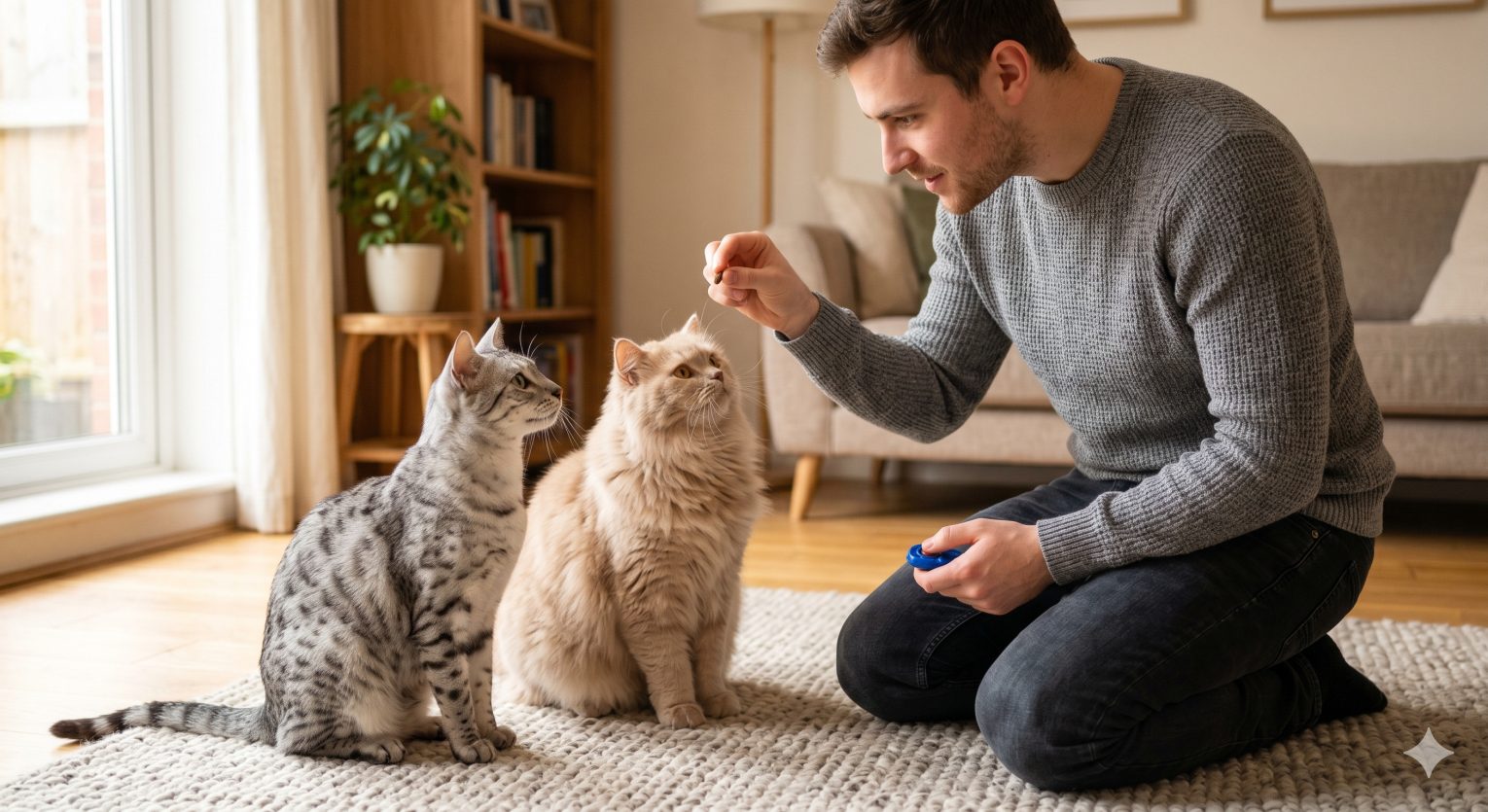
Cat training works through positive reinforcement — a precise marker, an immediate high-value reward, and sessions short enough to end before the cat loses interest. Unlike dogs, cats are not motivated by pleasing their owner. They are motivated by what is in it for them — which means the trainer’s job is to make the right behavior consistently worth the cat’s effort. Every behavioral challenge covered in this guide, from furniture scratching to litter box avoidance, follows the same principle: understand the biological drive, redirect or reinforce appropriately, and build the desired behavior through consistent reward.
Cats are widely misunderstood as untrainable. The reality is that cats respond excellently to training when the approach respects their biology. A cat that scratches furniture is not being destructive — they are meeting a genuine need in the wrong location. A cat that bites during petting is not being aggressive — they have reached their stimulation threshold and signaled it. This guide covers the biological reality of feline behavior and gives you the practical tools to work with it.
Table of Contents
📰 Rule Out Medical Issues: Before addressing any behavioral challenge in this guide, one step comes first. The Cornell Feline Health Center—one of the most authoritative voices in feline medicine globally—consistently notes that what appears to be a stubborn behavioral problem is frequently a hidden medical condition. Conditions like feline lower urinary tract disease (FLUTD), arthritis, and hyperthyroidism can dramatically alter a cat’s behavior and will not respond to training until the underlying cause is treated. If your cat has developed a new behavioral issue suddenly—particularly inappropriate elimination or unprovoked aggression—consult your veterinarian before beginning any behavioral modification plan.
The Foundation: How Cats Actually Learn
Before addressing any specific behavior, it helps to understand how cats process and retain new information — because this determines which approaches work and which do not.
🐾 Cats Learn Through Consequences
Cats repeat behaviors that have been rewarding and reduce behaviors that have not — the same principle that underlies all animal learning. The critical variable is timing: a reward delivered within 2–3 seconds of a behavior teaches the cat that the behavior produced the reward. A reward delivered 10 seconds later teaches nothing meaningful about the preceding behavior.
This is why punishment after the fact is universally ineffective for cats — they cannot connect the punishment to an action that occurred even 30 seconds ago. It simply creates an association between the punishment and whatever is happening right now, which is almost always the owner’s presence.
🐾 Cats Are Not Motivated by Approval
The most important difference between training cats and training dogs is motivational. Dogs have co-evolved with humans to find human approval intrinsically rewarding — a word of praise or an enthusiastic response from their owner is genuinely motivating.
Cats have not made this evolutionary bargain. They respond to training when the reward is something they genuinely value — typically food, play, or access to something they want. The trainer’s primary job is identifying what that reward is for each individual cat, not choosing the “correct” training method.
🐾 Short Sessions, High Success Rate
Cats disengage from training sessions faster than dogs. A session that exceeds 5 minutes is almost certainly continuing past the cat’s genuine engagement window — which means the final minutes are either ignored or associated with frustration.
Two 3–5 minute sessions daily, with a high rate of successful repetitions and rewards, produces better results than one 20-minute session with mixed outcomes.
(🐈 Trainer’s Note: “I always ask owners to end sessions at their peak — while the cat is still engaged, before they walk away. A cat that ends a session by walking away has experienced the training ending on a neutral note at best. A cat that ends a session by receiving a final jackpot reward and then having training end remembers the session positively”—LovingPetsGuide Feline Behavior Advisor.)
📰 The Science-Backed Approach: The training methods in this guide align with the official position of the American Veterinary Society of Animal Behavior (AVSAB), whose Position Statement on Humane Training explicitly recommends behavioral modification focused on reinforcing desired behaviors—avoiding punishment-based methods entirely. The techniques also reflect the core competencies required by the International Association of Animal Behavior Consultants (IAABC) for their Certified Cat Behavior Consultant (CCBC) credential. When I researched this guide, searching PubMed for “feline positive reinforcement training” returned 11 peer-reviewed studies—including research conducted in shelter environments showing that cats trained with positive reinforcement display significantly lower stress markers and adapt to new environments faster than untrained cats.
Understanding Cat Body Language
Effective training requires reading your cat’s communication system — because every training session involves constant behavioral feedback that tells you whether to push forward, slow down, or stop entirely.
The Five Communication Channels
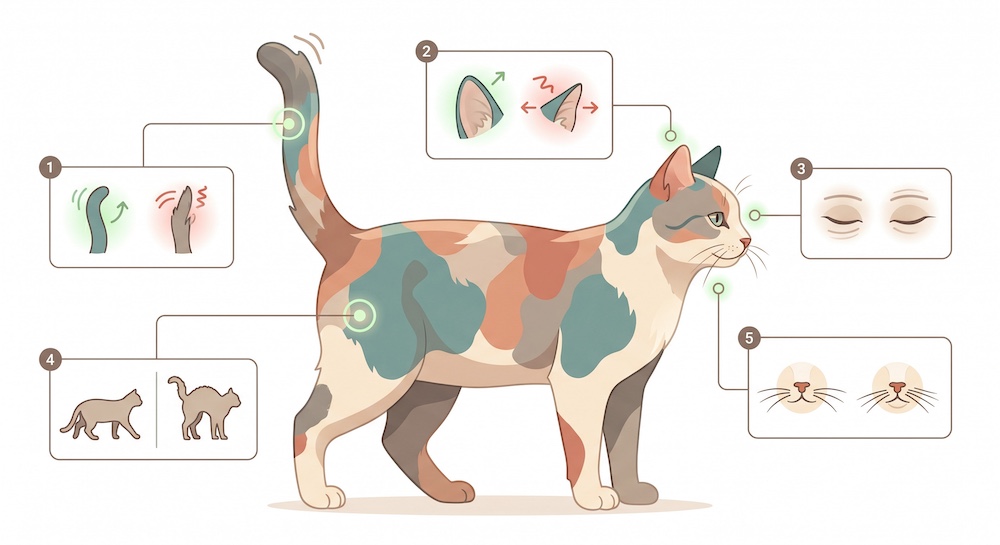
Cats communicate simultaneously through tail position, ear orientation, eye signals, body posture, and vocalization. Reading any single signal in isolation is unreliable — reading all five together gives an accurate picture of emotional state.
🐈 The signals every trainer must know:
| Tail lashing or thrashing: A rapidly moving tail during petting or training is a clear escalation signal — not happiness (as in dogs) but irritation. Stop what you are doing immediately. This signal precedes biting by seconds. |
| Ears rotating sideways: The first visible warning signal of overstimulation or discomfort. When ears begin to rotate from forward-facing to sideways, end the session or change what you are doing. |
| Slow blink: The clearest positive engagement signal. A cat that slow-blinks at you during training is communicating trust and comfort. Return the slow blink and continue. |
| Body tension: Muscles visibly tightening, hackles raising, or posture compressing toward the floor — all indicate stress. Back off or end the session. |
For the complete guide to every feline communication signal and its meaning in context, our cat body language guide covers the full vocabulary in detail.
The Core Behavioral Challenges
This section links to the complete guide for each major behavioral topic — with a summary of the key principle and the most effective first intervention for each.
🐾 Furniture Scratching
The biological reality: Scratching is a hardwired biological need — claw maintenance, full-body stretching, territorial marking, and stress relief. It cannot be eliminated. It can be redirected.
The single most effective intervention: Place a sisal scratching post of appropriate height (minimum 75 cm / 30 in) directly beside the furniture your cat currently scratches. Apply double-sided tape to the furniture corner simultaneously. Most cats redirect within days.
The most common mistake: Placing the post in an out-of-the-way location the cat rarely visits. Post location is as important as post quality — it must go where the cat already scratches.
👉🏼 Why does my cat scratch furniture and how to stop it — the complete guide with post selection, deterrent options, and the step-by-step redirection protocol.
🐾 Litter Box Problems
The biological reality: Cats are instinctively drawn to eliminate in loose substrate and bury their waste. When they stop using the litter box, something specific has changed — cleanliness, litter type, location, box size, health status, or negative association.
The critical first step: Always rule out a medical cause before any behavioral intervention. Urinary tract infections, feline idiopathic cystitis, and urinary blockages (a life-threatening emergency in male cats) all cause litter box avoidance. A cat straining with no output is a veterinary emergency — act immediately.
The most effective setup: One litter box per cat plus one extra. Fine-grained unscented clumping litter. Box sized at 1.5 times the cat’s body length. Quiet location with multiple exit routes. Scooped at least twice daily.
👉🏼 Litter box training and troubleshooting — causes, solutions, and the complete multi-cat litter box setup guide.
🐾 Cat Biting and Aggression
The biological reality: Cat biting is not random or malicious. Every bite has a specific cause: petting-induced overstimulation, play aggression from hand-play habits, redirected arousal from an external trigger, fear-based defense, or territorial assertion. Each type has distinct warning signals and a distinct solution.
The universal first principle: Learn the pre-bite warning signals — tail lashing, ear rotation, skin rippling, body tension — and stop what you are doing at the first signal. Prevention is significantly more effective than correction after the fact.
The single most important rule: Never use hands as toys. Play aggression in adult cats almost always traces back to hand play during kittenhood. Wand toys and toy mice redirect the prey drive to appropriate targets.
👉🏼 How to stop cat biting and aggression — the complete guide to every type of feline aggression with specific protocols for each.
🐾 Introducing a New Cat
The biological reality: Cats are territorial semi-solitary animals. An unfamiliar cat entering their territory is a threat by default. There is no feline equivalent of meeting a friend — the initial assumption is always territorial challenge.
The core protocol: Safe room confinement (Week 1) → scent swapping (Week 2) → controlled visual contact through a barrier (Week 3) → supervised physical access (Week 4). Each stage builds on the previous one. Skipping stages is the single most common cause of lasting territorial conflict.
The most important patience point: Two weeks of careful introduction prevents two months of territorial conflict. It feels slow. It is worth every day.
👉🏼 How to introduce a new cat to your home — the complete week-by-week introduction protocol for single and multi-cat households.
🐾 Clicker Training: Commands and Enrichment
The biological reality: Cats have the same cognitive need for problem-solving and mental challenge as any intelligent animal. A cat that receives regular training sessions shows lower cortisol levels, engages in less destructive behavior, and develops stronger trust in their owner.
Where to start: Charge the clicker (pair click with treat, 20 repetitions) before any command training. Then begin with Sit — the simplest behavior to shape and the foundation every other command builds on.
The five most valuable commands: Sit, Come (recall), Touch (target), Carrier (go in), and Station (go to mat).
👉🏼 Can you train a cat — clicker training for beginners — the complete training guide with step-by-step instructions for all five commands.
📰 Carrier Training: Training your cat to enter their carrier voluntarily is one of the highest-return investments in feline wellbeing—a cat that enters calmly has a measurably lower stress response at the vet, which means more accurate health assessments and faster recovery. The Fear Free Pets initiative, dedicated specifically to preventing fear, anxiety, and stress in veterinary settings, recommends the gradual desensitization approach described in this guide: carrier available year-round as a resting spot, high-value treats associated with entering, and no forced confinement until the cat enters voluntarily.
Solving Common Training Problems
“My cat loses interest immediately”
❗️The most common causes:
- Treat not high-value enough — try freeze-dried meat rather than standard treats.
- Training after meals — cats are least food-motivated when full. Train before meals.
- Sessions too long — 2–3 minutes is sufficient for a first session.
“My cat knows the command but sometimes ignores it”
This is a generalization problem — the cat has not learned the command applies in all contexts, only in the specific situation where they first learned it. Practice in different rooms, at different times of day, and at gradually increasing distraction levels.
“My cat is aggressive and can’t be trained”
Aggressive cats can be trained — and training is often the most effective tool for reducing aggression because it gives the cat control over an outcome, reducing the fear and stress that drives most feline aggression.
Start at a distance where the cat is comfortable, use very high-value treats, and keep sessions under 2 minutes initially. Progress is slow but consistent.
Building a Daily Training Routine
Consistency matters more than duration. Two 3-minute sessions daily produces faster results than one 20-minute session weekly.
Sample daily routine:
☀️ Morning (before breakfast):
- 3-minute session on established commands.
- Reward with a portion of the morning meal in the training area.
🌙 Evening (before dinner):
- 3-minute session introducing or reinforcing a new behavior.
- Reward with a portion of the evening meal.
🗓️ Weekly progression:
- Week 1: Charge clicker + Sit.
- Week 2: Add Come + Touch.
- Week 3: Add Carrier training + Station.
- Week 4+: Build distance, duration, and distraction on all established commands.
The Role of Enrichment in Behavior
Training addresses the cognitive need directly. Environmental enrichment addresses the ongoing background need for stimulation that prevents problem behaviors from developing.
Most effective enrichment strategies:
| Puzzle feeders: Feed at least one meal per day from a puzzle feeder rather than a bowl. Cats that work for food are mentally stimulated in a way that reduces boredom-driven behaviors like furniture destruction and over-grooming. |
| Wand toy sessions: 10–15 minutes of interactive wand toy play per day satisfies the predatory behavior sequence (stalk, chase, catch, kill) that cats cannot complete with static toys. This is one of the most significant interventions for cats with play aggression problems. |
| Vertical space: Cat trees, shelves, and window perches expand the total available territory without requiring more floor space. Cats with adequate vertical territory show lower territorial tension, particularly in multi-cat households. |
| Window access: A secure window perch with a view of outdoor movement (birds, other animals) provides passive mental stimulation for indoor cats throughout the day. |
When to Seek Professional Help
Most feline behavioral problems are resolvable with the approaches in this guide and our linked cluster articles. Seek professional help when:
- A cat has not eaten for 48+ hours due to stress from a behavioral or environmental issue.
- Physical injuries from inter-cat conflict.
- Aggression that has caused injury to a person.
- Behaviors that persist unchanged despite 6+ weeks of consistent, correctly applied intervention.
- Sudden behavioral changes in an adult cat with no obvious environmental trigger (always rule out medical causes first).
A certified cat behavior consultant (CCBC through IAABC) or veterinary behaviorist can provide individualized assessment and intervention plans for cases that do not respond to general guidance.
Conclusion: Training Is Communication
Every technique in this guide comes back to one principle: understanding what your cat is trying to communicate and responding in a way that works with their biology rather than against it.
A cat that scratches furniture is communicating a biological need. A cat that avoids the litter box is communicating that something has changed. A cat that bites during petting is communicating that their threshold has been crossed. None of these are problems with the cat. They are information — and information has solutions.
The cats that are genuinely difficult to live with are not bad cats. They are cats whose communication has been consistently misread, responded to with the wrong approach, or whose environment does not meet their biological needs. Addressing the root of the behavior — rather than the surface symptom — is the only approach that produces lasting results.
Key takeaways:
- ✅ Cats learn through consequences — timing is everything.
- ✅ Cats are not motivated by approval — find their genuine motivator.
- ✅ Short sessions with high success rates beat long sessions.
- ✅ Every behavioral problem has a biological root.
- ✅ Body language is the most honest feedback system available.
- ✅ Punishment is universally ineffective.
- ✅ The right intervention addresses the cause, not the symptom.
Complete Cat Training Resource Library
| Topic | What You Will Learn |
|---|---|
| 📖 Cat body language guide | Every tail, ear, eye, and posture signal — what your cat is telling you right now. |
| 📖 Why does my cat scratch furniture | The biology of scratching and the step-by-step redirection protocol. |
| 📖 Litter box training and troubleshooting | Every cause of litter box avoidance and the solution for each. |
| 📖 How to stop cat biting and aggression | Five types of cat aggression with specific protocols for each. |
| 📖 How to introduce a new cat to your home | The week-by-week safe introduction protocol for single and multi-cat households. |
| 📖 Can you train a cat — clicker training | How to start clicker training from scratch with the five most useful commands. |

🐈 Browse cat food, treats, toys, health products, supplements, litter and everything else your cat needs 🐾

🐈 Browse raw cat food, freeze-dried meals, toppers and natural treats from Indiana farms 🐾

🐈 Browse cat food, treats, veterinary diets, supplements and everything else your feline needs 🐾
(This post contains affiliate links. If you purchase through our links, we may earn a small commission at no extra cost to you. This never influences our editorial opinions.)
FAQ: Cat Training Guide
Can any cat be trained, regardless of age or history?
Yes — cats of any age and any background can be trained using positive reinforcement. Senior cats learn more slowly than kittens but retain new behaviors reliably. Rescue cats with unknown histories or trauma backgrounds may take longer to build the trust necessary for training engagement but respond well once that trust is established. The training protocol adapts to the individual cat’s pace — there is no minimum confidence or socialization level required to begin.
How long does it take to see results from cat training?
For command training (Sit, Come), most cats show a reliable response within 5–10 short sessions — often within the first week of daily training. For behavioral modification (redirecting scratching, resolving litter box problems, managing aggression), results typically emerge within 2–4 weeks of consistent, correctly applied intervention. Medical causes of behavioral problems resolve more quickly once the underlying condition is treated.
Do I need any special equipment to train a cat?
The minimum equipment is a clicker (or a consistent verbal marker) and high-value treats. A clicker costs very little and can be sourced from any pet store. Everything else — wand toys, scratching posts, puzzle feeders — supports the training but is not required to begin. Start with what you have and add tools as the training progresses.
My cat is very independent and doesn’t seem to want to interact. Can I still train them?
Independent cats can be trained — the approach simply requires patience and a willingness to let the cat set the pace. Rather than approaching the cat and initiating training, leave high-value treats in locations the cat visits naturally. Over days, the cat begins approaching you in anticipation of rewards — and from there, formal training can begin in short, cat-initiated sessions. Never force proximity with an independent cat during early training.
Should I train my cat alone or can other family members participate?
Multiple family members can participate in training — but consistency is essential. Everyone must use the same cue words, the same marker, and the same reward protocol. A cat that hears “Sit” from one person and “Sit down” from another, with different treat timings from each, will learn more slowly than a cat trained by one consistent person. Establish the protocol first with one person, then bring in others once the basics are reliable.
How do I know if my cat’s behavior problem is medical or behavioral?
The clearest indicator is onset pattern. Sudden behavioral changes in a cat with a previously stable behavioral history almost always have a medical component — particularly for behaviors involving elimination, eating, grooming, or aggression. Gradual behavioral changes that correlate with environmental shifts (new pet, new person, moved house, changed routine) are more likely to be behavioral. When in doubt, a veterinary assessment is always the right first step — treating a behavioral problem as medical wastes time but causes no harm. Treating a medical problem as behavioral causes the condition to progress without treatment.