
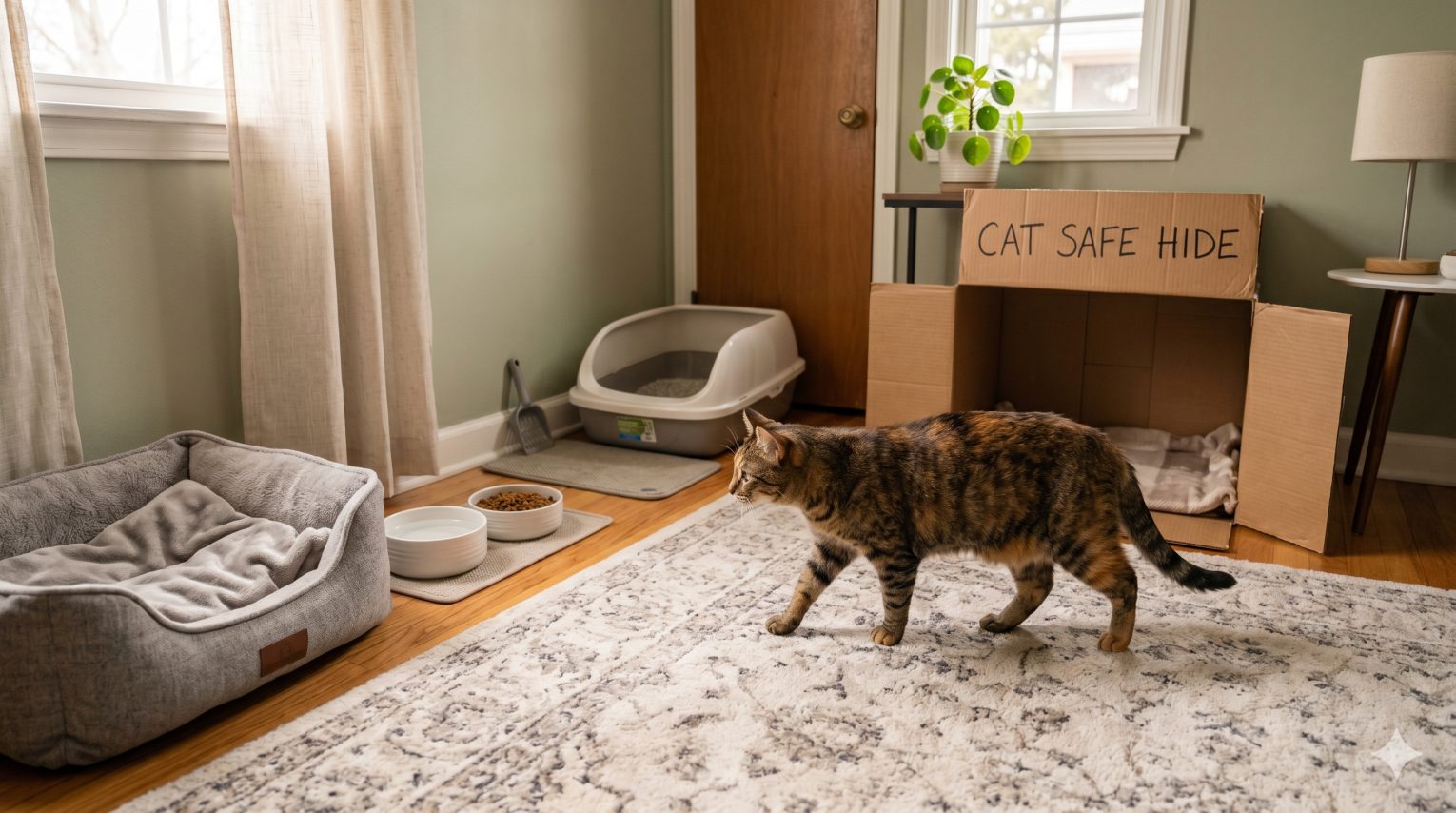
Introducing a new cat to your home safely requires a minimum of 2–3 weeks using the safe room method: confine the new cat to a single room for 7–14 days, allow scent exchange through the door before any visual contact, then progress through controlled visual meetings before allowing unsupervised access. Rushing this process is the single most common cause of lasting territorial conflict between cats.
Cats are not naturally social animals in the way dogs are. They do not instinctively welcome new companions — they perceive them as territorial intruders. A successful multi-cat introduction works with this reality rather than against it, building familiarity gradually through scent before sight, and sight before contact. Every week of patient introduction reduces the likelihood of months of territorial conflict later.
The introduction process draws on fundamental feline behavioral principles — territorial communication, stress signals, and positive association training. Our cat training guide covers the behavioral foundations that make this process work before you begin.
(💡 The safe room is not a punishment, it is a decompression space that gives the new cat time to feel secure before facing the wider world.)
Table of Contents
Why Cat Introductions Require a Process
Understanding cat territorial biology makes the introduction process make sense rather than feel arbitrary.
| Cats are territorial semi-solitary animals: In the wild, cats maintain exclusive or semi-exclusive territories marked with scent — facial pheromones, scratch marks, urine. An unfamiliar cat entering that territory is a threat by default. There is no natural feline equivalent of “meeting a friend” for the first time — the initial assumption is always territorial challenge. |
| Scent is the primary trust-building tool: Cats gather most of their environmental information through smell. Before a cat can begin to accept another cat’s presence, they first need to process their scent in a non-threatening context — separate, without the stress of visual or physical presence. |
| Rushing causes lasting damage: A forced face-to-face meeting without prior scent introduction almost always results in hissing, chasing, or fighting. The resulting fear and stress responses can take weeks or months to reverse — and in some cases, the cats never recover to peaceful coexistence. |
The 2–4 week process described in this guide is the minimum for a reliable outcome. It feels slow. It is worth every day.
(🐈 Trainer’s Note: “The most common call I receive about multi-cat households is from owners who introduced their cats ‘and it went terribly’ — and in almost every case, they skipped the scent phase and put the cats together within the first few days. Four weeks of patience prevents four months of conflict”—LovingPetsGuide Feline Behavior Advisor.)
Before the New Cat Arrives: Setup
The Safe Room
Choose a room that will be the new cat’s exclusive territory for the first 1–2 weeks. A spare bedroom, bathroom, or office works well.
✅ The safe room must contain:
- Litter box (one — in the far corner from the food and water).
- Food and water bowls.
- A comfortable bed or padded surface.
- At least one hiding spot—a cardboard box, a covered bed, or a space under the furniture is sufficient.
- A scratchable surface—cardboard scratcher or small sisal post.
- A window if possible—visual access to the outside world reduces stress.
❌ What the safe room must not have:
- The resident cat’s resources (food, bed, litter box).
- Free access for the resident cat.
Resource Preparation
Before the new cat arrives, prepare your home for eventual multi-cat living:
The N+1 rule: One litter box per cat plus one extra. Adding a second cat = minimum three litter boxes.
Separate feeding stations: Cats should not have to share food and water bowls — even cats that eventually get along do better with separate stations in separate locations.
Vertical space: Cat trees, shelves, and elevated surfaces dramatically increase the total available territory in a multi-cat home. A cat that can claim vertical space has more territory available without competing with another cat for the same floor space.
For our complete guide to litter box setup in multi-cat households, see our litter box training and troubleshooting guide.
The Introduction Process: Week by Week
🗓️ Week 1: Confinement and Decompression
Goal: The new cat feels safe in the safe room. The resident cat knows something has changed but has not had a threatening encounter.
❔What to do:
- Confine the new cat exclusively to the safe room. The door stays closed.
- Spend time with the new cat in the safe room each day — sitting on the floor, allowing them to approach on their terms.
- Continue the resident cat’s normal routine completely — same feed times, same play sessions, same sleeping arrangements.
- Allow both cats to sniff under the door at their own pace. Do not force either cat toward the door.
❔What to expect:
- New cat: likely hiding for the first 1–3 days. This is normal decompression behavior, not a sign of a problem. A cat that hides is not ill — they are processing a significant change.
- Resident cat: likely sniffing the door, possibly hissing at it. This is also normal — they are acknowledging the new presence.
When to move to Week 2: Both cats are showing relaxed body language in their respective spaces — eating normally, grooming, sleeping. The new cat is approaching you voluntarily in the safe room.
🗓️ Week 2: Scent Swapping
Goal: Both cats become familiar with the other’s scent before any visual contact.

Scent swapping works because cats process social information primarily through smell—a cat that eats calmly next to another cat’s scent has already begun building positive association before any visual or physical contact occurs. Placing the scent item near the food bowl is deliberate: the cat’s brain links the unfamiliar smell with the reliable pleasure of mealtime, which is the fastest route to neutral acceptance.
(💡 Scent before sight—the most important principle in feline introductions. A cat that eats comfortably near the other cat’s scent is ready for visual contact.)
Scent swapping technique:
| Method 1 — Bedding exchange: Take a blanket or soft item from each cat’s sleeping area and place it near (not in) the other cat’s food bowl. The association between the unfamiliar scent and something positive (food) builds positive association. |
| Method 2 — Sock rubbing: Take a clean soft sock and rub it gently along one cat’s cheeks and forehead (collecting facial pheromones). Then place the sock near the other cat’s food bowl. Repeat in both directions daily. |
| Method 3 — Room swap: Briefly swap the cats between spaces — allow the new cat into the main living area for 15–20 minutes while the resident cat is confined to the safe room. Each can investigate the other’s territory through scent with no risk of encounter. |
Signs the scent swap is going well:
- Cats sniff the scent item and then walk away calmly.
- Cats rub against the scent item (positive response).
- No hissing, growling, or aggressive response to the scent.
Signs to slow down:
- Either cat hisses or shows aggressive response to scent items.
- Either cat stops eating when scent items are present.
- Either cat shows significant stress signals (hiding more, not eating, over-grooming).
If aggressive responses to scent occur, return to Week 1 protocols for several more days before trying again.
🗓️ Week 3: Controlled Visual Contact
Goal: Both cats see each other without a threatening encounter.
The visual barrier technique: Replace the safe room door with a baby gate or crack the door open enough for visual contact but not physical access. Alternatively, use a tall baby gate that the cats cannot easily jump over.
❔What to do during visual sessions:
- Feed both cats near the barrier simultaneously—one on each side. The positive association of food during visual contact accelerates acceptance significantly.
- Keep sessions short initially — 5–10 minutes — and increase duration as both cats remain calm.
- Stay present during all visual sessions. Do not leave them unsupervised with visual access until both are consistently relaxed.
⚠️ Body language to watch for:
Positive signs:
- Both cats eating normally near the barrier.
- Slow blinks from either cat.
- One cat moving away from the barrier voluntarily (not fleeing—just uninterested).
- Relaxed tail positions.
Warning signs—slow down:
- Either cat stops eating when they see the other.
- Sustained hissing, growling, or focused hard staring.
- Puffed tails or arched backs.
- Either cat fixating on the barrier and refusing to eat.
If warning signs appear consistently, return to scent swapping for another week before trying visual contact again.
🗓️ Week 4: Supervised Physical Access
Goal: Both cats share the same space under supervision without conflict.
How to begin: Open the door or gate for short supervised sessions — 15–30 minutes initially.
Setup for the first meeting:
- Create multiple escape routes—no corners where a cat could be trapped.
- Have vertical spaces available—cat trees or shelves the cats can climb to create distance.
- Remove particularly high-value resources (favorite beds, toys) to reduce guarding triggers.
- Have a thick blanket or cardboard barrier available to separate cats quickly if needed — do not use hands to separate fighting cats.
❔What to expect:
- Hissing and growling are normal and acceptable during early physical access—this is communication, not combat.
- One cat chasing the other briefly is concerning but not always a sign of failure—watch whether the chased cat has escape routes and whether the chasing stops quickly.
- Sustained chasing, cornering, or physical contact with injury are signs to separate immediately and return to Week 3.
When to allow unsupervised access: Only when both cats can spend 30+ minutes in the same room without sustained aggression — when they are able to exist in the same space, even if they are not interacting positively.
Do not rush this step. Two weeks of supervised access is normal. Some cat pairs need a month.
Managing Multi-Cat Tension Long-Term
Even successfully introduced cats can develop tension weeks or months later — particularly when resources become a competition point.
The most reliable long-term strategies:
| Separate resource stations: Every cat should have their own food bowl, water source, and litter box in separate locations. Guarding behavior at resources is the most common source of inter-cat tension after a successful introduction. |
| Vertical territory: A home with cat trees, window perches, and accessible shelving gives each cat vertical territory that does not directly compete with the other. A cat that can claim a high shelf owns a territory the other cat cannot easily challenge. |
| Pheromone diffusers: Feliway MultiCat diffusers release synthetic feline facial pheromones that reduce territorial tension in multi-cat households. Not a substitute for a proper introduction process but a useful support tool — particularly during the first 4 weeks. |
| Playtime separation: Play sessions with each cat individually prevent resource competition around toys and avoid arousal states that can trigger redirected aggression. |
Introducing a Cat to a Dog
The same core principles apply — safe room, scent swapping, controlled visual contact, supervised physical access — with one important additional consideration:
Dogs require leash control during all physical access sessions. A dog that lunges or chases a cat during the first physical meeting can create a fear-based response that takes months to overcome. Even a dog that is not aggressive can frighten a cat significantly with normal dog enthusiasm.

Additional steps for cat-dog introductions:
- Ensure the cat always has a dog-free zone they can access at all times.
- Train a reliable “Leave It” and “Down-Stay” before introducing physical access.
- Feed the dog before meetings—a calmer dog means a more positive first impression.
- Allow the cat to approach the dog and retreat freely—never force proximity.
(💡 Leash control is non-negotiable during cat-dog introductions—a single lunge from an enthusiastic dog can create a fear response that takes months to undo.)
For dog-specific training commands that help manage cat-dog introductions, see our complete dog training guide.
When to Seek Help
Some cats do not successfully integrate regardless of how slowly the process is managed. 🚨 Signs that professional help is warranted:
- Either cat has stopped eating for more than 48 hours due to stress from the introduction process.
- Physical injuries from fighting.
- One cat is completely unable to use litter boxes, eat, or sleep normally due to the presence of the other cat.
- After 8+ weeks of slow introduction, sustained aggression persists every time the cats encounter each other.
A veterinary behaviorist can assess whether the cats are compatible and design a more intensive desensitization program for difficult cases.
Conclusion: Patience Is the Entire Strategy
Every day of a slow introduction is a day the cats are building a scent-based familiarity that reduces the threat perception from both sides. Every week cut short is a week of territorial mapping that did not happen — and territorial conflicts that could have been avoided.
The cats that share homes peacefully are almost always the cats whose owners gave the introduction 3–4 weeks rather than 3–4 days.
Key takeaways:
- ✅ Minimum 2–3 weeks for any introduction.
- ✅ Safe room for week 1 — complete separation.
- ✅ Scent swapping before any visual contact.
- ✅ Feed both cats near the barrier during visual sessions.
- ✅ Never force physical proximity.
- ✅ One litter box per cat plus one extra.
- ✅ Hissing and growling are communication, not failure.
- ✅ Vertical space dramatically reduces territorial tension.
👉🏼 Cat Training Guide — behavioral foundations for multi-cat households.
👉🏼 Cat Body Language Guide — reading the stress and acceptance signals during introductions.
👉🏼 Litter Box Training and Troubleshooting — multi-cat litter box setup.
👉🏼 How to Stop Cat Biting and Aggression — managing territorial aggression if it develops.

🐈 Browse cat food, treats, toys, health products, supplements, litter and everything else your cat needs 🐾

🐈 Browse raw cat food, freeze-dried meals, toppers and natural treats from Indiana farms 🐾

🐈 Browse cat food, treats, veterinary diets, supplements and everything else your feline needs 🐾
(This post contains affiliate links. If you purchase through our links, we may earn a small commission at no extra cost to you. This never influences our editorial opinions.)
FAQ: How to Introduce a New Cat to Your Home
How long does it take to introduce a new cat to a resident cat?
The minimum reliable introduction timeline is 2–3 weeks using the safe room and scent swapping process. Some cat pairs — particularly adult cats with established territorial behavior — need 4–6 weeks before unsupervised access is appropriate. Kittens typically integrate faster than adult cats, and adult cats integrating with senior cats often need more time. There is no upper limit on how long to take — only a lower one.
My new cat hides constantly. Is this normal?
Yes — hiding is the most common initial behavior in a new cat and is a healthy stress response, not a sign of illness or trauma. Most cats hide for the first 1–5 days in a new environment as they process the new smells, sounds, and space. As long as the cat is eating (even if at night when they feel safer), drinking, and using the litter box, they are adjusting normally. If hiding persists beyond 5–7 days with no improvement and the cat is not eating, a veterinary check is appropriate.
My resident cat is hissing at the door. Is this a problem?
No — hissing at a closed door is normal and expected territorial communication. The resident cat is acknowledging the new presence and expressing their initial response to it. As long as the hissing is at the door rather than escalating into other stress behaviors (not eating, not using the litter box, hiding excessively), this is the introduction working as intended. The hissing typically reduces as scent swapping builds familiarity.
Can I speed up the introduction process?
You can allow the process to progress at the cats’ pace — which may be faster than the timeline above if both cats show consistently relaxed body language sooner. What you cannot safely do is skip stages — scent before sight, sight before contact is the sequence that builds reliable positive association. Cutting from Week 1 to Week 3 because “they seem fine” is the most common cause of failed introductions. Progress when the behavioral signs indicate readiness, not when the calendar does.
My cats had one fight during their first unsupervised session. Do I need to start over?
One fight does not necessarily mean the introduction has failed — it means the physical access was given before both cats were ready. Separate them immediately and return to supervised sessions only. The question is whether the fight was a brief altercation (one chase, no injuries, both cats settle quickly) or sustained combat. Brief altercations are a signal to slow down. Sustained fighting with injuries is a signal to return to full separation and contact a veterinary behaviorist.
How do I introduce a second cat to a home that already has two cats?
The same process applies — safe room, scent swapping with both resident cats, then gradual visual and physical access. The complexity increases because the new cat must process two resident cats’ scents and territories, and the two resident cats may also react to each other differently when a new animal is introduced. Allow more time — 4–6 weeks minimum — and monitor the resident cats’ relationship with each other alongside the new introduction.