
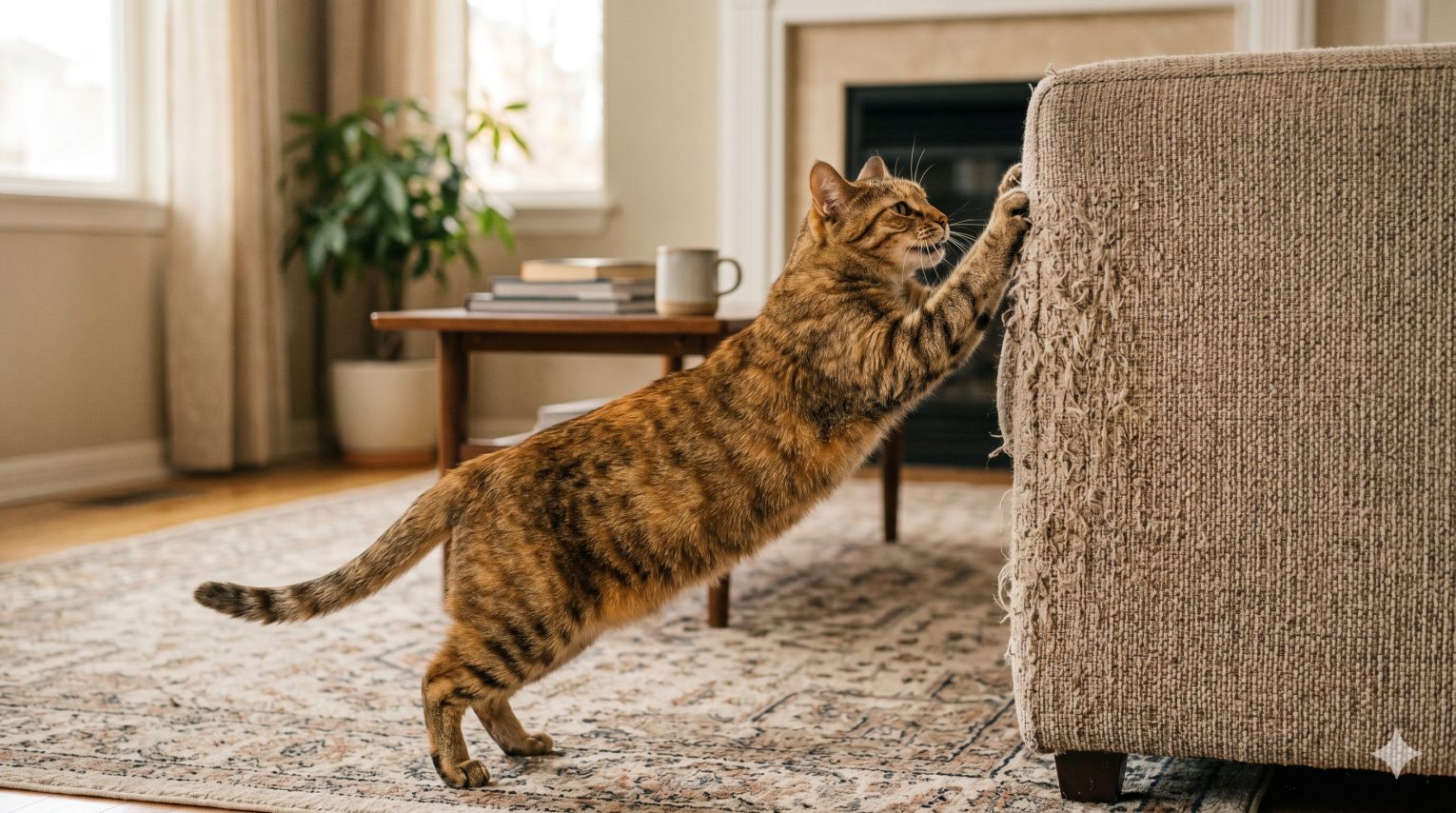
Cats scratch furniture because scratching is a hardwired biological behavior — not spite, boredom, or bad training. Every cat scratches to maintain claw health, stretch their muscles, mark territory visually and through scent glands in their paws, and release stress. The solution is never to stop scratching entirely — it is to redirect it to an appropriate surface through strategic placement of scratching posts and mild deterrents on the furniture itself.
Furniture scratching is one of the most common reasons cat owners surrender their pets to shelters — and one of the most preventable behavioral problems in feline care. The cats that scratch furniture are not problem cats. They are cats whose owners have not yet provided a scratching outlet that meets their specific preferences. This guide covers exactly how to identify what your cat wants and how to give it to them in the right place.
Scratching behavior is one part of a much larger picture of feline communication and training. For the complete guide to understanding and working with your cat’s natural behaviors — from body language to positive reinforcement training — our cat training guide covers everything before and beyond scratching.
Table of Contents
Why Cats Scratch: The Biology
Understanding why cats scratch is the essential first step — because the solution must address the underlying drive, not just block the behavior.
1. Claw Maintenance 🐾
Cats’ claws grow in layers — like an onion. Scratching removes the outer dead sheath of the claw, exposing the sharp new claw beneath. This is not the same as nail trimming. It is an essential grooming function that cats cannot perform any other way. A cat that cannot scratch will have overgrown, damaged claws — not well-behaved ones.
2. Muscle and Tendon Stretching 🐾
Watch your cat scratch — they dig in, lean back, and extend fully through their body. Scratching is a full-body stretch that works the muscles of the back, shoulders, and forelimbs. Cats typically scratch after waking, because it serves the same function as a human morning stretch after a night of stillness.
3. Territory Marking — Visual and Scent 🐾
Cats have scent glands in the pads of their paws. Scratching deposits their unique chemical signature on the scratched surface — invisible to humans but clear communication to other cats and, importantly, to the cat themselves. The visual marks left by scratching are equally important — a scratched surface is a visible territorial marker.
This is why cats often scratch in socially prominent locations: the corner of the most-used sofa, the doorframe, the area near the entrance. These are territorial communication points, not random choices.
4. Stress Relief and Emotional Regulation 🐾
Scratching releases endorphins and provides a physical outlet for frustration, excitement, or anxiety. Cats often scratch when overstimulated during play, when a new person or animal enters the home, or during routine stressful events like vet visits or changes to the household.
(🐈 Trainer’s Note: “Declawing was once promoted as the solution to furniture scratching. We now understand it as the amputation of the last bone of each digit — causing chronic pain, altered gait, and behavioral changes including increased biting. It is banned in many countries and strongly opposed by veterinary associations. Redirection is the only appropriate response to normal scratching behavior”—LovingPetsGuide Feline Behavior Advisor.)
📰 The AVMA (avma.org) officially states that it “strongly discourages” elective declawing, characterizing onychectomy as an amputation that may cause chronic pain, maladaptive behavior, and disability. The American Association of Feline Practitioners (AAFP) similarly “strongly opposes” declawing as an elective procedure, emphasizing that scratching is normal feline behavior requiring appropriate outlets rather than surgical prevention.
Why Your Furniture Specifically
If cats need to scratch and you have provided scratching posts, why does your cat still choose the sofa? The answer almost always comes down to one of these reasons:
| The post is in the wrong location: Scratching posts are often placed in out-of-the-way corners — laundry rooms, spare bedrooms, behind doors. But cats scratch in socially prominent locations. A post that is invisible and isolated will be ignored in favor of the sofa’s prime corner position. |
| The post is the wrong texture: Cats have strong texture preferences. Most cats prefer sisal rope or sisal fabric. Many commercial posts use carpet — which many cats find less satisfying, and which may actually encourage carpet scratching elsewhere. Observe what your cat is scratching: rough fabric (sisal-like) or soft fabric (carpet-like)? |
| The post is the wrong orientation: Some cats prefer vertical scratching (the full upright stretch). Others prefer horizontal surfaces (lying down to scratch). Most commercial posts are vertical — but if your cat scratches the carpet or low on furniture legs, they may prefer horizontal. |
| The post is not tall enough: A cat needs to fully extend to get the complete stretch benefit. Most budget posts are too short for a full-grown cat. The post must be at least as tall as your cat’s full length when stretched — typically 75–90 cm (30–36 in) for an adult cat. |
| The post is unstable: If the post wobbles when a cat leans into it, they will not use it. The base must be heavy enough to remain completely stable under full scratching pressure. |
The Redirection Strategy: Step by Step
Stopping furniture scratching requires two simultaneous actions: making the furniture less appealing and making the scratching post more appealing. Neither alone is sufficient.
Step 1: Choose the Right Scratching Post
🧵 Material:
- Sisal rope or sisal fabric — the gold standard. Most cats prefer the rough, satisfying drag of sisal over carpet or cardboard.
- Cardboard — horizontal scratchers love corrugated cardboard pads. Many cats that ignore vertical posts will use a horizontal cardboard scratcher enthusiastically.
- Wood — some cats, particularly those that scratch tree trunks outdoors, prefer rough natural wood surfaces.
📏 Height:
- Minimum 75 cm (30 in) for most cats.
- 90 cm (36 in) for large breeds (Maine Coon, Norwegian Forest Cat, Ragdoll).
⚓️ Stability:
- The base must be wide and heavy enough to stay completely still under full pressure.
- If it tips or wobbles when a cat first approaches — they will never use it.
🧭 Orientation:
- Offer both vertical and horizontal options initially — observe which your cat prefers.
🐾 Sisal Scratching Posts 🐾
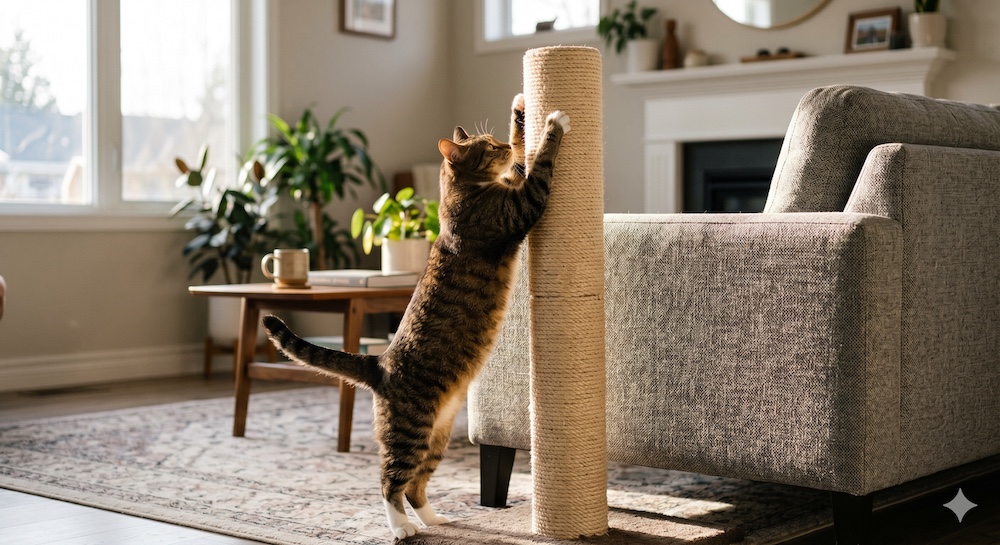
🧵 Tall Sisal Scratching Posts — Minimum 30 in (75 cm) for most cats, 36 in (90 cm) for large breeds like Maine Coons. Look for a wide, heavy base that stays completely stable under full scratching pressure — an unstable post is the fastest way to lose your cat’s interest.
Step 2: Place the Post Strategically
✅ The cardinal rule: Place the post WHERE your cat currently scratches, not where you would prefer them to scratch.
- If they scratch the sofa corner → post goes next to the sofa corner.
- If they scratch the doorframe → post goes beside the doorframe.
- If they scratch when they wake up from their favorite sleeping spot → post goes beside that sleeping spot.
✔️ Additional placement considerations:
- At least one post per floor of the home.
- Near entrance areas — high territorial significance for cats.
- In the main living area where the family spends time — not isolated in spare rooms.
Step 3: Make the Post More Attractive
Catnip: Rub dried catnip directly into the sisal of a new post. Approximately 50–70% of cats have a genetic response to catnip — for those that do, this dramatically accelerates initial post engagement.
Play near the post: Use a wand toy to play near and around the post — when a cat reaches up to bat at the toy, they often make contact with the post and discover the texture. Reward any contact with the post with play or treats.
Praise and reward: When your cat uses the post, mark the moment with a calm, positive verbal marker and offer a small treat. Do not make a dramatic fuss — calm positive reinforcement is more effective than over-excited celebration.
Step 4: Make the Furniture Less Appealing
While you are building the post habit, temporarily make the furniture surface less satisfying to scratch.
⚠️ Important: Deterrents alone do not solve the problem — they must be used alongside an attractive post in the right location. A cat blocked from their preferred spot without an alternative will simply find a new inappropriate surface.
(💡 Post placement next to the preferred furniture target — not across the room — is the single most important factor in successful redirection.)
Double-sided tape: Applied to the corners and edges of furniture, double-sided tape creates an unpleasant sticky sensation that most cats immediately dislike. This is the most effective temporary deterrent. Use product specifically designed for furniture to avoid damaging fabric.
Aluminum foil: Draped over furniture corners, foil creates an unpleasant sound and texture under claws. Effective but not aesthetically pleasant.
Commercial deterrent sprays: Citrus-based sprays applied to furniture can deter scratching — cats generally dislike citrus aromas. Reapply every 2–3 days as the scent fades.
🐾 Cat Scratch Deterrent Sprays 🐾
🍊 Citrus-Based Deterrent Sprays — Applied directly to furniture to make it less appealing while an alternative scratching post is being established nearby. Reapply every 2–3 days as the scent fades. Works best combined with a post, never as a standalone fix.
Furniture corner protectors: Clear plastic covers for furniture corners that remove the satisfying texture without altering furniture appearance.
What NOT to Do
| ❌ Never punish scratching: Punishing a cat for scratching — spray bottles, loud noises, physical correction — does not eliminate the drive to scratch. It teaches the cat to scratch when you are not present, makes them associate you with unpleasant experiences, and damages trust without changing behavior. |
| ❌ Never declawing: Declawing (onychectomy) involves the amputation of the last bone of each digit and causes chronic pain, behavioral changes, and gait abnormalities. It is banned in the UK, Europe, Australia, and many other regions. It is not a solution — it is a welfare issue. |
| ❌ Never isolate the scratching post: A post in the laundry room will never compete with the living room sofa. Location is as important as the post itself. |
| ❌ Never use punishment-based deterrents alone: Blocking access to furniture without providing an appropriate alternative simply moves the problem to a different piece of furniture. |
Nail Trimming: A Complementary Strategy
Regular nail trimming does not stop scratching but significantly reduces the damage when scratching does occur on inappropriate surfaces.
❔How often: Every 2–4 weeks for indoor cats.
❔How to trim:
- Gently press the paw pad to extend the claw.
- Trim only the transparent tip — avoid the pink quick (blood vessel).
- Use cat-specific nail clippers — human nail clippers crush rather than cut cleanly.
- One or two claws per session if your cat is resistant — build up gradually.
🐾 Nail caps (Soft Claws): Plastic caps glued over the claws prevent scratching damage entirely. They fall off naturally as the claw grows and need replacing every 4–6 weeks. Appropriate for cats with persistent furniture scratching while post training is established.
🐾 Soft Claws Nail Caps 🐾
🐾 Soft Claws Nail Caps — Plastic caps glued over the claws to eliminate scratching damage entirely while post training is being established. Fall off naturally as the claw grows; replace every 4–6 weeks. A practical bridge solution, not a substitute for redirection training.
When Scratching Increases Suddenly
If a cat that previously scratched appropriately suddenly increases furniture scratching, this often signals a change in their environment or emotional state:
- New person or animal in the household.
- Changes to routine or the owner’s schedule.
- A new piece of furniture that has an unfamiliar scent.
- Increased outdoor cat presence near windows (territorial stress).
- Medical issue causing discomfort (rare but possible — claw problems, paw pain).
Address the environmental cause while reinforcing the post through play and reward.
For more on how cats communicate stress and environmental changes through behavior, our guide to cat body language covers the full range of feline communication signals.
Conclusion: Redirection Always Wins
Furniture scratching is solved by meeting the biological need in the right place — not by eliminating the behavior. Every cat that scratches furniture can be redirected to a scratching post when the post is the right texture, the right height, in the right location, and introduced with the right positive reinforcement.
The process takes consistency — typically 2–4 weeks of parallel deterrent and post reinforcement before the post becomes the preferred choice. Most owners who have “tried everything” have simply used the wrong post in the wrong place.
Key takeaways:
- ✅ Scratching is biological — never try to stop it.
- ✅ Sisal rope or fabric is the preferred texture for most cats.
- ✅ Place the post WHERE they currently scratch.
- ✅ Post must be tall and completely stable.
- ✅ Use deterrents on furniture simultaneously.
- ✅ Reward post use with calm praise and treats.
- ✅ Never punish scratching — never declaw.
- ✅ Trim nails every 2–4 weeks to reduce damage.
📝 Editor’s Note: Declawing risks and veterinary consensus were verified against official AVMA and AAFP position statements. Catnip response rate and scratching post preference data reflect established feline behavior research.
👉🏼 Cat Training Guide — the complete guide to feline training and behavior.
👉🏼 Cat Body Language Guide — understanding what your cat is communicating through behavior.
👉🏼 How to Stop Cat Biting and Aggression — the other common feline behavioral challenge.
👉🏼 How to Introduce a New Cat to Your Home — managing territorial behavior during transitions.

🐈 Browse cat food, treats, toys, health products, supplements, litter and everything else your cat needs 🐾

🐈 Browse raw cat food, freeze-dried meals, toppers and natural treats from Indiana farms 🐾

🐈 Browse cat food, treats, veterinary diets, supplements and everything else your feline needs 🐾
(This post contains affiliate links. If you purchase through our links, we may earn a small commission at no extra cost to you. This never influences our editorial opinions.)
FAQ: Why Does My Cat Scratch Furniture?
Why does my cat scratch the sofa right in front of me?
Cats often scratch in the most socially prominent location in the home — the corner of the main sofa is a prime territorial communication point. Scratching in front of you is not attention-seeking or defiance — it is your cat marking the most important territory in their environment. Provide a post of equal or greater prominence in the same location and the behavior will shift to the post over time.
I bought a scratching post but my cat ignores it. Why?
The most common reasons a cat ignores a post are: wrong location (too far from where they actually scratch), wrong texture (carpet when they prefer sisal, or vice versa), too short (cannot achieve a full-body stretch), or unstable (wobbles under pressure). Address all four and most cats will begin using the post within days.
Should I spray my cat with water when it scratches the furniture?
No. Spray bottle punishment teaches a cat to scratch when you are not in the room — it does not address the underlying drive and damages your relationship. Cats associate the punishment with your presence, not with the act of scratching. Redirection and environmental management are significantly more effective and do not have these side effects.
My cat scratches horizontally on the carpet. What should I do?
Offer a horizontal scratching option — flat corrugated cardboard scratchers are inexpensive, widely available, and enthusiastically accepted by many horizontal scratchers. Place it where the carpet scratching currently happens. Most cats that ignore vertical posts will use a horizontal cardboard scratcher immediately.
Can I train my cat not to scratch at all?
No — and attempting to do so causes behavioral and health problems. Scratching is as fundamental to a cat’s biology as grooming or sleeping. The goal is always redirection to appropriate surfaces, not elimination of the behavior. Cats that cannot scratch appropriately will develop overgrown claws, experience increased stress, and often develop other behavioral problems as a consequence.
How long does it take to stop a cat from scratching furniture?
With the right post in the right location, combined with mild furniture deterrents, most cats shift their primary scratching to the post within 2–4 weeks. The key variable is post placement — a post directly beside the preferred furniture target works within days for most cats. A post across the room may never compete.