
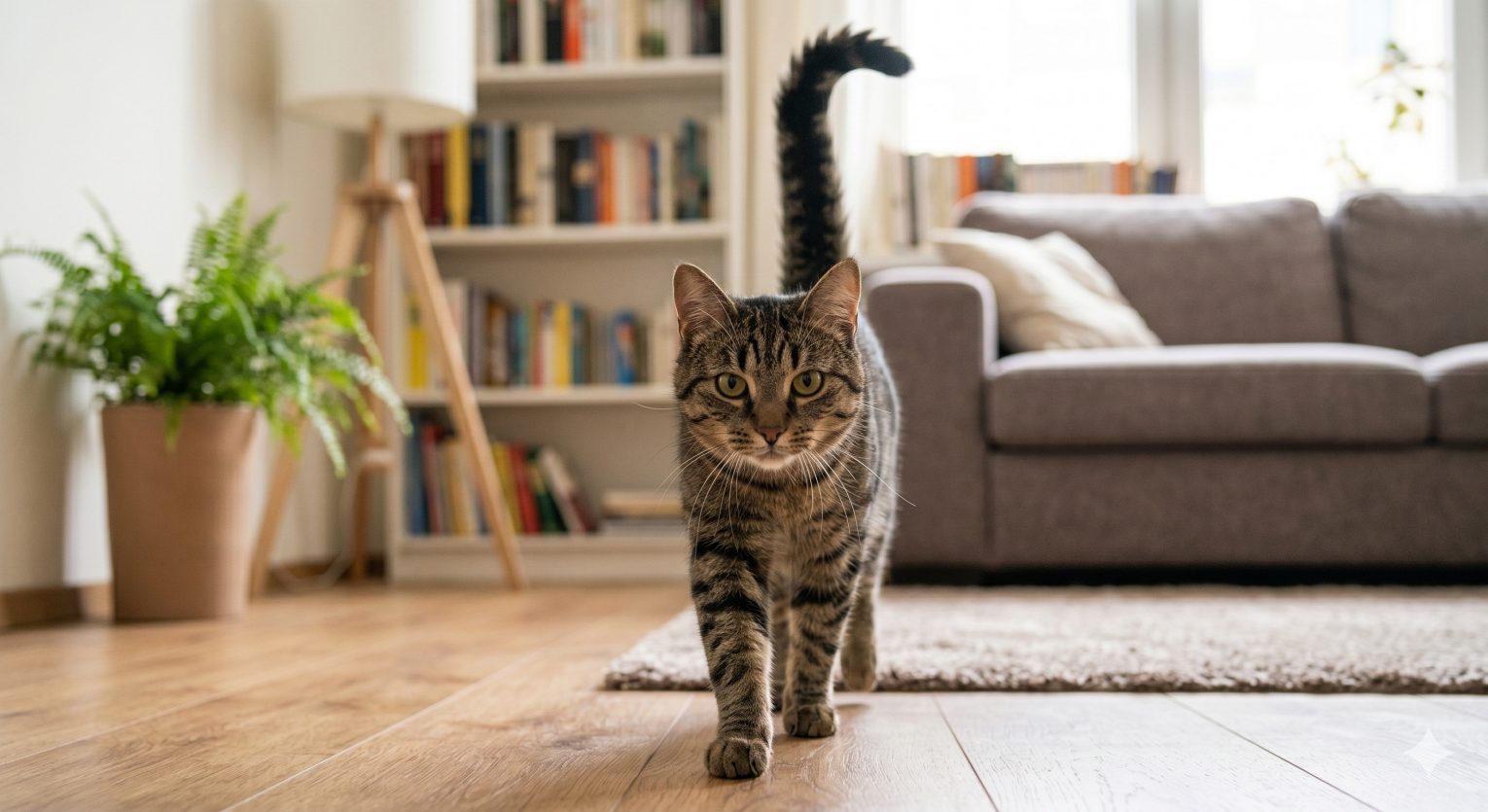
Cat body language communicates through five simultaneous channels: tail position, ear orientation, eye signals, body posture, and vocalizations — and understanding it requires reading all five together rather than any one in isolation. A tail held high signals confidence, but combined with a puffed coat and arched back it signals fear. A slow blink directed at you is one of the clearest expressions of trust a cat can offer. A belly display invites proximity but rarely actually invites touching.
Cats are often described as mysterious or unpredictable — but this reputation comes from humans misreading a communication system that is actually highly consistent and expressive. Once you understand the vocabulary, you will find your cat is communicating clearly and constantly. This guide covers every major body language signal and what it means in context.
Body language is the foundation of working with your cat — understanding what they are telling you makes training, handling, and daily interaction significantly more effective. Our cat training guide covers how to use this understanding in practical training and behavior management.
Table of Contents
Why Cats Communicate the Way They Do
Cats are a semi-solitary species that evolved without the pack social structure of dogs. Where dogs developed elaborate social communication because survival depended on group coordination, cats developed communication primarily for one-to-one interactions — with prey, rivals, and mates.
Interestingly, adult cats almost never meow at other cats. Vocalization in adult cats is largely a communication system developed specifically for interacting with humans — an adaptation that has evolved over thousands of years of domestication. Body language, by contrast, is the system cats use with each other and with humans when they choose precision over sound.
Understanding body language is therefore understanding the cat’s primary, most honest communication channel.
Tail Language: The Emotional Barometer
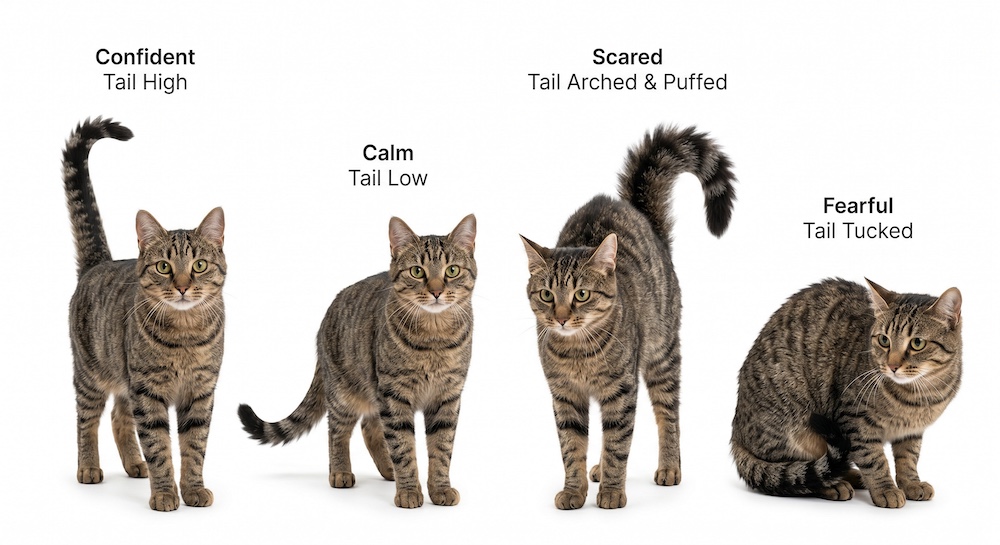
The tail is the most expressive single body part, it changes position rapidly in response to emotional state and provides the clearest single-signal indicator of what a cat is feeling.
(💡 Tail position changes within seconds in response to emotional state, it is the fastest and clearest communication signal cats have.)
Tail Up — Vertical or Near-Vertical 😺
❔What it means: Confidence, positive emotional state, openness to interaction, often greeting.
A tail held straight up is one of the clearest positive signals a cat gives. Cats approaching with tails up are greeting you warmly — it is the feline equivalent of a confident, friendly wave. A slight curve at the very tip of an upright tail signals particular affection.
In context with kittens: Kittens approach their mothers with tails up — bringing this behavior to their human relationships is a sign of trust and attachment.
Tail Horizontal or Slightly Lowered 😺
❔What it means: Neutral, relaxed, going about business with no strong emotional state.
A tail held out behind at approximately body height or slightly below indicates a cat in a calm, exploratory state — neither excited nor threatened.
Tail Low, Slow Movement 😼
❓What it means: Mild unease, caution, assessing a situation.
A tail hanging low but moving slowly from side to side indicates a cat that is watchful and uncertain — not aggressive, but not relaxed.
Tail Lashing or Thrashing 😼
❓What it means: Agitation, frustration, escalating arousal — a warning signal.
This is one of the most commonly misread cat signals. Many owners interpret a moving tail as a dog-like “wagging” expression of happiness. In cats, a rapidly moving or lashing tail is the opposite — a clear signal of mounting irritation. If you are petting a cat whose tail begins to lash or thrash, stop immediately. Biting or scratching will follow if you continue.
Tail Puffed (Bottlebrush) 😾
❓What it means: Fear, perceived threat, defensive arousal.
The hair on a puffed tail stands erect — this piloerection (same mechanism as human goosebumps) makes the cat appear larger. Combined with an arched back and lateral body presentation (sideways to the threat), this is full defensive threat display.
Do not approach or attempt to interact with a puffed-tail cat. Give them space to retreat and calm down.
Tail Tucked Under or Wrapped Around Body 😾
❓What it means: Anxiety, submission, discomfort.
A cat sitting with their tail wrapped tightly around their body or tucked between their legs is communicating anxiety or discomfort. Common in unfamiliar environments, during veterinary visits, or when a cat feels unable to retreat from a stressful situation.
Ear Language: Direction and Angle
Ears are highly mobile and change position rapidly. They work together with other signals to provide more precise emotional information.
Ears Forward — Facing Front 😺
❔What it means: Alert, interested, engaged, positive anticipation.
Forward-facing ears indicate a cat paying positive or neutral attention to something. Combined with upright posture and dilated pupils, it often signals excitement about something positive — prey movement, a toy, or an interesting sound.
Ears Sideways — “Airplane Ears” 😼
❓What it means: Irritation, mild anxiety, conflict — the early warning signal.
When ears begin to rotate sideways and flatten slightly, a cat is telling you they are uncomfortable with what is currently happening. This is the first warning before escalation. Stop whatever is causing the discomfort.
Ears Flat Back Against Head 😾
❓What it means: Fear or aggression — a serious warning.
Ears pinned completely flat against the skull indicate maximum threat response — either extreme fear or imminent aggression. Do not approach, do not reach out, do not make direct eye contact. Give the cat complete space and time to recover.
One Ear Forward, One Sideways 😼
❔What it means: Uncertainty, monitoring two different stimuli simultaneously.
This asymmetry indicates a cat tracking multiple things at once — often a sound in one direction while maintaining attention on something in front of them. It is not a concerning signal on its own.
Eye Language: Pupils and Blinks
Slow Blink 😺
❔What it means: Trust, relaxation, affection — the cat equivalent of a smile.
The slow blink is one of the most important signals in human-cat communication. A cat that slow-blinks at you is expressing profound comfort and trust in your presence. You can return the slow blink — research has shown that humans who slow blink back at cats increase the likelihood of the cat approaching and interacting with them.
How to slow blink: Make soft eye contact, then close your eyes slowly and fully, hold for a moment, then open slowly. Do not stare hard — soft, relaxed eyes work best.
📰 The bidirectional nature of slow blinking is documented in a 2020 study published in Scientific Reports by Humphrey et al. at the University of Sussex, which found that cats were significantly more likely to slow blink back at their owners after being slow blinked at, and were also more likely to approach an unfamiliar experimenter who had slow blinked at them compared to one who maintained a neutral expression. The researchers concluded this represents genuine two-way communication between cats and humans.
Dilated Pupils (Large, Round) 😼
❓What it means: Context-dependent — excitement, fear, or low light conditions.
Large pupils alone do not indicate emotional state — light level is the primary determinant of pupil size in all mammals. In adequate light, large pupils combined with puffed tail and flattened ears indicate fear. Large pupils combined with forward ears, upright posture, and play behavior indicate excited arousal. Read the pupils alongside other signals.
Constricted Pupils (Narrow Slit) 😾
❓What it means: In good light — contentment or intense focus. Combined with tense posture and direct stare — aggression.
A cat relaxed in good light will have narrow, slit-like pupils. A cat in tense, focused predatory or aggressive mode in good light will also have constricted pupils. Context determines meaning.
Hard Stare (Unblinking Direct Eye Contact) 😾
❓What it means: Challenge, threat, assertion.
In cat social communication, prolonged direct eye contact is a challenge or assertion of dominance — not a friendly gesture. A cat engaged in a hard stare with another cat is often on the verge of a confrontation. With humans, a cat staring hard without blinking is often communicating that they feel threatened or are asserting their personal space.
The appropriate response is to break eye contact — look away or slow blink.
Body Posture: The Full Emotional Picture
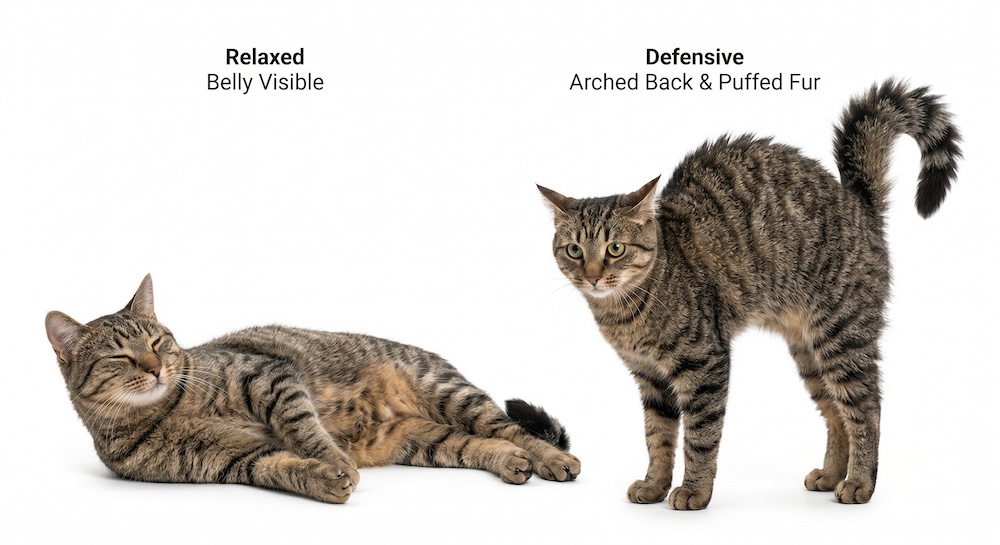
The difference between a cat that is safe to approach and one that needs space is written entirely in their posture — relaxed and low means comfort, tense and large means back off.
Reading these two states correctly prevents the vast majority of biting incidents that owners describe as coming out of nowhere.
Relaxed — Lying Stretched or Curled 😺
❔What it means: Complete safety and comfort.
A cat lying fully stretched out or curled in a tight ball with eyes partially or fully closed is expressing maximum trust in their environment. Exposing the belly (without rolling in invitation — just lying relaxed) indicates profound security.
The Belly Display — A Frequent Misread 😺
❔What it means: Trust and comfort — not necessarily an invitation to touch.
The belly is the most vulnerable part of a cat’s anatomy. A cat that rolls over and exposes their belly is expressing profound trust in your presence — they feel safe enough to reveal their most vulnerable area.
This is commonly misread as an invitation for a belly rub. For most cats, it is not. Reaching for the belly of a cat that has not specifically invited touch through slow-blinking and approaching you often results in the “love bite-and-grab” response — the cat grabs your hand and bites. This is not aggression — it is a predictable response to having their vulnerable area unexpectedly touched.
What to do: Accept the belly display as the compliment it is, without necessarily touching. Some cats do enjoy belly contact — but let the cat initiate and guide the duration, rather than assuming permission.
Arched Back — Lateral Presentation 😼
❓What it means: Defensive threat or playful pouncing, depending on context.
An arched back combined with sideways stance, puffed tail, and flattened ears is full defensive threat display — “I am making myself look larger because I feel threatened.”
An arched back during play, with relaxed tail and forward ears, is the playful pounce posture — a completely different context with a completely different meaning.
Loaf Position 😺
❔What it means: Relaxation, mild alertness, comfort.
The “loaf” — sitting with paws tucked under the body — indicates a cat that is relaxed but not deeply sleeping. They are comfortable enough to tuck in their paws but not committed to full sleep. A very common resting position in comfortable domestic cats.
Head Bunting and Rubbing 😺
❔What it means: Affection, ownership, social bonding.
When a cat presses their head or face against you — head bunting — they are depositing their facial pheromones and claiming you as part of their social group. This is a profoundly affectionate behavior expressing ownership in the most positive sense. Cats bunt on objects, other cats, and trusted humans.
Cheek rubbing along furniture, legs, or other surfaces is the same mechanism — marking familiar items with their scent, building a “home scent profile” that makes their environment feel safe.
Vocalizations: Sound as Body Language
Though we cover vocalizations briefly here, they are most meaningful when read alongside body language rather than in isolation.
| 🟢 🟠 Slow, rhythmic purring: Contentment, but also self-soothing during stress or pain. Purring is not exclusively positive — sick and injured cats also purr as self-comfort. |
| 🟠 Chirping or chattering: Directed at prey or birds outside the window — a frustrated predatory response to something they cannot reach. |
| 🟢 Trilling: A friendly, upward-inflected vocalization used for greeting — especially from mothers to kittens, and from cats to their trusted humans. |
| 🟠 Yowling: Territorial communication, mating calls (in intact cats), or distress — especially common in senior cats with cognitive dysfunction. |
| 🔴 Hissing and spitting: Clear threat signal — “do not approach me.” |
Reading the Complete Picture: Examples
| 🟢 The confident approach: Tail high, ears forward, slow blink as they approach → safe to pet, they are initiating friendly interaction. |
| 🟠 The overstimulation warning: Was purring during petting, then tail begins to lash, ears rotate sideways → stop petting immediately. Overstimulation is imminent. |
| 🔴 The fearful cat: Tail tucked, ears flat, pupils dilated, body low to the ground or pressed into a corner → do not approach. Give space and time. |
| 🟠 The territorial challenge: Hard stare, tail low and still, body tense and upright → break eye contact, move slowly, give the cat space to assert without confrontation. |
| 🟢 The trust signal: Cat approaches, slow blinks at you, then turns away and sits nearby → they are comfortable in your presence. Returning the slow blink reinforces the bond. |
Conclusion: A Language Worth Learning
Reading cat body language transforms your relationship with your cat from a series of mysterious reactions into a coherent, ongoing conversation. A cat whose communication you understand is a cat you can respond to appropriately — reducing their stress, building trust, and preventing the misunderstandings that lead to biting, scratching, and behavioral problems.
The vocabulary is not large. Tail up means confidence. Ears back means stop. Slow blink means trust. Belly display means comfort, not invitation. Tail lashing means stop now. Once these core signals become intuitive, everything else follows naturally from observation.
Key takeaways:
- ✅ Read five signals together: tail, ears, eyes, posture, vocalization.
- ✅ Tail high = confidence and friendly greeting.
- ✅ Tail lashing = stop what you are doing immediately.
- ✅ Slow blink = trust — return it.
- ✅ Belly display = trust, not touching invitation.
- ✅ Ears flat back = serious warning, give space.
- ✅ Hard stare = challenge — break eye contact.
📝 Editor’s Note: The slow blink research cited in this guide reflects the 2020 University of Sussex study published in Scientific Reports (Humphrey et al.). Piloerection (tail puffing) as an involuntary fear response reflects standard mammalian physiology, the same mechanism behind human goosebumps.
👉🏼 Cat Training Guide — using body language understanding in practical training.
👉🏼 How to Stop Cat Biting and Aggression — the body language signals that precede biting.
👉🏼 Litter Box Training and Problems — stress signals in body language that predict litter box issues.
👉🏼 Why Does my Cat Scratch Furniture — scratching as territorial communication.

🐈 Browse cat food, treats, toys, health products, supplements, litter and everything else your cat needs 🐾

🐈 Browse raw cat food, freeze-dried meals, toppers and natural treats from Indiana farms 🐾

🐈 Browse cat food, treats, veterinary diets, supplements and everything else your feline needs 🐾
(This post contains affiliate links. If you purchase through our links, we may earn a small commission at no extra cost to you. This never influences our editorial opinions.)
FAQ: Cat Body Language
Why does my cat show me their belly then bite me when I touch it?
The belly display is an expression of trust and comfort in your presence — not an invitation for touch. Cats protect their belly instinctively as their most vulnerable area. When you reach for it without explicit invitation (the cat approaching your hand, pressing into it, or rolling toward you), you are violating an area they have not offered for contact. The grab-and-bite response is a reflexive protective reaction, not aggression. Accept the belly display as the compliment it is without necessarily touching, and wait for the cat to guide contact on their terms.
What does it mean when a cat slow blinks at me?
A slow blink from a cat is one of the clearest expressions of trust and relaxed affection they can offer. In cat social communication, prolonged eye contact is a threat signal — so deliberately closing their eyes in your presence is an act of trust, communicating that they feel completely safe with you. Research published in Scientific Reports (2020) confirmed that cats are more likely to approach humans who return slow blinks, suggesting it is a genuine bidirectional communication signal. Return the slow blink — close your eyes slowly, hold briefly, open slowly.
Why does my cat’s tail puff up suddenly?
Tail puffing — piloerection — is an involuntary fear response. The muscles that control hair follicles contract, causing the hair to stand erect and the tail to appear larger. It happens when a cat perceives a sudden threat — an unexpected loud noise, an unfamiliar animal, a sudden movement. It is not controllable by the cat, similar to human goosebumps. Give the cat space and time to calm down. The tail will return to normal once the threat is processed.
My cat purrs while seeming uncomfortable. Is purring always positive?
No — purring is a self-regulatory vocalization that cats use for both contentment and self-soothing during stress, pain, or illness. Research suggests cats may purr to comfort themselves during uncomfortable situations, similar to a human humming or rocking. A cat at the vet, a cat in pain, and a cat that is dying may all purr. Read purring alongside body posture — a purring cat with relaxed body, slow blink, and soft eyes is content. A purring cat with tense body, tucked tail, and flat ears may be in distress.
Why does my cat stare at me without blinking?
Context determines meaning. A soft gaze with occasional slow blinks in a relaxed setting is affection and trust. A hard, unblinking stare with tense body posture is asserting personal space or expressing mild challenge — common when a cat feels their territory is being encroached upon. Break eye contact and move slowly — this de-escalates the situation without confrontation. If your cat regularly stares at you in a way that feels tense rather than affectionate, assess whether there have been changes to their environment or routine causing stress.
What does it mean when my cat brings me dead animals?
This is a prey-gifting behavior — cats bring prey (or prey-like toys) to members of their social group as a form of sharing or teaching. In the wild, mother cats bring prey to kittens. Domestic cats extend this to trusted humans. While not pleasant for the recipient, it is a genuine expression of affiliation and social bonding. Accept the gift calmly, dispose of it discreetly, and do not punish the behavior — it is a compliment, not a behavioral problem.