
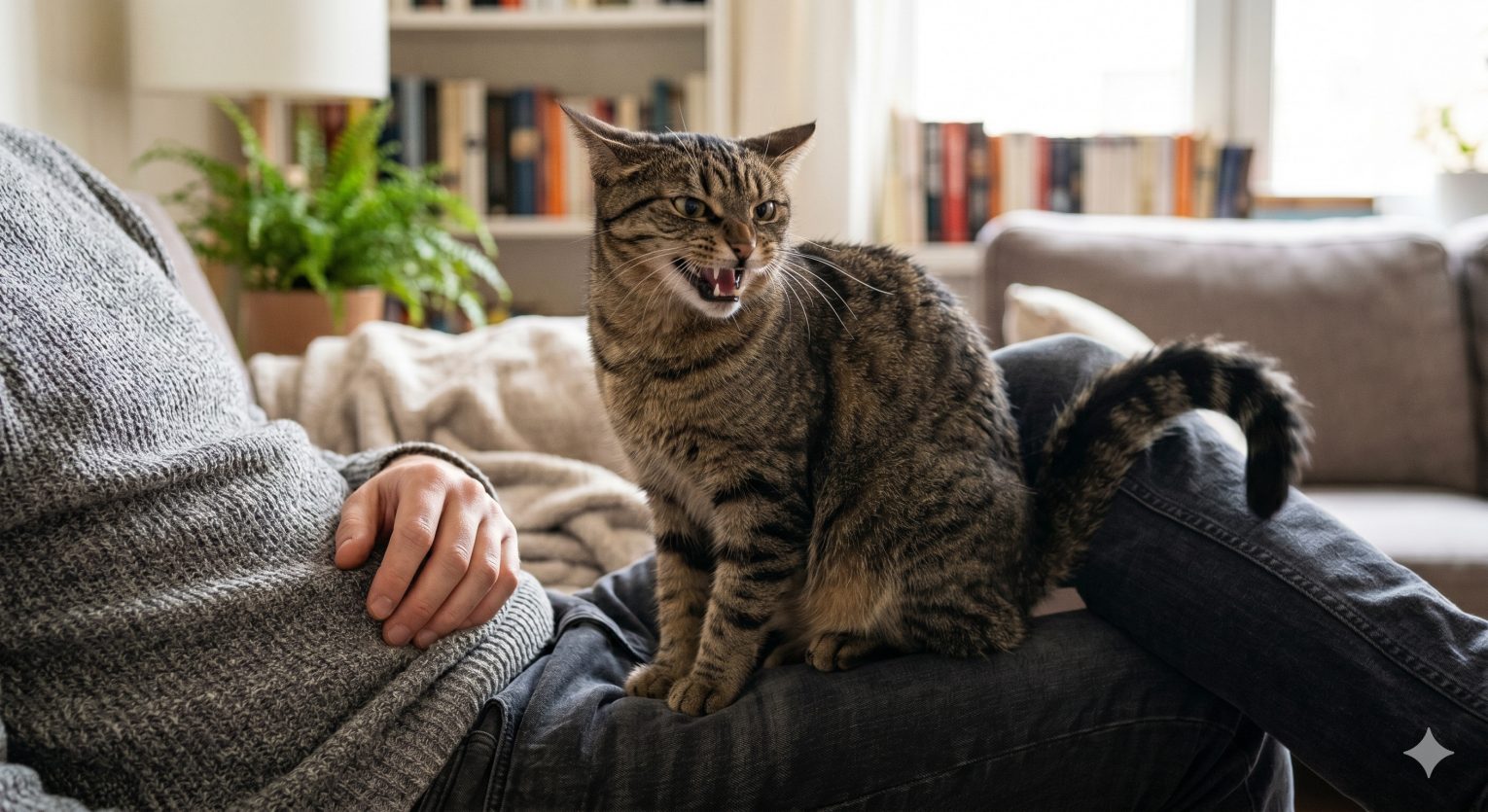
Cat biting almost always has a clear cause — and the cause determines the solution. The most common reasons cats bite are overstimulation during petting, play aggression from hand-play habits established in kittenhood, redirected aggression from an external trigger the cat cannot reach, and fear-based defensive responses. Each type has distinct warning signs in the seconds before a bite — learning to read them prevents most incidents before they happen.
Cat aggression is not evidence of a mean or broken cat. It is a communication system that has either been ignored, misread, or not taught appropriate outlets. A cat that bites during petting is telling you they have reached their threshold. A cat that bites during play was taught to treat hands as toys. Both are fixable with the right understanding and consistent response — this guide covers exactly what to do for each type.
Biting behavior is deeply connected to how cats communicate discomfort and emotional state. For the complete picture of feline communication — including body language signals that precede biting — our cat training guide covers everything you need before and alongside this guide.
Table of Contents
Rule Out Medical Causes First
Any sudden onset of biting or aggression in a previously gentle cat always warrants a veterinary assessment before behavioral intervention.
❗️Medical causes of sudden aggression:
- Pain — the most common medical trigger. A cat with dental pain, joint pain, arthritis, or an internal injury will bite when touched near the painful area.
- Hyperthyroidism — elevated thyroid hormone causes irritability and increased reactivity, particularly in cats over 10 years.
- Cognitive dysfunction — senior cats with cognitive decline may react aggressively to familiar people or situations.
- Neurological conditions — rare but possible. Sudden onset of unprovoked aggression with no clear pattern warrants neurological assessment.
🚨 The key signal: If your cat has been gentle for years and suddenly becomes aggressive without any obvious environmental change, see your vet before attempting behavioral modification.
(🩺 Vet’s Note: “Pain is the most frequently missed cause of cat aggression. A cat that starts biting when picked up often has dental disease, arthritis, or an internal issue. I always examine for pain sources before discussing behavior management — treating the pain eliminates the aggression without any training needed”—LovingPetsGuide Veterinary Advisor.)
Type 1: Petting-Induced Aggression
The Most Common Type
❓What it looks like: The cat is purring and accepting petting, then bites the hand that is petting them — sometimes holding and biting repeatedly before releasing.
❓Why it happens: Cats have a threshold for tactile stimulation. Below it, petting feels pleasant. Above it, the same sensation becomes aversive. Different cats have wildly different thresholds. The bite feels sudden because owners miss the warning signals in the seconds before.
🚨 Warning signals — in order of escalation:
- Tail begins to twitch or lash.
- Skin on the back ripples or twitches.
- Ears rotate sideways or flatten slightly.
- Body becomes slightly tense.
- Head turns toward the petting hand.
- BITE.
Most owners only notice step 6. Steps 1–5 are the reliable predictors.
❓How to stop it:
- Watch for the tail twitch (step 1) and stop petting before escalation.
- When you stop, stop completely and let the cat disengage on their own terms.
- Do not resume petting immediately — give the cat a minute to reset.
- Let the cat guide the session duration — when they move away, the session is over.
❌ What NOT to do:
- Do not continue petting through warning signals.
- Do not punish the bite — the cat has no connection between punishment and the act.
- Do not hold the cat when they try to leave.
Type 2: Play Aggression
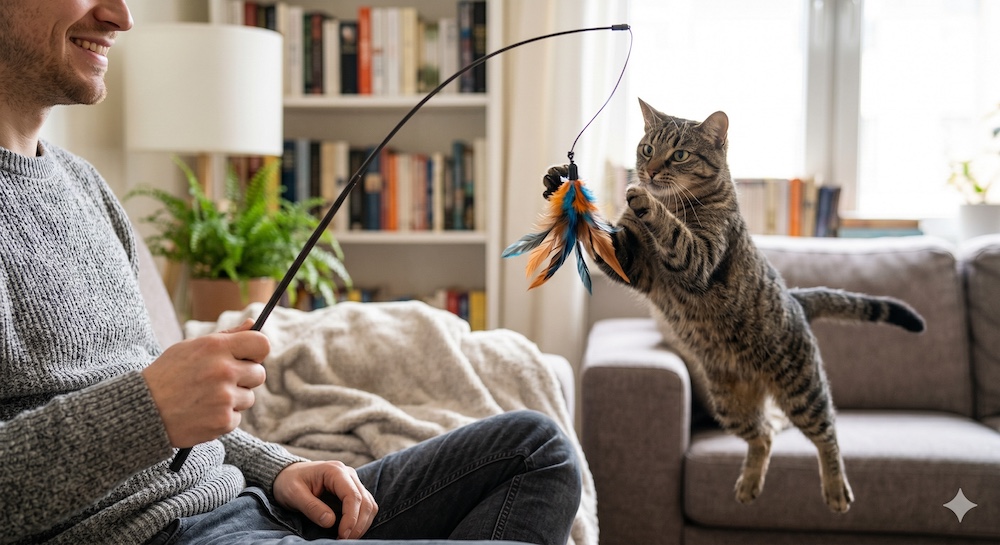
Play Aggression vs Real Aggression
Play aggression is accompanied by:
- Playful sideways pounce posture.
- Relaxed tail (not lashing).
- No vocalization — hissing means escalation.
- The cat releases after the grab.
(💡 A wand toy creates the same prey-chase experience without teaching the cat that hands are targets.)
A Learned Behavior from Kittenhood
❓What it looks like: Cat grabs hands or feet, bites and kicks with back legs, ambushes legs while walking, bites without clear provocation.
❓Why it happens: Play aggression almost always develops when owners play with kittens using their hands — wiggling fingers, letting the kitten bite and grab. The kitten learns that hands are toys. At 8 weeks this is cute. At 2 years with adult teeth and strength — it is a problem.
❓How to stop it:
- Never use hands as toys — the primary rule.
- When a cat grabs your hand, go completely still and limp — do not pull away (triggers the prey response). Wait for the cat to release, then redirect immediately to a toy.
- Increase structured play with wand toys, 10–15 minutes twice daily significantly reduces play aggression.
🐾 Wand Toys for Cats 🐾
🪶 Interactive Wand Toys — Recreates the prey-chase experience without teaching a cat that hands are acceptable targets. Two 10–15 minute sessions daily significantly reduce play-driven biting.
Type 3: Redirected Aggression
The Most Dangerous Type
❓What it looks like: Cat was calm, became intensely agitated at a window (outdoor cat, bird, other stimulus), then attacked the nearest person or pet with serious, seemingly unprovoked aggression.
❓Why it happens: The cat becomes highly aroused by something they cannot reach. The arousal has nowhere to go. When someone approaches the highly aroused cat, the aggression is redirected onto them.
This type causes the most serious injuries because:
- Arousal level is very high.
- The owner approaches thinking the cat is simply looking out the window.
- The attack is genuinely without warning from the owner’s perspective.
🚨 Warning signs (easy to miss):
- Cat fixated on something outside — tail lashing, chattering, very tense.
- After trigger disappears, cat remains in highly aroused state for minutes to hours.
❓How to manage it:
- Do not approach or interact with a cat in a visibly aroused state — leave them completely alone until fully calm (30–60 min minimum).
- Block visual access to common triggers (frosted window film for areas frequented by outdoor cats).
Type 4: Fear-Based Aggression
Defense as the Primary Motivation
❓What it looks like: Cat backs into a corner, hisses, growls, strikes or bites when approached — particularly with unfamiliar people, in new environments, or during handling.
❓Why it happens: A frightened cat that feels it cannot escape will attack when approached. This is the biological “fight” response when “flight” is not available.
🚨 Warning signs:
- Flattened ears against skull.
- Dilated pupils.
- Tail tucked or low.
- Hissing, growling, spitting.
- Crouched, tense body.
❓How to manage it:
- Do not approach a fear-aggressive cat.
- Create an escape route — cats stop being defensively aggressive when they can leave.
- Lower your body level — crouching is less threatening than standing over the cat.
- Avoid direct eye contact — use a slow blink from a distance instead.
- Allow the cat to approach you in their own time.
❗️For cats with severe ongoing fear aggression, consult a veterinary behaviorist.
Type 5: Status or Territorial Aggression
❓What it looks like: Cat blocks doorways, attacks when owner sits in a particular spot, guards food or sleeping areas, attacks other cats or pets.
❓How to manage it:
- Ensure adequate resources — one more of everything than cats: food stations, water bowls, litter boxes, sleeping spots.
- Vertical space (cat trees, shelves) dramatically reduces territorial tension.
- Consult your vet about pheromone therapy or anti-anxiety support for severe cases.
🐾 Cat Calming Pheromone Diffusers 🐾
🕊️ Feline Pheromone Diffusers — Can reduce territorial tension and general anxiety in multi-cat households, complementing resource-based fixes like added litter boxes and vertical space.
What Never Works: Common Mistakes
| ❌ Punishing the bite after it happens: Punishment more than 2 seconds after the behavior teaches the cat nothing about the bite. It damages trust and increases anxiety — which increases aggression. Counterproductive in every scenario. |
| ❌ Spray bottles: Increases arousal and stress. Cats learn to bite when the spray bottle is absent, not to stop biting. |
| ❌ Scruffing: Painful, causes extreme stress, significantly damages trust. Not an appropriate handling or training technique for adult cats. |
| ❌ Continuing to handle through warning signals: The most common mistake with petting-induced aggression — guarantees the bite will occur. |
📰 The narrow timing window for punishment to have any instructional value is a foundational principle in operant conditioning, and is explicitly addressed in the American Veterinary Society of Animal Behavior’s position statement on punishment (avsab.org), which states that corrections must occur during or within about one second of a behavior to be effective—a window so brief that virtually all after-the-fact punishment falls outside it and instead teaches only fear or anxiety toward the punisher.
The Universal Rule: Prevention Over Correction
Every type of cat biting has a warning system. Learning to read these signals and responding before the bite occurs is more effective than any correction after the fact.
For a complete guide to the body language signals that precede biting, our guide to cat body language covers every signal and its meaning in context.
Conclusion: Every Cat Bite Has a Cause
Cat biting is not random, mean, or unpredictable. Every bite has a cause — and every cause has a solution. Petting-induced bites are prevented by reading thresholds. Play aggression is redirected with toys. Redirected aggression is managed by not approaching an aroused cat. Fear aggression is resolved by creating space and safety.
Key takeaways:
- ✅ Rule out pain and medical causes first.
- ✅ Identify the specific type of aggression.
- ✅ Learn the pre-bite warning signals.
- ✅ Never use hands as toys — ever.
- ✅ Never punish after the bite.
- ✅ Give space to a fear or aroused cat.
- ✅ Redirect play aggression to a wand toy.
- ✅ Redirected aggression — 30–60 minutes decompression before any interaction.
👉🏼 Cat Training Guide — complete feline training and behavioral guide.
👉🏼 Cat Body Language Guide — the warning signals that precede every bite.
👉🏼 Why Does my Cat Scratch Furniture — the other common feline behavioral challenge.
👉🏼 How to Introduce a New Cat to your Home — managing aggression during multi-cat introductions.

🐈 Browse cat food, treats, toys, health products, supplements, litter and everything else your cat needs 🐾

🐈 Browse raw cat food, freeze-dried meals, toppers and natural treats from Indiana farms 🐾

🐈 Browse cat food, treats, veterinary diets, supplements and everything else your feline needs 🐾
(This post contains affiliate links. If you purchase through our links, we may earn a small commission at no extra cost to you. This never influences our editorial opinions.)
FAQ: How to Stop Cat Biting
Why does my cat bite me when I’m petting them?
This is petting-induced aggression — the most common type of cat bite. Every cat has a tactile stimulation threshold. The bite feels sudden but is almost always preceded by warning signals: a twitching tail, ears rotating sideways, skin rippling on the back, and subtle body tension. Learning to recognize step one (tail twitch) and stopping at that point prevents the bite entirely. Let the cat guide session duration rather than continuing until they react.
My cat bites and kicks with their back legs during play. Is this normal?
Yes — the grab-and-kick with back legs is normal predatory play behavior. The issue arises when the target is a hand rather than a toy. Go completely still and limp rather than pulling away — pulling triggers the prey response and escalates. Once the cat releases, redirect immediately to an appropriate toy. Going forward, use only wand toys and toy mice for play — never wiggle fingers or allow the cat to bite hands.
My cat attacked me suddenly with no warning. What happened?
This is likely redirected aggression. The cat was almost certainly highly aroused by something you did not notice — an outdoor cat at the window, a bird, or another triggering stimulus. After the external trigger, cats can remain in a state of high arousal for 30 minutes to several hours. Any interaction during this window risks receiving the redirected aggression. After such an incident, give the cat at least 60 minutes completely alone before attempting any interaction.
Should I punish my cat for biting?
No — punishment is ineffective for cat biting and counterproductive in most scenarios. Punishment after the bite has no instructional value because the learning window for cats is 2–3 seconds. Punishment increases anxiety and arousal — both of which increase the likelihood of future aggression. The effective response is prevention through reading warning signals, not correction after the fact.
My cat bites strangers but not me. Is this a problem?
This is fear-based aggression directed at unfamiliar people — common in cats with limited socialization. It is manageable but requires guests to follow specific protocols: avoid direct eye contact, do not initiate contact, crouch rather than stand, and allow the cat to approach on their own terms. Forcing interaction makes fear aggression significantly worse.
My kitten bites constantly during play. Will they grow out of it?
Not automatically — and if hand-play is continued, they will grow into it rather than out of it. Play biting that is redirected appropriately in kittenhood (onto toys rather than hands) becomes well-controlled in adulthood. Now is the most important time to establish the rule: no hands as toys, ever. Use wand toys exclusively for interactive play and redirect every hand-bite immediately to a toy.