
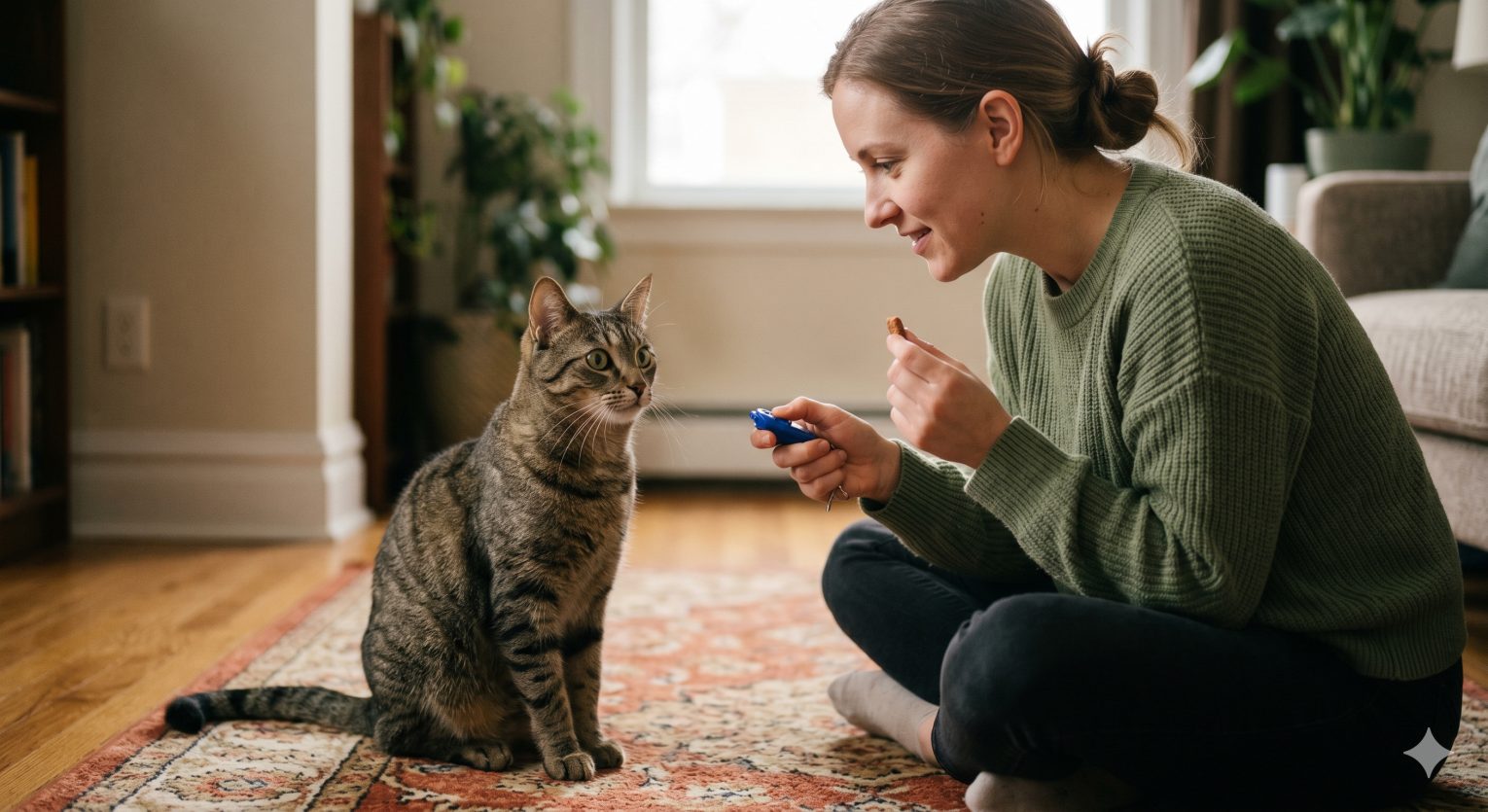
Yes, you can absolutely train a cat — and cats that receive regular training sessions are measurably calmer, more confident, and less likely to develop behavioral problems than untrained cats. Cats learn through the same positive reinforcement principles as dogs: a precise marker (clicker or verbal), an immediate high-value reward, and short sessions that end before the cat loses interest. The difference is that cats are not motivated by pleasing you — they are motivated by what is in it for them.
The myth that cats are untrainable comes from applying dog-training logic to a species with completely different motivational drivers. A dog works for your approval. A cat works for the reward — and when the reward is genuinely high-value and the sessions are genuinely short, cats learn remarkably fast. This guide covers exactly how to start clicker training your cat from scratch, with the five commands that have the highest practical value.
Clicker training is one of the most practical tools in the broader picture of feline behavior management. Our cat training guide covers the full range of behavioral strategies — from body language reading to problem-solving — that complement what you learn here.
Table of Contents
Why Training Is Good for Your Cat
Training is often discussed as something owners do for their own convenience — but the evidence suggests it benefits the cat significantly.
| Mental stimulation: Cats have the same cognitive need for problem-solving and mental challenge as any other intelligent animal. A cat that spends its day sleeping in a stimulus-free environment and then receives 5 minutes of training — where they are actively solving a problem and receiving immediate rewards — shows measurably lower cortisol (stress hormone) levels and engages in less destructive behavior. |
| Confidence building: For anxious or shy cats, training builds confidence because it gives them control over an outcome. A cat that learns “if I sit, a treat appears” has discovered agency in their environment — they can make good things happen. This agency reduces anxiety in ways that enrichment toys alone cannot replicate. |
| Veterinary and handling cooperation: A cat trained to tolerate handling, accept nail trims, and enter a carrier voluntarily has a measurably lower stress response at the vet — which means more accurate health assessments and less cortisol damage from every examination. |
| Relationship building: Training sessions create structured, positive interaction between cat and owner. Cats that train regularly show stronger approach behavior toward their owners — they initiate interaction more frequently because they associate the owner with positive outcomes. |
(🐈 Trainer’s Note: “I recommend clicker training to every cat owner regardless of behavioral problems — not because their cat needs obedience, but because five minutes of training a day does more for a cat’s mental health than any toy or treat dispensed passively. It is the single highest-return investment in feline welfare I know of”—LovingPetsGuide Feline Behavior Advisor.)
How Clicker Training Works
Clicker training uses a precise marker sound — the click — to communicate the exact moment a correct behavior occurs, bridging the gap between the behavior and the reward.
Why the clicker matters: Timing is everything in training. If you give a treat 3 seconds after a correct behavior, you are rewarding whatever the cat did in those 3 seconds — often looking away, walking toward you, or something entirely unrelated. A click at the exact moment of correct behavior creates a precise communication that treats alone cannot.
The three elements:
- Marker (click): communicates “that exact thing you just did earned the reward”.
- Reward: the motivator that makes the marker meaningful.
- Behavior: what you want the cat to do.
The clicker has no meaning until it is “charged” — associated with the reward through pairing.
First Step: Charge the Clicker
Before training any command, the cat must learn that click = treat. This association is the foundation of everything that follows.
How to charge the clicker:
- Have 20 small, high-value treats ready.
- Click once—immediately deliver a treat.
- Wait 3–5 seconds.
- Click once—immediately deliver a treat.
- Repeat 15–20 times.
Do not ask for any behavior during this session — just click and treat regardless of what the cat is doing. The goal is purely the association.
How to know it’s working: After 15–20 repetitions, your cat’s head will snap toward you the moment they hear the click — before the treat appears. This is the conditioned reflex. The clicker is now a meaningful marker.
⏱️ Session length: 2–3 minutes maximum. Cats have short training attention spans — 20 treats in one session is approximately right.
What Treats to Use
Treat selection is the single most important variable in cat training. The treat must be:
High-value: Something the cat genuinely wants, not something they accept when bored. Freeze-dried chicken, tuna, or commercial high-meat training treats work for most cats. Standard dry kibble does not — not high enough value for most cats to work for in a training context.
Small: Pea-sized or smaller. The cat should be able to eat it in one bite and be ready for the next repetition within 2–3 seconds.
Consistent: Use the same treat during a training session. Variety mid-session distracts from the learning.
How to find your cat’s training treat: Offer several options and observe response:
- Does the cat approach quickly?
- Do they eat it immediately without sniffing?
- Do they look for more?
A treat that produces all three is your training treat.
⚠️ Important: Keep daily treat amounts within 10% of daily caloric intake. Subtract training treats from the main meal if sessions are long or frequent. For cats on specific diets, use a portion of their regular wet food as the treat.
The 5 Most Useful Commands for Cats
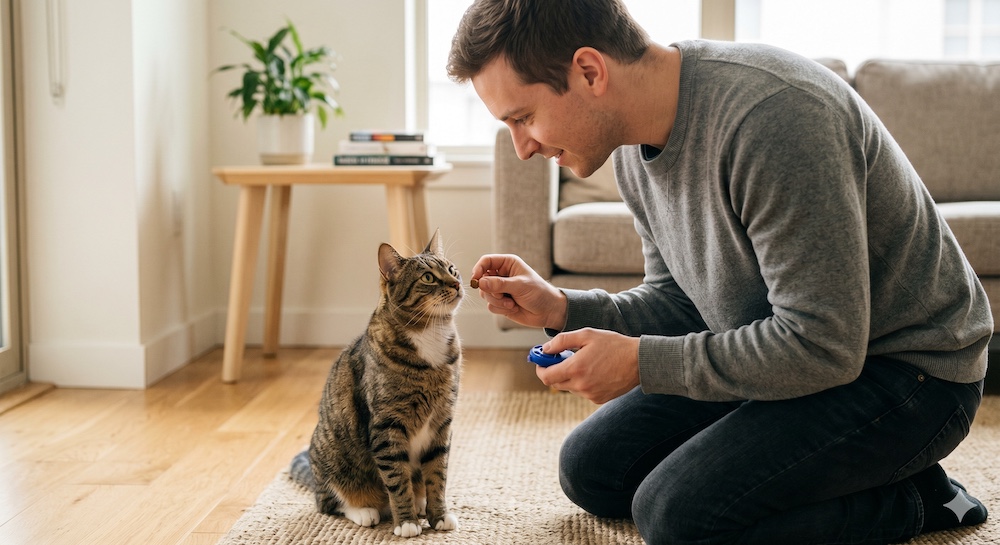
Sit is the foundation — every useful command builds on the cat’s ability to focus and offer a calm, stationary behavior.
🗣️ Command 1: Sit
Why it matters: Sit is the foundational command. A cat that sits on cue can be managed at doorways, during feeding, and during veterinary examinations. It is also the easiest command to shape, making it the ideal starting point.
❔How to teach it — luring method:
- Hold a small treat at your cat’s nose level.
- Slowly move the treat upward and slightly backward over their head.
- As the nose follows the treat upward, the rear end naturally drops toward the floor — the sit position.
- The moment the bottom touches the floor: click and deliver the treat.
- Release the cat (say “OK” or simply stop engaging).
- Repeat 5–8 times per session.
Adding the cue: Once your cat is reliably sitting within 2 seconds of the lure, add the verbal cue “Sit” just before you begin the luring motion. After 20–30 repetitions with the cue, begin saying “Sit” and waiting 1–2 seconds before luring — the cat will begin sitting on the verbal cue alone.
🗣️ Command 2: Come (Recall)
Why it matters: A cat that comes when called can be recalled from dangerous situations, called for medication, and managed at the front door. It is the most practically valuable command for everyday safety.
❔How to teach it:
- Start with the cat nearby (1 meter / 3 feet).
- Say your cat’s name followed by “Come” in an upbeat, light tone — never stern or loud.
- Crouch down and open your arms slightly — welcoming, non-threatening posture.
- The moment the cat takes even one step toward you: click.
- When they arrive: jackpot — 3–5 treats in rapid succession.
- Practice in different rooms and at increasing distances as the cat becomes reliable.
❗️The most important rule: Never call your cat for something they dislike — a bath, nail trimming, or going in the carrier — until the recall is very well established. If “Come” is associated with unpleasant events, the cat will stop responding. Call them for meals, treats, play, and cuddles. Build a recall they have every reason to respond to.
🗣️ Command 3: Touch (Target Training)
Why it matters: Touch — where the cat touches their nose to your finger or a target stick — is the most versatile foundational behavior in cat training. Once taught, it can be used to guide the cat to specific locations, into the carrier, and onto examination surfaces without physical manipulation.
❔How to teach it:
- Hold your index finger about 5 cm (2 inches) from your cat’s nose.
- Most cats will naturally sniff the finger — the moment their nose touches your finger: click and treat.
- Move your finger to a slightly different position and repeat.
- Once the cat is reliably touching your finger, add the verbal cue “Touch”.
❕Using touch practically:
- To move the cat onto the vet examination table: hold finger target on the surface and ask for touch.
- To guide into the carrier: hold target inside the carrier entrance.
🗣️ Command 4: Carrier Training (Go In)
Why it matters: A cat that enters the carrier voluntarily has significantly lower stress at the vet than one that is forced in. Lower stress means better health assessments and a calmer recovery.
❔How to teach it:
Week 1: Leave the carrier open in the living area with the door removed. Place treats inside periodically — click and treat any time the cat voluntarily goes near it.
Week 2: Click and treat any time the cat enters the carrier voluntarily. Begin using the cue “Carrier” or “Crate” when they enter.
Week 3: Begin briefly closing the door after the cat enters, immediately opening it. Extend duration gradually.
This process typically takes 2–3 weeks for a cat that currently avoids the carrier, and 3–5 days for a cat with no negative carrier history.
🗣️ Command 5: Station (Go to Your Place)
Why it matters: Station — where the cat goes to a specific mat or bed on cue — is useful for managing the cat during doorbell arrivals, meals, or guest visits. It gives the cat a clear, rewarded location to be during situations that might otherwise cause anxiety.
❔How to teach it:
- Place a small mat or towel on the floor.
- Click and treat any time the cat steps on it.
- Once the cat is offering the mat reliably, add the cue “Mat” or “Station” as they step on it.
- Build duration by waiting 2–3 seconds after the click before treating — click for remaining on the mat, not just touching it.
Common Training Mistakes
| Sessions too long: Cat training sessions should be 2–5 minutes maximum. A cat that walks away is telling you the session is over. Never continue past this point — it creates negative associations with training. |
| Treats too low-value: If your cat does not respond enthusiastically, the treat is not high-value enough. Switch to freeze-dried meat or another high-meat option before assuming the cat “can’t learn.” |
| Cue given too many times: Saying “Sit, sit, sit, SIT” teaches the cat that three repetitions is the expected number of cues before they need to respond. Say the cue once, wait 3–5 seconds, then reset and try again. |
| Training when the cat is full or sleepy: Train before meals — motivation is highest when the cat is slightly hungry. A cat that just ate a full meal is unlikely to find kibble-level treats motivating. Train when the cat is alert and active. |
| Punishing non-compliance: If the cat does not respond to a cue, the session ends — treats are put away, training is over for now. Never punish for non-compliance. The lack of reward is the only consequence a cat needs. |
Training Schedule: A Practical Plan
Week 1:
- Session 1: Charge the clicker (one session daily).
- Session 2: Begin Sit luring.
Week 2:
- Continue Sit — add verbal cue.
- Begin Touch (target training).
Week 3:
- Add Come (recall).
- Begin carrier desensitization alongside sessions.
Week 4+:
- Add Station.
- Build duration and distance on all established commands.
- Begin carrier training (Go In) if not started.
📅 Daily routine: Two 3–5 minute sessions per day, ideally before meals. Morning and evening work well for most cats. Consistency matters more than session length — daily short sessions outperform occasional long ones.
Training Anxious or Shy Cats
Shy cats can train — they simply need more time in each stage and lower initial demands.
Adaptations for anxious cats:
- Start with the cat in their preferred safe location — do not move them to a training space.
- Sit on the floor at their level — never stand over them during early sessions.
- Accept shorter voluntary engagement — if the cat offers 2 repetitions and then looks away, that is the session.
- Use a softer marker if the click startles them — a quiet verbal marker like “Yes” works equally well once conditioned.
For cats that are highly anxious or fearful, training is one of the most effective tools for building confidence over time. Our guide to cat body language helps you read the stress signals that indicate when to stop and when to push forward slightly.
Conclusion: Five Minutes Changes Everything
Five minutes of clicker training per day creates a mentally stimulated, more confident, and more cooperative cat — within weeks of starting. The commands themselves are secondary to the training relationship they build.
A cat that has learned that engaging with their owner produces reliably good outcomes is a cat that approaches rather than avoids, cooperates during handling rather than fighting it, and develops the calm confidence that comes from having control over their environment.
Key takeaways:
- ✅ Cats absolutely can be trained — motivation is the key, not intelligence.
- ✅ Charge the clicker first — always.
- ✅ High-value treats only — kibble is rarely enough.
- ✅ Sessions 2–5 minutes maximum.
- ✅ One cue, once — never repeat.
- ✅ End every session before the cat disengages.
- ✅ Never punish non-compliance — simply end the session.
- ✅ Train before meals, not after.
👉🏼 Cat Training Guide — the complete feline behavior and training guide.
👉🏼 Cat Body Language Guide — reading your cat’s engagement and stress signals during training.
👉🏼 Why Does my Cat Scratch Furniture — how clicker training redirects scratching behavior.
👉🏼 How to Introduce a New Cat to Your Home — using training to ease multi-cat introductions.

🐈 Browse cat food, treats, toys, health products, supplements, litter and everything else your cat needs 🐾

🐈 Browse raw cat food, freeze-dried meals, toppers and natural treats from Indiana farms 🐾

🐈 Browse cat food, treats, veterinary diets, supplements and everything else your feline needs 🐾
(This post contains affiliate links. If you purchase through our links, we may earn a small commission at no extra cost to you. This never influences our editorial opinions.)
FAQ: Can You Train a Cat?
At what age can I start training my cat?
Kittens can begin basic clicker training from 8 weeks — the same age they arrive in their new home. Young kittens have shorter attention spans (1–2 minutes per session) but learn extremely fast. The critical socialization window (8–16 weeks) is also the ideal time to introduce carrier training, handling acceptance, and basic commands, as new experiences are processed more positively during this period. Adult cats learn more slowly but learn reliably — there is no upper age limit for starting clicker training.
My cat loses interest after 2–3 treats. What am I doing wrong?
Almost certainly one of two things: the treat is not high-value enough, or the session is starting at a point when the cat is not hungry. Try freeze-dried chicken or a small piece of cooked plain chicken as your treat — few cats are indifferent to these. Also try training 5–10 minutes before a scheduled meal rather than after. If the cat still disengages after 2–3 treats with high-value food, shorten the session to match the cat’s genuine engagement window rather than pushing past it.
Does clicker training work for older cats?
Yes — adult and senior cats learn clicker training reliably, though they may need more repetitions than kittens to form new associations. Senior cats in particular benefit significantly from the mental stimulation of training sessions, which can slow cognitive decline and maintain engagement with their environment. The training protocol is identical — the only adjustment for senior cats is ensuring physical comfort during sessions (sitting rather than jumping, no commands requiring physical exertion for arthritic cats).
Can I use a verbal marker instead of a clicker?
Yes — a short, consistent verbal marker like “Yes” or “Good” works equally well once conditioned through the same pairing process. The advantage of a clicker is precision and consistency — a clicker always sounds identical, while a human voice varies in tone and timing. For cats that are startled by the click sound, a verbal marker is a practical alternative. Whichever marker you choose, condition it through repeated pairing with treats before using it to mark behaviors.
My cat knows the command at home but ignores it in other situations. What should I do?
This is called “generalization” — the process of training a behavior in multiple contexts so the cat understands the cue applies everywhere, not just in one specific setting. Begin practicing known commands in slightly different locations (different rooms, different times of day) and at gradually higher distraction levels. Build from known to unknown — your cat is not being stubborn, they simply have not yet learned that “Sit” in the kitchen means the same thing as “Sit” in the living room.
Is clicker training appropriate for aggressive cats?
Yes — and it is particularly effective for building trust with aggressive or fearful cats because it is entirely positive and never physically coercive. For cats with aggression rooted in fear, training gives them control over an outcome for the first time, which reduces the fear-based responses that drive the aggression. Start at a distance that is comfortable for the cat and work toward proximity gradually. For severe aggression cases, consult a veterinary behaviorist before beginning.