
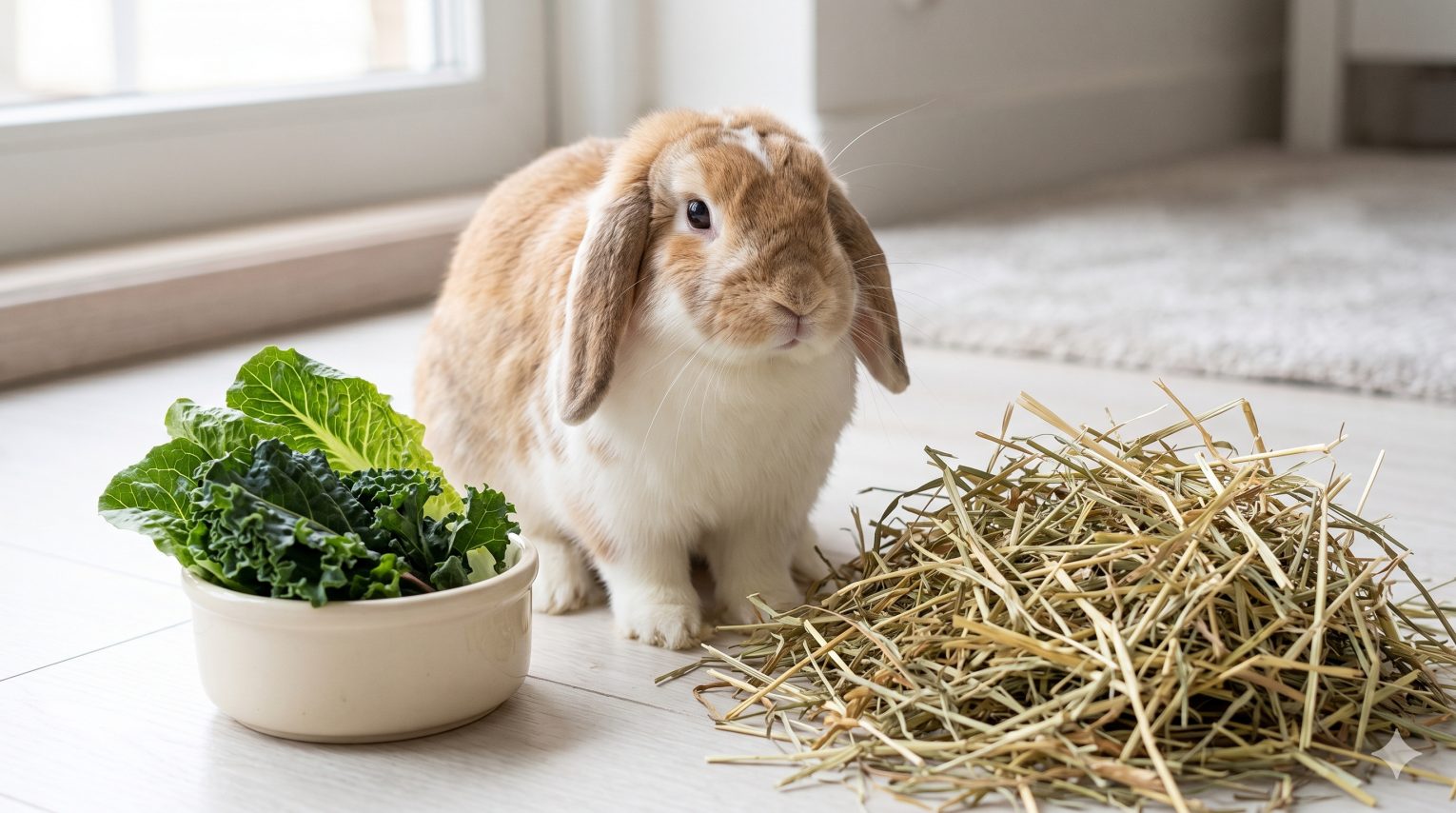
A healthy rabbit needs three things above all else: unlimited fresh hay (80–90% of their diet), daily fresh leafy greens, and a living space large enough to run, jump, and fully stretch out. Hay is not optional—it keeps the rabbit’s GI tract moving, wears down continuously growing teeth, and is the single most important factor in preventing GI stasis, the most common life-threatening emergency in pet rabbits. Everything else in rabbit care—pellets, vegetables, enclosure enrichment, and veterinary care—builds on this foundation.
Rabbits are not low-maintenance pets. They live 8–12 years, require rabbit-savvy veterinary care, need significant daily exercise time outside a cage, and have a sensitive digestive system that reacts quickly to diet changes, stress, and inadequate fiber intake. Done correctly, rabbit ownership is deeply rewarding—but the commitment is more similar to a cat than a hamster.
Rabbit care is one of three small pet species covered in our small pet care guide—the complete hub for rabbits, guinea pigs, and hamsters covering nutrition, housing, health, and species-specific needs in one place.
(💡 Unlimited fresh hay, daily greens, and adequate space to move—the three foundations of rabbit care that everything else builds on.)
Table of Contents
What Rabbits Actually Are (And Why It Matters)
Before covering care specifics, understanding rabbit biology makes every care decision clearer.
Rabbits are obligate hindgut fermenters—their cecum (a fermentation chamber in their digestive tract) breaks down plant fiber using bacteria, producing cecotropes (soft, nutrient-rich droppings) that the rabbit re-ingests directly from their bottom. This process provides essential B vitamins and proteins. It is normal, healthy, and should not be interfered with.
The practical implication: rabbits need continuous, high-fiber food movement through their digestive system. If food stops moving— due to low fiber intake, stress, pain, or dehydration—the cecum fermentation process disrupts, harmful bacteria overgrow, and the result is GI stasis: a life-threatening digestive emergency that can kill a rabbit within 24–48 hours without veterinary intervention.
This is why hay is non-negotiable. And this is why understanding rabbit biology first makes everything else in this guide make sense.
📰 The clinical significance of dietary fiber for rabbit GI health is documented in peer-reviewed veterinary literature. Clauss and Hatt (2017), published in Veterinary Clinics of North America: Exotic Animal Practice, documented that hay should constitute 80–90% of a rabbit’s diet and that grass hay provides the insoluble fiber essential for GI motility. Research cited in the BSAVA Manual of Rabbit Medicine confirms that low-fiber diets cause cecocolic hypomotility—the mechanism behind GI stasis—and that dietary fiber insufficiency is the primary preventable risk factor for this condition.
Part 1: Rabbit Diet
🐾 The Correct Diet Ratio
Think of rabbit nutrition as a priority stack— not a rigid pie chart:
Priority 1️⃣ — Unlimited hay (80–90% of diet): Always available, never rationed. Hay wears teeth, keeps the gut moving, and provides the fiber that prevents GI stasis.
Priority 2️⃣ — Daily fresh greens (10–15%): 1–2 cups of leafy greens per 4–6 lbs of body weight per day, minimum 3 different types. For a complete list of safe vegetables with quantities for rabbits, guinea pigs, and hamsters, see safe vegetables for small pets.
Priority 3️⃣ — Measured pellets (5–10%): Approximately ¼ cup per 5 lbs of body weight per day. Pellets are a supplement—not the foundation of the diet.
🍪 Treats (< 5%) Fruit and high-sugar vegetables like carrots. Very small quantities only, a few times per week.
(🩺 Vet’s Note: “The single most common diet mistake I see in rabbit patients is overfeeding pellets and underfeeding hay. A rabbit that has unlimited pellets will preferentially eat pellets over hay—reducing the fiber intake that keeps their gut moving. This is the dietary pathway to GI stasis. Ration pellets strictly and ensure hay is always the most available food in the enclosure”—LovingPetsGuide Veterinary Advisor.)
🐾 Hay: The Foundation
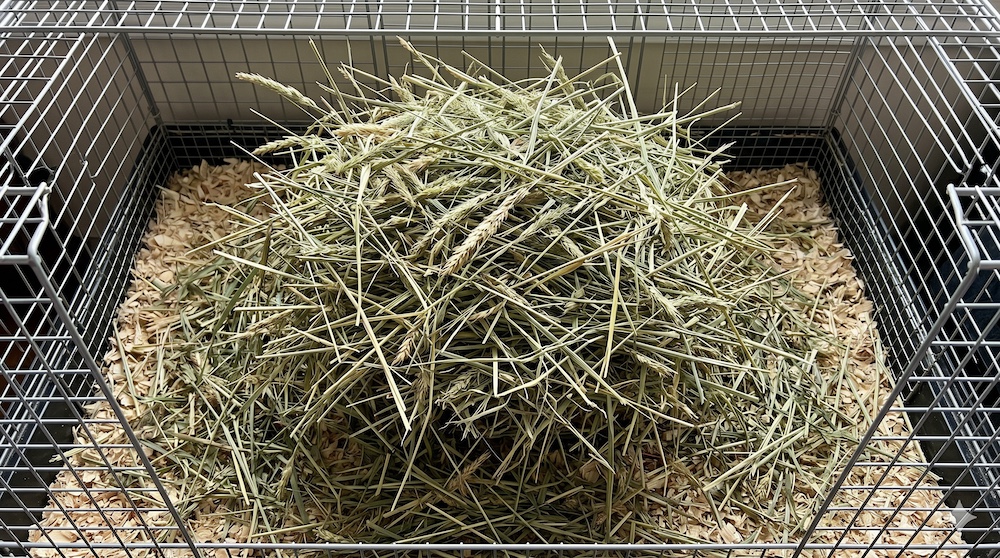
✅ Hay quality checklist:
- No mold, insects, or unusual debris.
- Smells fresh and slightly sweet—not musty or dusty.
- Long strands present—not all crumbs or powder.
- Golden-green color—not brown or bleached.
(💡 Hay should always be the largest volume of food in a rabbit’s enclosure—they should eat roughly their own body size in hay every day
Grass hays (for adult rabbits 7+ months):
- Timothy hay—the gold standard for most adult rabbits. High fiber, moderate protein.
- Orchard grass—softer texture, many rabbits prefer it. Nutritionally similar to timothy.
- Oat hay—slightly higher protein, good for variety rotation.
- Meadow hay—good fiber, natural mixed plant content.
Alfalfa hay (for young rabbits under 7 months and nursing females only):
- Alfalfa is a legume hay—higher in protein and calcium. Essential for young rabbits and nursing mothers. For adult rabbits, the high calcium content causes urinary sludge and stones over time. Switch to grass hay at 7 months.
🐾 Oxbow Western Timothy Hay 🐾
🌾 Oxbow Western Timothy Hay—The most widely vet-recommended timothy hay for adult rabbits. Hand-selected, first-cut timothy with long strands that encourage foraging behavior. High in fiber, low in protein and calcium—the correct nutritional profile for adult rabbit dental and GI health.
🐾 Pellets: Supplement, Not Staple
✅ What to look for in rabbit pellets:
- Timothy hay as the first ingredient.
- Minimum 18–25% fiber content.
- No seeds, nuts, dried fruit, or colored pieces mixed in—these cause selective feeding and nutritional imbalance.
- Plain, uniform extruded pellets only.
⚖️ Pellet amount by weight:
- Standard adult rabbit: ¼ cup per 5 lbs body weight per day.
- Young rabbits under 7 months: unlimited alfalfa-based pellets (growth stage requires more calories).
- Senior rabbits 6+: adjust with vet guidance based on weight and dental health.
❌ What to avoid in pellets:
- Corn, oats, wheat as primary ingredients.
- Anything below 18% fiber.
- Multi-colored mixes.
- “Yogurt drops” or sugary treats marketed alongside pellets.
🐾 Oxbow Essentials Adult Rabbit Food 🐾
🥕 Oxbow Essentials Adult Rabbit Food—Timothy grass meal as the first ingredient, 25–29% fiber, no seeds or sugars. The top-rated rabbit pellet by veterinary exotic animal practitioners and consistently the most recommended brand in clinical settings for adult rabbits over 7 months.
🐾 Fresh Greens: Daily Requirement
Fresh leafy greens provide hydration, micronutrients, and variety. Feed a minimum of 1–2 cups of mixed greens per 4 lbs of body weight daily. For a complete A–Z list of safe and unsafe foods for rabbits, guinea pigs, and hamsters, see safe vegetables for small pets.
✅ Safe leafy greens (feed regularly):
- Romaine lettuce (not iceberg—no nutritional value)
- Bok choy.
- Cilantro (coriander).
- Parsley (limited—high in calcium).
- Kale (limited—high in calcium and oxalates).
- Basil.
- Arugula.
- Watercress.
✅ Safe vegetables (feed in smaller amounts):
- Bell peppers (all colors).
- Cucumber.
- Zucchini.
- Broccoli (leaves and stems—florets cause gas).
- Celery (cut small—strings can cause blockage).
❌ Foods to avoid completely:
- Onions, garlic, leeks—toxic to rabbits.
- Avocado—toxic.
- Rhubarb—toxic.
- Iceberg lettuce—no nutrition, causes diarrhea.
- Potatoes and corn—too high in starch.
- Sugary commercial rabbit treats.
- Any human processed food.
Fruit and high-sugar vegetables (treats only): 🥕 Carrots, 🍏 apples (no seeds), 🍓 strawberries, 🫐 blueberries—small piece (½–1 teaspoon per 2 lbs of body weight) a few times per week maximum. Contrary to popular belief, carrots are a treat, not a staple.
📰 The House Rabbit Society at rabbit.org, the RSPCA rabbit care guidelines, and NC State Veterinary Hospital’s rabbit nutrition guidance at hospital.cvm.ncsu.edu all consistently confirm that grass hay should comprise 75–90% of an adult rabbit’s diet, with pellets as a measured supplement and fresh greens as a daily addition. These three sources were cross-referenced for all dietary recommendations in this article.
Part 2: Habitat
🐾 Minimum Space Requirements
The most common rabbit habitat mistake is buying a cage that is too small. Most commercially sold “rabbit cages” in pet stores are inadequate. The standard guideline from the House Rabbit Society: a rabbit’s living space must allow them to make at least 3 full consecutive hops and stand fully upright on their hind legs without ears touching the top.
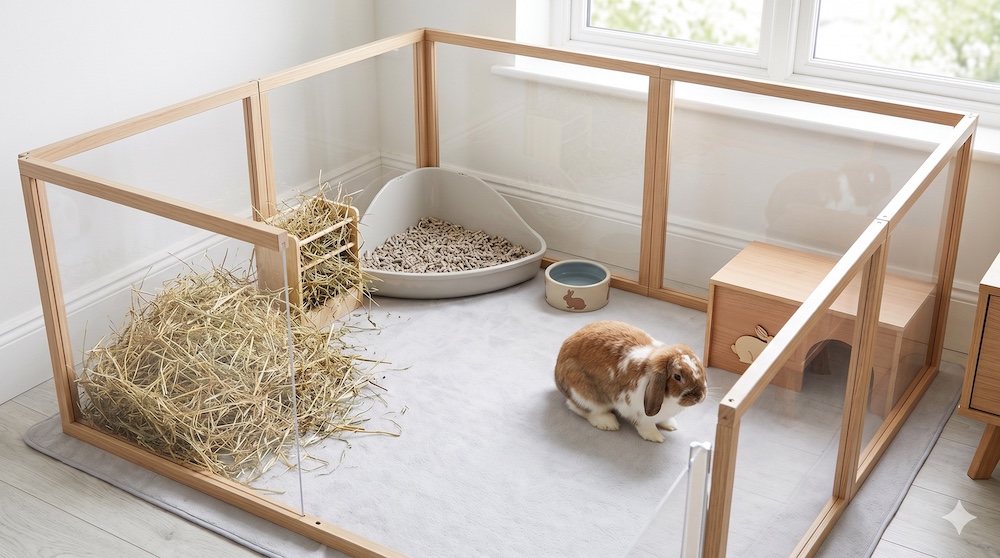
Exercise space—free-range time outside the enclosure—is not optional. Rabbits need a minimum of 3–4 hours of free-range time daily. If you’re also considering a guinea pig or hamster setup, see best cages for guinea pigs for size comparisons across small pet species.
(💡 A rabbit’s enclosure should allow full stretching and multiple consecutive hops—most commercially sold rabbit cages are too small.)
Minimum enclosure sizes by rabbit size:
| Rabbit Size | Minimum Enclosure | Exercise Space |
|---|---|---|
| Small (< 4.4 lbs / < 2 kg) | 4 × 2 ft (120 × 60 cm) | 24 sq ft (2.2 sq m) minimum |
| Medium (4.4–8.8 lbs / 2–4 kg) | 5 × 2 ft (150 × 60 cm) | 32 sq ft (3 sq m) minimum |
| Large (8.8+ lbs / 4+ kg) | 6 × 2 ft (180 × 60 cm) | 40 sq ft (3.7 sq m) minimum |
🐾 Rabbit Cages & Enclosures 🐾
🏠 Rabbit Cages & Enclosures—Most commercially sold rabbit cages fall short of the 5 × 2 ft (150 × 60 cm) minimum. Chewy carries a range of appropriately sized enclosures, hutches, and exercise pens from Kaytee, MidWest, Oxbow, and more—worth browsing to find a setup that meets minimum space requirements for your rabbit’s size.
🐾 Enclosure Type
| X-pen/exercise pen: The best value option for indoor rabbits. A standard 36-inch dog exercise pen creates a large, safe space that can be expanded easily. |
| Wire cage with attached exercise area: Purpose-built rabbit cages with a separate run attached. Ensure the floor is not wire mesh—wire floors damage rabbit feet and should always be covered with solid flooring or a mat. |
| Free-range with a safe base area: Fully rabbit-proofed room or section of a room. The most space-appropriate option but requires thorough rabbit-proofing. |
| Outdoor hutch: Rabbits can live outdoors in appropriate climates, but outdoor housing requires significant predator-proofing, weather protection, and social companionship. Outdoor rabbits are at higher risk of predator stress, hypothermia, heatstroke, and fly strike. |
🐾 Bedding and Litter
✅ Safe bedding options:
- Paper-based bedding (Carefresh, paper pellets).
- Fleece liners on top of absorbent base.
- Hay itself as bedding in sleeping areas.
❌ Unsafe bedding:
- Cedar or pine shavings—aromatic oils are toxic and damage the respiratory system.
- Sawdust—respiratory irritant.
- Cat litter (especially clumping)—dangerous if ingested.
Litter training: Rabbits can be reliably litter trained. Place a litter box in the corner where they naturally choose to toilet. Use paper-based litter only. Place hay in or directly next to the litter box— rabbits eat hay while toileting, which encourages both hay consumption and litter box use simultaneously.
🐾 Enrichment and Exercise
⚙️ Essential enrichment:
- Cardboard boxes and tunnels to hide in and chew.
- Hay foraging opportunities—hide hay in paper bags, toilet rolls, or hanging hay racks.
- Digging trays (soil or shredded paper in a shallow container).
- Chew toys made from untreated wood or willow.
Social needs: Rabbits are social animals. A single rabbit without sufficient human interaction or rabbit companionship is likely to develop depression and behavioral problems. Consider keeping two neutered rabbits together—bonded pairs are significantly happier than solo rabbits.
Part 3: Health Essentials
🐾 Finding a Rabbit-Savvy Vet
This is the single most important health step before getting a rabbit. Not all vets are trained in exotic animal medicine. Rabbits require a vet experienced in exotic animal practice or small mammal medicine. Search for “rabbit vet” or “exotic animal vet” in your area. The House Rabbit Society maintains vet recommendation resources at rabbit.org.
🐾 Spaying and Neutering
🐰 Female rabbits (does): Spaying is strongly recommended. Unspayed female rabbits have a 50–80% lifetime risk of uterine cancer by age 5. This is one of the most preventable causes of rabbit death. Spay before 2 years of age.
🐰 Male rabbits (bucks): Neutering reduces territorial behavior, aggression, and urine spraying, and is required before bonding with another rabbit.
🐾 Vaccinations
In Europe and Australia, vaccinations against myxomatosis and RHDV are essential and annually required. In the US, RHDV2 outbreaks have increased significantly since 2020—check with your vet for regional vaccine availability and recommendations.
🐾 GI Stasis: The Primary Health Emergency
GI stasis is the most common life-threatening condition in pet rabbits. The digestive system slows or stops, cecal fermentation is disrupted, and gas buildup causes severe pain and rapid deterioration.
🚨 Warning signs of GI stasis:
- Reduced or no droppings.
- Reduced appetite or complete food refusal.
- Hunched posture, tooth grinding.
- Distended or hard abdomen.
- Lethargy.
⚠️ GI stasis is a veterinary emergency—do not wait to see if it resolves on its own. A rabbit showing these signs needs veterinary care within hours, not days.
❕Prevention:
- Unlimited hay—always.
- Daily fresh water.
- Daily exercise time.
- Minimize stress.
- Monitor droppings daily—changes are the earliest warning sign.
📰 GI stasis as a veterinary emergency is documented extensively in exotic animal veterinary literature. Veterinary Partner (VIN) at veterinarypartner.vin.com identifies dietary fiber insufficiency as the primary preventable risk factor and confirms that GI stasis can be fatal within 24–48 hours without intervention. The NC State Veterinary Hospital at hospital.cvm.ncsu.edu and the House Rabbit Society at rabbit.org both emphasize daily dropping monitoring as the earliest detection method available to rabbit owners.
🐾 Dental Health
Rabbit teeth grow continuously throughout their life—approximately 2–3 mm per week. Eating hay provides the lateral grinding motion that wears teeth down correctly. Insufficient hay leads to dental malocclusion, sharp points that cut into the tongue and gums, and eventual refusal to eat.
🚨 Warning signs of dental problems:
- Dropping food while eating.
- Wet chin or fur under the jaw.
- Weight loss despite apparent interest in food.
- Drooling.
Annual dental checks with a rabbit-savvy vet are recommended from age 2 onwards.
🐾 Rabbit Grooming
🐇 Short-haired breeds: Brush once a week, more during seasonal shedding.
🐇 Long-haired breeds (Angora, Jersey Wooly, Lionhead): Daily brushing required to prevent matting and fly strike risk.
✂️ Nails: Trim every 6–8 weeks.
🛁 Bathing: Never bathe rabbits in water. Spot-clean soiled areas with a warm damp cloth.
🐾 Oxbow Essentials Young Rabbit Food 🐾
🫘 Oxbow Essentials Young Rabbit—Alfalfa-based pellet formulated for rabbits under 7 months. Higher protein and calcium supports active development during the growth stage. Switch to the adult timothy-based formula at 7 months—do not continue alfalfa-based pellets in adult rabbits.
🐾 Signs of a Healthy Rabbit
| Area | Healthy | Concern |
|---|---|---|
| Droppings | Consistent round pellets | Fewer, smaller, or misshapen |
| Appetite | Consistent hay intake | Reduced or stopped eating |
| Eyes | Clear, bright, no discharge | Cloudy, sunken, or discharge |
| Nose | Dry or slightly moist | Runny or crusted |
| Coat | Clean, smooth, no mats | Patchy, dull, matted |
| Posture | Relaxed, loafing | Hunched, teeth grinding |
| Activity | Alert, curious | Lethargy, hiding constantly |
The 5 Most Common Rabbit Care Mistakes
| ❌ Overfeeding pellets and underfeeding hay: Ration pellets strictly and ensure hay is always the most abundantly available food. See safe vegetables for small pets for correct quantities across food types. |
| ❌ Housing in an inadequate enclosure: Most pet store rabbit cages are too small. See best cages for guinea pigs for a broader discussion of minimum enclosure standards across small pet species. |
| ❌ Skipping exotic vet registration: Rabbits require exotic-animal-qualified veterinary care. Register before problems arise. |
| ❌ Feeding carrots as a staple: Carrots are treats—high in sugar, appropriate only in very small quantities a few times per week. See safe vegetables for small pets for the complete safe and unsafe food list. |
| ❌ Skipping spaying for female rabbits: Uterine cancer affects 50–80% of unspayed female rabbits by age 5. Spay before 2 years of age. |
Conclusion
Rabbits are intelligent, social, and—with correct care—genuinely affectionate animals. They live 8–12 years and require daily hay management, daily exercise time, regular health monitoring, and species-appropriate veterinary care.
Key takeaways:
- ✅ Unlimited hay—always, no exceptions.
- ✅ Pellets are a supplement, not a staple.
- ✅ Minimum 3–4 hours daily exercise time.
- ✅ Find a rabbit-savvy vet before problems arise.
- ✅ Spay females before age 2.
- ✅ Monitor droppings daily.
- ✅ GI stasis is a veterinary emergency—act within hours, not days.
- ✅ Carrots are treats, not diet staples.
- ✅ Alfalfa hay for under-7-months only.
👉🏼 Small Pet Care Guide—complete hub for rabbits, guinea pigs, and hamsters.
👉🏼 Safe Vegetables for Small Pets—complete A–Z safe and unsafe food list.
👉🏼 Guinea Pig Care Guide—if you’re considering adding a guinea pig alongside a rabbit.
👉🏼 Hamster Care Guide—full cage setup, diet, and common mistakes.
👉🏼 Best Cages for Guinea Pigs—minimum size standards and top enclosure picks for small pets.
📝 Editor’s Note: Diet recommendations in this guide were cross-referenced with the House Rabbit Society at rabbit.org, NC State Veterinary Hospital rabbit nutrition guidance at hospital.cvm.ncsu.edu, and peer-reviewed veterinary literature (Clauss & Hatt 2017, BSAVA Manual of Rabbit Medicine). GI stasis emergency information was verified at veterinarypartner.vin.com. RHDV2 vaccination guidance reflects current (2026) regional outbreak tracking.

🐀 Browse small pet food, bedding, cages, toys, supplements and everything else your small pet needs 🐾
(This post contains affiliate links. If you purchase through our links, we may earn a small commission at no extra cost to you. This never influences our editorial opinions.)
FAQ: Rabbit Care
What do rabbits eat every day?
An adult rabbit’s daily diet consists of unlimited fresh timothy or orchard grass hay (80–90% of intake), approximately ¼ cup of timothy-based pellets per 5 lbs of body weight, and 1–2 cups of mixed leafy greens per 4–6 lbs of body weight. Water must always be available fresh. Fruits and high-sugar vegetables like carrots are treats only. See safe vegetables for small pets for the full list.
How big does a rabbit’s cage need to be?
Large enough for the rabbit to make at least 3 full consecutive hops and stand fully upright on hind legs without ears touching the top. For most medium rabbits, this means a minimum of 150 × 60 cm enclosure, plus a minimum of 32 square feet of daily exercise space outside the cage. Most commercially sold rabbit cages are significantly smaller than this minimum. See best cages for guinea pigs for a broader enclosure size discussion across small pets.
Do rabbits need to be vaccinated?
In Europe and Australia, annual vaccination against myxomatosis and RHDV is required. In the US and Canada, RHDV2 outbreaks have increased since 2020—vaccination availability varies by state. Consult a rabbit-savvy vet for current regional recommendations.
How long do rabbits live?
Domestic rabbits live 8–12 years with proper care. Some individuals reach 14–15 years. Rabbits are a decade-plus commitment—not a short-term pet.
What is GI stasis and how do I prevent it?
GI stasis is a potentially fatal slowdown of a rabbit’s digestive system. Symptoms include reduced droppings, loss of appetite, hunched posture, and lethargy. It is a veterinary emergency. Prevention: unlimited hay always, daily exercise, minimized stress, and daily dropping monitoring. Any rabbit showing GI stasis symptoms needs veterinary care within hours, not days.
Should I get one rabbit or two?
Two neutered rabbits of compatible temperament are significantly happier than a single rabbit in most cases. Rabbits are social animals—in the wild they live in groups. A single rabbit without sufficient companionship often develops depression, boredom-related destructive behavior, and chronic stress. Ensure both are neutered before bonding.