
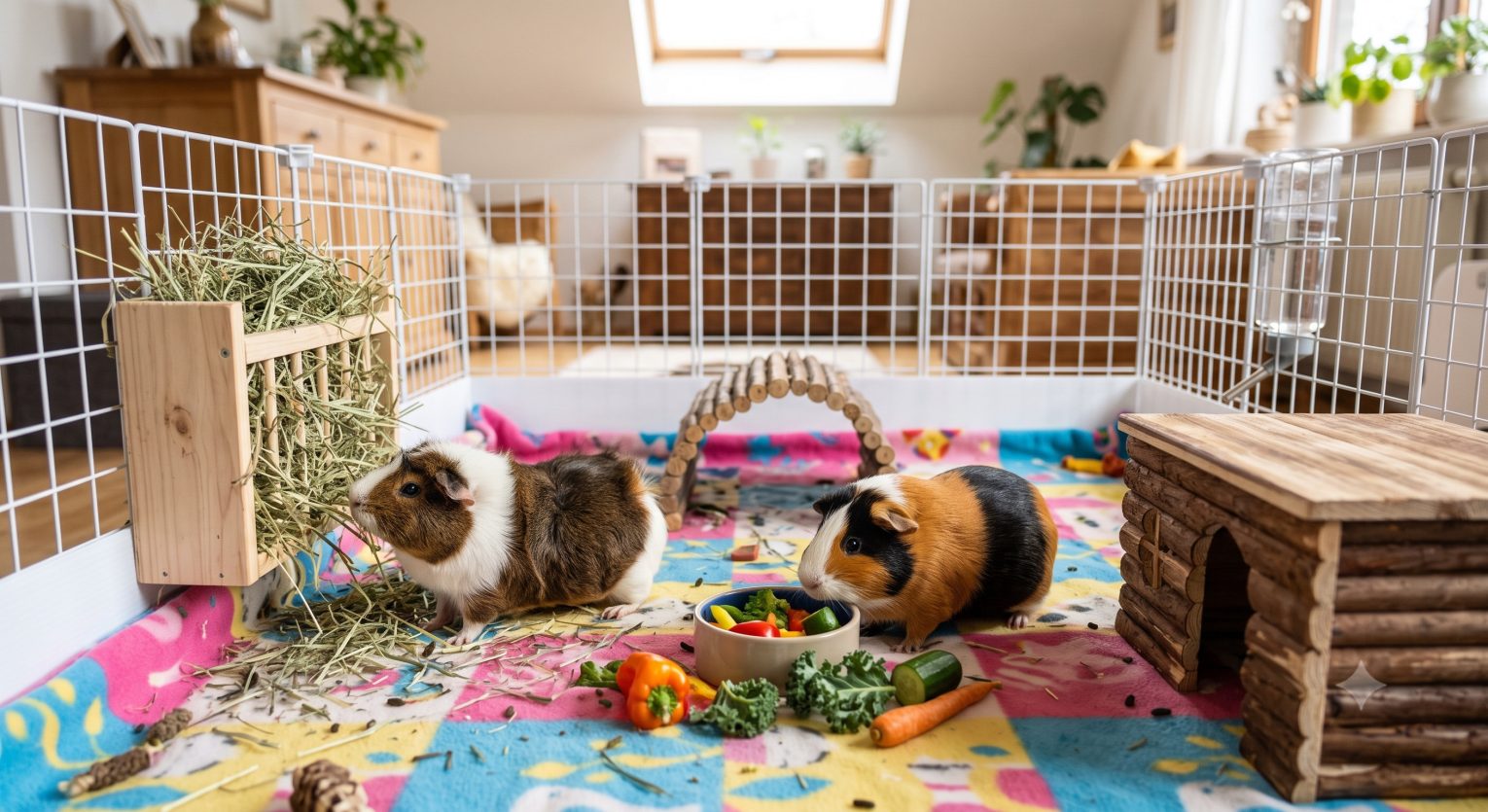
The best cage for guinea pigs is the one with the most floor space you can realistically accommodate—minimum 7.5 square feet for one guinea pig, 10.5 square feet for a pair. Most cages marketed specifically as “guinea pig cages” in pet stores fall significantly below this standard. The top picks for meeting this minimum are C&C cages (coroplast and wire grid panels), MidWest Homes for Pets guinea pig cages, and purpose-built indoor pens—all available at various price points.
The most important thing to understand before buying a guinea pig cage: floor area matters far more than height. Guinea pigs are ground- dwelling animals that run, popcorn, and patrol their territory horizontally. A tall cage with small floor space is a poor choice even if the total volume looks large on paper.
Guinea pig housing is one of the most important welfare decisions covered in our Guinea Pig Care Guide—the complete guide to guinea pig nutrition, health, and housing. This article is also part of our Small Pet Care Guide—the complete hub for rabbits, guinea pigs, and hamsters.
(💡 The most important feature of any guinea pig cage is floor area—most commercially sold “starter” cages fall well short of the 7.5 square foot minimum per pig.)
Table of Contents
Why Size Matters So Much
Guinea pigs are active animals. In the wild, cavies travel significant distances daily, grazing, socializing, and exploring. In captivity, the cage is their entire world—and a cage that is too small causes measurable behavioral and physical health problems.
❓What happens in an undersized cage:
- Reduced activity leading to obesity and associated health problems.
- Inability to express normal behavior (running, popcorning, exploring).
- Chronic stress from inadequate territory.
- Social tension in pairs due to inability to move away from each other.
- Higher ammonia buildup per square foot, increasing respiratory disease risk.
❗️The minimum size guidelines:
| Number of Guinea Pigs | Minimum Floor Space |
|---|---|
| 1 guinea pig 🐹 | 7.5 sq ft (0.7 m²) |
| 2 guinea pigs 🐹🐹 | 10.5 sq ft (1.0 m²) |
| 3 guinea pigs 🐹🐹🐹 | 13 sq ft (1.2 m²) |
| 4 guinea pigs 🐹🐹🐹🐹 | 15.5 sq ft (1.4 m²) |
These are minimums. Larger is always better. Guinea pigs kept alone—which is not recommended for welfare reasons—still need at least 7.5 square feet to move adequately.
(🩺 Vet’s Note: “The most common welfare problem I see in guinea pig patients is housing that is too small. A guinea pig in a starter cage has no room to run, nowhere to retreat from a cage mate, and no ability to express normal behavioral repertoire. Cage size is the single highest-impact welfare decision a guinea pig owner makes—it affects everything else”—LovingPetsGuide Veterinary Advisor.)
📰 The minimum floor space standard of 7.5 square feet per guinea pig is consistently cited across US veterinary and welfare sources. The Merck Veterinary Manual (merckvetmanual.com) and the Humane Society of the United States (humaneworld.org) both reference this minimum, with 10.5 square feet recommended for a pair. Wire flooring is separately documented across US veterinary literature — including the Merck Veterinary Manual and PetMD (petmd.com) — as a primary cause of pododermatitis (bumblefoot), reinforcing why solid flooring matters as much as floor area. All About Animals Veterinary Hospital and other US veterinary practices consistently confirm that most commercially sold “guinea pig starter cages” fall well short of this standard.
What to Look for in a Guinea Pig Cage
✅ Non-negotiables:
| Adequate floor space: The most important factor. Measure the internal floor area before purchasing—marketing terms like “large” or “XL” are not standardized and cannot be trusted. |
| Solid flooring: Wire mesh floors cause pododermatitis (bumblefoot)—painful sores on the feet from constant contact with wire. Every guinea pig cage must have a solid floor. If a cage has a wire floor, it needs to be covered entirely with a solid mat, fleece liner, or solid insert. |
| Adequate ventilation: Fully enclosed solid-sided cages cause ammonia buildup. Guinea pigs are particularly prone to respiratory disease. At least one side (ideally the top) should be open wire for ventilation. |
| Ease of cleaning: Guinea pigs produce a significant volume of waste. Cages that are difficult to access, have complicated disassembly, or have deep internal corners that trap waste are significantly harder to keep clean. |
| No running wheels: Guinea pigs do not use wheels. Any cage marketed with a wheel as a feature is misleading—guinea pigs’ physiology is not suited to wheel running. |
Guinea Pig Cage Types: Overview
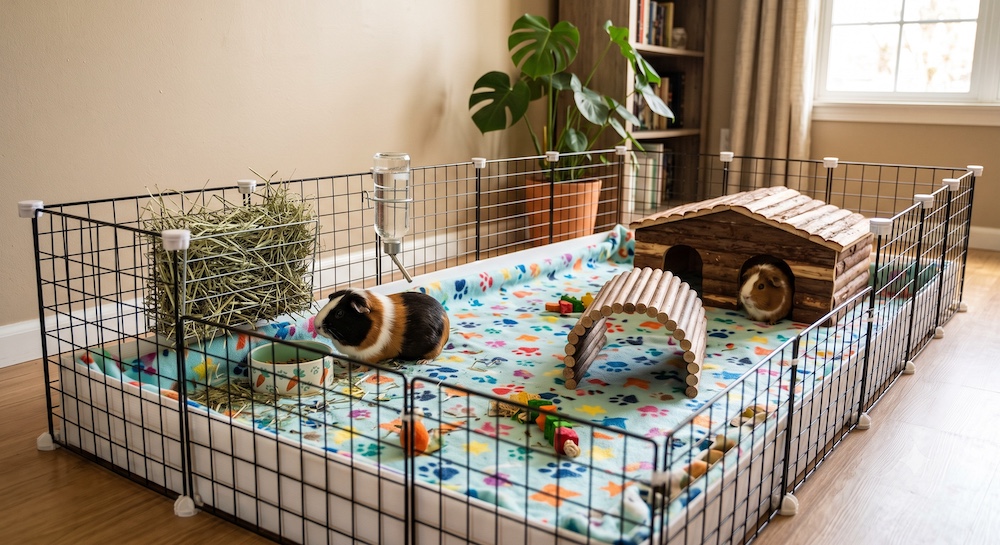
🐾 C&C Cages (Coroplast + Wire Grids)
C&C cages are the most popular choice among experienced guinea pig owners—and for good reason. They are the most customizable, most affordable per square foot, and most welfare-appropriate option available.
(💡 A C&C cage built to appropriate dimensions is the most space-efficient and cost-effective guinea pig housing option available.)
❔How they work: Modular wire grid panels (sold as “cube storage grids”) connect to form the walls. A coroplast (corrugated plastic) sheet forms the base and sides to contain bedding.
✅ Advantages:
- Can be built to any size—easily exceeds minimum size requirements.
- Highly customizable—expand, add levels, or change configuration.
- Coroplast base is easy to wipe clean.
- Most cost-effective option per square foot.
- Fleece liners work perfectly with this format.
❌ Disadvantages:
- Requires DIY assembly (grids + coroplast must be cut and shaped).
- Not as aesthetically polished as commercial cages out of the box.
- Grids sold separately from coroplast.
🏆 Best for: Owners who want maximum space at minimum cost and are willing to do basic DIY assembly.
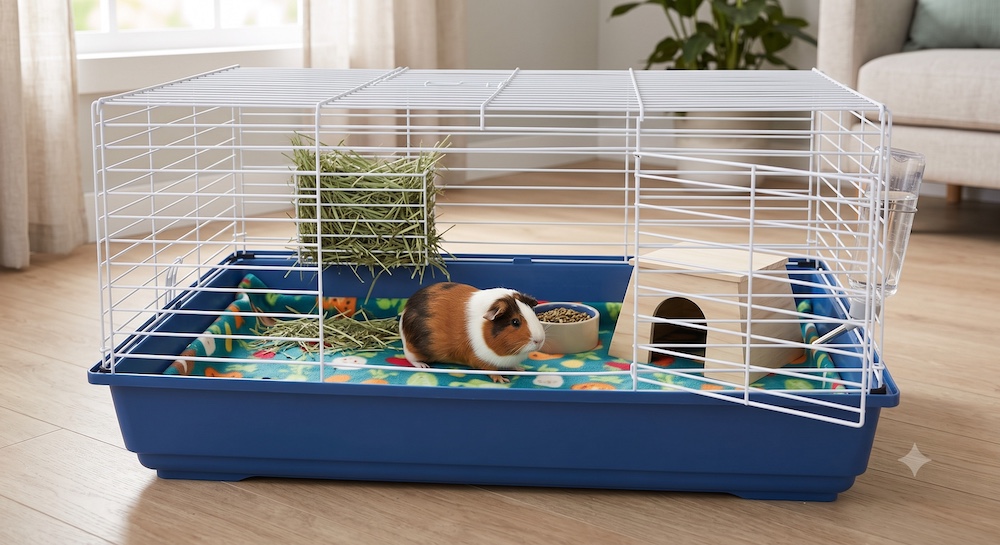
🐾 Commercial Cages
Commercial guinea pig cages offer the convenience of an out-of-the-box solution. The challenge is finding one that meets minimum size requirements— most do not.
(💡 Commercial cages offer convenience, but most fall short of the 7.5 sq ft (0.7 m²) minimum—always check internal floor dimensions before buying.)
❔What to look for in commercial cages:
- Internal floor dimensions stated in the product listing (not external).
- Solid plastic or coated wire floor options.
- Deep removable base tray for bedding containment.
- Wide opening lid or front door for easy access.
MidWest Homes for Pets Guinea Pig Cages are among the most consistently recommended commercial options—they offer larger floor areas than most competitors and use solid plastic base trays. The MidWest Guinea Habitat Plus at approximately 8 sq ft meets the minimum for a single guinea pig.
🐾 Guinea Pig Cages & Enclosures 🐾
🏠 Guinea Pig Cages & Enclosures—MidWest Homes for Pets Guinea Habitat Plus is the most consistently recommended commercial starting point at approximately 8 sq ft. Chewy carries a range of options—always verify the internal floor dimensions before purchasing and filter by size to find enclosures that meet the 7.5 sq ft minimum.
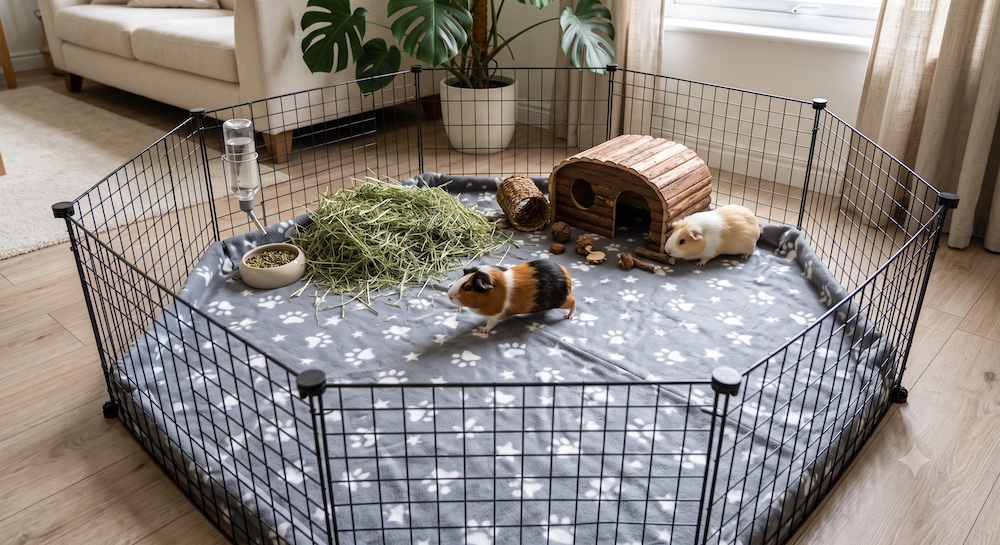
🐾 Indoor Pens and Exercise Pens
Dog or small animal exercise pens (x-pens) can work as guinea pig enclosures when the floor area meets minimum requirements. A standard 8-panel 24-inch dog x-pen creates approximately 16 square feet of floor area— more than double the minimum for a pair.
(💡 An 8-panel 24-inch x-pen creates roughly 16 sq ft (1.5 m²) of floor space—more than double the minimum for a pair of guinea pigs.)
✅ Advantages:
- Very large floor space at low cost.
- Easy to expand.
- Portable and reconfigurable.
❌ Disadvantages:
- Guinea pigs may climb 24-inch panels (36-inch panels are safer).
- No built-in base—requires a tarpaulin or mat underneath.
- Less aesthetically polished.
🏆 Best for: Owners who prioritize maximum floor space above all else and have the room to accommodate a large open pen.
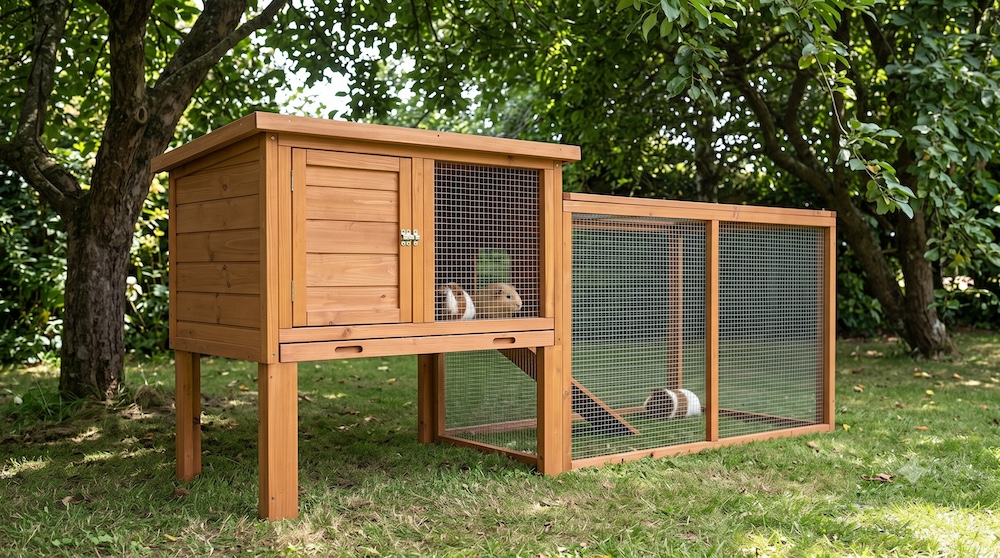
🐾 Outdoor Hutches
(💡 Outdoor hutches require secure predator-proofing and are only appropriate in temperature-stable climates—guinea pigs are highly sensitive to both heat and cold.)
Outdoor hutches can work for guinea pigs in appropriate climates, but carry significant additional welfare requirements:
🌡️ Temperature: Guinea pigs are highly sensitive to both heat and cold. Above 26°C (79°F) causes heatstroke; below 15°C (59°F) causes dangerous chilling. In most UK and northern European climates, outdoor housing is only appropriate for summer months.
🛡️ Predator protection: Guinea pigs can die from predator-induced stress even without physical attack—a fox passing the hutch at night can cause fatal cardiac events. Outdoor hutches require secure, predator-proof construction with no gaps.
❤️ Companionship: Outdoor guinea pigs must always be kept in pairs or groups— isolation outdoors with limited human contact causes severe welfare problems.
📝 Verdict: Indoor housing is strongly preferred. Outdoor hutches are acceptable in appropriate conditions but require significantly more management.
Top Picks by Category
🥇 Best Overall: MidWest Guinea Habitat Plus
❔Why: The most accessible commercial cage that approaches minimum size requirements. Solid plastic base, wire top for ventilation, wide access opening, and expandable with additional panels.
📏 Floor area: ~8 sq ft (meets minimum for one guinea pig, borderline for a pair)
🏆 Best for: New guinea pig owners wanting an out-of-the-box commercial solution that meets basic welfare standards.
❗️Limitation: Meets minimum for one pig— for a pair, pair it with an expansion panel or upgrade to a C&C build.
🥈 Best for Space: C&C Cage (DIY Build)
❔Why: The only housing option that reliably achieves appropriate size for two or more guinea pigs without spending a premium. A 2×4 grid C&C build (the standard entry-level configuration) creates approximately 10.5 sq ft— meeting the minimum for a pair.
⚙️ Standard configurations:
| Configuration | Approx Size | Best For |
|---|---|---|
| 2×3 grids | ~7.5 sq ft | 1 guinea pig minimum |
| 2×4 grids | ~10.5 sq ft | 2 guinea pigs |
| 2×5 grids | ~13 sq ft | 3 guinea pigs |
| 2×6 grids | ~15.5 sq ft | 4 guinea pigs |
💰 Cost: Wire grids $20–$40 / €20–€40. Coroplast sheet $12–$25 / €12–€25. Total less than most commercial cages— with significantly more space.
🥉 Best Budget Option: Large Indoor Exercise Pen
❔Why: A 36-inch 8-panel x-pen creates the largest floor area at the lowest cost. Requires a base layer underneath (tarpaulin or vinyl mat) and 36-inch panels to prevent climbing.
🏆 Best for: Owners with space for a large floor pen who want maximum square footage at minimum cost.
Bedding Options for Guinea Pig Cages
Fleece liners: The most popular option for C&C cages and commercial cages with solid bases. Washable, reusable, cost-effective long-term. Requires a wicking layer underneath (U-Haul moving blanket or puppy pads) to draw moisture away from the surface. Spot-clean daily, wash weekly.
Paper-based bedding (Carefresh, paper pellets): The standard alternative to fleece. Good odor control, absorbent, and available in large bags for cost efficiency. Full change every 5–7 days.
❌ Avoid:
- Cedar or pine shavings — ⚠️ aromatic oils cause respiratory disease.
- Cotton wool or fluffy bedding — ⚠️ impaction risk if ingested.
- Corn cob bedding — ⚠️ mold risk and poor odor control.
🐾 Guinea Pig Habitat Accessories 🐾
🏡 Hideouts, Hay Racks & Accessories—Every guinea pig cage needs at least one hideout per pig, a hay rack, water bottle, and food dish as a minimum. Chewy carries a wide range of guinea pig accessories—worth browsing once you have the cage sorted to complete the setup.
Essential Cage Accessories for Guinea Pigs
A cage is only the start. Every guinea pig setup needs:
❕Per pig minimum:
- One hideout/shelter — enclosed sleeping area per pig. If housing two pigs, two hideouts are essential so the lower-ranking pig always has an escape option.
- Hay rack or hay area — unlimited hay must always be available.
- Water bottle — sipper bottles preferred over open bowls which get soiled quickly.
- Food dish — heavy ceramic bowls that cannot be tipped.
❕Enrichment:
- Tunnels for natural exploratory behavior.
- Chew-safe wooden toys.
- Fleece forest tunnels (popular C&C accessory).
- Scatter feeding hay through the enclosure rather than just in a rack.
What to Avoid
| ❌ Pet store “starter kits”: Almost universally too small. Check dimensions independently before trusting any marketed description. |
| ❌ Cages with wire floors: Bumblefoot (pododermatitis) is painful and requires veterinary treatment. If you already own a wire-floor cage, cover it entirely with a solid mat before use. |
| ❌ Multi-level cages with small ramps: Guinea pigs can use ramps, but steep or narrow ramps cause falls and injuries. Any multi-level setup must have wide, gentle ramps with gripped surfaces. |
| ❌ Aquariums and glass tanks: Poor ventilation causes ammonia buildup and respiratory disease. Guinea pigs need airflow—glass enclosures do not provide adequate ventilation. |
| ❌ Any cage under 7.5 sq ft: No exceptions. A cage that looks large in a photo may have internal dimensions well below the minimum. Always measure and calculate floor area independently. |
Comparison Table
| Cage Type | Approx Cost | Min Size Achievable | Ease of Setup | Best For |
|---|---|---|---|---|
| C&C Cage (DIY) | $30–$65 / €30–€65 | Unlimited | Medium | Max space, min cost |
| MidWest Habitat Plus | $75–$110 / €75–€110 | ~8 sq ft | Easy | First-time owners |
| X-Pen / Exercise Pen | $25–$50 / €25–€50 | 16+ sq ft | Easy | Budget, max space |
| Outdoor Hutch | $100–$250+ / €100–€250+ | Varies | Hard | Specific climates only |
Conclusion
The cage decision is the most important welfare investment a guinea pig owner makes. Get the size right before worrying about accessories, bedding, or enrichment—a well-enriched cage that is too small is still a cage that is too small.
For most owners, the choice is between a C&C cage (best value per square foot, most customizable) and a commercial option like the MidWest Habitat Plus (convenient, out-of-the-box). Either can work—size is the only metric that cannot be compromised.
Key takeaways:
- ✅ Minimum 7.5 sq ft for one guinea pig.
- ✅ Minimum 10.5 sq ft for a pair.
- ✅ Solid floor only—no wire mesh.
- ✅ C&C cages offer the best value per square foot.
- ✅ MidWest Habitat Plus is the best commercial starting point.
- ✅ Always measure internal dimensions independently.
- ✅ Two hideouts minimum for a pair.
- ✅ Hay always available at all times.
👉🏼 Small Pet Care Guide—complete hub for rabbits, guinea pigs, and hamsters.
👉🏼 Guinea Pig Care Guide—full diet, health, and care guide to complement this housing guide.
👉🏼 Safe Vegetables for Small Pets—complete A–Z food list for guinea pigs and other small pets.
👉🏼 Rabbit Care Guide—rabbit housing and size requirements for comparison.
👉🏼 Hamster Care Guide—hamster-specific cage requirements and setup guide.

🐀 Browse small pet food, bedding, cages, toys, supplements and everything else your small pet needs 🐾
(This post contains affiliate links. If you purchase through our links, we may earn a small commission at no extra cost to you. This never influences our editorial opinions.)
FAQ: Best Cages for Guinea Pigs
What size cage do I need for 2 guinea pigs?
A minimum of 10.5 square feet of floor space for two guinea pigs. This is the standard recommendation from guinea pig welfare organizations and represents the minimum for two pigs to coexist comfortably with enough space to move away from each other. A 2×4 C&C cage configuration (approximately 10.5 sq ft) meets this minimum. Bigger is always better—more space reduces social tension and allows more natural behavior.
Are C&C cages better than commercial cages?
For most guinea pig owners, yes—C&C cages offer more floor space per pound/dollar spent than any commercial alternative. The trade-off is that they require basic DIY assembly (cutting coroplast and connecting grid panels). For owners who want an out-of-the-box solution, the MidWest Guinea Habitat Plus is the most size-appropriate commercial option, though it only meets the minimum for a single pig without expansion panels.
Can guinea pigs live in a rabbit cage?
Some rabbit cages have adequate floor space for guinea pigs, but check for wire floors (which cause bumblefoot) and bar spacing (guinea pigs can squeeze through wider-spaced bars designed for rabbits). A rabbit cage with solid flooring and appropriate bar spacing can work— measure the internal floor space against the 7.5 sq ft minimum before using.
How often do I need to clean a guinea pig cage?
Spot-clean the toilet corner daily and remove soiled bedding. For paper-based bedding, a full change every 5–7 days is typical. For fleece liners, spot-clean daily and wash the liner weekly. Guinea pigs produce significant waste volume—more frequent cleaning than most owners expect is normal and necessary to prevent ammonia buildup that contributes to respiratory disease.
Do guinea pigs need a cage with levels?
Not necessarily—and a multi-level cage with a small upper level does not substitute for adequate ground-floor space. Guinea pigs are ground-dwelling animals and spend the vast majority of their time on the floor level. If a multi-level cage is used, ramps must be wide, gently inclined, and have gripped surfaces to prevent falls. The ground floor area still needs to meet the minimum independently.
What is the best bedding for a guinea pig cage?
Fleece liners are the most popular choice among experienced owners—washable, reusable, and cost-effective long-term. Carefresh paper-based bedding is the best disposable alternative with good odor control. Never use cedar or pine shavings (respiratory toxicity) or cotton wool bedding (impaction risk).