
More than two-thirds of dogs over three years old have some degree of periodontal disease—making it the most common disease in pet dogs, far ahead of anything diet-related. The actual enemy isn’t the visible tartar most owners focus on; it’s plaque, an invisible bacterial biofilm that reforms daily on every tooth surface, including below the gumline where dental treats and chews can’t reach. Daily brushing is the only method that mechanically disrupts this plaque before it mineralizes into tartar within days.
Dental treats, water additives, and chew toys all help—but none of them replace brushing, because none of them reach below the gumline where periodontal disease actually begins. This guide covers why brushing specifically works, the correct technique and products to use, and the warning signs that mean it’s time for a professional cleaning.
Dental care is one part of the preventive health foundation covered alongside our Dog Nutrition Guide and Dog Training Guide. Persistent bad breath is also covered as a symptom worth monitoring in Common Dog Health Problems: Symptoms to Never Ignore.
(💡 Daily brushing is the only method that mechanically disrupts plaque before it mineralizes into tartar—no treat or chew fully replaces it.)
Table of Contents
Why “Non-Negotiable” Isn’t an Exaggeration
Periodontal disease isn’t a cosmetic issue affecting some dogs—it’s the single most common disease diagnosed in pet dogs, more prevalent than any nutrition-related condition covered elsewhere in this hub.
More than two-thirds of dogs over three years old have some degree of periodontal disease. Small and brachycephalic (flat-faced) breeds face even higher risk due to tooth crowding in a smaller jaw.
❗️The disease progresses in two stages:
- Gingivitis—early gum inflammation, still reversible with proper cleaning.
- Periodontitis—permanent damage to the tissue and bone supporting the teeth, not reversible even with treatment.
This is exactly why catching and preventing the early stage matters so much more than treating advanced disease after the fact.
(🩺 Vet’s Note: “By the time an owner notices bad breath and visible tartar, the disease process has usually already been active for a while. What worries me more than the tartar I can see is what’s likely happening below the gumline, where a home exam can’t tell us anything.”—LovingPetsGuide Veterinary Advisor)
📰 Periodontal disease is documented by VCA Animal Hospitals (vcahospitals.com) as affecting more than two-thirds of dogs over three years old, making it the most common disease in pet dogs—compared to tooth decay being the most common dental condition in humans. VCA confirms small breeds and brachycephalic dogs face elevated risk due to jaw size and tooth crowding.
The Real Enemy: Plaque, Not Tartar
This is the single most important concept to understand—and the one most dental product marketing gets backward.
Tartar is what you can see: the golden-brown, hardened buildup on visible tooth surfaces. It’s unsightly and harbors bacteria, but it isn’t actually the primary driver of periodontal disease.
Plaque is the real problem: an invisible bacterial biofilm that forms on every tooth surface—above and below the gumline—starting fresh every single day, even immediately after a professional cleaning. Left undisturbed, plaque mineralizes into tartar within days, but by then the bacterial damage to gum tissue is already underway.
❓Why this distinction matters practically: Products that only address visible tartar (some chews, certain water additives used alone) are tackling the symptom, not the ongoing daily process. Brushing is the only method that mechanically disrupts plaque itself, daily, before it has the chance to mineralize and before bacteria can do sustained damage below the gumline.
📰 Cornell University College of Veterinary Medicine (vet.cornell.edu) confirms that plaque—not tartar—is the true driver of periodontal disease, describing plaque as an invisible bacterial biofilm that forms above and below the gumline, causing gum inflammation, periodontal pockets, and eventual tissue damage. The Merck Veterinary Manual (merckvetmanual.com) separately confirms that plaque continuously reforms on tooth surfaces daily—including the day immediately following a professional cleaning—and that plaque matures into mineralized tartar as salivary minerals interact with the undisturbed biofilm.
How to Actually Brush Your Dog’s Teeth
Step-by-step technique:
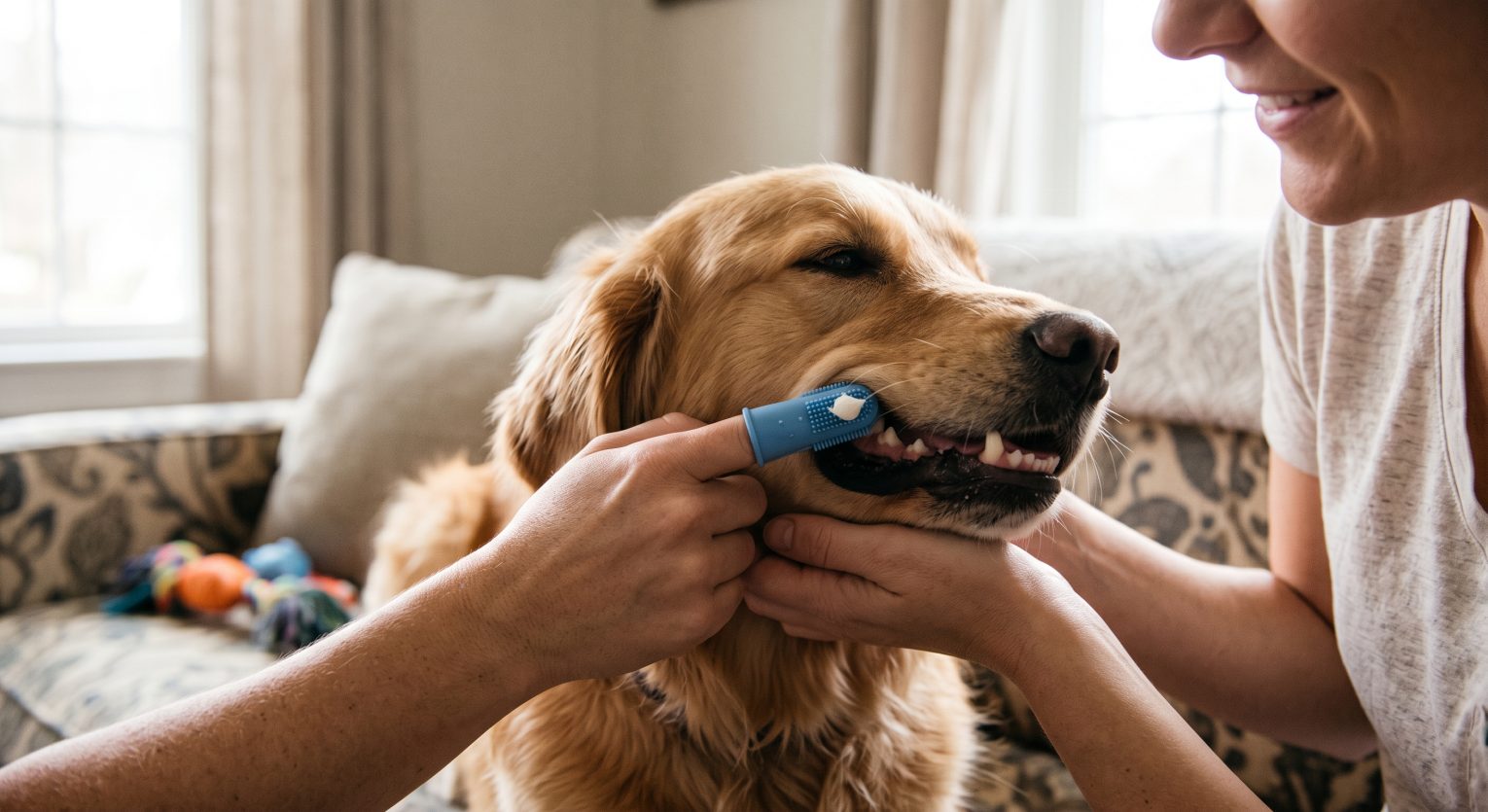
Start slowly, letting your dog taste the dog- safe toothpaste alone before introducing a brush.
Use a soft-bristled dog toothbrush or a silicone finger brush for smaller mouths or first-time brushing.
Lift the lip gently and brush at a 45-degree angle toward the gumline, where plaque accumulates most.
Focus especially on the outer surfaces of the back teeth, where tartar builds up fastest.
Aim for daily brushing; even 3–4 times weekly provides meaningful benefit over no brushing at all.
❗️Never use human toothpaste. Many contain xylitol or fluoride, both toxic to dogs even in small amounts. Always use a toothpaste formulated specifically for dogs.
❕Building the habit gradually matters more than perfect technique on day one. A short, calm session your dog tolerates well is more valuable long-term than a thorough but stressful one that makes future sessions harder.
🐾 Dog Toothbrushes & Enzymatic Toothpaste 🐾
🪥 Dog-Specific Toothbrushes & Toothpaste — Finger brushes work well for smaller mouths or first-time brushing; enzymatic toothpaste helps break down plaque chemically alongside the mechanical action of brushing. Never substitute human toothpaste, which can be toxic to dogs.
Dental Treats and Chews: A Supplement, Not a Substitute
Dental treats and chews genuinely help reduce plaque and tartar—but they work alongside brushing, not instead of it.
❗️Look for the VOHC seal. The Veterinary Oral Health Council reviews products against evidence-based testing standards for actual plaque and tartar reduction, rather than relying on marketing claims alone. A VOHC-approved product has demonstrated real effectiveness in controlled testing.
❓Why treats alone fall short: Chewing action addresses visible tooth surfaces reasonably well but can’t reach below the gumline, where the earliest and most consequential stages of periodontal disease develop. This is the same plaque-versus-tartar distinction covered above.
🏆 Best approach: Combine daily brushing as the primary method with VOHC-approved dental treats as a genuine, evidence-backed supplement—not a replacement for the days you don’t get to brushing.
🐾 VOHC-Approved Dental Treats 🐾
🦴 Dental Chews & Treats — A genuine supplement to daily brushing, not a replacement. Look specifically for the VOHC (Veterinary Oral Health Council) seal, which confirms independently tested plaque and tartar reduction rather than marketing claims alone.
Signs of Dental Disease Worth Watching For
- Persistent bad breath beyond normal “dog breath”.
- Red, swollen, or bleeding gums.
- Visible yellow-brown tartar buildup, especially near the gumline.
- Reluctance to chew, dropping food, or eating on one side of the mouth.
- Pawing at the mouth or face.
- Loose or visibly damaged teeth.
Any of these signs warrant a veterinary dental exam—see Common Dog Health Problems: Symptoms to Never Ignore for how this fits into your dog’s broader symptom checklist.
Why Professional Cleanings Require Anesthesia
This is a common source of owner hesitation worth addressing directly.
A thorough dental exam isn’t possible in an awake dog. Properly assessing periodontal disease requires probing below the gumline and often dental radiographs—neither is safely or accurately possible without anesthesia, since even a well-behaved dog won’t tolerate the discomfort of a genuine periodontal probe while conscious.
“Anesthesia-free” cleaning services have real limitations. These can improve the appearance of visible tartar but can’t assess or treat what’s happening below the gumline—precisely the area where periodontal disease actually causes lasting damage.
🩸 Pre-anesthetic bloodwork is standard practice before a professional cleaning, checking that kidney and liver function can safely support the anesthesia required for a thorough exam and treatment.
📰 The necessity of anesthesia for a genuine periodontal assessment is documented by VCA Animal Hospitals, which confirms that a proper dental cleaning includes examining tooth alignment and tartar accumulation both above and below the gumline—an assessment only possible once a dog is anesthetized—alongside pre-anesthetic bloodwork to confirm kidney and liver function can safely support the procedure.
Common Dental Care Mistakes
| ❌ Using human toothpaste. Xylitol and fluoride, common in human toothpaste, are toxic to dogs. |
| ❌ Relying on dental treats alone. Genuinely helpful as a supplement, but they can’t reach below the gumline the way brushing does. |
| ❌ Only addressing visible tartar. Covered in detail above—plaque, not tartar, drives the actual disease process. |
| ❌ Waiting for bad breath before starting a routine. By the time bad breath is noticeable, periodontal disease has often already progressed past the easily reversible gingivitis stage. |
| ❌ Avoiding professional cleanings due to anesthesia concerns. A genuine periodontal assessment isn’t possible without it—pre-anesthetic bloodwork exists specifically to make the procedure as safe as possible. |
| ❌ Giving up after one difficult brushing session. Gradual introduction, starting with just tasting the toothpaste, builds tolerance far better than pushing through a stressful first attempt. |
Conclusion
Periodontal disease is the most common health problem in pet dogs, and it’s also one of the most preventable—but only if the prevention method actually addresses plaque, not just visible tartar. Daily brushing remains the one method that reaches where treats, chews, and water additives can’t, making it the genuine foundation of dental care rather than one option among equals.
Key takeaways:
- ✅ More than two-thirds of dogs over three years old have some degree of periodontal disease.
- ✅ Plaque, not tartar, is the real driver of disease—and it reforms daily, even after cleaning.
- ✅ Gingivitis is reversible; periodontitis causes permanent damage.
- ✅ Brushing is the only method that mechanically disrupts plaque below the gumline.
- ✅ Dental treats and chews genuinely help but supplement brushing rather than replace it.
- ✅ Look for the VOHC seal for evidence-tested dental products.
- ✅ Professional cleanings require anesthesia for a genuine below-gumline assessment—this is a safety standard, not an unnecessary risk.
👉🏼 Dog Nutrition Guide—the nutritional foundation for long-term health.
👉🏼 Dog Training Guide—the training foundation for confident, well-adjusted dogs.
👉🏼 Common Dog Health Problems: Symptoms to Never Ignore—the complete symptom checklist, including dental warning signs.
👉🏼 Dog Vaccination Schedule: Complete Year-Round Guide—another preventive care essential.
👉🏼 [Senior Dog Care Guide: Health, Diet & Mobility]—how dental needs shift with age.
📝 Editor’s Note: Periodontal disease prevalence and mechanism in this guide were verified against VCA Animal Hospitals (vcahospitals.com), the Merck Veterinary Manual (merckvetmanual.com), and Cornell University College of Veterinary Medicine (vet.cornell.edu). VOHC certification standards reflect the Veterinary Oral Health Council’s published evidence-based testing criteria.

🐕 Browse dog food, treats, toys, health products, supplements, grooming and everything else your dog needs 🐾

🐕 Browse raw dog food, freeze-dried meals, chews, bones and natural treats from Indiana farms 🐾

🐕 Browse science-backed dry dog food, wet food, breed-specific formulas, and veterinary diets for your canin 🐾
(This post contains affiliate links. If you purchase through our links, we may earn a small commission at no extra cost to you. This never influences our editorial opinions.)
FAQ: Dental Care for Dogs
How often should I brush my dog’s teeth?
Daily brushing provides the most benefit, since plaque reforms on tooth surfaces every day. Brushing 3–4 times weekly still provides meaningful benefit over no brushing at all, though daily remains the gold standard recommendation.
Can I use human toothpaste on my dog?
No. Many human toothpastes contain xylitol or fluoride, both toxic to dogs even in small amounts. Always use a toothpaste specifically formulated and labeled for dogs.
Are dental chews and treats enough on their own?
No, though they’re a genuine, evidence-backed supplement when VOHC-approved. Chewing addresses visible tooth surfaces but can’t reach below the gumline, where periodontal disease actually begins and causes the most lasting damage.
What does the VOHC seal mean?
The Veterinary Oral Health Council reviews dental products against evidence-based testing standards for actual plaque and tartar reduction, rather than accepting marketing claims alone. A VOHC-approved product has demonstrated real, tested effectiveness.
Why does my dog need anesthesia for a teeth cleaning?
A genuine periodontal assessment requires probing below the gumline and often dental radiographs, neither of which is safely or accurately possible in an awake dog. Anesthesia-free cleaning services can improve visible appearance but can’t assess or treat the below-gumline disease process that actually matters most.
What breeds are most at risk for dental disease?
Small breeds and brachycephalic (flat-faced) breeds face elevated risk due to tooth crowding in a smaller jaw, though periodontal disease affects the majority of dogs over three years old regardless of breed without consistent preventive care.