
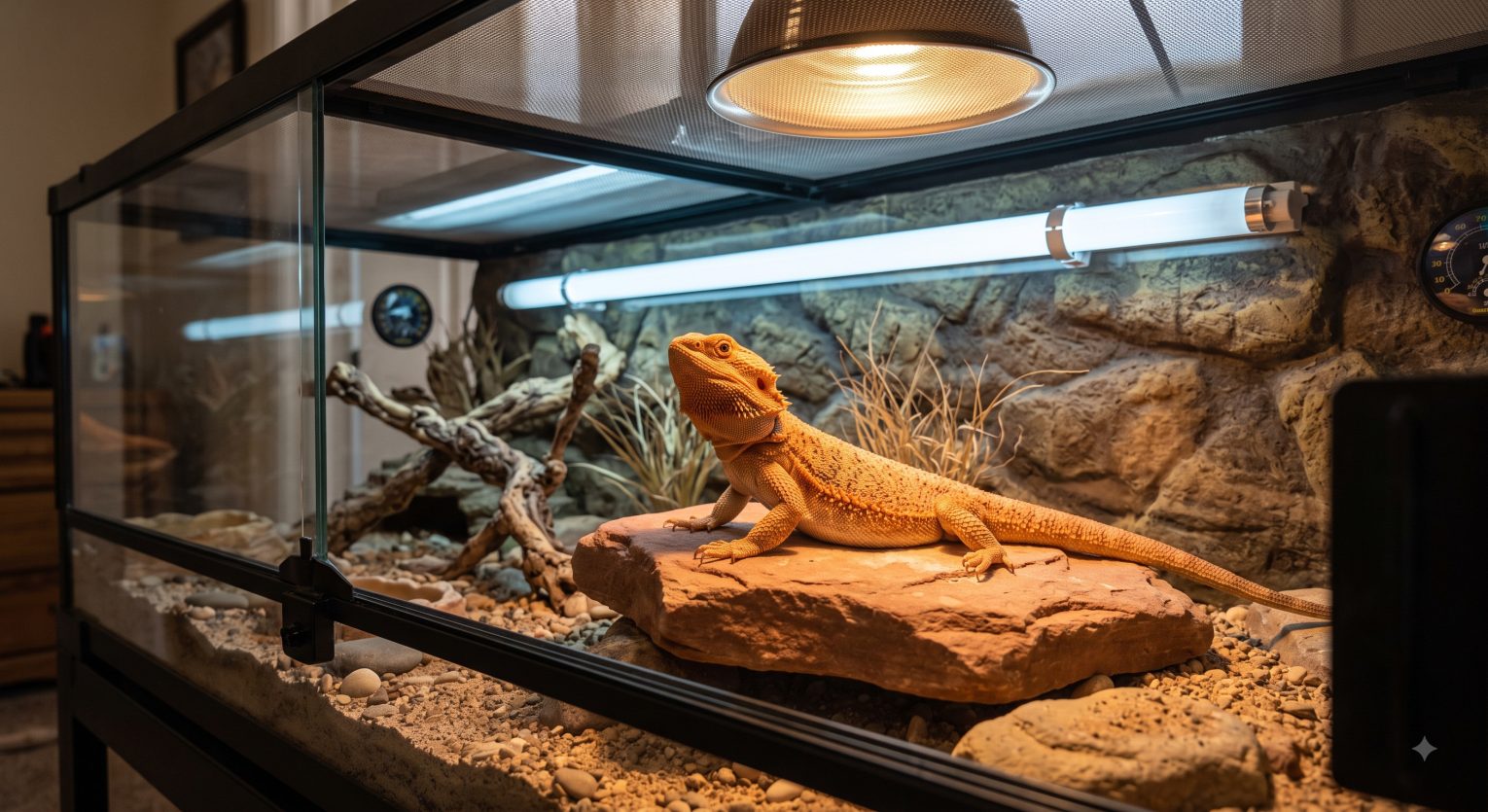
Bearded dragons need a basking surface temperature of 95–105°F (35–40°C), a cool side around 75–85°F (24–29°C), and a dedicated UVB bulb replaced every 6–12 months regardless of whether it still lights up—UVB output fades long before visible light does. Diet is the other non-negotiable: young dragons need roughly half their diet as insects for growth, while adults need mostly leafy greens and vegetables, with insects making up a much smaller share.
Most preventable bearded dragon health problems trace back to one of these two systems—heat/UVB or diet— being set up incorrectly from the start. This guide covers the exact temperatures, lighting setup, and diet ratios that keep a bearded dragon genuinely healthy, not just alive.
Bearded dragon care is one of several reptile species covered in our Exotic Pet Care Guide—the complete hub for reptile diet, lighting, and habitat setup. UVB lighting deserves particular attention—see UVB Lighting for Reptiles: Which Bulb Does Your Pet Need? for the complete breakdown of bulb types and placement.
(💡 A correctly set up basking spot and UVB source are the two most important investments in a bearded dragon’s long-term health.)
Table of Contents
Why Heat and UVB Come First
Before diet, habitat decor, or anything else, two systems determine whether a bearded dragon thrives or slowly declines: temperature gradient and UVB exposure. Both are frequently underestimated by new owners, and both cause health problems that develop quietly over weeks or months before becoming visible.
❗️Bearded dragons are ectothermic (cold-blooded). They cannot generate their own body heat and depend entirely on their environment to reach the internal temperature needed for digestion, immune function, and normal activity. Without adequate heat, a bearded dragon’s digestion slows dramatically, food sits undigested, and appetite and activity drop off.
❗️UVB is not optional lighting—it’s a metabolic requirement. Bearded dragons need UVB exposure to synthesize vitamin D3, which their body uses to absorb calcium from food. Without sufficient UVB, even a calcium-rich diet doesn’t get absorbed properly—a distinction that surprises many new owners.
(🦎 Reptile Keeper’s Note: “The two mistakes I see most often are basking bulbs that create a warm room instead of a hot surface, and UVB bulbs that still look bright but stopped producing usable UVB months ago. Both are invisible to a casual glance—you have to actually measure them to know your setup is correct.”—LovingPetsGuide Reptile Advisor)
Part 1: Temperature and Lighting
🌡️ The Temperature Gradient
Bearded dragons need a range of temperatures across their enclosure, not one single number—this range, called a thermal gradient, lets them move between warmer and cooler zones to regulate their own body temperature throughout the day.
Target temperatures:
| Zone | Temperature |
|---|---|
| Basking surface (adults) | 95–105°F (35–40°C) |
| Basking surface (juveniles) | 100–110°F (38–43°C) |
| Cool side (ambient) | 75–85°F (24–29°C) |
| Nighttime | 65–75°F (18–24°C), lights off |
⚠️ Measure the basking surface directly, not the air. A common setup mistake is checking ambient air temperature with a stick-on dial thermometer and assuming the basking spot is correct. Surface temperature—measured with a digital probe thermometer or infrared temperature gun placed directly on the basking platform—is what actually matters for thermoregulation.
❗️No light or heat at night. Bearded dragons need genuine darkness to sleep normally. If your home drops below 65°F (18°C) overnight, use a ceramic heat emitter (which produces no light) rather than leaving a basking bulb on.
📰 Basking surface temperature targets and the importance of surface-level (rather than ambient air) measurement are documented by UC Davis School of Veterinary Medicine (healthtopics.vetmed.ucdavis.edu), which confirms a daytime basking spot in the 88–95°F range with cooler ambient temperatures on the opposite side of the enclosure, creating the gradient bearded dragons need to thermoregulate effectively.
💡 UVB Lighting
Use a T5 HO (high output) 10.0 UVB fluorescent tube, spanning at least two-thirds of the enclosure’s length, mounted inside the enclosure rather than on top of a mesh lid or behind glass— both materials block a significant percentage of UVB output before it ever reaches your dragon.
Replace the UVB bulb every 6–12 months, regardless of whether it still produces visible light. UVB output degrades well before the bulb appears to dim—a bearded dragon basking under an expired tube can develop metabolic bone disease even though the light “looks fine” to the owner.
Run UVB and basking lights on the same 10–12 hour daily cycle, ideally on an automatic timer for consistency.
For the complete breakdown of UVB bulb types, placement distance, and how to verify your setup is actually working, see UVB Lighting for Reptiles: Which Bulb Does Your Pet Need?.
🐾 T5 HO UVB Bulbs 🐾
☀️ T5 HO 10.0 UVB Tubes — The standard UVB source for bearded dragons. Mount inside the enclosure, never behind glass or mesh, and replace every 6–12 months regardless of whether it still produces visible light.
💧 Humidity
Bearded dragons come from arid regions of Australia and need low humidity—30–40%, monitored with a hygrometer. Excess moisture in the enclosure contributes to respiratory infections and skin problems. If humidity runs high, improve ventilation, reduce water dish size, or reconsider your substrate choice.
Part 2: Diet
📊 The Ratio Flips With Age
This is the single most important diet concept to understand—and the one most new owners get backward by assuming one ratio applies at every life stage.
Juveniles and young dragons (under ~12–18 months): Growing dragons need significantly more protein. Roughly half their diet should be appropriately sized insects, with the remainder fresh vegetables and leafy greens.
Adults: The ratio shifts dramatically toward plants. A well-balanced adult diet is approximately:
- 50% dark leafy greens (collard, mustard, dandelion, turnip greens, bok choy).
- 20% chopped or grated vegetables (squash, sweet potato, carrot, broccoli).
- 25% insects (Dubia roaches, crickets).
- 5% or less fruit, offered only occasionally.
⏱️ Feeding frequency: Juveniles typically eat once daily; adults do well eating daily or every other day, offered an amount they can finish within the day.
📰 Adult bearded dragon diet composition—50% leafy greens, 20% chopped vegetables, 25% animal protein, and a maximum of 5% fruit—is documented by NC State Veterinary Hospital (hospital.cvm.ncsu.edu), which also confirms that young, growing dragons require substantially more protein than adults to support their more rapid growth phase.
💊 Supplements
Calcium powder: Dust insects with a phosphorus-free calcium powder 4–5 times weekly for juveniles, 2–3 times weekly for adults.
Multivitamin powder: Dust feeder insects with a reptile multivitamin 1–2 times weekly, in addition to (not instead of) calcium dusting.
⚠️ Calcium supplementation supports UVB—it doesn’t replace it. Without adequate UVB exposure, dietary calcium isn’t absorbed effectively regardless of how much supplement is used. Both systems need to work together.
🦗 Safe Staple Insects
Best staples: Dubia roaches and crickets—easier to digest and lower impaction risk than harder- bodied alternatives.
Occasional treats only: Mealworms and superworms have harder exoskeletons that carry higher impaction risk, particularly for juveniles.
❗️Never feed wild-caught insects—they can carry parasites or pesticide residue.
🐾 Calcium & Multivitamin Reptile Supplements 🐾
💊 Phosphorus-Free Calcium Powder — Dust feeder insects before offering. Works alongside UVB exposure, not as a replacement for it—both are needed for proper calcium absorption.
Part 3: Habitat
📏 Enclosure Size
Juveniles can start in a 40 gal (151 L) enclosure but grow quickly and will need to be upgraded.
Adults need significantly more space—75–120 gal (284–454 L) or larger. Bearded dragons need floor space more than height, since they’re primarily ground-dwelling baskers rather than climbers.
🟫 Substrate
For juveniles: solid surfaces only. Reptile carpet, ceramic tile, or paper towels. Young dragons are enthusiastic, indiscriminate hunters and will accidentally ingest loose particles while chasing insects, risking impaction.
For adults: Textured ceramic tile or slate remains the safest default. Some experienced keepers use fine, calcium-based sand with adults, but this still carries some impaction risk and requires closer monitoring—solid surfaces remain the lower- risk choice at any age.
Enclosure Furnishing
- A sturdy basking platform (flat rock or driftwood) positioned directly under the heat source.
- At least one hide for security.
- A shallow water dish, especially important for juveniles to prevent drowning risk.
- Safe climbing branches or décor (avoid anything treated with pesticides).
Common Bearded Dragon Care Mistakes
| ❌ Measuring air temperature instead of basking surface temperature. The single most common setup error—leads to a basking spot that’s actually too cool despite “correct” thermostat readings. |
| ❌ Letting the UVB bulb run past its replacement window. A tube that still visibly lights up can have already lost most of its usable UVB output. Track the install date, not the bulb’s appearance. |
| ❌ Feeding an adult ratio to a growing juvenile (or vice versa). Underfeeding protein to a juvenile slows healthy growth; overfeeding protein to an adult contributes to obesity and other long-term issues. |
| ❌ Loose substrate for juveniles. The impaction risk substantially outweighs any aesthetic benefit at this life stage. |
| ❌ Skipping calcium/UVB pairing. Both systems work together—strong UVB with no dietary calcium, or calcium supplementation with inadequate UVB, both leave a dragon vulnerable to metabolic bone disease. See Metabolic Bone Disease in Reptiles: Prevention & Treatment for the complete picture of how this condition develops and how to prevent it. |
Conclusion
Bearded dragons are genuinely rewarding reptile pets—alert, interactive, and generally tolerant of handling—but their health depends heavily on getting two invisible systems right: a properly measured heat gradient and functioning UVB exposure, paired with a diet ratio that shifts as they grow.
Key takeaways:
- ✅ Basking surface: 95–105°F adults, 100–110°F juveniles—measured at the surface, not the air.
- ✅ UVB tube replaced every 6–12 months regardless of appearance.
- ✅ Diet ratio flips with age: juveniles need more protein, adults need mostly leafy greens.
- ✅ Calcium supplementation works alongside UVB, not instead of it.
- ✅ Solid substrate for juveniles—loose substrate carries real impaction risk.
- ✅ Adults need 75–120 gal minimum, with floor space prioritized over height.
📝 Editor’s Note: Temperature and UVB guidance in this article were cross-referenced with UC Davis School of Veterinary Medicine (healthtopics.vetmed.ucdavis.edu). Diet composition and ratios were verified against NC State Veterinary Hospital (hospital.cvm.ncsu.edu). Substrate and impaction risk information reflects consistent guidance across established reptile husbandry resources.
👉🏼 Exotic Pet Care Guide—complete hub for reptile care essentials.
👉🏼 UVB Lighting for Reptiles: Which Bulb Does Your Pet Need?—the complete bulb and placement guide.
👉🏼 Metabolic Bone Disease in Reptiles: Prevention & Treatment—what happens when heat, UVB, or calcium goes wrong.
👉🏼 How to Set Up a Bioactive Terrarium—a more advanced, naturalistic enclosure approach.
👉🏼 Best Reptiles for Beginners: Easy Species to Start With—how bearded dragons compare to other beginner-friendly species.

🐍 Browse exotic pet food, terrariums, lighting, heating, supplements and everything else your reptile needs 🐾
(This post contains affiliate links. If you purchase through our links, we may earn a small commission at no extra cost to you. This never influences our editorial opinions.)
FAQ: Bearded Dragon Care Guide
What temperature should a bearded dragon’s basking spot be?
95–105°F (35–40°C) for adults, slightly warmer at 100–110°F (38–43°C) for juveniles, measured directly at the basking surface with a digital probe thermometer or infrared temperature gun—not the surrounding air temperature.
How often do I need to replace the UVB bulb?
Every 6–12 months, regardless of whether the bulb still produces visible light. UVB output degrades well before visible brightness fades, and a bearded dragon basking under an expired tube can develop metabolic bone disease without any obvious warning sign to the owner.
What do baby bearded dragons eat compared to adults?
Young, growing dragons need roughly half their diet as appropriately sized insects to support rapid growth. Adults need a much lower proportion of insects (around 25%), with the majority of their diet made up of dark leafy greens and chopped vegetables.
Can I use sand as substrate for my bearded dragon?
Not recommended for juveniles, who are prone to accidentally ingesting loose particles while hunting insects, risking digestive impaction. Some experienced keepers use fine, calcium-based sand with adults, but solid surfaces like reptile carpet or ceramic tile remain the lower-risk choice at any age.
Do bearded dragons need light or heat at night?
No. Turn off both UVB and basking lights at night— bearded dragons need genuine darkness to sleep normally. If your home drops below 65°F (18°C) overnight, use a ceramic heat emitter, which provides warmth without light.
How big of an enclosure does an adult bearded dragon need?
At least 75–120 gallons (284–454 L), with floor space prioritized over height since bearded dragons are primarily ground-dwelling baskers. Juveniles can start smaller but grow quickly and will need to be upgraded well before reaching adult size.