
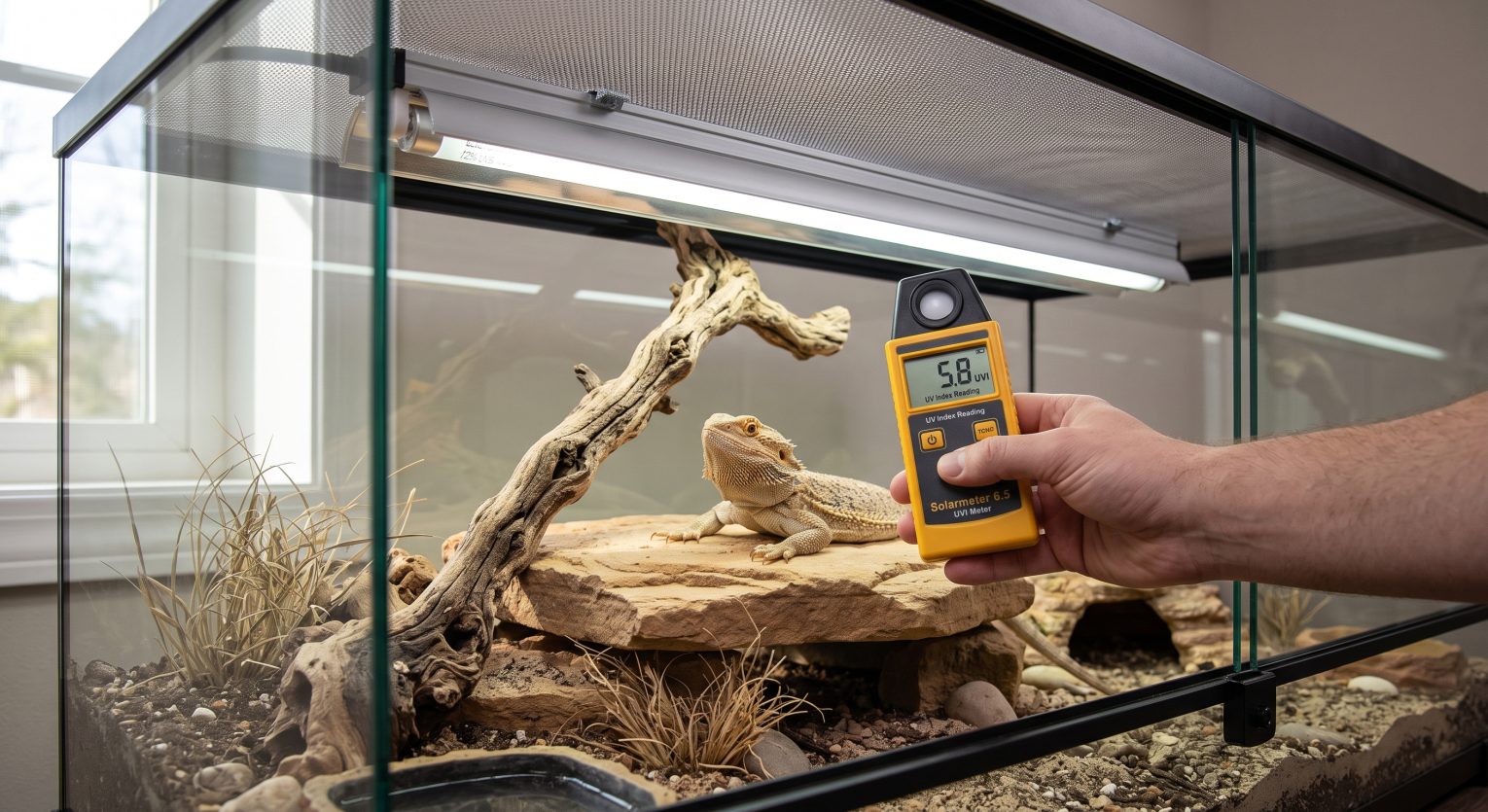
Reptile UVB needs vary dramatically by species, categorized using the “Ferguson zone” system—shade- dwelling species like leopard geckos need minimal UVB (Zone 1), while extreme baskers like bearded dragons need strong exposure (Zone 4). Regardless of species, place UVB bulbs 9–15 in (23–38 cm) from your reptile with nothing between the bulb and the animal—glass and most plastics block all UVB output—and replace bulbs every 6–12 months regardless of whether they still produce visible light.
One safety detail worth knowing: compact “coil” UVB bulbs were linked to eye damage (photokeratitis) in reptiles due to manufacturing defects in specific brands roughly 2006–2009. Reputable current brands have resolved this, but it’s a reason many experienced keepers still default to linear tube fixtures for larger or more UVB-dependent species.
UVB lighting is one part of the complete picture covered in our Exotic Pet Care Guide—the hub for reptile diet, lighting, and habitat setup. For species-specific UVB requirements already applied in practice, see our Bearded Dragon Care Guide (Zone 4, strong UVB) and Leopard Gecko Care Guide (Zone 1, low-level UVB) for two very different real-world examples.
(💡 Bulb percentage alone doesn’t confirm correct UVB delivery—distance, mesh, and glass all change the actual dose your reptile receives.)
Table of Contents
Why UVB Isn’t One-Size-Fits-All
UVB exposure allows reptiles to synthesize vitamin D3 in their skin, which their body then uses to absorb calcium from food. Without adequate UVB (or, in some cases, precise dietary D3 supplementation as an alternative), calcium isn’t absorbed properly regardless of diet quality—a foundation covered in more depth in Metabolic Bone Disease in Reptiles: Prevention & Treatment.
❗️But “adequate” varies enormously by species. A bearded dragon evolved basking in direct, intense Australian sun for hours daily. A leopard gecko evolved emerging briefly at dusk into low, indirect light. Applying the same UVB setup to both isn’t just imprecise—it can genuinely harm one species while underdosing the other.
(🦎 Reptile Keeper’s Note: “The most common UVB mistake isn’t choosing the wrong bulb—it’s assuming percentage alone tells you what your reptile is actually receiving. Distance, mesh, glass, and bulb age all change the real dose dramatically from what the box implies.”—LovingPetsGuide Reptile Advisor)
The Ferguson Zone System
Rather than guessing species-by-species, modern herpetoculture uses a standardized framework developed from real observation of wild reptile sun exposure.
❓What it is: In 2010, a research team led by Professor Gary Ferguson of Texas Christian University published a study in the journal Zoo Biology, using UV index meters to measure the actual daily sun exposure of 15 reptile species in their natural habitats. Species were grouped into four zones based on this real behavioral data.
| Zone | Description | Target UVI at Basking Spot | Example Species |
|---|---|---|---|
| Zone 1 | Crepuscular/shade-dwelling | 0.0–0.6 | Leopard geckos |
| Zone 2 | Partial sun/shade | 0.7–1.0 | Some snake species |
| Zone 3 | Open/partial-sun baskers | 1.0–2.6 | Many common lizards |
| Zone 4 | Full-sun extreme baskers | 3.0–6.0 | Bearded dragons |
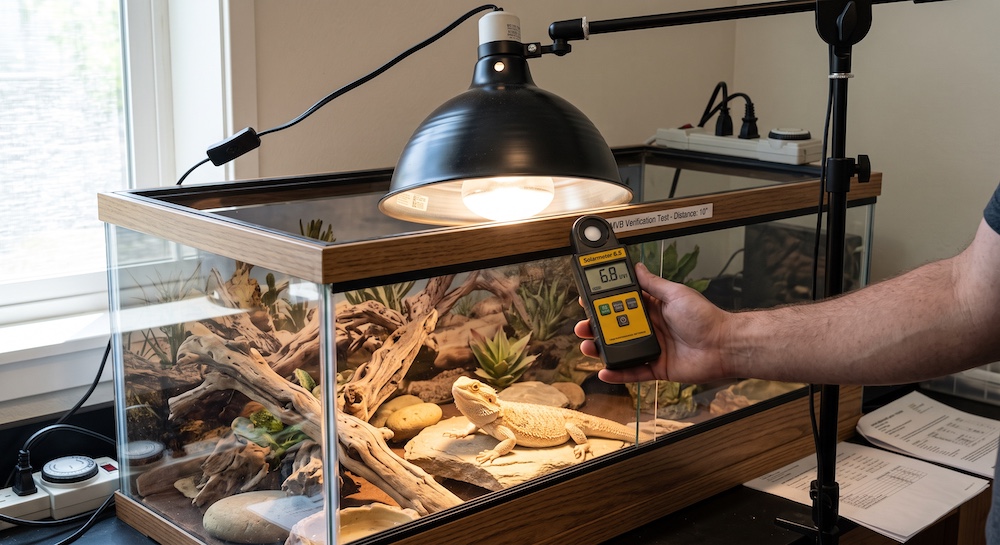
❔How to actually measure this: A UV index (UVI) meter—the Solarmeter 6.5 is the most widely referenced model—measures real UVB output at your reptile’s actual basking position, accounting for your specific bulb, distance, and any mesh or glass in the way. This is meaningfully more reliable than trusting a bulb’s printed percentage alone, since real-world output varies by brand, bulb age, and setup.
⚠️ Even Zone 4 species need a retreat. Every zone still requires a gradient down to near-zero UVI in a shaded area of the enclosure, not uniform high exposure everywhere—reptiles regulate their own UV intake by moving in and out of the beam, the same way they thermoregulate.
📰 The Ferguson zone classification system is documented in the original 2010 study published in Zoo Biology, led by Professor Gary Ferguson of Texas Christian University, which measured real UV index exposure across 15 wild reptile species and grouped them into four zones based on observed natural basking behavior. This research remains the foundation for current species-specific UVB guidance used across zoo, veterinary, and hobbyist herpetoculture resources.
Bulb Types Compared
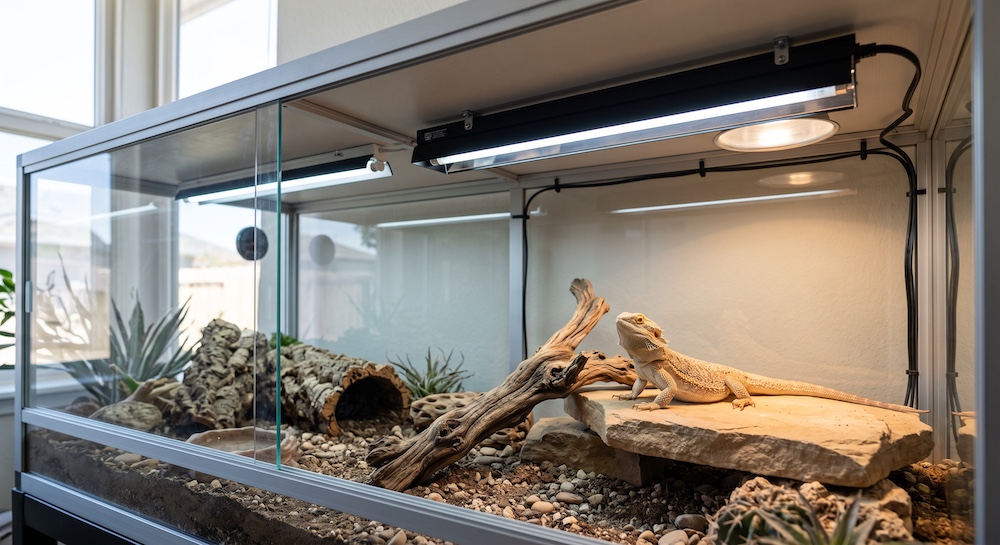
T5 HO (High Output) Linear Fluorescent Tubes
💡 T5 HO tubes are the current gold standard — even coverage, sun-strength UVB output, and close to a full 12-month lifespan.
⭐️ The current gold standard for most setups. Can produce sun-strength UVB, typically lasts close to the full 12-month replacement window, and provides even coverage across a wide basking area when sized correctly (should span roughly half the enclosure length, positioned over the basking zone specifically).
🏆 Best for: Most Zone 3–4 species, including bearded dragons—see Bearded Dragon Care Guide for this exact application.
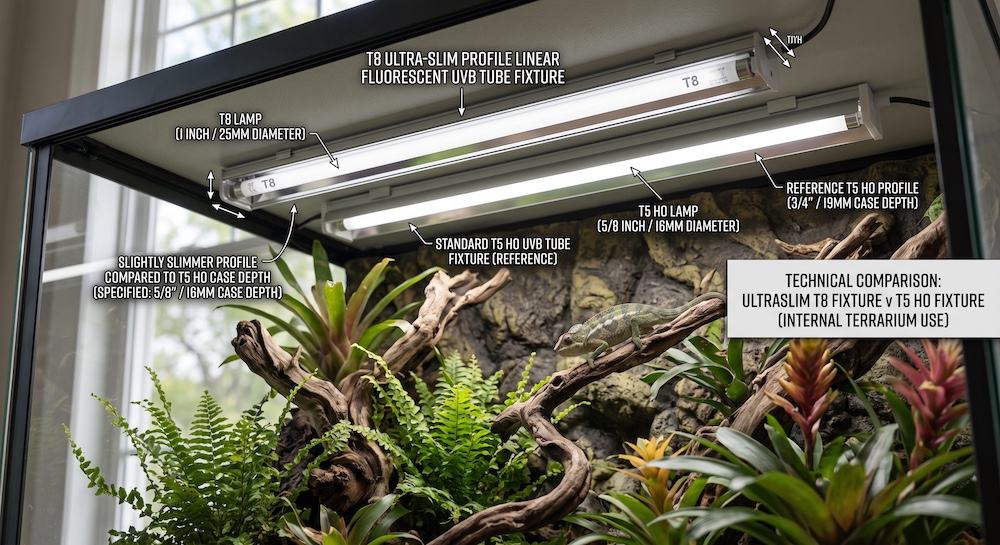
T8 Linear Fluorescent Tubes
💡 T8 tubes are an older fluorescent technology, generally weaker than T5 HO for the same percentage rating.
An older, less efficient fluorescent technology. Generally produces weaker UVB output than T5 HO for a given percentage rating and has largely been superseded by T5 HO as the standard recommendation.
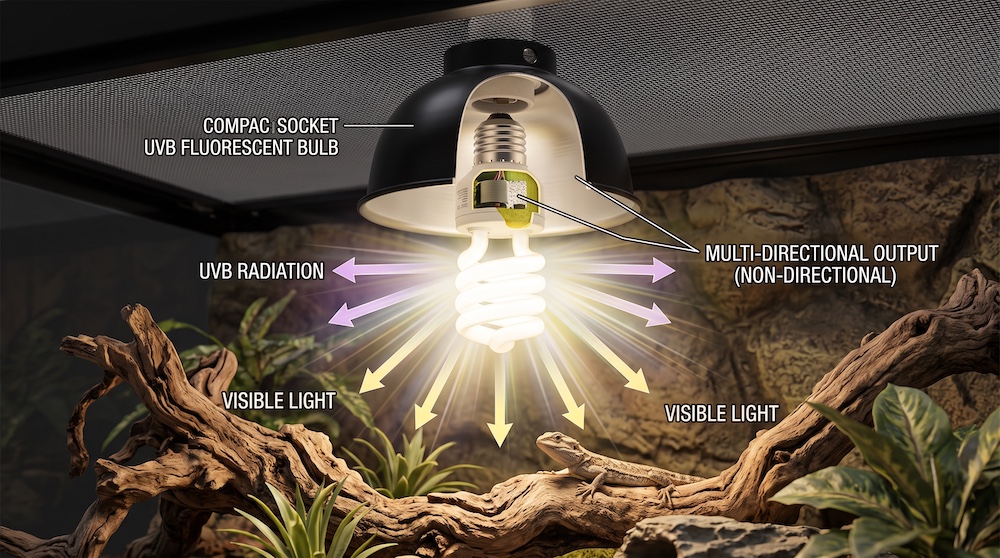
Compact (“Coil”) Fluorescent Bulbs
💡 Compact bulbs emit light in all directions rather than a focused beam, making a clean basking zone with a shaded retreat harder to achieve.
❗️Historical safety concern worth knowing. Manufacturing defects in specific compact UVB bulb batches from certain brands, roughly 2006–2009, lacked proper phosphor coating and leaked UVC radiation—a wavelength capable of causing genuine eye and skin damage. Reputable current manufacturers have resolved this issue, but cheaper import bulbs have continued to raise similar concerns.
❗️Additional limitation: compact bulbs emit light in all directions rather than in a focused downward beam, making it difficult to create a clean basking zone with a proper shaded retreat—and their output decays faster than tubes, often needing replacement around 6 months.
🏆 Best for: Small or arboreal setups where a full tube fixture isn’t practical—not recommended for larger Zone 3–4 baskers like bearded dragons.
Mercury Vapor Bulbs
💡 Mercury vapor bulbs combine heat and UVB in one bulb, but output varies enough between batches that a UV meter is essential to verify actual delivery.
Combine heat and UVB output in a single bulb— convenient, but output has been documented to vary significantly even between bulbs from the same manufacturing batch, and these bulbs cannot be controlled by a standard thermostat the way a heat mat or basking bulb can.
⚠️ Never use a mercury vapor bulb without a UV index meter to verify actual output. Given the batch-to-batch variability, assuming the printed rating is accurate is a real risk with this bulb type specifically.
🐾 T5 HO UVB Fluorescent Tubes 🐾
☀️ T5 HO UVB Tubes (Various Strengths) — The current gold standard for most reptile setups. Chewy carries a range of strengths from low-output (2.0–5.0) for shade-dwelling species to high-output (10.0–14%) for extreme baskers—match strength to your species’ Ferguson zone.
Placement: Distance, Barriers, and Verification
📏 Safe Distance
9–15 in (23–38 cm) from the bulb to your reptile’s basking position is the general safe range—closer risks skin damage, photokeratitis (a painful corneal inflammation, essentially a UV “sunburn” of the eye), or in extreme cases, abnormal cell growth from excessive exposure.
The inverse-square law matters more than most guides explain: doubling the distance between bulb and basking spot doesn’t halve the UV intensity—it reduces it by roughly 75%. Small changes in mounting height can dramatically change actual UVB delivery.
🌥️ What Blocks UVB Completely
Glass and most plastics filter out UVB entirely. A UVB bulb mounted outside a glass terrarium lid provides essentially zero benefit, regardless of bulb strength.
Mesh reduces output significantly, with the exact reduction depending on mesh material and thickness. Bulbs should be mounted inside the enclosure, or as close to an open-topped mesh lid as safely possible, rather than assuming any mesh barrier is negligible.
✅ Verifying Your Setup Actually Works
Watch for behavioral signs. A reptile that basks unusually close to the bulb for extended periods may be signaling insufficient UVB reaching its normal basking distance—worth investigating with a meter rather than assuming the behavior is just personality.
A UV index meter is the only way to know for certain. Bulb percentage on the box reflects output under ideal, controlled test conditions—not your specific distance, mesh, bulb age, or fixture.
📰 Safe UVB placement distance and the risk of photokeratitis from bulbs positioned too close are documented by VCA Animal Hospitals (vcahospitals.com), which specifies a safe range of 9 to 15 inches (23–38 cm) between bulb and reptile, confirms that UV light must reach the animal unfiltered—meaning no glass or plastic barrier—and identifies photokeratitis, skin damage, and abnormal cell growth as documented risks of excessive or improperly positioned UVB exposure.
Replacement Schedule
💡 Replace UVB tubes every 6–12 months, and compact bulbs closer to the 6-month mark, regardless of whether the bulb still produces visible light. UVB output degrades well before visible brightness fades—a bulb that “looks fine” can already be providing little to no usable UVB.
📅 Track the install date, not the bulb’s appearance. Writing the installation date directly on the fixture or setting a recurring reminder removes the guesswork that leads most owners to run bulbs well past their effective lifespan.
🐾 UV Index Meters 🐾
📊 UV Index (UVI) Meters — The only reliable way to confirm your specific setup delivers the correct UVB dose at your reptile’s actual basking distance, accounting for your exact bulb, fixture, and any mesh or glass barrier.
Common UVB Mistakes
| ❌ Mounting the bulb outside glass or behind a solid lid. Provides essentially zero real UVB regardless of bulb strength—glass blocks it entirely. |
| ❌ Trusting bulb percentage without measuring actual distance and barriers. The printed rating reflects ideal test conditions, not your specific enclosure setup. |
| ❌ Running bulbs past their replacement window. A bulb producing visible light can have already lost most of its usable UVB output. |
| ❌ Using a strong Zone 4 bulb for a Zone 1 species, or vice versa. Mismatched intensity either provides inadequate exposure or risks overexposure—match bulb strength and distance to your specific species’ zone. |
| ❌ No shaded retreat. Even the most sun-loving species need the ability to move away from UVB entirely, not constant uniform exposure across the whole enclosure. |
| ❌ Using cheap, unbranded compact bulbs without research. While reputable current brands have resolved the historical UVC leakage issue, quality control on unfamiliar budget imports remains a legitimate concern. |
Conclusion
UVB isn’t a single universal requirement—it’s a species-specific system that depends on matching zone, bulb type, distance, and replacement schedule correctly. Getting each piece right is what actually prevents the metabolic bone disease that improper UVB setup most commonly causes.
Key takeaways:
- ✅ Ferguson zones (1–4) categorize species by real measured wild UV exposure, from shade-dwellers to extreme baskers.
- ✅ T5 HO tubes are the current gold standard for most setups.
- ✅ Compact bulbs had a real historical safety issue—largely resolved for reputable brands, still worth caution with cheap imports.
- ✅ Safe distance: 9–15 in (23–38 cm), with glass and most plastics blocking UVB entirely.
- ✅ Doubling distance cuts UV intensity by roughly 75%, not 50%.
- ✅ Replace every 6–12 months regardless of visible brightness—track the install date, not appearance.
- ✅ A UV index meter is the only way to confirm your specific setup actually works.
📝 Editor’s Note: The Ferguson zone classification system referenced in this guide originates from Ferguson et al., published in Zoo Biology (2010), Texas Christian University. Safe placement distance and photokeratitis risk were verified against VCA Animal Hospitals (vcahospitals.com). Bulb type comparisons and the historical compact bulb safety issue reflect consistent documentation across established herpetoculture and reptile lighting resources.
👉🏼 Exotic Pet Care Guide—complete hub for reptile care essentials.
👉🏼 Bearded Dragon Care Guide: Diet, Heat & Habitat—a real-world Zone 4 UVB application.
👉🏼 Leopard Gecko Care Guide: The Best Beginner Reptile—a real-world Zone 1 UVB application.
👉🏼 Metabolic Bone Disease in Reptiles: Prevention & Treatment—what happens when UVB setup goes wrong.
👉🏼 Best Reptiles for Beginners: Easy Species to Start With—species compared by care complexity, including lighting needs.

🐍 Browse exotic pet food, terrariums, lighting, heating, supplements and everything else your reptile needs 🐾
(This post contains affiliate links. If you purchase through our links, we may earn a small commission at no extra cost to you. This never influences our editorial opinions.)
FAQ: UVB Lighting for Reptiles
What is a Ferguson zone?
A classification system grouping reptile species by their measured natural UV exposure in the wild, from Zone 1 (shade-dwelling species like leopard geckos, needing minimal UVB) to Zone 4 (extreme baskers like bearded dragons, needing strong UVB). It originates from a 2010 study published in Zoo Biology and remains the standard framework for matching UVB setup to species.
How far should a UVB bulb be from my reptile?
Generally 9–15 inches (23–38 cm), though the exact safe distance depends on your specific bulb’s strength and your species’ UVB requirements. Closer positioning risks photokeratitis (corneal inflammation) and skin damage; too far provides insufficient UVB to be useful.
Can I put a UVB bulb outside my reptile’s glass tank?
No. Glass and most plastics block UVB entirely, regardless of bulb strength. The bulb must be mounted inside the enclosure, or immediately above an open mesh top, for any UVB to actually reach your reptile.
Are compact “coil” UVB bulbs safe to use?
Reputable current brands have resolved the manufacturing defects that caused documented eye damage in specific compact bulb batches roughly 2006–2009. However, cheap or unbranded imports carry ongoing quality control uncertainty, and compact bulbs generally aren’t recommended for larger, strongly UVB-dependent species due to their limited coverage and faster output decay.
How often do I really need to replace a UVB bulb?
Every 6–12 months for tubes, closer to 6 months for compact bulbs—regardless of whether the bulb still produces visible light. UVB output declines well before visible brightness does, making appearance an unreliable guide.
Do I need a UV index meter, or is trusting the bulb’s percentage enough?
A UV meter is strongly recommended. The percentage printed on a bulb reflects output under controlled test conditions, not your specific setup’s distance, mesh, glass, or bulb age—all of which meaningfully change the actual dose your reptile receives.