
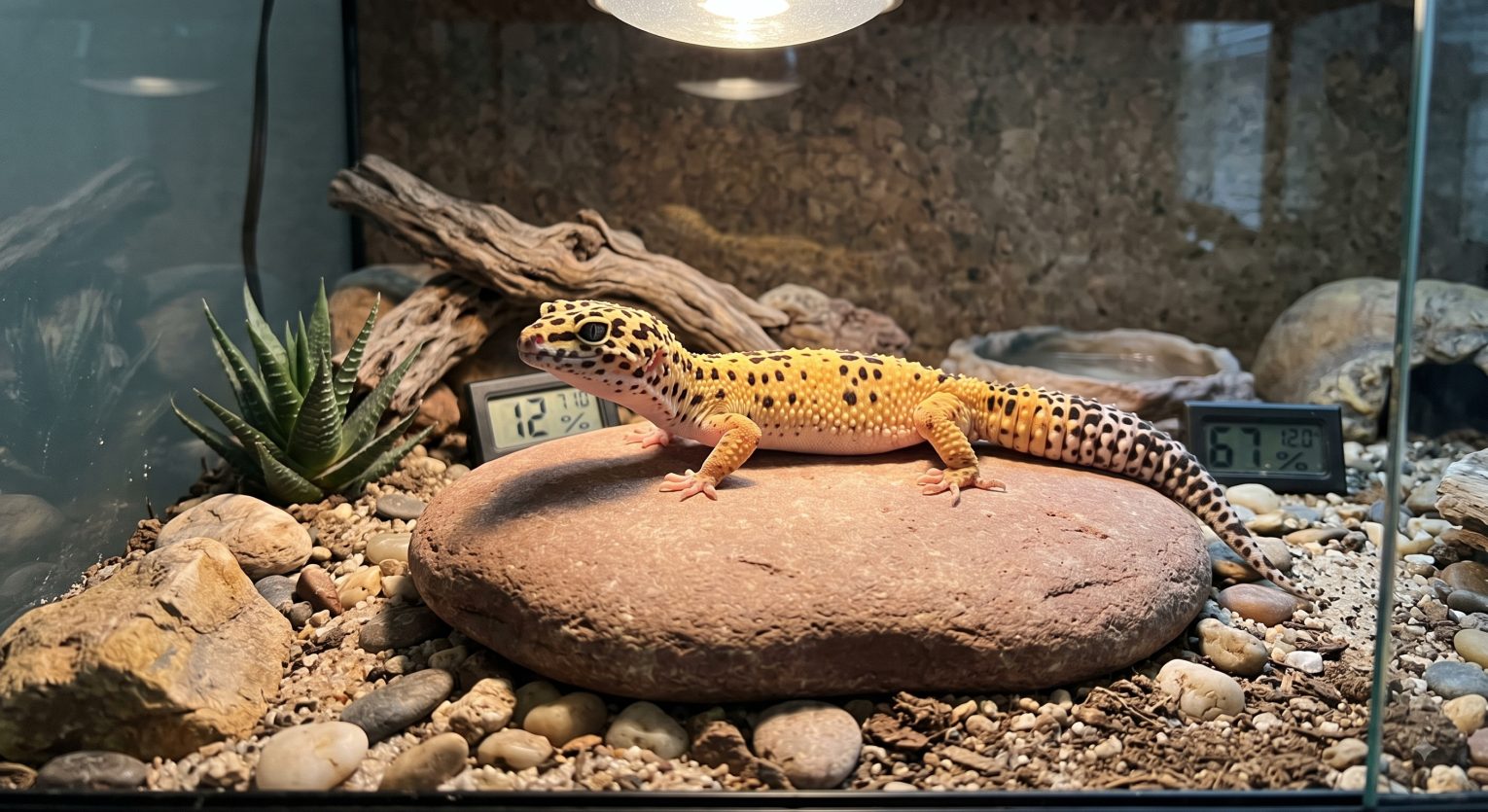
Leopard geckos need a warm hide around 88–92°F (31–33°C) via an under-tank heat mat, a cool side around 70–75°F (21–24°C), and a strict insectivore diet of appropriately sized crickets, mealworms, or dubia roaches—no vegetables or fruit at all. They’re widely considered the best beginner reptile thanks to their docile temperament, manageable size, and comparatively simple care requirements.
One piece of long-standing advice deserves an update: for years, leopard geckos were considered one of the few reptiles that didn’t need UVB lighting at all, since they’re active mainly at dawn and dusk. Newer research has revised this—low- level UVB is now considered genuinely beneficial, not just optional. This guide covers the current, accurate setup for heat, lighting, diet, and habitat.
Leopard gecko care is one of several reptile species covered in our Exotic Pet Care Guide—the complete hub for reptile diet, lighting, and habitat setup. If you’re deciding between species, our Bearded Dragon Care Guide: Diet, Heat & Habitat covers a similarly beginner-friendly but notably different reptile for comparison.
(💡 Leopard geckos are widely considered the best beginner reptile—docile, manageable in size, and comparatively simple to care for correctly.)
Table of Contents
Why Leopard Geckos Are the Beginner Standard
A few traits make leopard geckos a genuinely good starting point for new reptile keepers, not just a commonly-recommended default:
❕Docile temperament. Leopard geckos rarely bite and tolerate gentle handling well once accustomed to their owner, particularly compared to more defensive lizard species.
❕Manageable size. Adults reach roughly 8–10 in (20–25 cm), staying comfortably within a moderate enclosure for their entire life.
❕Simpler diet than many reptiles. As strict insectivores, there’s no age-based ratio to track the way there is with omnivorous species—see Bearded Dragon Care Guide for a direct comparison.
❕Long lifespan for a small reptile. Well-cared- for leopard geckos commonly live 15–20 years—a genuine long-term commitment worth planning for before bringing one home.
(🦎 Reptile Keeper’s Note: “Leopard geckos get recommended as ‘beginner reptiles’ so often that people sometimes assume that means low-effort. It doesn’t—it means the requirements are more forgiving of small mistakes, not that there aren’t real requirements to get right.”—LovingPetsGuide Reptile Advisor)
Part 1: Heat Setup
Unlike baskers such as bearded dragons, leopard geckos get their heat primarily from below—via an under-tank heat mat—rather than from an overhead basking bulb, reflecting how they naturally absorb warmth from sun-heated rock in the wild.
Target temperatures:
| Zone | Temperature |
|---|---|
| Warm hide (over heat mat) | 88–92°F (31–33°C) |
| Cool side | 70–75°F (21–24°C) |
🌡️ Always use a thermostat. A heat mat connected directly to a wall outlet without a thermostat can overheat and burn a gecko that can’t move away from direct contact. The thermostat keeps the mat within a safe range automatically.
🟧 Run the heat mat continuously (24/7). Unlike a basking bulb that follows a day/night light cycle, the heat mat typically stays on at all times, maintaining the warm hide as a stable option whenever your gecko needs it—since leopard geckos are most active at dusk and through the night, not primarily during daylight hours.
⚠️ Inadequate warm-side temperature is a leading cause of impaction. Digestion in reptiles is temperature-dependent—a warm hide that runs too cool leaves food only partially digested, which can lead to a dangerous blockage.
🐾 Reptile Heat Mats & Thermostats 🐾
🌡️ Under-Tank Heat Mats with Thermostat Control — Always pair a heat mat with a thermostat—never run one directly off the wall outlet, which risks overheating and burns. Aim for a warm hide surface of 88–92°F (31–33°C).
Part 2: The UVB Question — What’s Actually Changed
This deserves its own section because the standard advice has genuinely shifted, and a lot of information still online reflects the outdated version.
❗️The old consensus: Because leopard geckos are active primarily at dusk and through the night, they were long considered one of the few commonly kept reptiles that didn’t need UVB lighting at all—vitamin D3 needs were assumed to be fully met through dietary supplementation alone.
❓What’s changed: Leopard geckos are now understood to be more accurately described as crepuscular (active at dawn and dusk) rather than strictly nocturnal, meaning they do receive some natural UV exposure in the wild during those low-light hours. Research has since shown that low-level UVB exposure produces measurably higher vitamin D3 levels than dietary supplementation alone provides.
✅ The current recommendation: A low-strength UVB bulb (2.0–5.0, notably weaker than the 10.0 strength used for baskers like bearded dragons) is now considered genuinely beneficial best practice—not strictly mandatory if supplementation is dosed precisely, but a meaningful health upgrade over supplementation alone.
❔Why UVB is still preferable to supplements alone: UV-triggered vitamin D3 synthesis is self-regulating— a gecko’s body stops producing it once sufficient levels are reached. Oral D3 supplementation can’t self-regulate the same way, creating more room for under- or over-supplementation.
📰 A controlled study published in Comparative Biochemistry and Physiology accessed (via ScienceDirect) found that hatchling leopard geckos exposed to low-level UVB (33–51 μW/cm²) from hatching through 6 months of age had significantly higher serum vitamin D3 metabolite concentrations than non-exposed geckos, even though both groups received identical dietary vitamin D3 supplementation. This directly challenges the older assumption that supplementation alone fully replaces UVB exposure for this species, and reflects why current herpetological guidance now recommends low-level UVB as best practice rather than an unnecessary addition.
❕If you choose not to provide UVB: Consistent, correctly dosed oral D3 supplementation remains a workable approach—just a less precise one than UV-triggered synthesis. Dust feeder insects with a calcium powder containing D3 2–3 times weekly for adults, more frequently for juveniles, and pair with a separate D3-free calcium source to avoid over-supplementation.
🐾 Low-Strength UVB Bulbs (2.0–5.0) 🐾
☀️ Low-Output UVB Bulbs — Notably weaker than the 10.0 strength used for basking species like bearded dragons. Mount inside the enclosure per manufacturer distance guidelines, positioned so your gecko can choose to move toward or away from it.
Part 3: Diet
Strict Insectivore — No Exceptions
Leopard geckos are strict insectivores. Unlike omnivorous species covered elsewhere in this hub, there’s no plant matter component to plan for at any life stage—vegetables and fruit offer no nutritional benefit and aren’t part of a correct diet.
Staple feeder insects:
- 🦗 Crickets.
- 🪳 Dubia roaches.
- 🪱 Mealworms (adults only—harder exoskeleton, higher impaction risk for juveniles).
- 🪱 Hornworms.
Occasional treats only: Waxworms are high in fat and appropriate only as an occasional treat, not a regular staple.
Prey size rule: Never offer insects wider than the space between your gecko’s eyes. Oversized prey raises choking and impaction risk substantially.
Feeding frequency: Adults every other day; juveniles under one year daily.
❗️Never feed wild-caught insects—parasite and pesticide exposure risk.
🐾 Calcium & D3 Reptile Supplements 🐾
💊 Calcium Powder (With and Without D3) — Keep both a D3-inclusive and a D3-free calcium powder on hand. Use the D3 version 2–3 times weekly if providing UVB, or more consistently if UVB isn’t part of your setup.
Part 4: Habitat
📏 Enclosure Size
A single adult leopard gecko needs a minimum of a 20 gal (76 L) enclosure, with 40 gal (151 L) or larger recommended for more natural movement space. Floor space matters more than height—leopard geckos are ground-dwelling and don’t climb the way arboreal gecko species do.
🟫 Substrate
Avoid loose substrate entirely, including sand and crushed walnut shell—both carry real impaction risk if ingested, and even substrates marketed as “digestible” don’t eliminate this risk. Reptile carpet or paper towel remain the safest choices; carpet requires frequent washing to prevent bacterial buildup.
💧 Humidity and the Moist Hide
Overall enclosure humidity should stay around 30–40%, but include one dedicated moist hide at 70–80% humidity (a hide with damp sphagnum moss inside) to support healthy shedding. Incomplete shedding, particularly around the toes, is a common problem when humidity runs too low overall.
🪨 Hides
Provide at least two hides—one on the warm side, one on the cool side—plus the dedicated moist hide. Leopard geckos are secretive by nature and use hiding spots extensively, particularly during daylight hours.
Part 5: Understanding the Tail
The tail is worth its own section because it serves two distinct, easily misunderstood purposes.
Fat storage. A leopard gecko’s tail stores fat reserves—a plump, full tail is actually a good sign of body condition, while a thin, shrunken tail can signal poor nutrition or an underlying health issue worth monitoring.
Defense mechanism (autotomy). When frightened or roughly grabbed, a leopard gecko can voluntarily drop its tail to distract a predator and escape—a defense called autotomy. The tail regrows over time but typically returns shorter, differently shaped, or a different texture than the original.
⚠️ Never grab or hold a leopard gecko by the tail. This is the most common way tail drop happens in captivity, and while not medically dangerous on its own, it’s an avoidable stress event.
Common Leopard Gecko Care Mistakes
| ❌ Skipping the thermostat on the heat mat. A heat mat run directly off a wall outlet without temperature regulation is a genuine burn risk. |
| ❌ Following outdated “no UVB needed” advice. Covered in detail above—low-level UVB is now considered a meaningful health benefit, not an unnecessary extra. |
| ❌ Loose substrate, especially for juveniles. The impaction risk outweighs any aesthetic benefit at any life stage. |
| ❌ Offering oversized prey. Anything wider than the space between your gecko’s eyes raises choking and impaction risk. |
| ❌ Handling by the tail. The fastest way to trigger unnecessary tail-drop stress—always support the body, never the tail. |
| ❌ Assuming “beginner reptile” means minimal effort. Leopard geckos are forgiving of small mistakes compared to more demanding species—they still have real, non-negotiable requirements around heat and diet. |
Conclusion
Leopard geckos earn their reputation as the best beginner reptile honestly—docile, manageable, and comparatively simple to feed correctly. The one area where care advice has genuinely evolved is UVB: the old “geckos don’t need it” guidance is outdated, and current evidence supports low-level UVB as a real health benefit worth providing.
Key takeaways:
- ✅ Warm hide 88–92°F (31–33°C) via thermostat- controlled heat mat, not an overhead basking bulb.
- ✅ Low-strength UVB (2.0–5.0) is now genuinely recommended, not an unnecessary extra.
- ✅ Strict insectivore diet—no vegetables or fruit at any life stage.
- ✅ Avoid loose substrate entirely due to impaction risk.
- ✅ Include a dedicated moist hide for healthy shedding.
- ✅ Never handle by the tail—autotomy is a real, avoidable stress response.
- ✅ 15–20 year lifespan—a genuine long-term commitment.
📝 Editor’s Note: UVB guidance in this article was verified against a controlled study published in Comparative Biochemistry and Physiology (via ScienceDirect) on vitamin D3 synthesis in juvenile leopard geckos. Heat, diet, and substrate guidance reflects consistent consensus across established reptile husbandry and veterinary resources.
👉🏼 Exotic Pet Care Guide—complete hub for reptile care essentials.
👉🏼 Bearded Dragon Care Guide: Diet, Heat & Habitat—comparing another popular beginner reptile.
👉🏼 UVB Lighting for Reptiles: Which Bulb Does Your Pet Need?—the complete bulb strength and placement guide across species.
👉🏼 Metabolic Bone Disease in Reptiles: Prevention & Treatment—what happens when heat, UVB, or calcium goes wrong.
👉🏼 Best Reptiles for Beginners: Easy Species to Start With—how leopard geckos compare to other beginner-friendly options.

🐍 Browse exotic pet food, terrariums, lighting, heating, supplements and everything else your reptile needs 🐾
(This post contains affiliate links. If you purchase through our links, we may earn a small commission at no extra cost to you. This never influences our editorial opinions.)
FAQ: Leopard Gecko Care Guide
Do leopard geckos really need UVB lighting?
Current evidence says low-level UVB (2.0–5.0 strength) is genuinely beneficial, even though leopard geckos can technically survive on precise oral D3 supplementation alone. Research shows UVB- exposed geckos have measurably higher vitamin D3 levels than supplementation-only geckos, since UV- triggered synthesis self-regulates in a way oral supplements can’t.
What temperature does a leopard gecko’s warm hide need to be?
88–92°F (31–33°C), maintained via an under-tank heat mat connected to a thermostat—never run a heat mat directly off a wall outlet, which risks overheating and burns.
Can leopard geckos eat vegetables?
No. Leopard geckos are strict insectivores with no dietary use for plant matter at any life stage, unlike omnivorous reptile species. Their diet consists entirely of appropriately sized feeder insects.
Is sand safe as substrate for a leopard gecko?
No. Loose substrates including sand and crushed walnut shell carry real impaction risk if accidentally ingested while hunting, even in products marketed as “digestible.” Reptile carpet or paper towel are the safer standard choices.
Why did my leopard gecko drop its tail?
Tail drop (autotomy) is a defense mechanism triggered by fear or rough handling, particularly being grabbed by the tail itself. It regrows over time but typically returns a different shape or texture. It isn’t usually medically dangerous but represents an avoidable stress event—always support a gecko’s body, never its tail, when handling.
How long do leopard geckos live?
Well-cared-for leopard geckos commonly live 15–20 years, making them a genuine long-term commitment despite their manageable size and beginner-friendly reputation.