
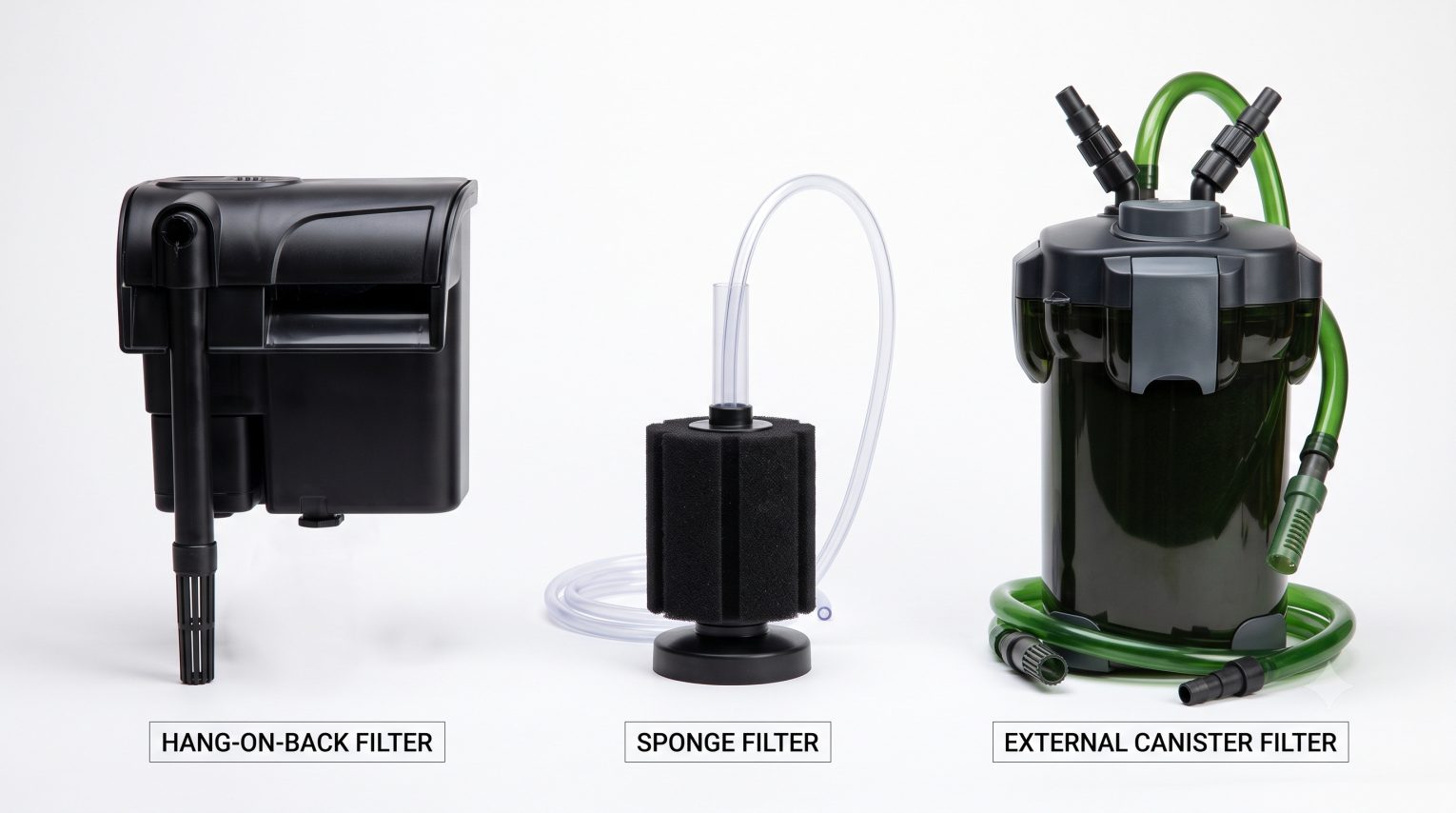
Hang-on-back (HOB) filters are the default choice for most community tanks up to 50 gal (190 L)—easy to install and maintain, covering mechanical, biological, and chemical filtration in one unit. Sponge filters offer the gentlest flow and excellent biological filtration for a low price, making them ideal for bettas, shrimp, and fry, but provide little chemical filtration. Canister filters hold the most media and deliver the cleanest water for tanks 40+ gal (150+ L), at a higher cost and more involved setup.
Whichever type you choose, aim for a filter rated to turn over your total tank volume 4–6 times per hour for a standard community tank, or 8–10 times for heavily stocked or messy species like goldfish. One detail most sizing guides skip: the GPH rating printed on the box is measured empty—actual flow drops 25–40% once the filter is loaded with media, so size up rather than buying exactly to the number.
Filtration is one part of a much bigger picture covered in our Fish Care Guide—the complete hub for freshwater aquarium setup and maintenance. Your filter is also where the bacterial colony from How to Cycle an Aquarium: The Nitrogen Cycle Explained actually lives—choosing and maintaining it correctly directly supports that process.
(💡 HOB, sponge, and canister filters each suit different tank sizes and species—there’s no single best option for every setup.)
Table of Contents
Why Filtration Matters Beyond “Clean Water”
A filter does three distinct jobs, and understanding each helps explain why filter choice affects far more than water clarity:
⚙️ Mechanical filtration — physically trapping debris, uneaten food, and particulate waste before it breaks down in the water column.
♻️ Biological filtration — providing surface area for the nitrifying bacteria that carry out the nitrogen cycle. This is arguably the filter’s most important job—see How to Cycle an Aquarium for why this bacterial colony matters so much.
🧪 Chemical filtration — typically activated carbon or similar media, removing dissolved organics, odors, and discoloration from the water.
Not every filter type handles all three equally well, which is the main reason the “best” filter depends on your specific tank rather than being a single universal answer.
(🐠 Aquarist’s Note: “The filter is the single piece of equipment I’d never cut corners on. Fish can tolerate an imperfect heater or a plain substrate—they can’t tolerate inadequate biological filtration. Buy the filter that fits your tank properly, not the cheapest one that technically fits on the rim.”—LovingPetsGuide Aquatics Advisor)
The Three Filter Types
Sponge Filters
🏆 Best for: Betta tanks, shrimp and fry tanks, nano tanks under 15 gal (57 L), hospital/quarantine tanks.
❔How they work: An air pump drives water through a porous sponge, which provides excellent biological surface area while creating very gentle flow.
📈 Strengths:
- Gentlest flow available—won’t damage delicate fins or pull in fry and shrimplets.
- Excellent biological filtration surface area.
- Inexpensive and simple, with no moving parts to fail.
- Easy to clean without disrupting the bacterial colony (squeeze gently in removed tank water).
📉 Limitations:
- Little to no mechanical or chemical filtration.
- Sits visibly inside the tank.
- Cannot achieve high turnover rates for larger or heavily stocked tanks.
🐾 Sponge Filters 🐾
🧽 Air-Driven Sponge Filters — The gentlest, safest flow available for bettas, shrimp, and fry tanks. Requires a separate air pump. Excellent biological filtration at a low price point.
HOB (Hang-on-Back) Filters
🏆 Best for: Most standard community tanks, 10–50 gal (38–190 L)—the default choice for the majority of freshwater setups.
❔How they work: Mounts on the tank’s back edge, drawing water up through a media cartridge or customizable media basket before returning it via a waterfall-style outflow.
📈 Strengths:
- Covers mechanical, biological, and chemical filtration in one unit.
- Fast, simple installation.
- Easy to access and clean without tools.
- Wide range of sizes and price points.
📉 Limitations:
- Limited media capacity compared to canisters.
- Waterfall flow can be too strong for bettas or other delicate-finned species without a baffle.
- Sits visibly on the tank rim.
🐾 Hang-on-Back (HOB) Filters 🐾
💧 Hang-on-Back Power Filters — The default choice for most community tanks. Covers all three filtration types in one easy-to-maintain unit. Look for a customizable media basket rather than proprietary cartridges for long-term flexibility.
Canister Filters
🏆 Best for: Larger tanks 40 gal (150 L) and up, planted aquascapes, heavily stocked or messy species like goldfish and cichlids.
❔How they work: An external, sealed unit—usually housed in the cabinet below the tank—pumps water through multiple stacked media trays before returning it via a spray bar or nozzle.
📈 Strengths:
- Largest media capacity of the three types, meaning the strongest biological and mechanical filtration.
- Completely hidden from view for a cleaner aesthetic.
- Quieter operation than most HOBs.
- Spray bar option distributes flow evenly—gentler on planted tanks and fish alike.
📉 Limitations:
- Higher upfront cost.
- More involved initial setup (priming, hose connections).
- Maintenance takes longer than a quick HOB cartridge swap.
🐾 Canister Filters 🐾
🛢️ External Canister Filters — The strongest media capacity of the three types, best suited to 40+ gallon tanks, planted aquascapes, and heavy bioload species like goldfish and cichlids. A spray bar attachment delivers gentler, more evenly distributed flow than an equivalent HOB.
How Much Flow Do You Actually Need?
The standard rule: Size your filter to turn over your total tank volume 4–6 times per hour for a moderately stocked community tank. Heavily stocked tanks or messy species (goldfish, cichlids) do better at 8–10 times.
| Tank Size | Standard Community (4–6×) | Heavy Bioload (8–10×) |
|---|---|---|
| 10 gal (38 L) | 40–60 GPH | 80–100 GPH |
| 20 gal (76 L) | 80–120 GPH | 160–200 GPH |
| 40 gal (151 L) | 160–240 GPH | 320–400 GPH |
| 75 gal (284 L) | 300–450 GPH | 600–750 GPH |
⚠️ The rated GPH on the box is measured empty. Once loaded with mechanical and biological media, actual flow typically drops 25–40%. If your calculation calls for 200 GPH of real flow, buy a filter rated closer to 250–300 GPH rather than exactly 200.
❗️Flow can also be too strong. Bettas, fancy goldfish, shrimp, and other delicate or slow-moving species can be stressed or physically battered by excessive current. If fish are constantly hiding from the outflow or struggling to swim normally, the filter is likely overpowered for that stock—dial it back with a flow valve, spray bar, or pre-filter sponge rather than accepting the stress.
📰 Filter turnover rate guidance—4–6 times tank volume per hour for standard community stocking, scaling to 8–10 times for heavily stocked or messy-eating species—is consistently documented across established aquarium equipment and hobbyist resources. These same sources confirm that manufacturer-rated GPH figures are measured without media installed, and that real-world flow predictably drops once a filter is loaded with mechanical and biological media—reinforcing why sizing slightly above a calculated target, rather than exactly to it, is standard practice.
Maintenance: Don’t Undo Your Filter’s Work
Rinse mechanical media every 2–4 weeks, and only in water removed from the tank during a water change—never under the tap.
Rinse biological media far less often—every 3–6 months, and only if flow is visibly reduced. This media houses the bacterial colony your entire nitrogen cycle depends on.
Never clean all media at once. Stagger mechanical and biological maintenance so you’re never disrupting the full bacterial colony in a single session—see How to Cycle an Aquarium for the full explanation of why chlorinated tap water is so damaging to this colony.
Matching Filter to Fish: Quick Scenarios
🟦 5 gal (19 L) betta tank: A sponge filter on a gentle air pump. HOB waterfall flow is frequently too strong and can damage a betta’s long, delicate fins.
🟦 10 gal (38 L) shrimp tank: Sponge filter, without exception. Shrimplets are pulled into HOB intakes and killed.
🟦 20 gal (76 L) community tank (tetras, corydoras, similar species from Best Fish for Beginners): A solid HOB rated for 30–40 gal, loaded with sponge and ceramic ring media.
🟦 40+ gal (151+ L) planted tank: A canister with a spray bar delivers gentler, more evenly distributed flow than an equivalent HOB, with better water clarity for viewing plants.
🟦 75 gal (284 L) goldfish tank: Goldfish bioload is exceptionally heavy—consider a canister rated well above the tank’s stated capacity, or run two filters in parallel.
Common Filter Mistakes
| ❌ Buying based on tank size alone, ignoring bioload. A lightly stocked 20-gallon shrimp tank and a heavily stocked 20-gallon goldfish tank have very different real filtration needs despite identical water volume. |
| ❌ Sizing exactly to the rated GPH. Given the 25–40% real-world flow drop once media is loaded, this consistently leaves tanks under-filtered. |
| ❌ Choosing a powerful HOB for a betta or shrimp tank. Strong current stresses or physically harms delicate species regardless of how good the filtration itself is. |
| ❌ Rinsing biological media in tap water. Chlorine and chloramine kill the bacterial colony this media is meant to house. |
| ❌ Replacing all filter media simultaneously. This can crash an established nitrogen cycle by removing too much of the bacterial colony at once. |
Conclusion
There’s no single best aquarium filter—only the right filter for your specific tank size, stocking, and species. Sponge filters protect delicate fish and fry, HOBs handle most standard community setups reliably, and canisters deliver the cleanest water and highest capacity for larger or heavily stocked tanks.
Key takeaways:
- ✅ Sponge filters: gentlest flow, best for bettas, shrimp, fry, and nano tanks.
- ✅ HOB filters: the default choice for most 10–50 gal community tanks.
- ✅ Canister filters: best for 40+ gal tanks, planted aquascapes, and heavy bioload.
- ✅ Target 4–6× turnover for standard tanks, 8–10× for heavily stocked ones.
- ✅ Size up—rated GPH drops 25–40% once media is loaded.
- ✅ Rinse mechanical media every 2–4 weeks, biological media every 3–6 months, never in tap water.
📝 Editor’s Note: Filter turnover rate guidance and the empty-vs-loaded GPH distinction in this guide reflect consistent, cross-referenced consensus across established aquarium equipment and hobbyist resources. Species-specific flow sensitivity (bettas, shrimp, fry) is a widely documented consideration in freshwater fishkeeping practice.
👉🏼 Fish Care Guide—complete hub for freshwater aquarium setup and maintenance.
👉🏼 How to Cycle an Aquarium: The Nitrogen Cycle Explained—why your filter’s biological media matters so much.
👉🏼 Aquarium Water Quality: pH, Ammonia & Nitrates Guide—ongoing testing that shows whether your filtration is keeping pace.
👉🏼 Best Fish for Beginners: Top 10 Community Tank Picks—species selection to pair with your filter choice.

🐠 Browse fish fish food, tanks, filters, heaters, decor and everything else your aquarium needs 🐾
(This post contains affiliate links. If you purchase through our links, we may earn a small commission at no extra cost to you. This never influences our editorial opinions.)
FAQ: Best Aquarium Filters
Which filter type is best for a beginner?
A hang-on-back (HOB) filter is generally the best starting point for most community tanks between 10 and 50 gallons (38–190 L)—it’s simple to install, easy to maintain, and covers all three filtration types in one unit.
Can I use a sponge filter for a regular community tank?
Yes for smaller or lightly stocked tanks, but sponge filters struggle to achieve the higher turnover rates larger or more heavily stocked community tanks need. They excel specifically where gentle flow matters more than raw turnover—bettas, shrimp, and fry tanks.
Do I need a canister filter, or is a HOB good enough?
For tanks under 40 gallons (150 L) with standard community stocking, a quality HOB is genuinely sufficient. Canisters become worth the extra cost and complexity for larger tanks, heavily planted aquascapes, or bioload-heavy species like goldfish and cichlids.
Why is my filter’s actual flow weaker than the box says?
Manufacturer GPH ratings are measured with an empty filter—no media installed. Once loaded with mechanical and biological media, real-world flow typically drops 25–40%. This is expected, not a sign of a defective filter—size your purchase above your calculated target to account for it.
How do I know if my filter’s flow is too strong for my fish?
Watch your fish’s behavior. Constant hiding from the outflow, difficulty swimming normally, or visible fin damage in long-finned species like bettas all indicate excessive flow. A flow valve, spray bar, or pre-filter sponge can reduce output without switching filters entirely.
How often should I clean my filter?
Rinse mechanical media (filter floss, pads) every 2–4 weeks in water removed from the tank. Rinse biological media (ceramic rings, sponges housing bacteria) far less often—every 3–6 months, and only if flow is noticeably reduced—since this media holds the bacterial colony your nitrogen cycle depends on.