
The nitrogen cycle is the biological process that converts toxic fish waste into progressively less harmful compounds: ammonia (highly toxic) is converted by bacteria into nitrite (also highly toxic), which a second set of bacteria then converts into nitrate (far less harmful, managed through regular water changes). “Cycling” an aquarium means growing enough of these bacteria before adding fish—skipping this step is the single most common cause of new fish dying within the first few weeks of aquarium ownership.
A brand-new tank has essentially none of these bacteria present. Without them, ammonia from fish waste builds up with nowhere to go, burning gills and skin at levels far lower than most new owners expect. The fishless cycling method—dosing pure ammonia and waiting for bacteria to establish before any fish are added—takes 4–6 weeks without shortcuts, or as little as one week using seeded filter media or a bottled bacteria starter.
Cycling is the foundational step covered in our Fish Care Guide—the complete hub for freshwater aquarium setup, fish selection, and ongoing maintenance. Skipping or rushing this step is the root cause of most new-aquarium fish deaths covered throughout this hub.
(💡 Ammonia, nitrite, and nitrate testing is the only reliable way to know when a new aquarium has finished cycling—not the calendar.)
Table of Contents
What the Nitrogen Cycle Actually Is
Every aquarium—regardless of size, fish species, or equipment—runs on the same three-stage biological process. Understanding it is the single most important thing a new aquarium owner can learn.
🧪 Stage 1: Ammonia (NH3): Produced continuously by fish waste, uneaten food, and any decaying organic matter in the tank. Highly toxic to fish above approximately 0.25 ppm (parts per million)—a threshold reached quickly in a new, uncycled tank with fish already present.
🧪 Stage 2: Nitrite (NO2-): Ammonia-oxidizing bacteria—primarily Nitrosomonas and related genera—convert ammonia into nitrite. This is progress, but nitrite is also highly toxic; some fish species can be lethally affected at concentrations as low as 1 ppm.
🧪 Stage 3: Nitrate (NO3-): A second group of bacteria, primarily Nitrobacter, convert nitrite into nitrate. Nitrate is dramatically less toxic and is managed on an ongoing basis through regular partial water changes or live plant uptake—generally considered safe below 20–40 ppm. For the complete ongoing testing routine once your tank is cycled, see Aquarium Water Quality: pH, Ammonia & Nitrates Guide.
🦠 The bacteria live mostly in your filter, not the water. This is a common misconception: the beneficial bacteria that perform this entire process colonize surfaces—filter media, substrate, decorations—far more than they exist freely in the water column. This is exactly why rinsing filter media under tap water is one of the most damaging mistakes a new owner can make (covered in the mistakes section below).
(🐠 Aquarist’s Note: “New owners often picture ‘cycling’ as something abstract that happens over time. It’s really just bacterial farming—you’re growing a population of two specific bacteria groups large enough to process everything your fish produce, in real time, before you add livestock that depends on it”—LovingPetsGuide Aquatics Advisor.)
📰 The nitrogen cycle’s biochemistry is documented by the University of Florida’s Institute of Food and Agricultural Sciences (IFAS) Extension (ask.ifas.ufl.edu), which confirms that ammonia is converted to nitrite by ammonia-oxidizing bacteria including Nitrosomonas and Nitrosospira species, and that this biological nitrification process is the primary mechanism by which toxic ammonia is removed from aquatic systems.
Why Skipping This Step Kills Aquarium Fish
“New Tank Syndrome” is the informal name for what happens when fish are added to an uncycled tank: ammonia and nitrite spike because no bacterial population exists yet to process them, and fish are exposed to toxic conditions with no biological buffer.
☣️ What toxic exposure looks like:
- Gasping at the water surface.
- Red or inflamed gills.
- Clamped fins, lethargy.
- Sudden, unexplained deaths in the first 1–3 weeks.
❓Why “just wait a few days” doesn’t work: The bacteria that process ammonia and nitrite don’t appear on their own timeline that matches a fish’s tolerance—they need an actual ammonia source to feed on and multiply, and that population growth takes weeks, not days, even under ideal conditions.
Before choosing which fish to start with, remember that even hardy species need a properly cycled tank first—see Best Fish for Beginners: Top 10 Community Tank Picks once cycling is complete.
📰 The connection between uncycled tanks and fish mortality is well established in aquaculture science. The University of Florida IFAS Extension confirms that un-ionized ammonia is toxic to fish at low concentrations and that the nitrogen cycle must be established before a system can safely support livestock, a principle that applies equally to home aquariums and commercial aquaculture systems.
Fishless Cycling: The Recommended Method
Fishless cycling means growing the bacterial colony using a pure ammonia source before any fish are introduced—avoiding the welfare and water-quality risks of the older “fish-in cycling” approach, which exposes live fish to the exact toxic conditions described above.
Step-by-Step Fishless Cycling
Follow these six steps in order—skipping ahead or rushing any single step is the most common reason a cycle stalls or takes longer than expected.
Set up the tank completely
Filter, substrate, heater, décor, and dechlorinated water—everything except fish.
Add a pure ammonia source
Dose the water to approximately 2 ppm ammonia, either using reagent-grade ammonium chloride sold specifically for this purpose, or a household ammonia product confirmed to contain no additives, surfactants, or fragrances.
Test daily
Track ammonia and nitrite levels using a liquid test kit. You’ll typically see ammonia begin dropping and nitrite begin appearing within the first 1–2 weeks.
Keep dosing small amounts of ammonia
As ammonia starts processing faster, add small amounts (roughly ¼ of the original dose) every few days to keep feeding the growing bacterial colony. Avoid pushing nitrite above 5 ppm—at higher concentrations, nitrite becomes toxic to the very nitrite-oxidizing bacteria you’re trying to grow, stalling the entire cycle.
Watch for the “double-zero” result
The cycle is complete when you can dose a full 2 ppm of ammonia and, 24 hours later, both ammonia and nitrite test at 0 ppm, with nitrate now present. This is the only reliable completion signal—not a calendar date.
Do a large water change before adding fish
Nitrate will have accumulated during cycling. A substantial partial water change brings it down to a safe starting range before livestock goes in.
⚠️ Watch your pH throughout. Nitrifying bacteria slow dramatically and can nearly stop functioning at a pH of 6.0 or below. A pH crash is one of the most common hidden causes of a stalled cycle that otherwise looks like it’s “not working.”
📰 The fishless cycling method and its specific failure modes are documented across aquarium science resources, which consistently describe dosing ammonia to approximately 2 ppm, monitoring for nitrite accumulation above 5 ppm (which poisons nitrite-oxidizing bacteria and stalls the cycle), and pH crashes below 6.0 as slowing or halting nitrifying bacteria activity. The “double-zero test”—confirming both ammonia and nitrite read 0 ppm with nitrate present 24 hours after a full ammonia dose—is the standard definitive marker of a completed cycle.
🐾 Freshwater Aquarium Test Kits 🐾
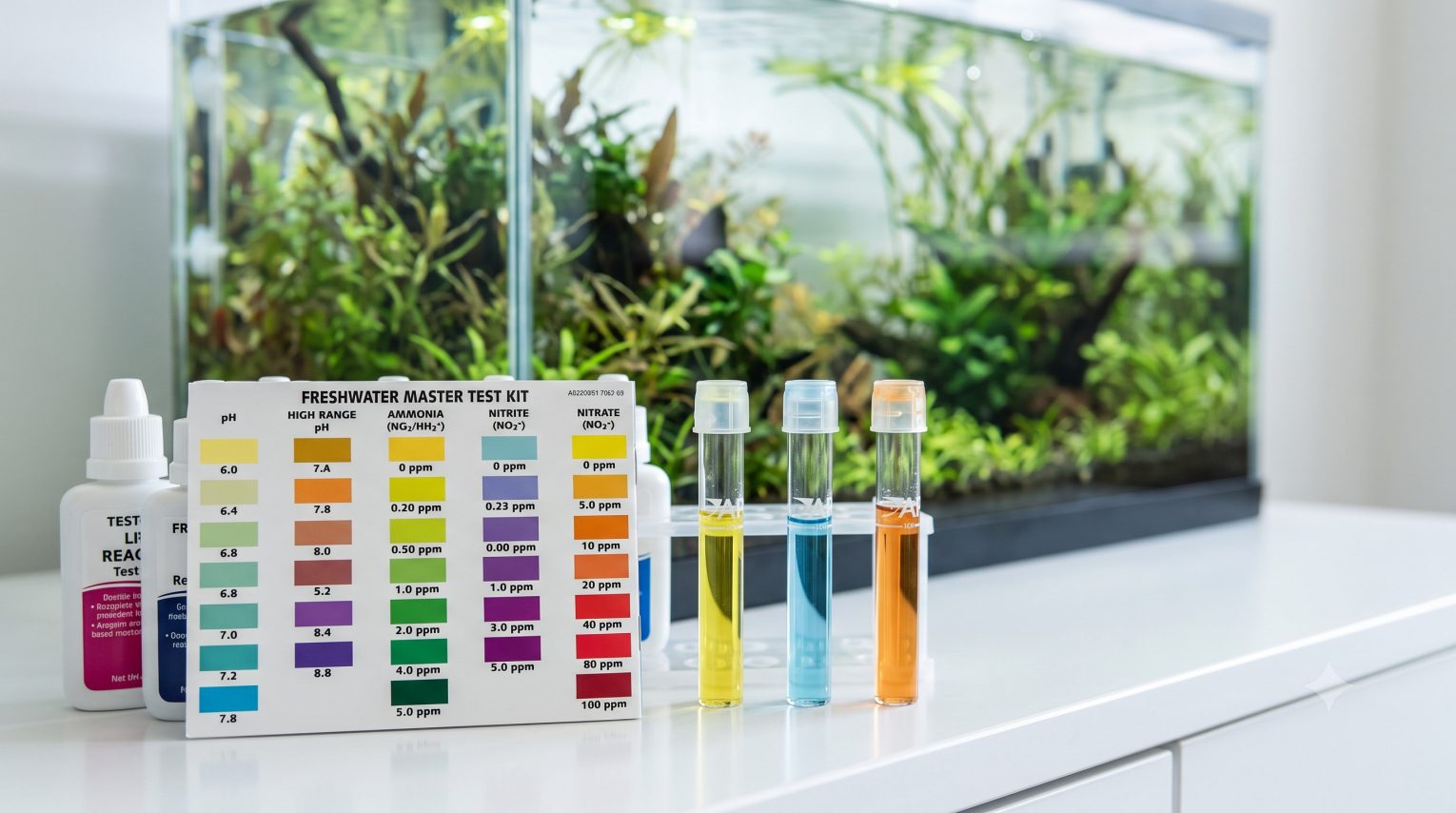
🧪 Liquid Test Kits—A liquid master test kit covering ammonia, nitrite, nitrate, and pH is the only reliable way to know your tank’s actual cycling status—test strips are far less accurate for this purpose. Chewy carries test kits and individual component tests across price points.
Speeding Up the Cycle
A full fishless cycle from a completely empty tank takes 4–6 weeks. Two methods can meaningfully shorten this:
Seeded filter media: Moving established filter media, substrate, or décor from an already- cycled, healthy tank instantly transfers a working bacterial colony. This is the fastest method when available—often completing a cycle in about a week. For guidance on which filter type holds and supports bacteria best long-term, see Best Aquarium Filters: HOB, Sponge & Canister Compared.
Bottled bacteria starters: Commercial live nitrifying bacteria products can meaningfully accelerate cycling when combined with an ammonia source, in some cases completing the process in under a week. Not all bottled bacteria products are equally effective—some rely on bacterial strains that survive poorly in a bottle, so product choice matters.
🐾 Live Nitrifying Bacteria Starters 🐾
🦠 Bottled Bacteria Starters—Can meaningfully shorten cycling time when combined with an ammonia source. Chewy carries several established brands—worth browsing to compare live bacteria counts and strain types before choosing.
Common Cycling Mistakes
| ❌ Rinsing filter media under tap water: Tap water contains chlorine or chloramine specifically intended to kill bacteria—including the beneficial bacteria colonizing your filter media. Rinse media only in removed tank water during maintenance. |
| ❌ Adding fish before testing confirms 0/0: “It’s been a month, that should be enough” is not a substitute for an actual double-zero test result. Cycling time varies by tank size, bioload, and conditions. |
| ❌ Overdosing ammonia during fishless cycling: Pushing nitrite above roughly 5 ppm poisons the nitrite-oxidizing bacteria themselves, stalling progress for weeks rather than speeding it up. |
| ❌ Not using a dechlorinator on tap water: Every water change during and after cycling needs a water conditioner to neutralize chlorine and chloramine—skipping this can damage or kill your bacterial colony with every water change. |
| ❌ Ignoring pH during the cycle: A pH drifting to 6.0 or below can silently stall an otherwise successful cycle—test pH alongside ammonia and nitrite, not just when something seems wrong. |
🐾 Water Conditioners & Dechlorinators 🐾
💧 Water Conditioners—Neutralizes chlorine and chloramine from tap water before it reaches your tank, protecting the bacterial colony you’re working to establish. Essential for every water change, not just during cycling.
Conclusion
The nitrogen cycle isn’t optional theory—it’s the single biological process every aquarium depends on to keep fish alive. Patience during cycling, before any fish are added, prevents the majority of new-aquarium deaths that happen in the first few weeks of ownership.
Key takeaways:
- ✅ Ammonia → nitrite → nitrate, via two different bacteria groups.
- ✅ Ammonia and nitrite are both highly toxic; nitrate is manageable through water changes.
- ✅ Fishless cycling avoids exposing live fish to toxic conditions.
- ✅ A full cycle takes 4–6 weeks; seeded media or bottled bacteria can shorten this to about a week.
- ✅ The only real completion signal is a double-zero test (0 ppm ammonia, 0 ppm nitrite, nitrate present) 24 hours after a full dose.
- ✅ Never rinse filter media in tap water—it kills the bacteria you’re trying to grow.
- ✅ Watch pH throughout; levels at or below 6.0 can stall nitrifying bacteria.
📝 Editor’s Note: The nitrogen cycle chemistry and toxicity thresholds described in this guide were verified against the University of Florida IFAS Extension (ask.ifas.ufl.edu). Fishless cycling methodology, including ammonia dosing targets, nitrite toxicity to nitrifying bacteria, and pH sensitivity, reflects consistent guidance across established aquarium science resources.
👉🏼 Fish Care Guide—complete hub for freshwater aquarium setup and maintenance.
👉🏼 Best Fish for Beginners: Top 10 Community Tank Picks—species well-suited to a newly cycled tank.
👉🏼 Aquarium Water Quality: pH, Ammonia & Nitrates Guide—ongoing testing and maintenance after cycling is complete.
👉🏼 Best Aquarium Filters: HOB, Sponge & Canister Compared—filtration options that house the bacterial colony this guide explains.

🐠 Browse fish fish food, tanks, filters, heaters, decor and everything else your aquarium needs 🐾
(This post contains affiliate links. If you purchase through our links, we may earn a small commission at no extra cost to you. This never influences our editorial opinions.)
FAQ: How to Cycle an Aquarium
How long does it take to cycle a new aquarium?
A full fishless cycle typically takes 4–6 weeks from a completely new setup with no additional help. Using seeded filter media from an established tank, or a quality bottled bacteria starter combined with an ammonia source, can shorten this to roughly one week in many cases.
Can I just add fish and let the tank cycle naturally?
This is called “fish-in cycling,” and while technically possible, it exposes live fish to toxic ammonia and nitrite levels throughout the process, risking illness or death. Fishless cycling—using a pure ammonia source instead of live fish—is the recommended, more humane approach.
How do I know when my tank is done cycling?
Test the water 24 hours after dosing a full 2 ppm of ammonia. If ammonia and nitrite both read 0 ppm and nitrate is present, the cycle is complete. This “double-zero test” is the only reliable confirmation—time elapsed alone is not a substitute for testing.
Why did my nitrite spike and then just stay high?
This often indicates nitrite has climbed too high (generally above 5 ppm), which can poison the nitrite-oxidizing bacteria themselves and stall the cycle. Reduce ammonia dosing, perform a partial water change to bring nitrite down, and resume smaller, less frequent dosing.
Can I use tap water during cycling?
Yes, but only after treating it with a water conditioner that neutralizes chlorine and chloramine. Both compounds are specifically designed to kill bacteria in municipal water supplies—including the beneficial bacteria you’re trying to establish in your tank.
Do I need special equipment to cycle a tank?
A liquid test kit covering ammonia, nitrite, nitrate, and pH is essential—test strips are generally less accurate for this purpose. Beyond that, you need a pure ammonia source (or seeded media/bottled bacteria) and a water conditioner for any tap water used during water changes.