
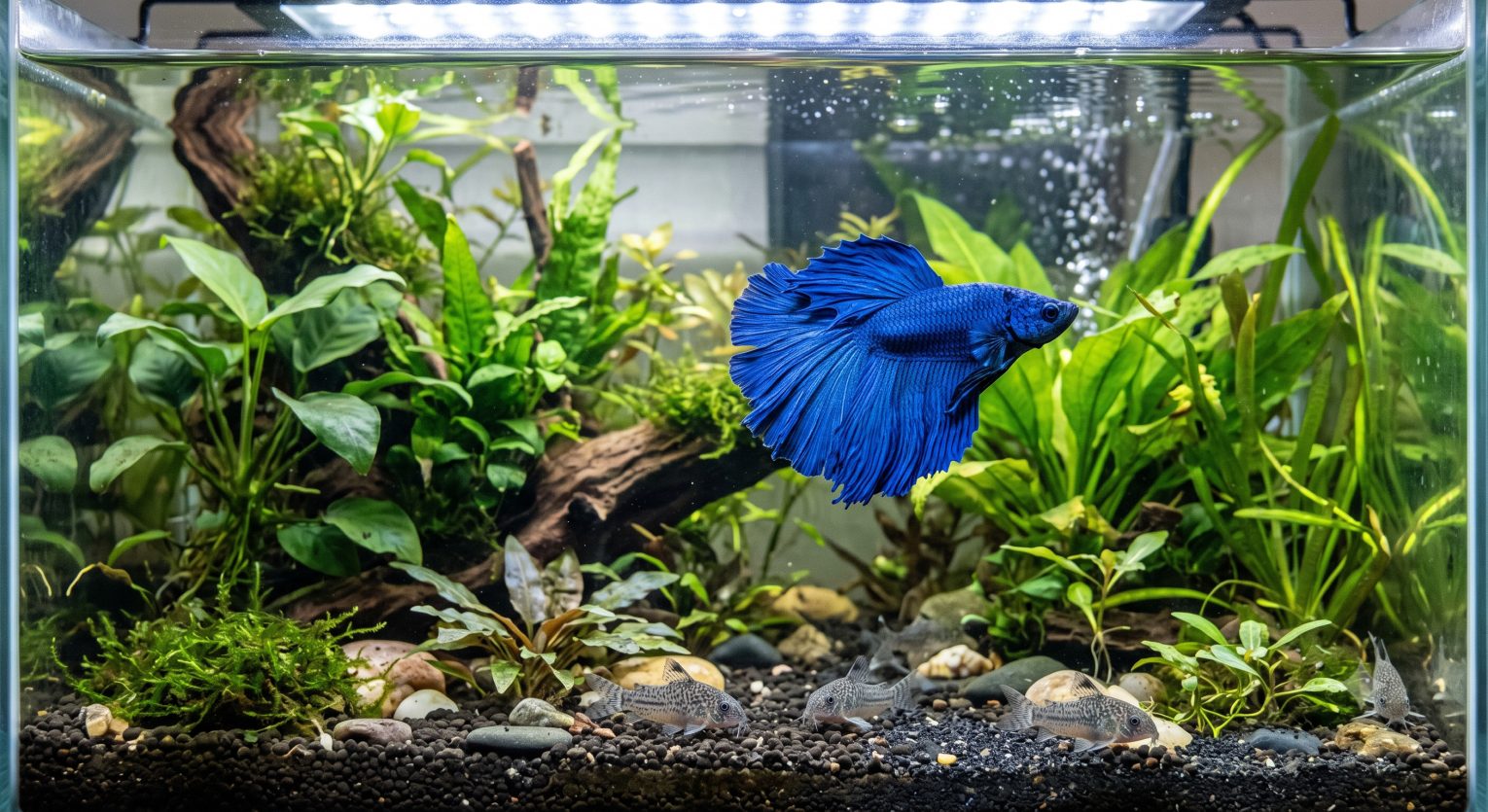
Betta fish can live with the right tank mates in a tank of at least 10 gallons (38 L)—but success depends heavily on the individual betta’s temperament, not just species choice. Good options include corydoras catfish, kuhli loaches, otocinclus, nerite or mystery snails, ghost or Amano shrimp, and peaceful, subdued-colored schooling fish like ember tetras or harlequin rasboras. Never house a betta with another betta of the same sex, fin-nipping species, or other labyrinth fish like gouramis.
The honest truth most care sheets skip: some bettas simply cannot have tank mates, regardless of how carefully you choose species. Territorial aggression varies enormously from one betta to another, and a calm setup on paper can still fail with a particularly aggressive individual fish. Always have a backup plan to separate fish if aggression appears.
Betta compatibility is one part of a much bigger picture covered in our Fish Care Guide—the complete hub for freshwater aquarium setup and species selection. If you haven’t chosen your other community fish yet, see Best Fish for Beginners: Top 10 Community Tank Picks for species that also work well alongside a betta.
(💡 Success with betta tank mates depends as much on the individual fish’s temperament as on which species you choose.)
Table of Contents
Why Betta Compatibility Isn’t a Simple Yes or No
Bettas were selectively bred for generations specifically for aggression toward other bettas—a history that shapes their territorial instinct even in captive-bred fish today. This is why “can bettas live with other fish” doesn’t have a single universal answer.
❔What actually determines success:
- Individual temperament — some bettas are calm enough to ignore tank mates entirely; others will chase or attack almost anything sharing their space.
- Tank size — a cramped tank concentrates territorial pressure; more space genuinely reduces conflict.
- Species choice — some fish are simply lower- risk than others, covered in detail below.
- Setup order — adding tank mates before the betta, rather than after, meaningfully improves the odds of acceptance.
⚠️ No compatibility list guarantees success for every betta. Some individual bettas cannot safely have tank mates of any kind. Always have a backup plan—a divider or spare tank—ready before you commit to a community setup.
(🐠 Aquarist’s Note: “I’ve kept bettas that ignored tank mates completely, and I’ve kept bettas that turned an entire 20-gallon community tank into a one-fish tank within a week. Species selection improves your odds significantly—it doesn’t guarantee anything with an individual fish.”—LovingPetsGuide Aquatics Advisor)
📰 The individual variability in betta temperament, and the recommendation to add tank mates before the betta to reduce territorial claiming, is documented by Chewy’s veterinary-reviewed education content (chewy.com/education), with expert input from Melissa Witherell, DVM, which confirms that success depends on tank size, hiding spots, and matching water parameter needs, and that betta fish can coexist with peaceful, non-fin-nipping species when these conditions are met.
Best Tank Mates for Bettas
Fish that spend most of their time near the substrate, in a different zone than a betta’s typical mid-to-upper water territory, generate the least direct conflict.
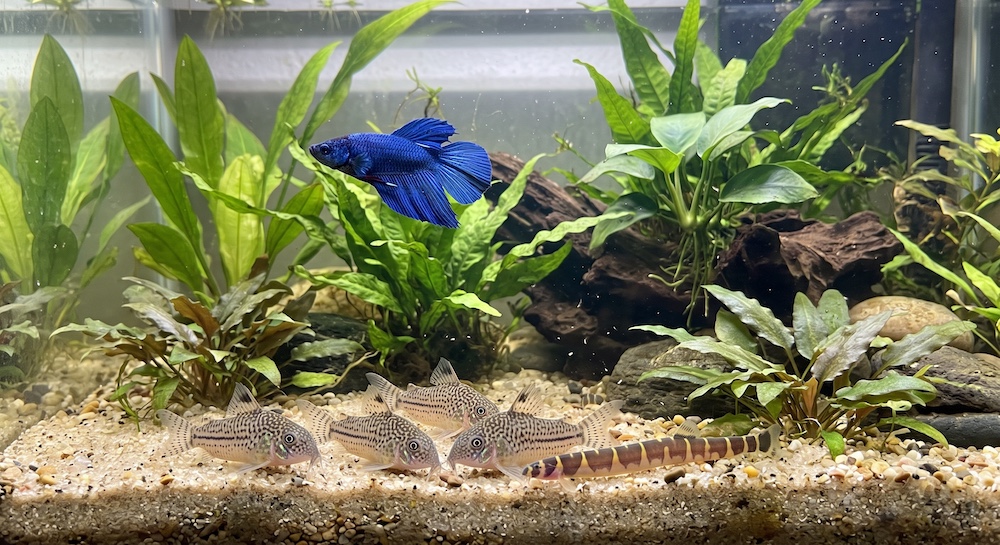
Bottom Dwellers (Lowest Risk Overall)
🐠 Corydoras catfish — Peaceful, social bottom dwellers that rarely interact with a betta at all. Keep in groups of 6+.
🐠 Kuhli loach — Primarily nocturnal, most active while the betta rests, further reducing overlap.
🐠 Otocinclus (Oto cats) — Peaceful algae grazers that stay low and out of the way. Note: as covered in Best Fish for Beginners, otos do best in an already-established, algae-present tank rather than a brand-new setup.
ℹ️ Bottom-dwelling species like corydoras and kuhli loaches generate the least territorial conflict — different zone, different schedule.
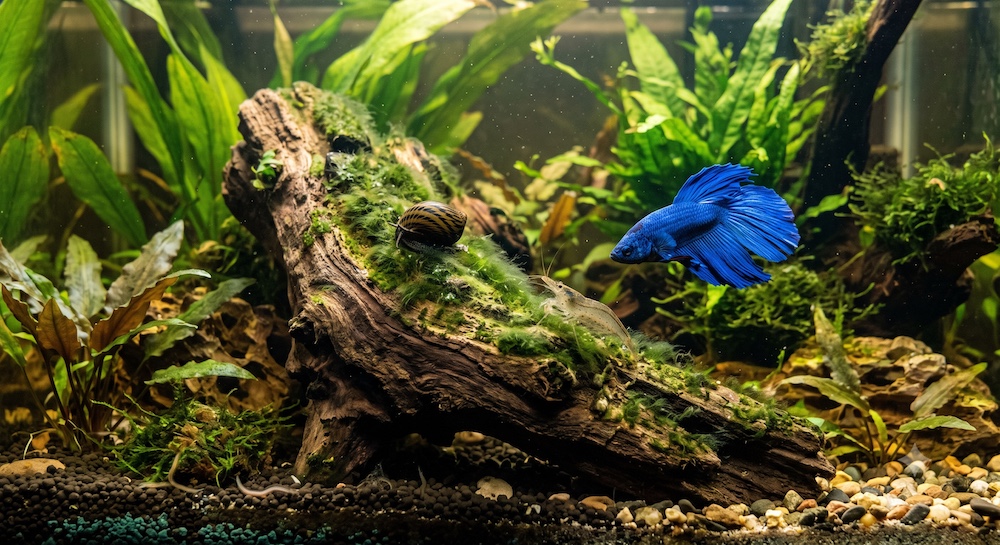
Snails and Shrimp
🐌 Nerite snails, Mystery snails — Almost always ignored by bettas; excellent low-risk cleanup crew.
🦐 Ghost shrimp, Amano shrimp — Generally safe, particularly larger specimens. Avoid small cherry shrimp specifically—a betta is far more likely to view them as food given their smaller size.
ℹ️ Snails and larger shrimp are among the lowest-risk tank mates — usually ignored entirely by a betta.
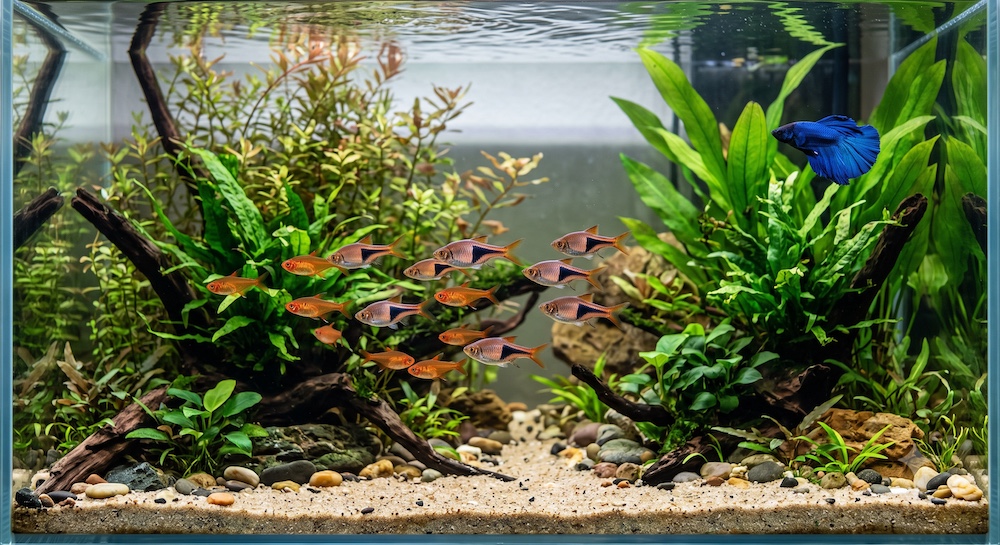
Peaceful Schooling Fish
🐠 Ember tetra — Small, peaceful, and subdued in coloration—less likely to trigger territorial aggression than brighter, flashier species.
🐠 Harlequin rasbora — Peaceful schooling behavior and calm temperament, covered in detail in Best Fish for Beginners: Top 10 Community Tank Picks.
🐠 Neon tetra — Can work, though as noted in our beginner fish guide, neons do best in an established tank rather than immediately after cycling.
ℹ️ Small, subdued-colored schooling fish like ember tetras and harlequin rasboras are less likely to trigger territorial aggression.
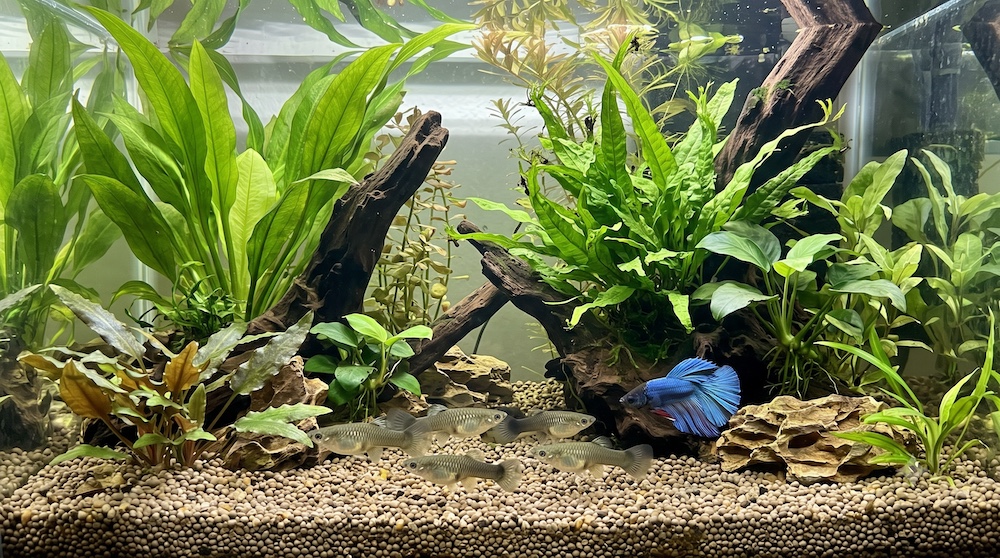
The Nuanced Case: Guppies
🐠 Guppies — Commonly recommended, but with an important caveat: plain or short-finned “feeder” guppies tend to do fine, while fancy, long-finned guppy varieties are meaningfully more likely to be mistaken for a rival betta or targeted for fin- nipping. If adding guppies, choose subdued, short-finned varieties rather than flashy ones.
ℹ️ Plain, short-finned guppies tend to do better with bettas than flashy, long-finned varieties that can be mistaken for a rival.
🐾 Nerite & Mystery Snails 🐾
🐌 Aquarium Snails — Among the lowest-risk tank mates available for bettas. Effective algae and detritus cleanup with virtually no territorial conflict.
Fish and Species to Avoid Entirely
| Species | Why to Avoid |
|---|---|
| ❌ Other bettas (same sex) | Males will fight, sometimes fatally; females can also fight seriously |
| ❌ Gouramis, paradise fish | Similar labyrinth fish, often perceived as rivals; territorial themselves |
| ❌ Tiger barbs, serpae tetras | Known fin-nippers—will shred a betta’s flowing fins |
| ❌ Plecos | Become more aggressive with age; can strip a slow-moving betta’s slime coat; many species grow far too large |
| ❌ Zebra danios | Fast, top-dwelling, active fish competing for the same surface-level territory bettas need for air access |
| ❌ Angelfish | Only for experienced aquarists with careful monitoring; generally not recommended |
| ❌ Goldfish | Cold-water species with entirely different temperature and care needs than tropical bettas |
⚠️ Never house two male bettas together, under any circumstances. This is the one absolute rule with no individual-temperament exception—male bettas will fight, often fatally, regardless of tank size or setup.
📰 The specific risks of housing bettas with plecos and other incompatible species are documented in detail by veterinary-reviewed sources, including the observation that plecos—despite being marketed as “cleaner fish”—are not strictly herbivorous, can remove the protective slime coat from slower-moving tank mates, and frequently grow far larger than appropriate for a typical betta tank. PetMD (petmd.com) separately confirms that male bettas should never be housed together, as fighting— sometimes fatal—is the near-universal outcome.
Setting Up for Success
| Minimum tank size. A single betta can survive in as little as 2–5 gal (7.5–19 L), but any community setup with tank mates needs at least 10 gal (38 L) of space to meaningfully reduce territorial pressure. |
| Add tank mates first, betta last. Introducing other fish to an empty tank, then adding the betta afterward, means the betta is entering an already- established space rather than defending home territory from newcomers—this single ordering decision meaningfully improves acceptance odds. |
| Provide visual barriers. Dense planting, driftwood, and decor break sightlines and reduce constant visual confrontation between a betta and its tank mates. |
| Choose fin type wisely. Long-finned betta varieties (like halfmoons) are more vulnerable to fin damage from nippy tank mates than short-finned varieties (like plakats)—worth factoring into your overall risk tolerance. |
| Always have a backup plan. A spare divider, container, or small secondary tank ready to separate an aggressive individual immediately, without needing to source one in an emergency. |
🐾 Aquarium Tank Dividers 🐾
🚧 Tank Dividers — A practical backup plan if aggression appears after introducing tank mates. Allows immediate separation within the same tank without needing a second full setup on hand.
What to Watch For After Introducing Tank Mates
✅ Signs your betta is adjusting well:
- Normal swimming and exploring behavior continues.
- Flaring is brief and infrequent, not constant.
- Tank mates move freely without being chased persistently.
🚨 Signs to separate immediately:
- Persistent chasing or cornering of a specific tank mate.
- Visible fin damage on the betta or on tank mates.
- A tank mate hiding constantly and refusing to eat.
- The betta flaring constantly at tank mates rather than in brief, occasional displays.
❗️If aggression appears, don’t wait to see if it resolves on its own—separate the aggressor immediately using your backup plan.
Conclusion
Bettas can absolutely share a tank with the right companions—but species selection is only part of the equation. Tank size, setup order, and the individual fish’s own temperament all matter as much as which species you choose, and no compatibility list can promise success with every betta.
Key takeaways:
- ✅ Corydoras, kuhli loaches, otocinclus, snails, and shrimp are consistently lower-risk tank mates.
- ✅ Never house two bettas of the same sex together— no exceptions.
- ✅ Avoid fin-nippers, other labyrinth fish, and plecos entirely.
- ✅ Minimum 10 gal (38 L) for any community setup with tank mates.
- ✅ Add tank mates first, introduce the betta last.
- ✅ Individual temperament varies enormously—always have a backup separation plan ready.
📝 Editor’s Note: Compatibility guidance in this article was cross-referenced with Chewy’s veterinary- reviewed education content (chewy.com/education), including expert input from Melissa Witherell, DVM, and PetMD (petmd.com/fish/care/betta-fish-facts). Individual temperament variability and setup-order recommendations reflect consistent guidance across established aquarium hobbyist resources.
👉🏼 Fish Care Guide—complete hub for freshwater aquarium setup and species selection.
👉🏼 Best Fish for Beginners: Top 10 Community Tank Picks—species that also work well alongside a betta.
👉🏼 How to Cycle an Aquarium: The Nitrogen Cycle Explained—essential before adding any fish.
👉🏼 Aquarium Water Quality: pH, Ammonia & Nitrates Guide—ongoing water quality for a community tank.

🐠 Browse fish fish food, tanks, filters, heaters, decor and everything else your aquarium needs 🐾
(This post contains affiliate links. If you purchase through our links, we may earn a small commission at no extra cost to you. This never influences our editorial opinions.)
FAQ: Best Tank Mates for Betta Fish
Can two bettas live together in the same tank?
Two male bettas should never be housed together— they will fight, often fatally, regardless of tank size. Female bettas can sometimes be kept together in a group (“sorority”), but this requires specific setup conditions and still carries real risk of aggression; it isn’t a simple, guaranteed-safe option.
What is the minimum tank size for a betta with tank mates?
While a single betta can survive in as little as 2–5 gallons (7.5–19 L), any setup including tank mates needs a minimum of 10 gallons (38 L) to meaningfully reduce territorial conflict.
Can bettas live with shrimp?
Ghost shrimp and Amano shrimp generally do well with bettas, especially larger specimens. Cherry shrimp are riskier specifically due to their smaller size— a well-fed betta is less likely to view any shrimp as food, but smaller shrimp remain more vulnerable.
Why shouldn’t I add a betta to an established community tank?
You actually should do the opposite of what many assume—adding tank mates to an empty tank first, then introducing the betta afterward, tends to work better than adding a betta and introducing tank mates later. This way, the betta enters an already-populated space rather than needing to defend established territory from newcomers.
My betta is flaring at its tank mates. Is this normal?
Occasional, brief flaring is a normal territorial display and not necessarily cause for concern. Constant, persistent flaring directed at a specific tank mate—especially combined with chasing or fin damage—signals the pairing isn’t working and separation is needed.
Can bettas live with goldfish?
No. Goldfish are cold-water fish with completely different temperature requirements than tropical bettas, in addition to being messy, high-bioload fish that require significantly more filtration and space than a typical betta setup provides.