
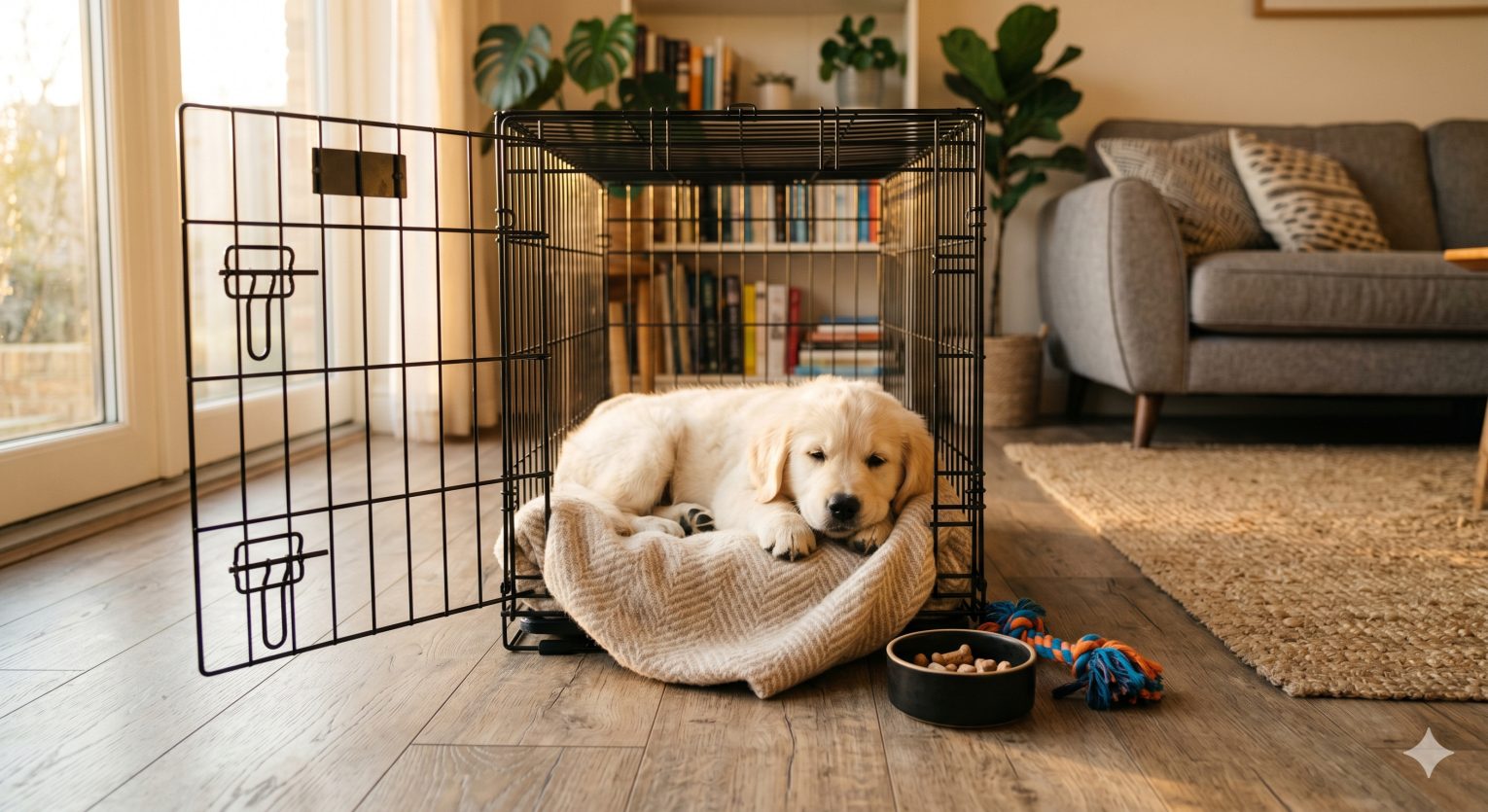
Crate training a puppy starts with one principle: the crate must always be a positive, safe space— never a punishment. Introduce it slowly with treats and meals, build duration gradually over several days, and never leave a puppy inside longer than they can physically hold their bladder. Most puppies accept their crate within 1–2 weeks when the introduction is done correctly.
A properly crate-trained puppy sleeps better, has fewer accidents, and develops stronger impulse control. The crate is not a cage—it is your puppy’s den, and dogs are instinctively drawn to enclosed spaces that feel safe and calm. This guide covers the exact step-by-step process from day one to sleeping through the night.
Crate training is one of the foundational skills every puppy needs in their first weeks at home. For the full picture of raising a well-trained dog—from basic commands to fixing behavioral issues—our complete dog training guide covers every stage from puppyhood to adulthood.
Table of Contents
Why Crate Training Is Worth It
Many new puppy owners resist crate training because it feels unkind. The reality is the opposite. Dogs are den animals—in the wild, their ancestors sought out small, enclosed spaces to sleep and feel safe. A crate satisfies this instinct and gives your puppy a space that is entirely their own.
The practical benefits are significant:
- Fewer accidents: Dogs instinctively avoid soiling their sleeping area. A correctly sized crate is the single most powerful potty training tool available.
- Prevents destructive behavior: A puppy left unsupervised will chew, destroy, and get into dangerous situations. The crate keeps them safe when you cannot watch them. Once your puppy has outgrown the crate phase, destructive chewing can persist as a separate behavioral issue—our how to stop dog chewing guide covers what to do when it continues past puppyhood.
- Builds impulse control: Learning to settle calmly in a confined space teaches self-regulation that carries into every area of training.
- Reduces anxiety: Counter-intuitively, a crate-trained dog is often less anxious—they have a predictable safe space when the world feels overwhelming.
(🎓 Trainer’s Note: “The owners who resist crate training almost always come back six months later with a dog that has destroyed furniture, developed separation anxiety, or has persistent housetraining problems. The crate is not cruel—rushing a puppy into free roam before they are ready is”—LovingPetsGuide Training Advisor.)
📰 The den-seeking behavior referenced here is documented in canine ethology literature and consistent with ASPCA dog care resources at aspca.org/pet-care/dog-care, which recommend a training crate as an ideal resting space for dogs. The American Kennel Club’s training resources at akc.org describe crate training as working with dogs’ natural behavioral tendencies—distinguishing it clearly from confinement as punishment.
Choosing the Right Puppy Crate
Before you start the introduction, you need the right crate. The wrong size is one of the most common mistakes and actively undermines training.
🐾 MidWest Homes iCrate Double Door Dog Crate 🐾
🏠 MidWest iCrate (Wire Crate with Divider)—Includes a divider panel so you buy for the adult size and reduce the interior while your puppy grows—preventing them from using a corner as a bathroom. Double door design for flexible room placement. The most recommended crate for first-week introduction.
📏 Size: The Most Important Factor
The crate must be just large enough for your puppy to stand up, turn around, and lie down comfortably—nothing more.
Why size matters so much: If the crate is too large, your puppy will use one end as a bedroom and the other as a bathroom. The instinct to keep their sleeping space clean only works when the crate is appropriately sized.
For growing puppies: Buy a crate sized for your dog’s adult dimensions and use a divider panel to reduce the interior space as needed. Move the divider forward as your puppy grows.
⚙️ Crate Types: Wire vs Plastic vs Soft
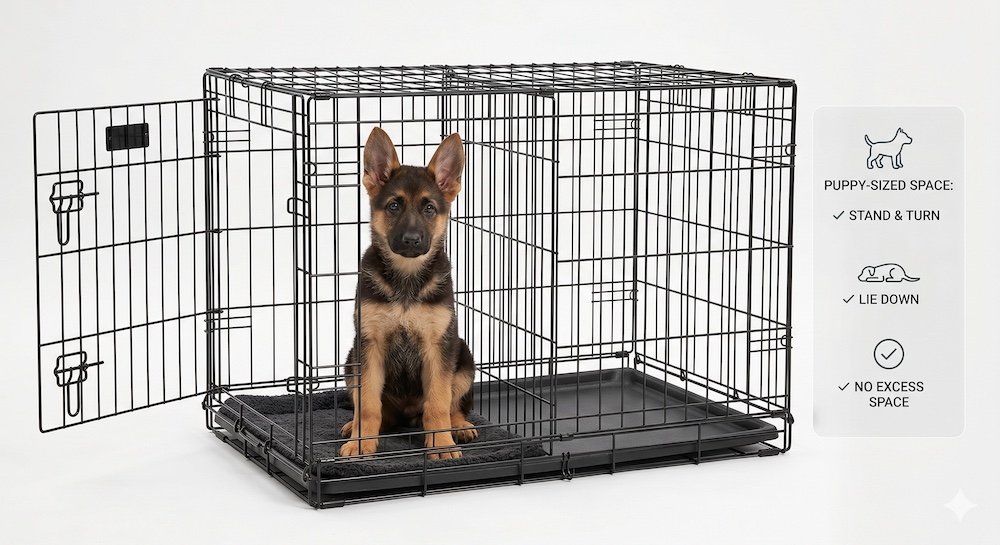
Wire crates
- Collapsible and easy to transport.
- Good ventilation and visibility.
- Most puppies accept these well.
- Best for most home training situations.
Wire crates offer the best ventilation and visibility—the most popular choice for home training.
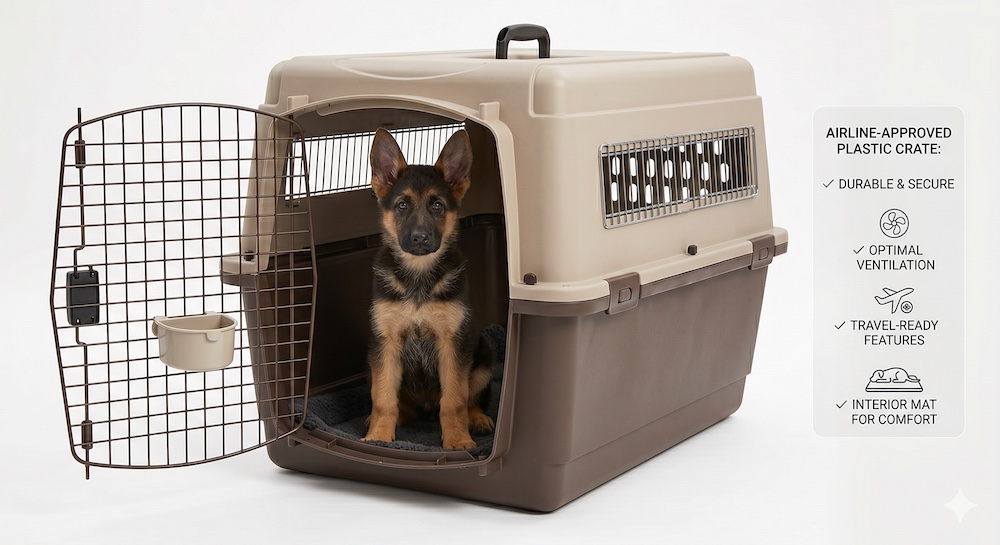
Plastic crates (airline-style)
- More enclosed and den-like.
- Some anxious puppies feel safer in these.
- Required for air travel.
- Less visibility can help some dogs settle faster.
Plastic crates feel more den-like— ideal for anxious puppies who prefer a darker, more enclosed space.
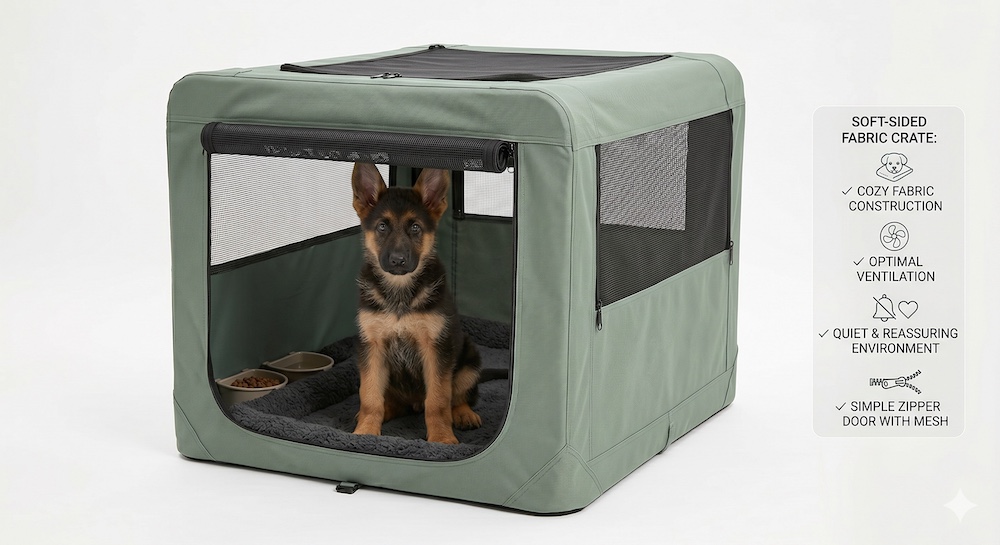
Soft-sided crates
- Not recommended for puppies.
- Easy to chew through.
- Only suitable once a dog is reliably crate-trained and past the destructive phase.
Soft-sided crates are not suitable for puppies—save them for fully trained adult dogs only.
The Introduction Process: Step by Step
This is where most owners go wrong—they rush the process. A puppy that learns to love their crate in the first week will use it happily for life. A puppy that is forced in or left to cry it out often develops lasting negative associations that take months to undo.
Phase 1: Open Door Exploration (Day 1–2)
Goal: Your puppy enters the crate voluntarily with zero pressure.
✅ How to do it:
- Place the crate in a busy area of your home where the family spends time—not an isolated room. Your puppy needs to see normal household activity from inside.
- Remove the door entirely or prop it open so it cannot swing shut accidentally.
- Toss high-value treats just inside the entrance. Let your puppy walk in, take the treat, and walk back out freely. Do not close the door.
- Gradually toss treats further inside until your puppy is walking all the way in to retrieve them.
- Place a worn item of your clothing inside to make it smell familiar and comforting.
❌ What not to do:
- Never push your puppy all the way in and close the door on day one
- Never force them in if they are hesitant—let curiosity bring them in at their own pace
Phase 2: Meals Inside the Crate (Day 2–4)
Goal: Your puppy associates the crate with something they love—food.
✅ How to do it:
- Begin feeding all meals inside the crate with the door open. Place the bowl just inside the entrance at first.
- Over the following meals, move the bowl progressively further inside until your puppy walks all the way in to eat.
- Once your puppy is eating comfortably with their entire body inside, gently close the door while they eat.
- Open the door the moment they finish eating— before they begin to fuss or paw at the door.
- Each meal, leave the door closed for slightly longer after they finish—a few extra minutes per session.
(🎓 Trainer’s Note: “Feeding meals in the crate is the fastest route to positive association. Food is the most powerful positive reinforcer available. If your puppy voluntarily walks into the crate to eat, you have won half the battle before formal training even begins”—LovingPetsGuide Training Advisor.)
Phase 3: Building Duration With the Door Closed (Day 3–5)
Goal: Your puppy stays calmly in the crate for increasing periods.
✅ How to do it:
- Lure your puppy into the crate with a treat and a calm verbal cue—”Crate” or “Bed” works well. Use the same word every time.
- Close the door and sit quietly next to the crate for a few minutes. Offer a treat through the door if they remain calm.
- Open the door before any signs of distress. You are building the association: crate = calm and rewarding.
- Build duration gradually:
- Day 3: 5 minutes.
- Day 4: 10–15 minutes.
- Day 5: 20–30 minutes.
- Begin moving away from the crate while the door is closed. Leave the room briefly, then return and release calmly.
⚠️ The critical rule: Always release your puppy from the crate before they become distressed. If they begin whining or pawing at the door, you have pushed too long. Go back to shorter durations and rebuild more gradually.
Phase 4: Longer Periods and Night Time (Day 5–7+)
Goal: Your puppy settles calmly for extended periods, including overnight.
✅ How to do it:
- Begin using the crate for naps. Place a frozen Kong or chew inside to help them settle.
- Move the crate to your bedroom for the first few nights. Your puppy can hear and smell you, which dramatically reduces nighttime distress.
- Establish a pre-bed routine: last toilet trip outside → crate → frozen Kong → lights out.
- Expect 1–2 wake-ups for toilet trips in the first 1–2 weeks. Set an alarm at the 4–5 hour mark for puppies under 12 weeks.
- Gradually move the crate to its permanent location over 1–2 weeks as your puppy adjusts.
Nighttime crate training works hand in hand with your potty training schedule. Our guide to potty training a puppy fast covers the exact overnight schedule that prevents accidents while your puppy is learning to hold their bladder.
The Bladder Hold Rule: How Long Is Too Long?
This is one of the most critical practical rules in crate training. A puppy physically cannot hold their bladder indefinitely—leaving them in a crate past their limit causes accidents that set your entire training back.
General guideline: One hour per month of age, plus one.
| Puppy Age | Maximum Crate Time (Daytime) |
|---|---|
| 8–10 weeks | 1–1.5 hours |
| 3 months | 2–3 hours |
| 4 months | 3–4 hours |
| 6 months | 4–5 hours |
| Adult | 4–6 hours maximum |
Never leave a puppy in a crate for more than 4 hours during the day without a toilet break, regardless of age. Overnight, most puppies can hold slightly longer due to lower activity—but not indefinitely in the early weeks.
📰 The “one hour per month of age” bladder control guideline cited in this section is consistent with veterinary developmental references including the AKC’s breeder education resources at akc.org and the AVMA’s puppy care guidelines. Both sources acknowledge individual variation—smaller breeds may need more frequent breaks than the formula suggests, while larger breeds often exceed it by 30–60 minutes once past 12 weeks. The absolute limit regardless of age: no puppy under 6 months should be crated for more than 4–5 hours during the day. Overnight confinement tolerance increases faster because puppies naturally slow their metabolism during sleep.
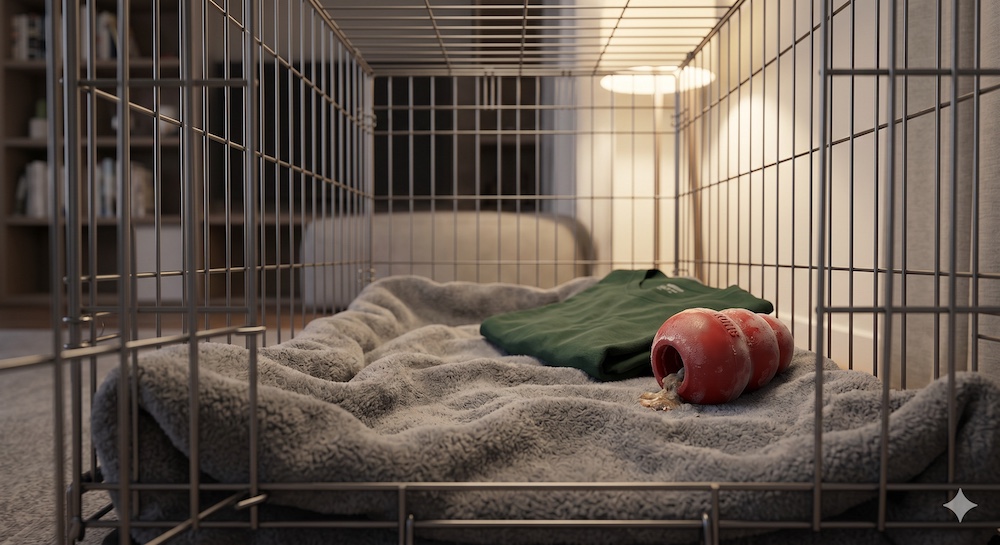
What to Put Inside the Crate
What’s inside makes a significant difference to how quickly your puppy settles.
(💡 The right crate setup makes settling faster—a frozen Kong alone can buy 30–45 minutes of calm.)
✅ Always include:
- A soft, washable blanket or crate mat.
- A worn item of your clothing (first few weeks).
- A frozen Kong or long-lasting chew for settling periods.
🐾 KONG Puppy Toy 🐾
🧸 KONG Puppy (Settling & Teething Toy)—Freeze with wet food or peanut butter to create a 30–45 minute settling distraction inside the crate. Softer rubber designed for puppy teeth—the most effective single tool for building calm crate associations during the first weeks.
➕ Optional but helpful:
- A heartbeat toy for the first few nights to mimic littermate warmth.
- A white noise machine nearby to mask sudden household sounds.
❌ Avoid:
- Water bowls in overnight crates for very young puppies—they increase toilet frequency.
- Toys with small parts that can be chewed off when unsupervised.
- Puppy pads inside the crate—this directly undermines the clean-den instinct that makes crate training work.
Common Crate Training Mistakes
Even well-intentioned owners often slow their own progress. These are the most frequent errors.
| ❌ Using the crate as punishment: If your puppy associates the crate with being sent away when they misbehave, they will resist it. The crate must only mean good things—meals, treats, rest, and safety. |
| ❌ Responding to every whine: If your puppy whines and you immediately open the door, you have taught them that whining works. Wait for even a brief pause before responding—you reward the quiet, not the noise. The exception: a sustained, escalating cry may signal a toilet emergency, not manipulation. |
| ❌ Progressing too fast: Jumping from “first introduction” to “locked in overnight” within 24 hours almost always backfires. Each phase builds on the last. Rushing creates negative associations that take significantly longer to undo. |
| ❌ Crate in an isolated room: Putting the crate in a spare room away from family activity makes it feel like isolation, not rest. Keep it in the living area during the day and your bedroom at night initially. |
| ❌ Crate that is too large: If there is enough space for your puppy to toilet in one corner and sleep in another, the potty training benefit disappears entirely. Always use a divider. |
How to Know When Your Puppy Is Ready for More Freedom
Crate training is a tool, not a permanent state. The goal is a dog that has earned the freedom to roam the house reliably—but that freedom must be earned gradually.
✅ Signs your puppy is ready for more freedom:
- Accident-free for at least 3–4 consecutive weeks.
- Enters the crate voluntarily without being asked.
- Settles quickly without extended whining.
- Has passed the peak destructive chewing phase (typically 6–12 months).
- Can be left briefly in a puppy-proofed room without incidents.
How to expand freedom: One room at a time, supervised initially. A puppy crate-trained for 4 months does not automatically earn free run of the whole house. Expand access slowly and watch for regression.
For the complete desensitization protocol for dogs already showing separation distress, see [How to Leave a Dog Home Alone: Separation Anxiety Prevention].
📰 The gradual freedom expansion approach in this section is consistent with separation anxiety prevention guidelines published by the ASPCA at aspca.org/pet-care/dog-care/common-dog-behavior-issues/separation-anxiety and the American College of Veterinary Behaviorists. Research published in Applied Animal Behaviour Science has found that dogs introduced to alone time gradually—in small, incremental durations— show significantly lower cortisol levels and fewer stress behaviors than dogs given sudden unsupervised access. The crate-to-freedom transition is the critical window where separation anxiety either develops or is prevented—rushing this stage is the primary identified risk factor for developing separation-related disorders.
Conclusion: The Work You Do Now Lasts 15 Years
Crate training requires consistency and patience in the first 2–3 weeks. The whining at night and the structured routine can feel exhausting.
But a crate-trained puppy becomes a crate-trained dog. That means a safe space during storms, travel, vet stays, and any future situation where confinement is necessary. It means fewer accidents, less destruction, and a dog with better impulse control in every area of their life.
Key takeaways:
- ✅ Introduction must be gradual—never force or rush.
- ✅ Always positive association—never use as punishment.
- ✅ Correct size is critical—always use a divider.
- ✅ Never exceed bladder hold time guidelines.
- ✅ Position the crate near you for the first nights.
- ✅ Expand freedom gradually once the foundation is solid.
📝 Editor’s Note: The crate training principles in this guide were cross-referenced with ASPCA crate training guidelines at aspca.org, AKC training resources at akc.org, and the AVMA’s puppy care recommendations. The bladder control timeline aligns with standard veterinary developmental references. The separation anxiety prevention research is consistent with Applied Animal Behaviour Science publications on graduated alone-time introduction. The instinct-based rationale for crate training is documented by both the ASPCA and AKC as standard behavioral science.
Ready to tackle the next challenge?
👉🏼 Full Dog Training Guide — all commands and behavioral strategies in one place.
👉🏼 How to Potty Train a Puppy Fast — the exact schedule that works alongside crate training.
👉🏼 Puppy Training 101: First 7 Days at Home — what to focus on the week your puppy arrives.
👉🏼 How to Stop Puppy Biting and Nipping — the other urgent first-week lesson.
🐾 Raw Paws Long-Lasting Dog Chews 🐾
🦷 Raw Paws (Long-Lasting Dog Chews)—Natural single-ingredient chews that keep puppies calm and occupied during crate settling periods. No artificial additives or chemical processing—a safe, appropriate alternative to stuffed Kongs for puppies who drain a Kong too quickly. 15% off 1st Auto Ship + 5% off future orders.

🐕 Browse dog food, treats, toys, health products, supplements, grooming and everything else your dog needs 🐾

🐕 Browse raw dog food, freeze-dried meals, chews, bones and natural treats from Indiana farms 🐾

🐕 Browse science-backed dry dog food, wet food, breed-specific formulas, and veterinary diets for your canin 🐾
(This post contains affiliate links. If you purchase through our links, we may earn a small commission at no extra cost to you. This never influences our editorial opinions.)
FAQ: Crate Training a Puppy — Your Questions Answered
At what age should I start crate training a puppy?
Start the day your puppy arrives home—typically at 8 weeks old. There is no benefit to waiting, and early introduction makes the process significantly easier. An 8-week-old puppy is a blank slate; a 5-month-old with established free-roaming habits takes considerably longer to crate train successfully.
How long does crate training take?
Most puppies accept the crate within 1–2 weeks when the introduction is done correctly and gradually. Full reliability—where the puppy settles quickly and without fuss every time— typically takes 3–4 weeks. Puppies from difficult early backgrounds may take longer.
Should I cover the crate with a blanket?
Many puppies settle faster in a partially covered crate because it feels more den-like and reduces visual stimulation. Cover the top and three sides but always leave the front open for ventilation. Never cover the crate completely. If your puppy chews the blanket, remove it and use a purpose-made crate cover with secure fastening.
My puppy cries for hours in the crate. What do I do?
Extended crying almost always means one of three things: the introduction was too fast, the crate is associated with negative experiences, or the puppy has a genuine toilet need. Go back to Phase 1 of the introduction process, slow everything down, and rebuild the positive association from scratch. Never open the crate during sustained crying—wait for even a brief pause, then open it and reward the quiet. If crying persists despite a gradual restart, consult a certified trainer.
Can I use the crate for a dog that has separation anxiety?
The crate itself does not cause separation anxiety—but forcing a dog with existing separation anxiety into a crate without proper desensitization can intensify it. If your puppy shows extreme distress (self-harm attempts, excessive drooling, vomiting) rather than normal adjustment whining, consult a certified trainer or veterinary behaviorist before continuing crate training.
Should I put a puppy pad inside the crate?
No. Placing a pad inside teaches your puppy that it is acceptable to toilet in their sleeping space, which directly undermines the core mechanism of crate training. The instinct to keep their den clean is your most powerful tool—do not neutralize it. Take your puppy outside on a schedule instead.