
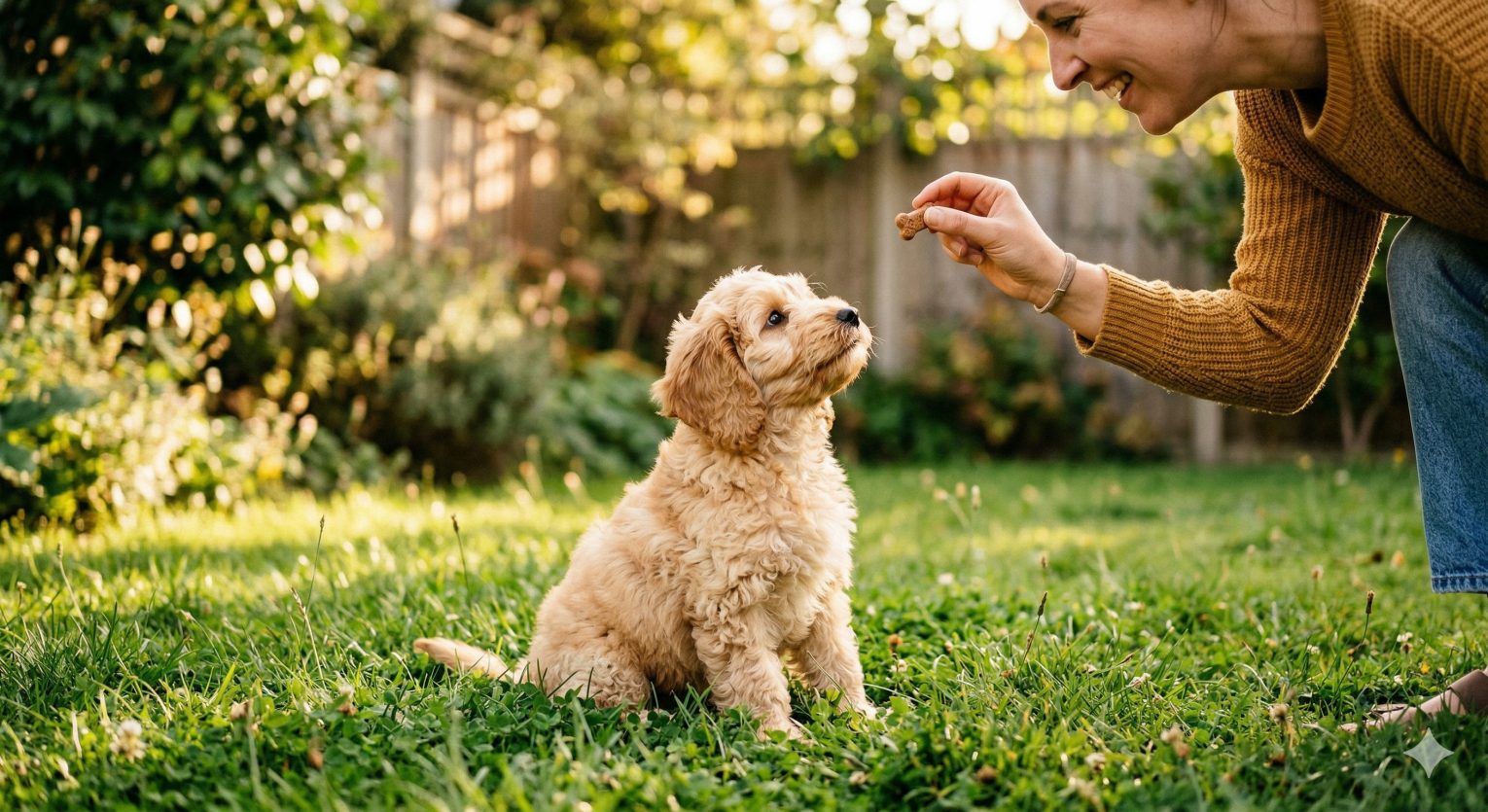
Learning how to potty train a puppy fast comes down to one thing: consistency. Take them outside every 1–2 hours, immediately after meals, naps, and play. When they go in the right spot, reward them instantly with a treat and praise—most puppies show clear progress within 2 weeks of a strict routine.
Accidents will happen. The key is to never punish your puppy for them. Instead, interrupt calmly, take them outside immediately, and reward success every single time. This guide covers the exact schedule, common mistakes, and troubleshooting tips to get you there as fast as possible.
Potty training is just one piece of the puzzle. If you want a complete picture of how to raise a well-behaved dog from day one, our complete dog training guide covers everything from basic commands to breed-specific strategies.
Table of Contents
Why Puppies Struggle With Potty Training
Puppies are not being defiant when they have accidents in the house. Their bladder muscles are simply too immature to hold on for long periods. A general rule of thumb: a puppy can hold their bladder for roughly one hour per month of age. So a 2-month-old puppy needs a toilet trip every 2 hours—even during the night.
Understanding this biologically removes the frustration. You’re not dealing with a stubborn dog. You’re working with a baby whose body hasn’t caught up with your expectations yet.
📰 The “one hour per month of age” bladder control guideline is consistent with veterinary developmental literature. The American Kennel Club’s breeder education resources at akc.org and the AVMA both reference this approximation as a practical starting point—acknowledging that individual variation exists based on breed size, water intake, and activity level. Smaller breeds typically have proportionally smaller bladders and may need more frequent trips than the formula suggests, while larger breeds often exceed the estimate by 30–60 minutes once past 12 weeks.
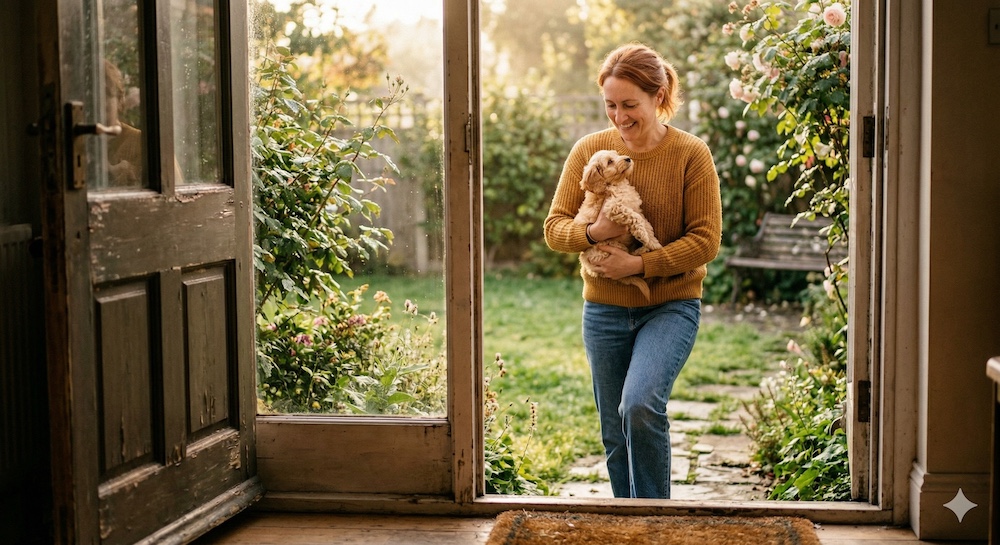
The 4 Core Rules of Fast Potty Training
(🎓 Trainer’s Note: “The most common reason potty training takes months instead of weeks is inconsistent supervision. A puppy that has 3 accidents a day inside is practicing the wrong behavior 21 times a week. Management first—training second”—LovingPetsGuide Training Advisor.)
Before diving into the schedule, these four rules are non-negotiable. Skip any one of them and your timeline doubles.
Supervision or Confinement
Supervision or confinement, no exceptions: If you cannot watch your puppy with 100% of your attention, they must be in a crate or a small puppy-proofed pen. Puppies only learn where NOT to go if they never get the opportunity to go in the wrong place unsupervised.
Consistent Toilet Spot
Always take your puppy to the exact same patch of grass or outdoor area. The residual scent from previous visits acts as a powerful trigger that signals “this is the bathroom.” Switching spots constantly confuses them and slows progress.
Immediate Reward—Within 3 Seconds
The reward must happen the moment they finish going outside—not when you walk back inside, not after you’ve taken off their leash. Timing is everything in dog training. If you miss the 3-second window, your puppy has no idea what they’re being rewarded for.
Zero Punishment for Accidents
Rubbing their nose in it, scolding, or yelling after an accident does absolutely nothing to speed up potty training. Your puppy’s memory for past events is essentially zero after 30 seconds. All punishment does is teach them to fear going to the bathroom in front of you—which makes outdoor training significantly harder.
📰 The ineffectiveness of punishment-based potty training is consistent with the AVSAB 2021 Position Statement on Humane Dog Training, verified at avsab.org/resources/position-statements. The statement notes that aversive methods increase fear and anxiety without improving learning outcomes—and in the specific context of elimination training, punishment after the fact creates location aversion rather than behavioral change. Dogs associate the punishment with the environment or owner proximity, not with the act of eliminating indoors, which is why “rubbing their nose in it” consistently produces the opposite of the intended effect.
The Exact Potty Training Schedule (By Age)
This is the schedule that gets results. Follow it strictly for the first 2–4 weeks and you will see a dramatic reduction in indoor accidents.
🐾 Puppies 8–12 Weeks Old
At this age, their bladder capacity is tiny. Expect to go outside every 60–90 minutes during waking hours, with no exceptions.
- First thing in the morning—immediately upon waking, before anything else.
- After every meal—within 5–10 minutes of finishing food.
- After every nap—the moment they wake up.
- After every play session—excitement triggers the urge to go.
- Every 60–90 minutes during the day.
- Right before bed.
- Once during the night (set an alarm at the 4–5 hour mark).
🐾 Puppies 3–5 Months Old
Bladder control improves. You can stretch outdoor trips to every 2 hours during the day. Night trips can often be eliminated by 4 months if daytime training is consistent.
🐾 Puppies 6 Months+
By 6 months, most puppies can hold on for 3–4 hours and will begin actively signaling at the door when they need to go. This is your “graduation” moment.
Quick Reference Table
| Puppy Age | Max Bladder Hold | Trips Per Day |
|---|---|---|
| 8–10 weeks | 1–1.5 hours | 10–12 |
| 3 months | 2–3 hours | 8–10 |
| 4 months | 3–4 hours | 6–8 |
| 6 months | 4–5 hours | 4–6 |
How to Use a Crate for Potty Training
A crate is not a punishment. When introduced correctly, it becomes your puppy’s den—a safe, calm space they genuinely enjoy. And it is the single most powerful potty training tool available.
Dogs instinctively avoid soiling their sleeping area. A properly sized crate (just big enough for them to stand, turn, and lie down—no larger) uses this instinct to your advantage. Too large and they’ll simply use one corner as a bathroom.
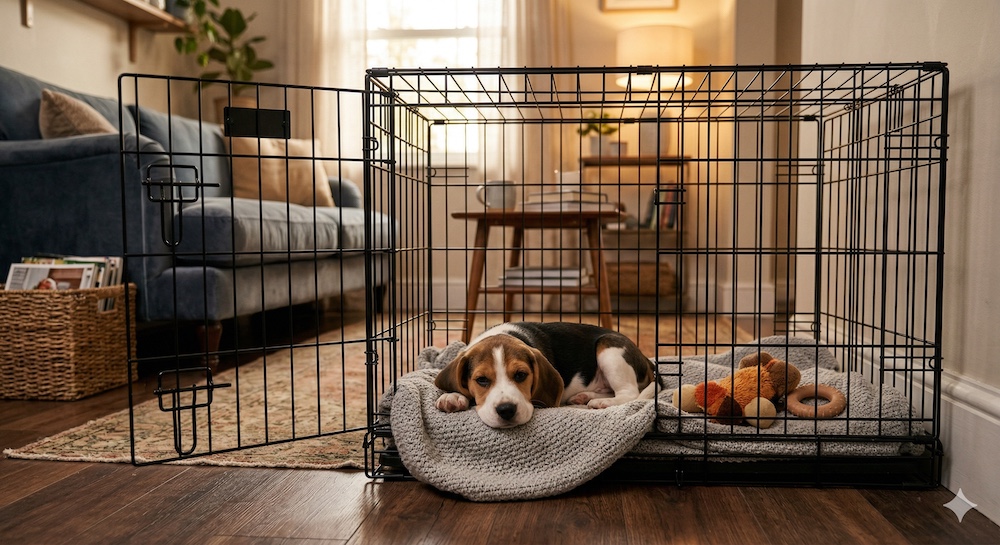
Crate Training Basics:
- Never leave a puppy in a crate longer than their maximum bladder hold time.
- Always take them directly outside the moment you open the crate door—no detours.
- Make the crate positive with treats, meals fed inside, and a worn t-shirt of yours for comfort.
- Never use the crate as punishment.
Once your puppy is reliably using the crate, you can begin expanding their freedom gradually.
👉🏼 For a complete guide to crate introduction, see our crate training a puppy step-by-step guide.
🐾 MidWest Homes iCrate Double Door Dog Crate 🐾
🏠 MidWest iCrate (Wire Crate with Divider) — Includes a divider panel—buy for your dog’s adult size now and reduce the interior as your puppy grows. The divider prevents using a corner as a bathroom. Double door design gives flexible placement in any room.
Common Potty Training Mistakes (And How to Fix Them)
Even owners who follow the schedule religiously sometimes hit a wall. Here are the most common mistakes and their fixes.
| ❌ Mistake 1: Cleaning accidents with the wrong product: Regular household cleaners don’t fully eliminate the urine odor that your puppy’s nose can detect. If the scent remains, they will return to the same spot. Always use an enzymatic cleaner specifically designed for pet accidents. It breaks down the urine at a molecular level and eliminates the signal. |
| ❌ Mistake 2: Too much freedom too soon: Many owners celebrate a week of no accidents by giving the puppy free run of the house. Then the accidents return. Don’t expand your puppy’s freedom until they have been accident-free for at least 3–4 consecutive weeks. Earn freedom gradually—one room at a time. |
| ❌ Mistake 3: Inconsistent schedule on weekends: Your puppy doesn’t know it’s Saturday. The schedule must be the same every day. Owners who are strict Monday through Friday and relaxed on weekends consistently report that their training takes twice as long. |
| ❌ Mistake 4: Going outside but not waiting long enough: If you take your puppy out, they don’t go within 2 minutes, and you bring them back in—they will almost certainly go inside 10 minutes later. Give them at least 5 full minutes outside, walking them slowly around their toilet spot. Movement stimulates the urge. |
📰 The chemistry behind repeat-accident marking is well documented. According to the National Library of Medicine’s PubChem database (pubchem.ncbi.nlm.nih.gov), uric acid has very low water solubility and crystallizes into porous surfaces as urine dries—these crystals survive standard mopping, detergent, and most household cleaning products. When moisture or humidity returns, the crystals reactivate and release odor again, which is why a spot cleaned with regular detergent often smells “clean” to humans but still signals “bathroom here” to a dog’s far more sensitive nose. Enzymatic formulas—using protease, urease, and lipase—are the only cleaning approach that breaks these compounds down at the molecular level rather than masking them with fragrance.
🐾 Rocco & Roxie Professional Strength Enzyme Cleaner 🐾
🧹 Rocco & Roxie (Enzyme Cleaner) — Stain & Odor Eliminator Cleaner breaks down uric acid crystals at the molecular level—the scent marker that brings puppies back to the same spot. Standard household cleaners leave this residue behind. This one eliminates it permanently.
What to Do When Your Puppy Regresses
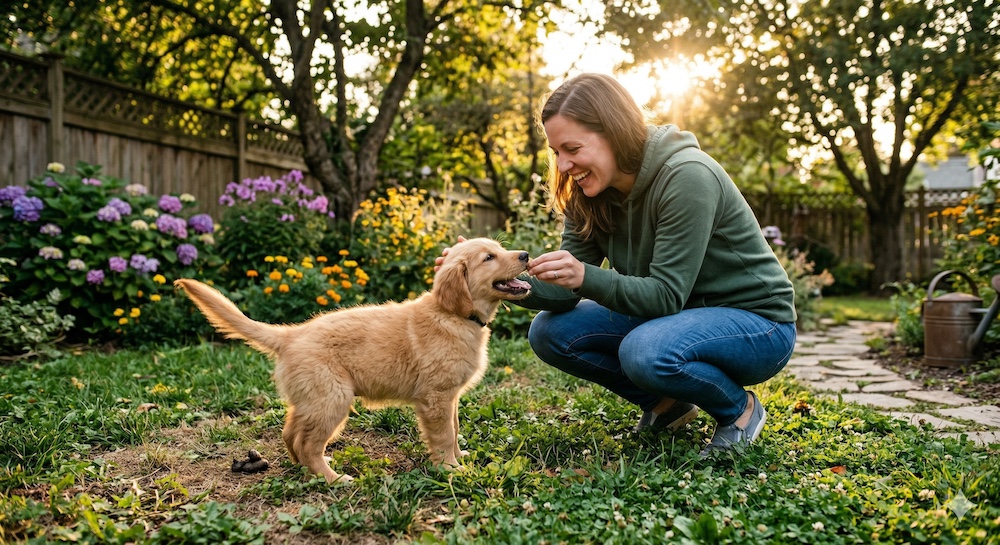
Potty training regression—when a puppy who was doing well suddenly starts having accidents again—is extremely common and almost always has a specific cause.
- Growth spurt: Rapid physical growth can temporarily reduce bladder control.
- Schedule change: A new work routine, a visitor in the house, or moving furniture can throw a puppy off.
- Medical issue: If regression is sudden and severe, a urinary tract infection (UTI) is common in puppies and easily treated by a vet.
- Too much freedom: The most common cause—see Mistake 2 above.
Don’t start from scratch. Simply tighten supervision, return to the strict schedule for 1–2 weeks, and the regression typically resolves quickly.
A well-introduced crate eliminates most regression causes overnight. Our guide on how to crate train a puppy shows the exact procedure.
Conclusion: Consistency Beats Every Potty Training Shortcut
Potty training a puppy fast isn’t about tricks or shortcuts. It’s about consistency, timing, and setting your puppy up to succeed rather than waiting for them to fail.
Stick to the schedule. Reward every single success outside. Clean every accident with an enzymatic cleaner. Supervise or confine at all times. Do this for 3–4 weeks without exception and you’ll have a puppy who understands exactly where the bathroom is.
Key takeaways:
✅ Take outside every 1–2 hours (8–12 weeks).
✅ Reward within 3 seconds of going outside.
✅ Use a crate when you can’t supervise.
✅ Use enzymatic cleaner for every accident.
✅ Never punish—redirect and reward.
✅ Don’t give freedom too soon.
📝 Editor’s Note: The bladder control timeline in this guide was cross-referenced with AKC breeder education resources at akc.org and the AVMA veterinary guidelines. The punishment ineffectiveness section aligns with the AVSAB 2021 Position Statement at avsab.org. The enzyme cleaner recommendation reflects the established chemistry of uric acid crystallization, verified against the National Library of Medicine’s PubChem database at pubchem.ncbi.nlm.nih.gov.
🐾 Zuke’s Mini Naturals Training Treats 🐾
🎯 Zuke’s Mini Naturals (Training Treats) — Pea-sized, under 3 calories per treat. The reward must arrive within 3 seconds of going outside—these are small enough to have ready in your pocket on every trip and eaten instantly so training momentum stays high.
Just brought your puppy home this week? Our puppy training first 7 days guide covers everything from day one—before potty training even begins.
Ready to tackle the next challenge?
👉🏼 How to Stop Puppy Biting and Nipping
👉🏼 Leash Training: Stop Your Dog Pulling on Walks

🐕 Browse dog food, treats, toys, health products, supplements, grooming and everything else your dog needs 🐾

🐕 Browse raw dog food, freeze-dried meals, chews, bones and natural treats from Indiana farms 🐾

🐕 Browse science-backed dry dog food, wet food, breed-specific formulas, and veterinary diets for your canin 🐾
(This post contains affiliate links. If you purchase through our links, we may earn a small commission at no extra cost to you. This never influences our editorial opinions.)
FAQ: Potty Training a Puppy—Your Questions Answered
How long does it take to potty train a puppy?
Most puppies show significant progress within 2 weeks of a consistent schedule, but full reliability—where accidents are rare and the puppy signals at the door—typically takes 4–6 months. Smaller breeds often take longer due to smaller bladder capacity.
What is the fastest way to potty train a puppy?
The fastest method combines strict supervision or crate confinement, a consistent outdoor schedule every 1–2 hours, and immediate high-value rewards the moment the puppy goes in the correct spot. Consistency beats every shortcut.
Should I use puppy pads when potty training?
Puppy pads can be useful for apartment dwellers or puppies not yet fully vaccinated. However, they teach the puppy that going indoors is acceptable, which can significantly delay outdoor training. If possible, skip pads and go straight to outdoor training.
What should I do when my puppy has an accident inside?
Calmly interrupt the accident with a neutral “outside” or “ah-ah,” carry them to their outdoor spot, and wait for them to finish there. Reward if they do. Clean the indoor spot thoroughly with an enzymatic cleaner. Never scold or punish—it achieves nothing.
At what age should a puppy be fully potty trained?
Most puppies are reliably potty trained between 4 and 6 months old, though some—particularly small breeds—may not be fully reliable until 8–12 months. Full bladder muscle maturity develops gradually, so patience combined with consistency is essential throughout.