
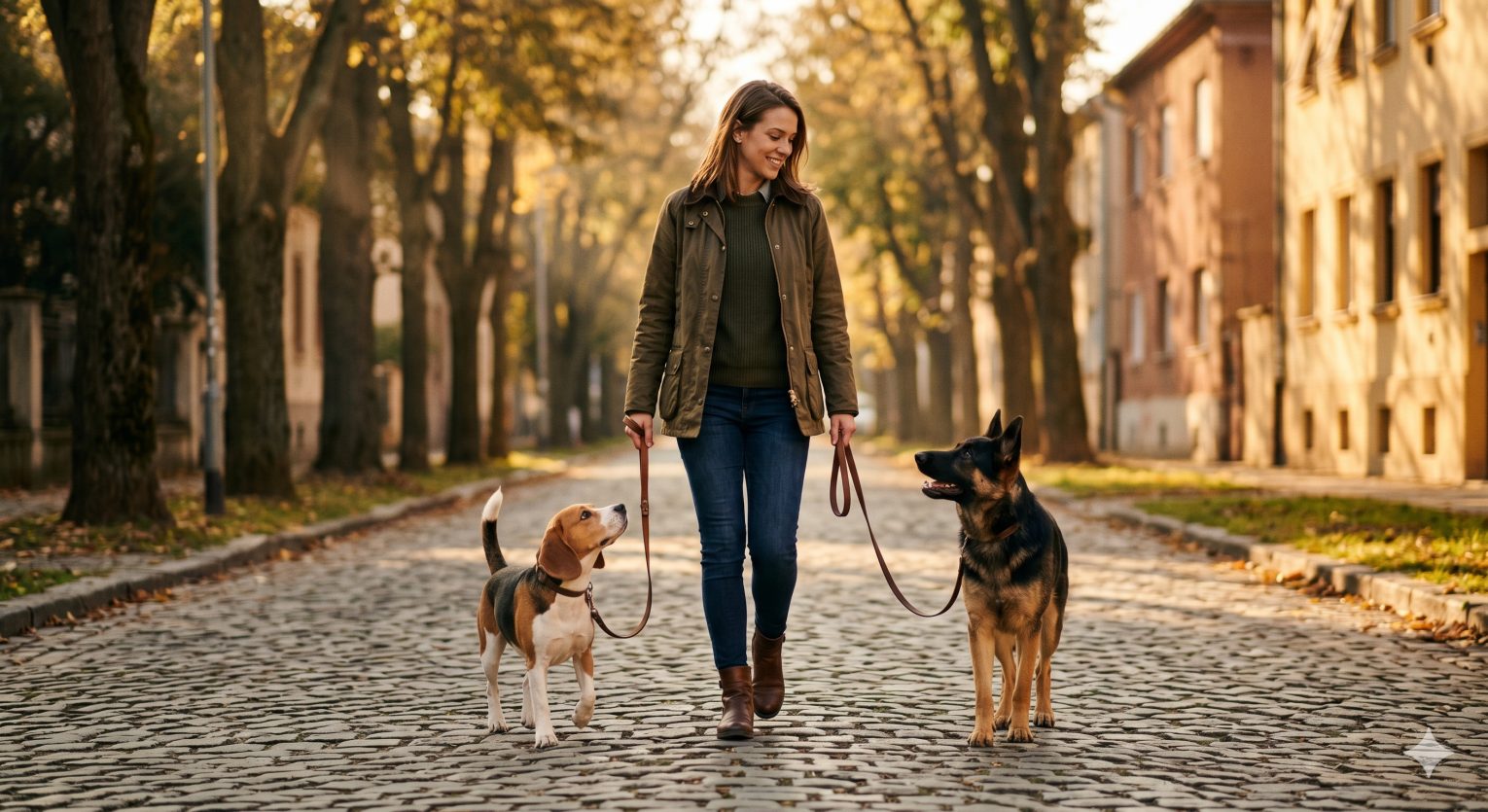
To stop your dog from pulling on the leash, stop walking the moment the leash goes tight. Stand completely still, wait for your dog to release the tension and look back at you, then reward and continue walking. Repeat every single time the leash tightens—most dogs show clear improvement within 2–3 weeks of consistent leash training practice.
Pulling on the leash is one of the most common dog behavior complaints—and one of the most misunderstood. Dogs don’t pull to dominate you. They pull because moving forward has always been the reward for pulling. This guide breaks down exactly how to change that equation using equipment, technique, and consistency.
Loose-leash walking is one of seven essential commands every dog should know. For a complete picture of how to train a well-behaved dog from the ground up, our complete dog training guide covers everything from basic commands to breed-specific strategies.
Table of Contents
Why Dogs Pull on the Leash
Understanding the root cause is half the battle. Dogs pull on the leash for one simple reason: it works.
Every time a pulling dog reaches the interesting smell, the other dog, or the exciting person ahead—the pulling was reinforced. The dog learned that tension on the leash equals getting where they want to go. You didn’t cause this on purpose, but the pattern was built one walk at a time.
The fix is equally simple in principle: make pulling the least effective strategy available. The moment the leash goes tight, all forward movement stops. Loose leash equals forward movement. Tight leash equals nothing.
Dogs are logical creatures. Once the equation changes consistently, the behavior changes with it.
(🎓 Trainer’s Note: “The single biggest leash training mistake owners make is continuing to walk while their dog pulls—even slowly. Every step forward on a tight leash teaches the dog that pulling works. You must be willing to stand still on a busy street for five minutes if that’s what it takes. The dog learns faster than you think”—LovingPetsGuide Training Advisor.)
The Right Equipment: What Actually Helps
Before you change your technique, you need the right tools. The wrong equipment makes leash training significantly harder—and some equipment actively makes pulling worse.
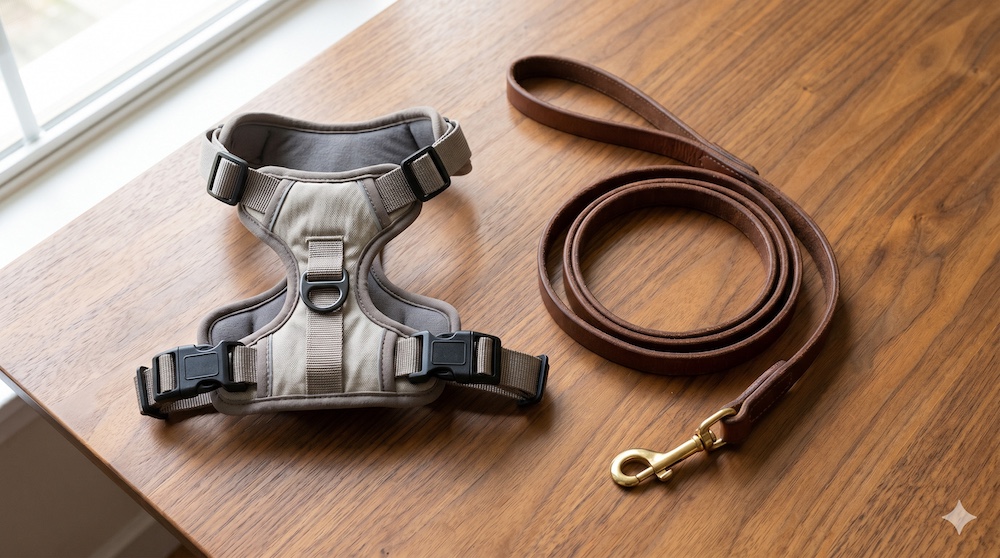
(🦮 A front-clip harness and a standard 6-foot leash are all you need to get started.)
✅ What Works
Front-clip harness: This is the single most effective piece of leash training equipment for most dogs. When your dog pulls, the front clip rotates their body back toward you rather than allowing them to lean forward into the pressure. It doesn’t hurt—it simply makes pulling mechanically ineffective.
📰 The biomechanical principle behind front-clip harnesses is documented by veterinary behaviorists. When the attachment point sits at the chest rather than the back, pulling forward rotates the dog’s shoulders and redirects their trajectory back toward the handler—rather than allowing the dog to lean into a back-clip attachment point above their center of gravity, the same mechanical advantage sled dogs use intentionally. The AKC (akc.org) recommends front-clip harnesses specifically for dogs learning loose-leash walking for this reason.
Look for a harness with:
- A chest clip (not just a back clip).
- Adjustable fit across chest and shoulders.
- Padded straps that don’t rub the armpits.
Standard 6-foot flat leash: Simple, effective, and gives you full control. The ideal length for training—long enough for your dog to move naturally, short enough for precise communication.
High-value training treats: Loose-leash walking requires your dog to choose you over the environment. Dry kibble won’t compete with the smell of another dog or a food wrapper on the ground. Use soft, smelly, pea-sized treats—boiled chicken, freeze-dried liver, or soft training treats cut small.
🐾 Zuke’s Mini Naturals Training Treats 🐾
🎯 Zuke’s Mini Naturals (Training Treats)—Pea-sized, under 3 calories each, and soft enough to eat instantly without breaking training momentum. Small enough to carry in a pocket or pouch for the precise 2–3 second reward timing that makes loose-leash training work.
🐾 PetSafe Easy Walk Front-Clip Harness 🐾
🦺 PetSafe Easy Walk (Front-Clip Harness)—The chest attachment point rotates your dog back toward you the moment they pull—making pulling mechanically ineffective without any pain or pressure. Padded straps, adjustable fit, and available in sizes for every breed.
New puppy just starting leash work? Our puppy training first 7 days covers how to introduce the leash before any formal training begins.
❌ What Doesn’t Help
Retractable leashes: These are the single worst tool for leash training. They teach your dog that pulling creates more leash—the exact opposite of what you want. The constant tension on a retractable also removes the clear signal between “tight leash = stop” and “loose leash = go.” Retire the retractable during all training.
📰 The operant conditioning principle underlying the retractable leash problem is well-established in animal learning research. Variable reinforcement schedules—where the reward (more leash) is unpredictable—actually strengthen behavior rather than extinguishing it, which is why dogs trained with retractable leashes often pull more persistently than those trained on fixed-length leashes. The AKC’s training resources at akc.org and the IAABC (International Association of Animal Behavior Consultants) at iaabc.org both recommend against retractable leashes for dogs undergoing leash training for this reason.
Back-clip harnesses for pullers: A back-clip harness places the attachment point above the dog’s center of gravity—which actually amplifies pulling by allowing the dog to lean into the harness like a sled dog. Fine for dogs who already walk well, counterproductive for dogs who pull.
Prong collars and choke chains: These tools use pain and pressure to suppress pulling—not to teach an alternative behavior. Even when they appear to “work,” the dog has learned to avoid pain, not to walk on a loose leash. The behavior typically returns the moment the aversive tool is removed.
📰 The recommendation against prong collars and choke chains is consistent with the AVSAB 2021 Position Statement on Humane Dog Training, verified at avsab.org/resources/position-statements. The statement explicitly recommends against aversive tools that use pain or discomfort as a training mechanism, noting that suppression of behavior through aversive means does not address the underlying motivation and typically results in behavior returning when the aversive tool is absent. A 2021 study published in Frontiers in Veterinary Science also found that dogs trained with aversive equipment showed higher levels of stress indicators (cortisol, behavioral signs) compared to dogs trained with reward-based methods.
The Stop-and-Wait Method: Step by Step
This is the foundation of loose-leash training and the technique that delivers the most reliable long-term results. It requires patience but no special skills.
How to Teach Your Dog Loose-Leash Walking Using the Stop-and-Wait Method.
Cost: $0
Supply: High-value training treats
Tools: Front-clip harness, standard 6-foot leash
Step 1: Start in low distraction
Begin in your garden, driveway, or a quiet street—not a busy park. Your dog cannot learn a new behavior when they are overstimulated. Low distraction first, always.
Step 2: The moment the leash tightens, stop
Plant your feet. Don’t say anything. Don’t pull back. Don’t call their name. Simply stop moving completely and stand still like a statue.
Step 3: Wait for the release
Your dog will pull, look back at you, pull again, sniff the ground, and eventually orient back toward you and release the tension in the leash. The moment the leash goes slack—even slightly—mark it with a cheerful “Yes!” and reward immediately.
Step 4: Resume walking
Take a step forward. If the leash tightens again within seconds, stop again immediately. Be consistent—every single step on a tight leash must result in zero forward movement.
Step 5: Build duration gradually
The goal is not just one loose step—it is a sustained loose leash. Gradually build the distance your dog walks on a loose leash before rewarding. Start by rewarding every 2–3 steps, then every 10, then every corner.
The Change of Direction Method
For dogs who are highly distracted or have been pulling for years, the stop-and-wait method alone can feel impossibly slow. The change of direction method is faster and more engaging.
How it works:
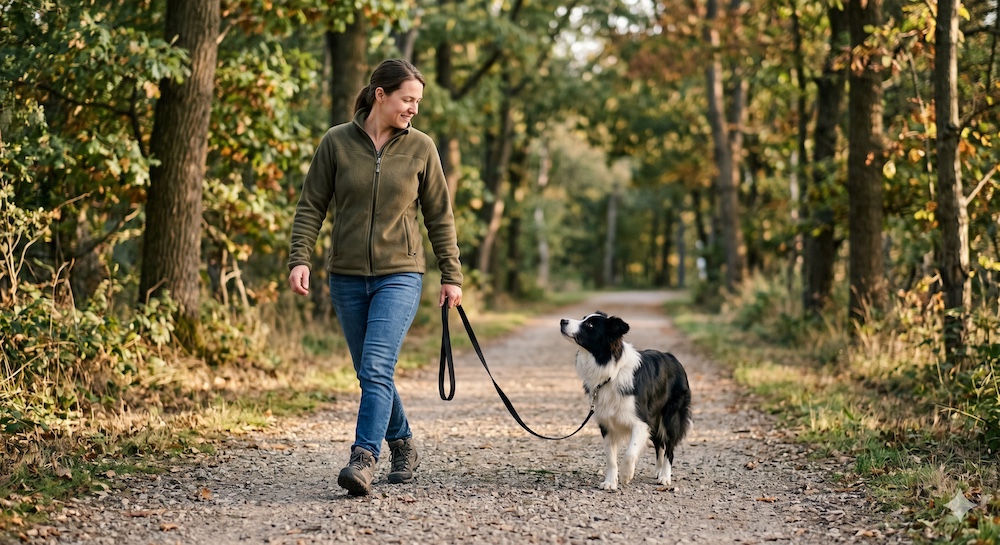
- The moment your dog pulls ahead, calmly turn and walk in the opposite direction.
- Don’t yank the leash—simply turn and walk.
- Your dog will naturally follow (they’re attached).
- The moment they catch up and the leash is loose, reward and praise enthusiastically.
- Repeat every time they drift ahead.
This method keeps the walk moving—which many dogs find more rewarding than standing still— while consistently communicating that pulling results in going the wrong direction.
The combination approach: Most experienced trainers use both methods together: stop-and-wait for the first half of a training walk when the dog is fresh and focused, change of direction when the dog starts losing attention in the second half.
Common Dog Leash Pulling Mistakes
Even committed owners often slow their own progress without realizing it. These are the most frequent mistakes.
| ❌ Training only on dedicated “training walks”: Leash manners must be practiced on every single walk, every day—not just the walks you mentally designate as “training sessions.” If your dog pulls on Tuesday and gets to reach the park anyway, Tuesday’s walk undid Monday’s training session. |
| ❌ Inconsistency with family members: If one household member allows pulling and another corrects it, the dog learns that the rules change depending on who is holding the leash. Every person who walks the dog must use the same method, the same equipment, and the same criteria. Inconsistency is also the number one reason chewing problems persist. Our how to stop dog chewing covers the same household consistency principles. |
| ❌ Starting in too much distraction: Trying to train loose-leash walking on a busy street full of dogs, children, and food smells before the behavior is solid in a quiet garden is like trying to learn a new language in a noisy concert. Always train in the least distracting environment your dog can succeed in, then raise the difficulty gradually. |
| ❌ Rewarding too late: The reward must happen within 2–3 seconds of the loose leash moment. If your dog walks nicely for 5 steps and you reach into your pocket on step 6, you may accidentally be rewarding the moment they started to drift ahead again. Keep treats easily accessible—a treat pouch on your waist makes timing precise. |
| ❌ Giving up too early: Leash pulling is a deeply ingrained habit in most dogs—especially if it has worked for months or years. Real improvement takes 3–6 weeks of consistent daily training. Two or three sessions is not enough data to decide the method isn’t working. |
Breed-Specific Leash Challenges
Different breeds pull for different reasons—and the solution is slightly different for each.
High-prey drive breeds (Huskies, Greyhounds, Terriers, Beagles)
These dogs pull because something in the environment triggered their chase or scent drive. Management is critical—a front-clip harness or a head halter gives you mechanical advantage before the prey drive kicks in. Training in low-distraction environments first is essential.
Strong, large breeds (Labradors, German Shepherds, Rottweilers)
Pure body strength makes stop-and-wait training physically demanding. A front-clip harness is non-negotiable for large pullers. The change of direction method often works faster for large breeds because it breaks their momentum.
Small breeds (Chihuahuas, Yorkies, Dachshunds)
Small dogs are often allowed to pull because “they can’t do much damage.” This builds the same habit—and a small dog straining on a collar puts just as much pressure on their delicate trachea as a large dog. Apply the same standards you would to any breed.
Conclusion: Every Walk Is a Training Session
Loose-leash walking is not a command you teach once and tick off a list. It is a standard you maintain on every walk, with every person, in every environment—until it becomes your dog’s default way of moving through the world.
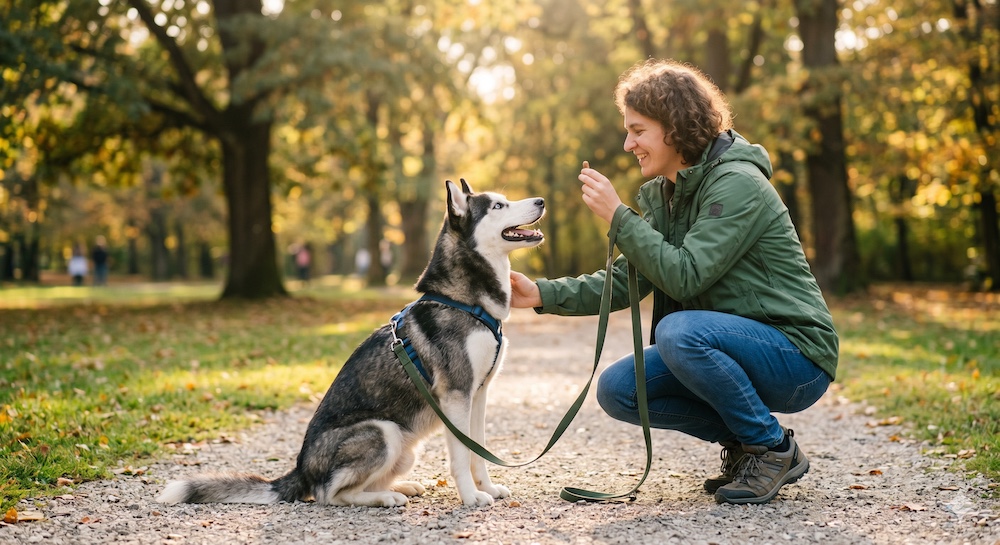
Reward the loose leash the moment it happens—timing is everything.
The investment is significant in the first 4–6 weeks. But a dog that walks beautifully on a loose leash is a dog you actually enjoy taking out—which means more exercise, more socialization, and a stronger bond for the rest of their life.
👉🏼 Puppy Training 101: First 7 Days at Home
Key takeaways:
- ✅ Stop walking the moment the leash tightens.
- ✅ Use a front-clip harness—retire the retractable.
- ✅ Reward every loose-leash moment, especially early.
- ✅ Train in low distraction first, build up gradually.
- ✅ Every person who walks the dog uses the same rules.
- ✅ Real improvement takes 3–6 weeks—don’t quit early.
📝 Editor’s Note: The equipment recommendations in this guide were cross-referenced with AVSAB guidelines at avsab.org and AKC training resources at akc.org. The recommendation against aversive tools aligns with the 2021 AVSAB Position Statement on Humane Dog Training and a 2021 peer-reviewed study in Frontiers in Veterinary Science on stress indicators in dogs trained with aversive versus reward-based methods. The stop-and-wait and change-of-direction methods follow standard positive reinforcement protocols consistent with IAABC training competency guidelines at iaabc.org.
Struggling with other behavioral issues alongside leash pulling? Our how to stop dog chewing and how to stop puppy biting and nipping guides cover the two most common companion problems.
🐾 Raw Paws Freeze-Dried Dog Treats 🐾
❄️ Raw Paws Freeze-Dried Treats—Single-ingredient, high-value treats that compete with outdoor distractions better than standard kibble or dry biscuits. Shelf-stable, no refrigeration needed, and accepted by virtually every dog including selective eaters. 15% off 1st Auto Ship + 5% off future orders.

🐕 Browse dog food, treats, toys, health products, supplements, grooming and everything else your dog needs 🐾

🐕 Browse raw dog food, freeze-dried meals, chews, bones and natural treats from Indiana farms 🐾

🐕 Browse science-backed dry dog food, wet food, breed-specific formulas, and veterinary diets for your canin 🐾
(This post contains affiliate links. If you purchase through our links, we may earn a small commission at no extra cost to you. This never influences our editorial opinions.)
FAQ: Dog Leash Training—Your Questions Answered
How long does it take to teach a dog to stop pulling?
Most dogs show clear improvement within 2–3 weeks of consistent daily training using the stop-and-wait method. Full reliability—where pulling is rare even in high-distraction environments—typically takes 4–8 weeks. Dogs that have been pulling for years may take longer, but the behavior is always trainable with consistency.
My dog walks perfectly at home but pulls outside. Why?
Dogs do not generalize well—a behavior learned in one environment doesn’t automatically transfer to others. Your dog understands loose-leash walking in the house, but the outside environment is so stimulating that their training hasn’t been practiced there yet. Start outdoor training in the least distracting outdoor space you have access to—your driveway or a quiet side street— before attempting busier areas.
Should I use a head halter to stop pulling?
Head halters (like the Gentle Leader or Halti) are highly effective at giving you mechanical control of a strong puller. They redirect the dog’s head when they pull forward, which immediately removes their momentum. However, they require a careful introduction period—most dogs resist them initially. Never use a head halter with a retractable leash, as a sudden lunge can cause a neck injury.
Can I teach an older dog to stop pulling?
Yes—adult and senior dogs can absolutely learn to walk on a loose leash. The training takes the same approach but may require more patience if pulling has been reinforced for years. Start with a front-clip harness to give yourself immediate mechanical advantage while the training takes hold, and be consistent on every single walk regardless of how long it takes.
Why does my dog pull toward other dogs but walk fine otherwise?
Reactivity toward other dogs is a separate issue from general leash manners. Your dog has learned that pulling toward other dogs occasionally results in a greeting—which is highly rewarding. Increase distance from other dogs during training walks, reward heavily for attention toward you when another dog is visible, and work on the “Leave It” command for controlled encounters. If dog-directed reactivity is severe, a certified trainer can help significantly.