
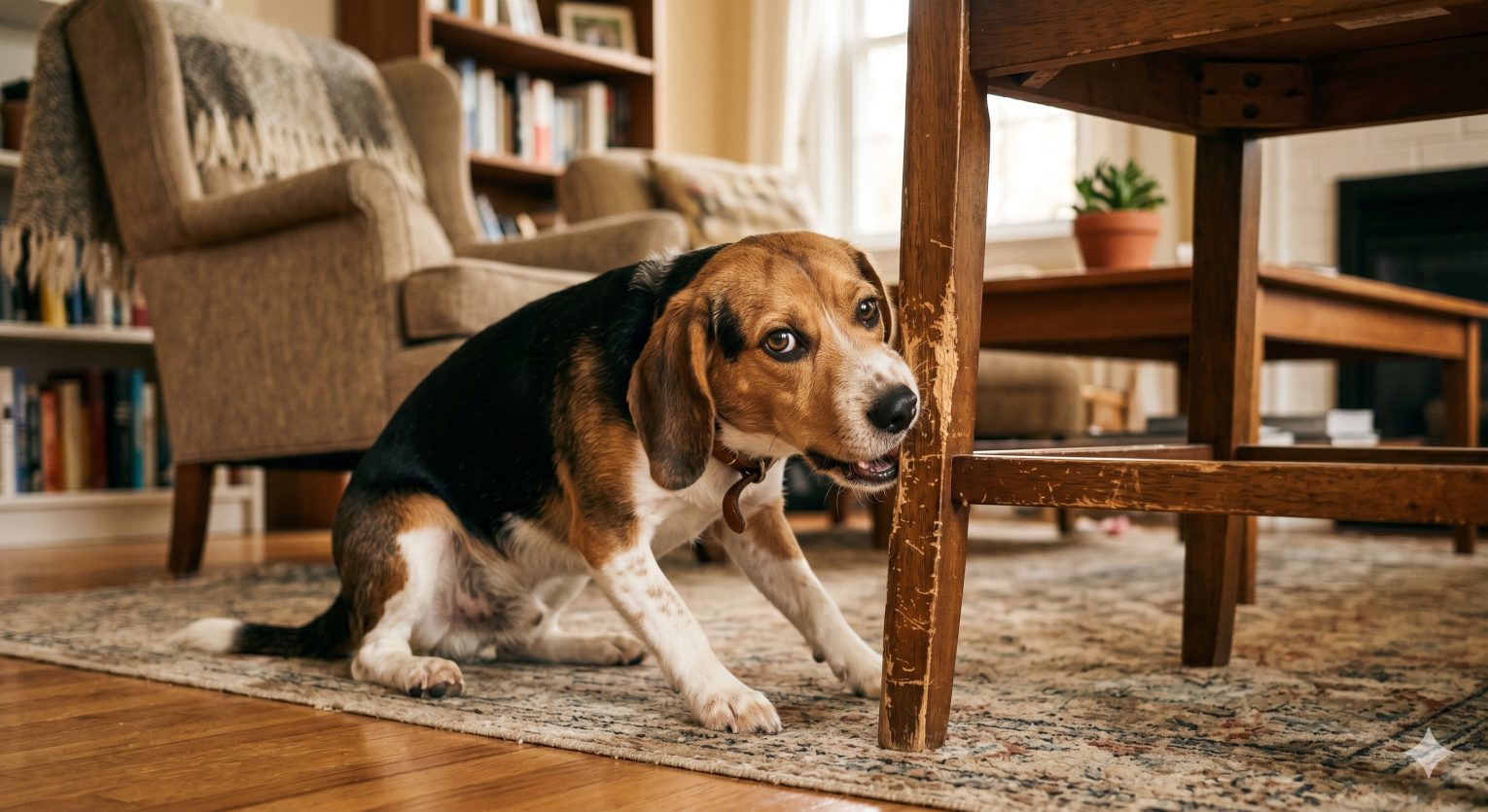
To stop a dog from chewing everything, you need to do three things at once: manage the environment so they cannot practice the wrong behavior, redirect every chewing urge toward an appropriate outlet, and address the root cause—whether that is boredom, teething, anxiety, or lack of training. Most dogs show significant improvement within 2–3 weeks when all three elements are applied consistently.
Destructive chewing is one of the most common behavioral complaints from dog owners—and one of the most misunderstood. Dogs do not chew your furniture out of spite or revenge. They chew because it is biologically driven, mentally satisfying, and because no one has given them a better alternative. This guide covers exactly how to change that.
Chewing is one of the most common behavioral issues dog owners face—but it is just one piece of the training puzzle. Our complete dog training guide covers everything from basic commands to fixing behavioral issues at every life stage.
Table of Contents
Why Dogs Chew: Understanding the Root Cause
Before you can fix the problem, you need to know why it is happening. Destructive chewing is almost never random—it has a specific cause, and the solution changes depending on which one applies to your dog.
🐾 1. Teething (Puppies 3–6 Months)
Between 3 and 6 months, puppies lose their 28 baby teeth and grow 42 adult teeth. Their gums are genuinely sore during this period, and chewing provides physical relief. Teething-driven chewing is frantic, targeted at hard surfaces, and often escalates in the late afternoon when puppies are tired.
The fix: Frozen chews and frozen Kongs provide cold relief on sore gums. Redirect relentlessly and manage the environment—teething is temporary and always resolves by 6–7 months.
📰 The teething timeline described here—28 baby teeth giving way to 42 adult teeth between 3 and 6 months—is confirmed by the Merck Veterinary Manual (merckvetmanual.com), which also notes that discomfort during this eruption period is the primary driver of the frantic, hard-surface-targeted chewing typical of this life stage.
🐾 2. Boredom and Under-Stimulation
A dog left alone in a house with nothing to do will create their own entertainment. Chewing is satisfying, time-consuming, and releases endorphins—it is the canine equivalent of stress-eating.
The fix: More mental and physical exercise, enrichment toys, and structured training sessions. A mentally tired dog does not chew furniture.
🐾 3. Separation Anxiety
Dogs with separation anxiety often chew specific items that smell strongly of their owner—shoes, cushions, clothing. The chewing is self-soothing behavior triggered by the distress of being alone.
The fix: Separation anxiety requires a structured desensitization program, not just better chew toys. If your dog only chews when alone and shows other signs of distress (pacing, excessive barking, accidents), anxiety is likely the root cause.
🐾 4. Lack of Appropriate Outlets
Many dogs simply have never been taught what they are allowed to chew. If a puppy has chewed the same sofa corner twelve times without consequence, they have learned that the sofa is a chew toy.
The fix: Consistent redirection to appropriate outlets combined with management that prevents access to the wrong items while training takes hold.
🐾 5. Attention-Seeking
Some dogs learn that picking up a forbidden item gets an immediate and exciting response from their owner—shouting, chasing, grabbing. The chewing becomes a game.
The fix: Remove the reward. Never chase a dog that has picked up something forbidden. Instead, calmly offer a high-value trade and redirect.
(🎓 Trainer’s Note: “The most common mistake owners make is punishing chewing after the fact. If you find a chewed shoe an hour later and scold your dog, they have absolutely no idea what they are being punished for. Punishment only works within about one second of the behavior. Everything else just damages your relationship without changing the behavior”—LovingPetsGuide Training Advisor.)
📰 The precise timing requirement for punishment to be effective is documented by the American Veterinary Society of Animal Behavior (avsab.org), which states that punishment must be applied as the animal is performing the behavior, or within one second of it, to have any real effect—a window so narrow that most owners inadvertently punish long after it has closed. AVSAB’s position statement further notes that punishment applied outside this window does not modify the underlying cause of the behavior and is more likely to damage the human-animal bond than correct the chewing itself.
The 3-Part Solution to Destructive Chewing
Stopping destructive chewing requires three simultaneous approaches. Applying only one or two of them produces temporary results at best.
Part 1: Manage the Environment
Management means removing the opportunity to practice the wrong behavior while training is underway. You cannot teach a dog not to chew the sofa if they have unsupervised access to the sofa 23 hours a day.
⚙️ Management tools:
- Crate when unsupervised: A properly introduced crate is the single most effective management tool available. A dog in a crate cannot chew your furniture. Our crate training a puppy guide covers the complete introduction process if you haven’t started this yet.
- Baby gates and closed doors: Limit your dog’s access to the house to only the rooms you can supervise them in. One puppy-proofed room with you is safer than free run of the whole house.
- Tether training: A light house leash attached to you or a heavy piece of furniture keeps your dog within reach and prevents them from wandering off to chew something unsupervised.
- Remove temptation: Put shoes in cupboards, remotes on high shelves, cables in cable management covers. Do not leave forbidden items accessible while your dog is still learning.
(⚠️ Important: Management is not a permanent solution—it is scaffolding while training takes hold. As your dog reliably chooses appropriate outlets, management can be gradually relaxed.)
Part 2: Redirect to Appropriate Outlets
Telling your dog what not to chew is only half the job. You must also show them what they should chew—consistently and every single time.
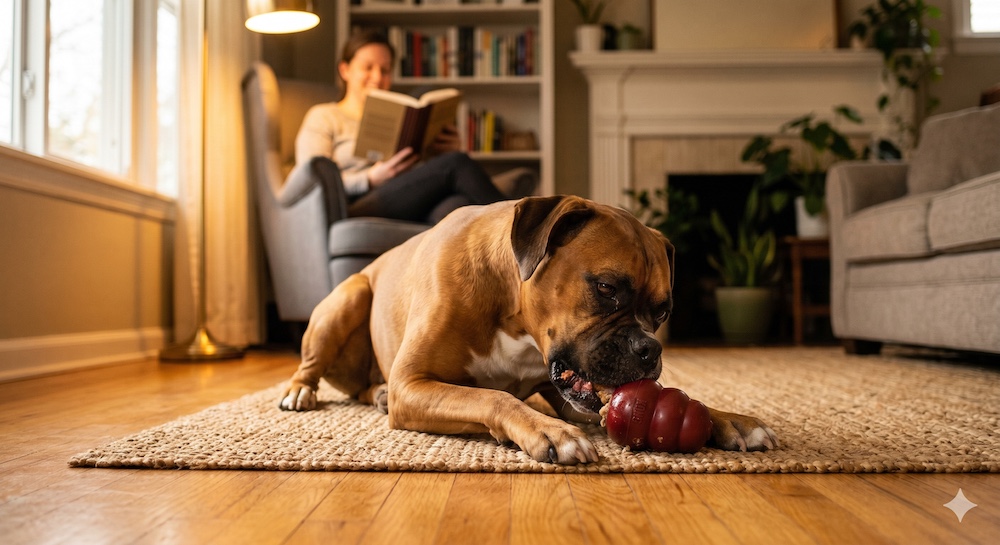
The redirection protocol:
- The moment you see your dog approach or pick up a forbidden item, calmly say “Leave it” or “Ah-ah”.
- Immediately offer an appropriate chew toy.
- The moment they take the toy, praise warmly.
- Do not make a dramatic fuss—calm, consistent redirection is more effective than excited reactions.
The best chew outlets by category:
For teething puppies (3–6 months):
- Frozen Kongs stuffed with wet food or peanut butter.
- Frozen carrots or frozen wet washcloths.
- Rubber teething rings designed for puppies.
- Bully sticks and natural chews.
For adult dogs (boredom/enrichment):
- Bully sticks and natural single-ingredient chews.
- Kongs and Toppls stuffed and frozen overnight.
- Deer antlers and elk antlers (long-lasting).
- Raw bones under supervision (never cooked— cooked bones splinter dangerously).
For power chewers:
- Heavy-duty rubber toys (Kongs Black, Goughnuts).
- Nylabone Power Chew range.
- Elk antlers (split antlers for moderate chewers, whole for power chewers).
👉🏼 Raw Paws offers meaty bones and long-lasting chews sourced from local Indiana farms—see Raw Paws chews and bones.
🐾 KONG Classic Dog Toy 🐾
🧸 KONG Classic (Stuffable Chew Toy)—The single most versatile redirection tool across every chewing cause. Stuff with kibble and freeze for 30–45 minutes of independent occupation, or offer plain as an appropriate chew outlet during the redirection protocol below. Durable rubber suitable for moderate chewers.
🐾 Nylabone Power Chew 🐾
🦴 Nylabone Power Chew (Heavy-Duty)—Built for power chewers who destroy standard rubber toys within minutes. Textured nylon resists aggressive chewing significantly longer than softer alternatives, satisfying the same biological drive without the destruction or splintering risk of cooked bones.
Part 3: Address the Root Cause
Management and redirection address the symptom. Addressing the root cause eliminates the underlying drive to chew inappropriately.
❗️If the cause is boredom:
The “Ditch the Bowl” approach is one of the most effective solutions available. Instead of feeding your dog from a standard bowl—where the food is gone in 30 seconds—use their daily kibble to make them work:
- Stuff it into a Kong or Toppl and freeze overnight.
- Scatter it on a snuffle mat.
- Use it for a 10-minute training session.
- Hide it around the house for a “Find It” game.
15 minutes of structured mental stimulation—puzzle feeding, training, or scent work—taps the same problem-solving drive that physical exercise alone doesn’t address. A mentally tired dog does not chew furniture.
❗️If the cause is insufficient exercise:
Different breeds have vastly different exercise requirements. A Border Collie or Husky that receives one 20-minute walk per day will express their excess energy through destructive behavior—chewing, digging, and barking. Know your breed’s requirements and meet them before expecting good behavior indoors.
❗️If the cause is separation anxiety:
Separation anxiety is a complex condition that requires a specific desensitization protocol beyond the scope of this guide. Key signs:
- Chewing only occurs when the dog is alone.
- Vocalization (barking, howling) when left.
- Pacing, drooling, or house-soiling when alone.
- Destructive behavior focused on exits (doors, windows).
If these signs apply, consult a certified trainer or veterinary behaviorist. Attempting to “punish out” separation anxiety makes it significantly worse.
(🎓 Trainer’s Note: “Separation anxiety is often misdiagnosed as stubbornness or spite. A dog that destroys the house only when alone is not being bad—they are in genuine psychological distress. The intervention is completely different from training a bored dog, and treating them the same way will make things worse, not better”—LovingPetsGuide Training Advisor.)
The “Leave It” Command: Your Most Powerful Tool
Teaching a reliable “Leave It” command gives you real-time control before chewing starts—not just after. A dog that will leave a forbidden item on command saves furniture, shoes, and potentially their own life when they pick up something toxic.
How to teach “Leave It”:
- Place a low-value treat in your closed fist. Let your dog sniff and paw at your hand—ignore all attempts to get it.
- The moment your dog pulls back and stops trying, say “Leave It” calmly and reward them from your other hand with a higher-value treat.
- Repeat until your dog backs away from your closed fist immediately on the cue.
- Generalize to real objects on the floor: drop a treat, say “Leave It,” reward with a better treat from your hand.
- Progress to forbidden items—shoes, cables, food on the coffee table—always setting up scenarios where you can reward success.
For a full breakdown of Leave It and the other six essential commands, our guide to all 7 essential dog commands covers the complete progression from basics to real-world reliability.
Chewing by Life Stage: What to Expect
Chewing behavior changes significantly as dogs age—and the approach must change with it.
🐕 Puppies (8 Weeks to 6 Months)
This is peak chewing. Everything goes in the mouth for sensory exploration and teething relief. The priority at this stage is management and redirection—puppies are not yet capable of sustained impulse control. Do not expect perfection; expect progress.
The crate is your most important tool during this phase. Pair it with our guide on puppy training 101: first 7 days at home, to build the right foundations before chewing becomes a serious habit.
🐕 Adolescents (6 to 18 Months)
Adult teeth are now in, but adolescent dogs chew for different reasons—boredom, excess energy, and the hormonal shift of adolescence. This is the phase where most owners give up because the puppy “should know better by now.” They do not—their brain is still under construction.
Maintain management, increase mental stimulation, and stay consistent with redirection. Most adolescent chewing resolves significantly by 18 months as the brain reaches maturity.
🐕 Adult Dogs (18 Months+)
Adult dogs that still chew destructively typically fall into one of two categories: under-stimulated or anxious. Rule out anxiety first. If anxiety is not the cause, increase enrichment, exercise, and training—and ensure they still have appropriate daily chewing outlets.
A dog that has appropriate chews available and sufficient mental and physical stimulation rarely chooses to chew furniture.
What NOT to Do
These common responses make the problem worse:
| ❌ Punishing after the fact: Scolding your dog 10 minutes after they chewed something teaches them nothing about chewing— it only teaches them to fear your unpredictable anger. Punishment is only effective within about one second of the behavior. |
| ❌ Chasing the dog when they have something: A dog that grabs your sock and gets chased has found a brilliant new game. Never chase—always calmly trade for something better. |
| ❌ Using physical corrections: Hitting, scruffing, or using a rattle can to startle your dog suppresses behavior in the short term but builds anxiety that often makes chewing worse. Anxiety is a primary cause of destructive chewing—adding more anxiety to the mix is counterproductive. |
| ❌ Giving up management too soon: Many owners relax management after a week of good behavior, give the dog free roam, and then blame the dog when chewing resumes. Freedom must be earned gradually over weeks—not given back after a good few days. |
| ❌ Not providing enough appropriate outlets: Removing forbidden chew items without replacing them with appropriate ones leaves your dog with an unmet biological need. Always add before you take away. |
Bitter Sprays and Deterrents: Do They Work?
Bitter apple spray and similar deterrents are commonly recommended—and they have a role to play, but a limited one.
✅ When they work:
- On specific high-value targets (a particular chair leg, cable, or skirting board).
- As a temporary barrier while management and training catch up.
- On dogs that are chewing out of habit rather than anxiety or strong drive.
❌ When they don’t work:
- On dogs chewing from anxiety—the anxiety drives them past the deterrent.
- On dogs that simply don’t find the taste unpleasant (some dogs are unbothered by it).
- As a standalone solution without management and redirection.
How to use them correctly: Apply to the target surface every 1–2 days as the spray wears off. Always pair the spray with a chew toy placed nearby—you are redirecting, not just blocking.
🐾 NaturVet Bitter Yuck! No Chew Spray 🐾
🚫 NaturVet Bitter Yuck! (Chew Deterrent)—A water-based, non-staining bitter spray formulated to be unpleasant without causing pain or harm, unlike hot sauce or pepper. Best used on specific high-value targets while paired with an appropriate chew toy placed nearby—deterrents work best alongside redirection, not alone.
Conclusion: Consistency Beats Every Shortcut
Stopping destructive chewing is not a single intervention—it is a combination of management, consistent redirection, and addressing the underlying reason your dog is chewing in the first place.
The owners who get results fastest are the ones who accept that this takes 2–4 weeks of consistent effort, not one or two corrections.
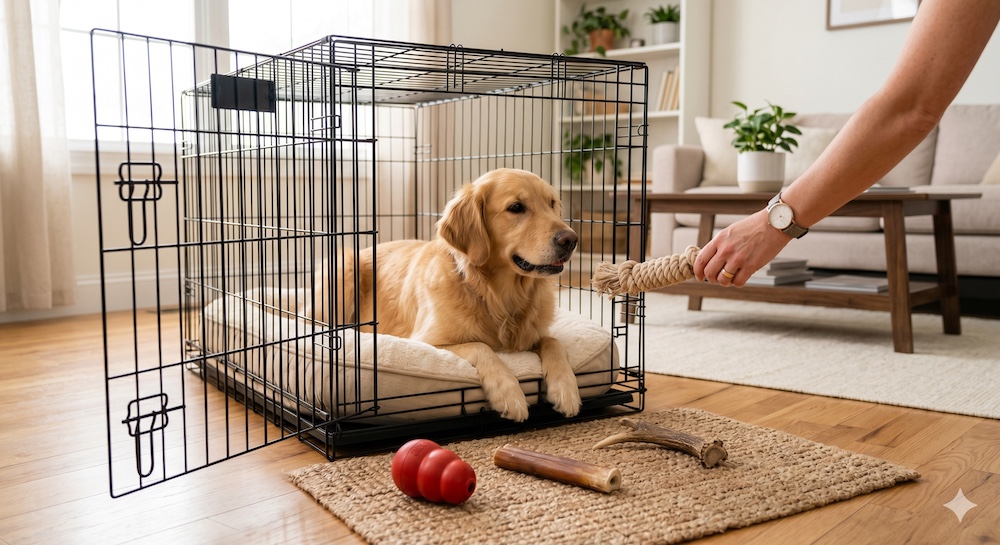
Key takeaways:
- ✅ Identify the root cause first—the fix differs.
- ✅ Manage the environment while training takes hold.
- ✅ Always redirect to an appropriate outlet.
- ✅ Never punish after the fact—it achieves nothing.
- ✅ Mental stimulation eliminates boredom chewing.
- ✅ “Leave It” is your most powerful real-time tool.
- ✅ Expand freedom gradually as trust is earned.
Ready to tackle the next challenge?
👉🏼 Full Dog Training Guide — commands, enrichment, and fixing behavioral issues.
👉🏼 Crate Training a Puppy — the management foundation that prevents chewing opportunities.
👉🏼 How to Stop Puppy Biting and Nipping — the other common first-year behavioral challenge.
👉🏼 Leash Training: Stop Your Dog Pulling on Walks — the next skill to work on once chewing is managed.

🐕 Browse dog food, treats, toys, health products, supplements, grooming and everything else your dog needs 🐾

🐕 Browse raw dog food, freeze-dried meals, chews, bones and natural treats from Indiana farms 🐾

🐕 Browse science-backed dry dog food, wet food, breed-specific formulas, and veterinary diets for your canin 🐾
(This post contains affiliate links. If you purchase through our links, we may earn a small commission at no extra cost to you. This never influences our editorial opinions.)
FAQ: How to Stop a Dog from Chewing — Your Questions Answered
At what age do dogs stop chewing everything?
The peak chewing phase—teething-driven—resolves by 6–7 months once all adult teeth are in. However, adolescent dogs (6–18 months) often continue chewing from boredom and excess energy. Most dogs settle into predictable, manageable chewing habits by 18–24 months, provided they have appropriate outlets and sufficient stimulation throughout.
Why does my dog only chew things when I’m not home?
If chewing occurs exclusively when you are absent, separation anxiety is a strong possibility rather than straightforward boredom. Other signs include barking or howling when alone, accidents despite being house-trained, and destructive behavior focused near exits. If these symptoms apply, consult a certified trainer or veterinary behaviorist—the intervention differs significantly from standard chewing protocols.
My dog chews things right in front of me. Why?
Dogs that chew forbidden items in front of you are often attention-seeking—they have learned that picking up the wrong item produces an immediate, exciting response. Remove the reward by staying completely calm. Do not chase, shout, or grab. Instead, calmly offer a high-value trade and praise heavily when they take it. Repeating this consistently removes the entertainment value.
Are antlers safe for dogs to chew?
Split elk antlers are generally considered safe for moderate chewers—the exposed marrow makes them more accessible and reduces the risk of tooth fractures. Whole antlers are very hard and can crack teeth in dogs that chew aggressively. As a general guideline, if you cannot make a dent in the chew with your thumbnail, it may be too hard for your dog. Always supervise with any new chew until you know your dog’s chewing style.
Can I use hot sauce or pepper on furniture to stop chewing?
This is not recommended. Strong flavors like hot sauce and pepper can cause genuine pain and distress, and a dog in pain may become anxious or reactive. Use purpose-made bitter apple sprays specifically formulated to be unpleasant but not harmful. More importantly, pair any deterrent with positive redirection—deterrents alone do not teach the dog what to do instead.
My adult dog suddenly started chewing after years of good behavior. Why?
Sudden onset of destructive chewing in an adult dog with a previously clean record almost always signals a change in circumstances: a new work schedule leaving them alone longer, a move to a new home, a new family member, or occasionally an underlying health issue causing discomfort or cognitive changes. If the behavior is sudden and unexplained, a veterinary check-up is warranted to rule out medical causes before pursuing behavioral intervention.