
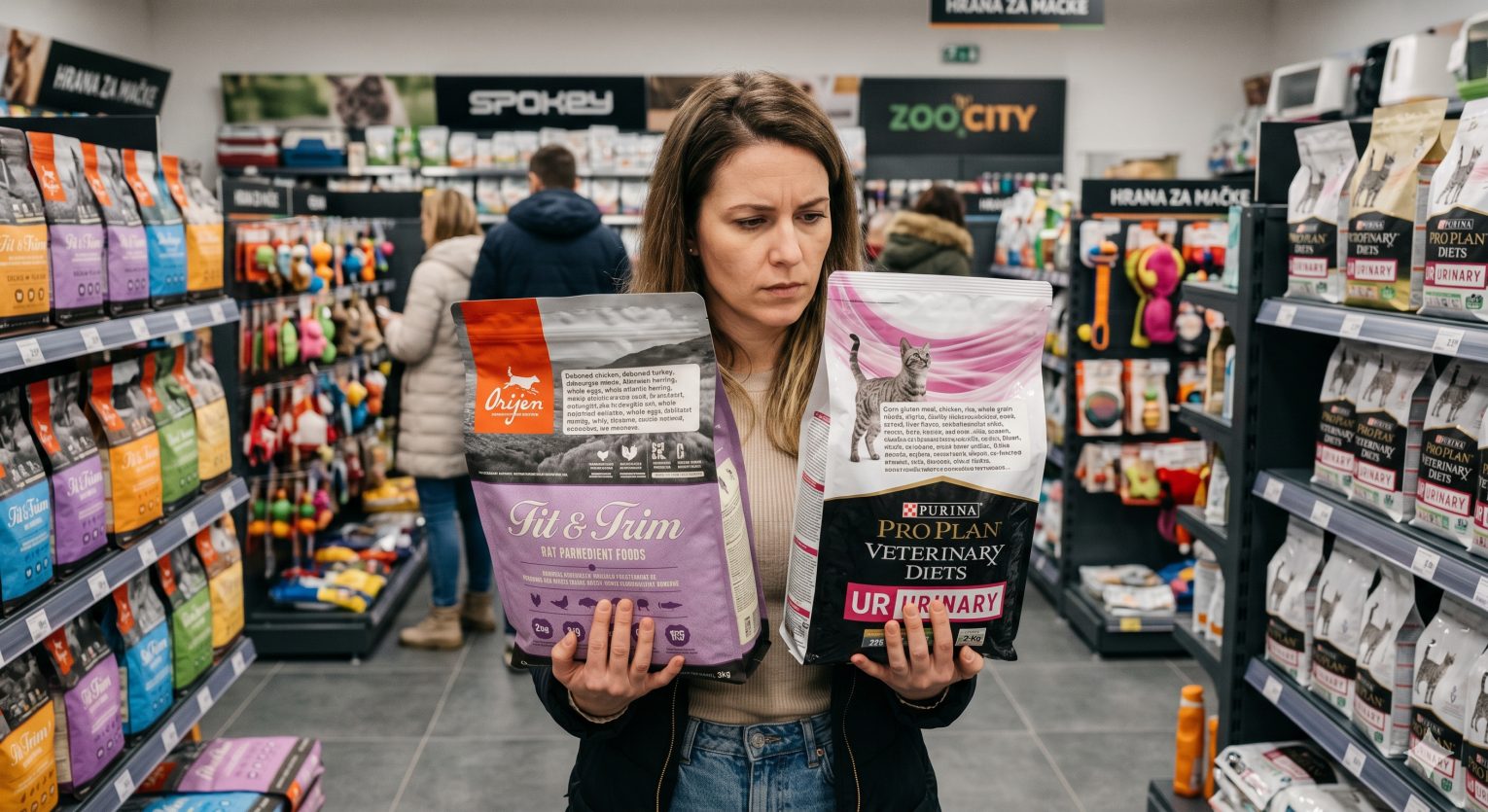
Evaluating cat food brands comes down to five questions recommended by the World Small Animal Veterinary Association (WSAVA): Does the company employ a board-certified veterinary nutritionist full-time? Do they conduct and publish original research? Do they use AAFCO feeding trials rather than formulation alone? Can they provide a complete nutrient analysis on request? And do they have quality control at every manufacturing stage? Brands that answer yes to all five consistently outperform those that do not—regardless of what is printed on the front of the bag.
Cat food marketing is among the most misleading in the pet industry. “Grain-free,” “ancestral,” “raw-inspired,” “human-grade,” and “biologically appropriate” are marketing categories with no regulated nutritional definitions—they tell you nothing about digestibility, safety, or whether the formula was developed by anyone with relevant expertise. The WSAVA framework replaces marketing language with objective, verifiable questions that any brand can answer—and the brands that refuse to answer them tell you everything you need to know.
Brand evaluation makes most sense when you understand what cats actually need nutritionally— because knowing the standard is what lets you judge whether a brand meets it. Our cat nutrition guide covers the complete picture of feline macronutrient requirements, taurine needs, hydration, and life stage feeding before you apply this framework.
Table of Contents
Why Cat Food Marketing Cannot Be Trusted at Face Value
Before applying any evaluation framework, it helps to understand which terms you can safely ignore—because most of the language on cat food packaging is designed to appeal to human psychology, not feline nutritional science.
⚠️ Terms with no regulated definition in cat food:
- “Natural“—no legal definition.
- “Holistic“—no legal definition.
- “Human-grade“—no enforceable standard.
- “Biologically appropriate“—marketing only.
- “Ancestral diet“—marketing only.
- “Raw-inspired“—no nutritional standard.
- “Grain-free“—describes what is absent, not what nutritional quality is present.
- “Premium“—no definition.
- “Superfood“—no definition.
✅ Terms that DO have meaning:
- “Complete and balanced“—AAFCO regulated.
- “AAFCO feeding trial“—tested on actual cats.
- “Board-certified veterinary nutritionist (DACVN or DECVCN)“—specific, verifiable credential.
- “Named animal protein in ingredient list“—verifiable.
- “Specific nutrient percentages in guaranteed analysis“—measurable.
❓Why “grain-free” deserves special mention: Grain-free is the most aggressively marketed claim in cat food—and the one with the least nutritional justification for most cats. Unlike dogs (where an FDA investigation linked some grain-free diets to cardiac disease), grain-free status has not been implicated in the same concern for cats. However, the marketing of grain-free as inherently superior remains unsupported by evidence— high-quality grains like rice are among the most digestible carbohydrate sources for cats, and grain-free formulas often replace grains with legumes that are equally or less digestible.
(🩺 Vet’s Note: “The cats I see with the most nutrition-related health problems are often eating expensive boutique grain-free foods that look impressive on the label but have no research behind them. The brands that score highest on objective criteria—Purina, Hill’s, Royal Canin—are often dismissed as ‘not premium enough’ by owners who are making decisions based on marketing rather than evidence”—LovingPetsGuide Veterinary Advisor.)
The Label: Four Checks Before WSAVA Questions
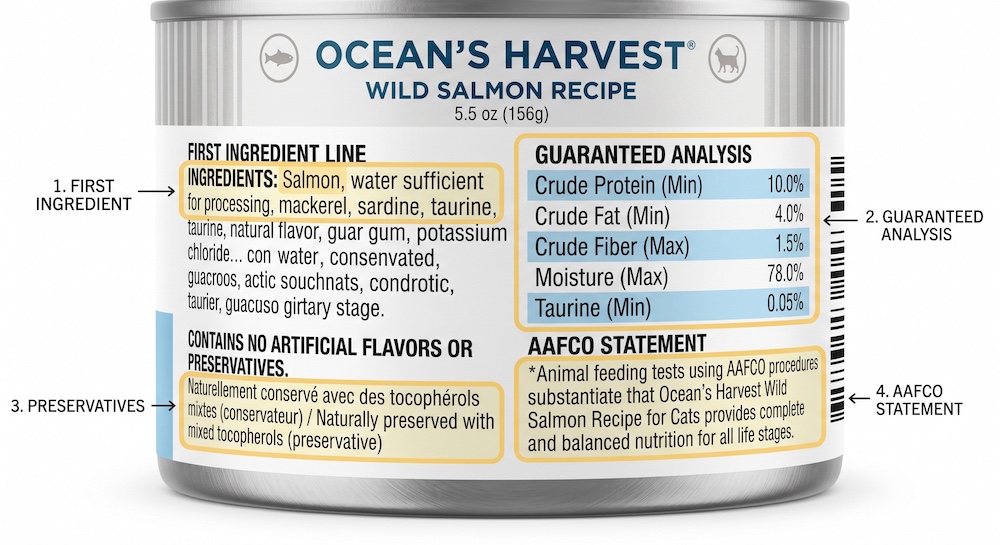
Before asking a single brand question, the label provides an immediate first filter.
Four label checks take 60 seconds and eliminate most poor options before the WSAVA questions even begin.
(💡 The front of the product is advertising. The ingredient list, AAFCO statement, and the answers to five specific questions tell you what you actually need to know.)
✅ Check 1: First ingredient = named animal protein: “Chicken,” “Salmon,” “Turkey,” “Tuna”—not “poultry,” “fish,” “meat,” or “animal digest.” A named species as the first ingredient is the minimum quality signal.
✅ Check 2: AAFCO complete and balanced statement: Must say “complete and balanced nutrition for that specific life stage.” If it says “for supplemental or intermittent feeding only”—it is not a complete diet and should not be used as the primary food.
✅ Check 3: Taurine listed in ingredients or guaranteed analysis: Cats are obligate carnivores that cannot synthesize adequate taurine. Every complete cat food must contain sufficient taurine—and any reputable brand will list it in the guaranteed analysis or ingredients. A food without visible taurine sourcing warrants a call to the manufacturer.
✅ Check 4: No artificial preservatives: Avoid BHA, BHT, and ethoxyquin. Choose foods preserved with mixed tocopherols (Vitamin E) or rosemary extract.
The WSAVA Framework: Five Questions That Matter
The World Small Animal Veterinary Association publishes guidelines for evaluating pet food manufacturers—used by veterinary nutritionists worldwide as an objective quality framework. These five questions form its core.
📰 The WSAVA Global Nutrition Committee guidelines referenced throughout this article are publicly available at wsava.org/global-guidelines. Developed by board-certified veterinary nutritionists representing professionals across more than 100 countries, the guidelines are updated based on current veterinary nutrition science and are freely downloadable. These are the same criteria veterinary nutritionists use when recommending brands to clients.
🐾 Question 1: Does the Company Employ a Board-Certified Veterinary Nutritionist Full-Time?
Why this matters: Formulating a nutritionally complete diet for an obligate carnivore across multiple life stages, health conditions, and weight categories requires specialist expertise. A board-certified veterinary nutritionist—Diplomate of the American College of Veterinary Nutrition (DACVN) in North America, or DECVCN in Europe—has completed a veterinary degree, a residency in clinical nutrition, and passed rigorous board examinations.
Many companies employ “animal nutritionists,” “pet nutrition specialists,” or “formulation experts”—titles with no specific accreditation requirement. The credential to verify is DACVN or DECVCN. Ask specifically for this.
How to verify: Email or call the company and ask: “Does your company employ a board-certified veterinary nutritionist (DACVN or DECVCN equivalent) full-time who is directly involved in formulating your products?”
A reputable company will answer clearly and specifically. A company that deflects to “our team of experts” without naming credentials is a yellow flag.
Brands known to employ veterinary nutritionists:
Hill’s Science Diet ✅
🥇 Hill’s Science Diet — Formulated by board-certified veterinary nutritionists with clinically proven digestibility and no artificial additives—the most frequently recommended brand by veterinary internists for cats at every life stage.
Purina ✅
🏆 Purina Pro Plan — Over 200 peer-reviewed publications, AAFCO feeding trials, live probiotics, and 500+ scientists across eight global R&D facilities—the most research-backed mainstream cat food brand available.
Royal Canin ✅
🔬 Royal Canin — Breed-specific and condition-specific nutrition backed by substantial veterinary research—the go-to brand for cats with specific health predispositions or those requiring highly targeted formulas.
Iams ✅
✅ Iams — A WSAVA-compliant brand with veterinary nutritionist oversight, AAFCO feeding trials, and real chicken as the first ingredient—one of the most accessible research-backed options at a mid-range price point.
🐾 Question 2: Does the Company Conduct and Publish Its Own Research?
Why this matters: Original peer-reviewed research published in veterinary journals is evidence of a scientific commitment that cannot be faked through marketing. Research costs money. Publishing invites scrutiny from the scientific community. Brands that invest in this level of transparency are accountable in a way that brands without published research are not.
How to verify: Search PubMed (pubmed.ncbi.nlm.nih.gov) for the brand name. Look for peer-reviewed publications in journals like the Journal of Veterinary Internal Medicine, Journal of Feline Medicine and Surgery, or Journal of Animal Physiology and Animal Nutrition.
What counts: Studies on the brand’s specific formulas—not just generic ingredient studies. Research on feeding outcomes—not just palatability.
📰 When researching this article, searching PubMed for “Purina cat nutrition” returned over 200 peer-reviewed publications—a level of research output that no boutique brand comes close to matching. Hill’s and Royal Canin have comparable publication records. I also searched for several trending boutique brands by name—most returned zero results. This research gap is not visible on the label or in marketing materials, but it is the most reliable single indicator of a brand’s genuine scientific investment.
🐾 Question 3: Does the Company Use AAFCO Feeding Trials or Just Formulation?
Why this matters: Two routes to AAFCO nutritional adequacy:
- Formulation: Calculate on paper that the recipe contains required nutrients. Tells you nothing about bioavailability, palatability, or whether the formula produces healthy cats when actually fed.
- Feeding trial: Feed the actual food to actual cats over a minimum period and measure health outcomes. Significantly more rigorous—and expensive. Feeding trial approval means cats ate this food and remained healthy.
How to check: The AAFCO nutritional adequacy statement on the label states one of two things:
- ✅ “Animal feeding tests using AAFCO procedures substantiate that product provides complete and balanced nutrition…”—this is a feeding trial.
- ⚠️ “Product is formulated to meet the nutritional levels established by the AAFCO Cat Food Nutrient Profiles…”—this is formulation only.
Both are legal. Feeding trial data is the gold standard.
🐾 Question 4: Can the Company Provide a Complete Nutrient Analysis on Request?
Why this matters: Cat food labels show minimum protein, minimum fat, maximum fiber, and maximum moisture—they are not required to show taurine levels, specific amino acid profiles, omega-3 content, calcium and phosphorus levels, or sodium.
For cats with specific health conditions—kidney disease (where phosphorus is critical), heart disease (where sodium and taurine matter), and urinary conditions (where magnesium is relevant)—this detailed analysis is essential for informed feeding decisions.
A confident brand provides it on request or publishes it on their website. Many research-backed brands publish full nutrient analyses by formula publicly— Purina and Hill’s both do.
How to request: Check the brand’s website first. If not available, contact customer service and ask for the complete guaranteed analysis for the specific formula you are considering.
🐾 Question 5: Does the Company Have Quality Control at Every Manufacturing Stage?
Why this matters: Pet food recalls happen. The brands with the best safety records invest in ingredient testing on arrival, in-process testing, finished product testing, and traceability systems that enable rapid recall management.
The contract manufacturing concern: Many boutique brands—including some of the most heavily marketed premium cat foods—do not own their manufacturing facilities. They contract production to third-party manufacturers, which means quality control depends entirely on the contractor’s standards.
Large research-backed brands (Purina, Hill’s, Royal Canin) primarily manufacture in their own facilities with published quality standards.
How to verify: Ask: “Do you own your manufacturing facilities or use contract manufacturers? What testing do you perform on ingredients before production and on finished products before shipping?”
📰 The FDA maintains a publicly accessible pet food recall database at fda.gov/animal-veterinary/safety-health/recalls-withdrawals. I cross-referenced all brands in this article against the database before publishing. Recent or repeated contamination recalls—particularly for Salmonella or aflatoxin—are a meaningful quality control signal that no amount of marketing can override.
Brands That Meet WSAVA Standards
| Brand | DACVN | Research | Feeding Trials | Nutrient Analysis | Own Facilities |
|---|---|---|---|---|---|
| Purina (Pro Plan, ONE) | ✅ | ✅ Extensive | ✅ | ✅ Public | ✅ |
| Hill’s Science Diet | ✅ | ✅ Extensive | ✅ | ✅ Public | ✅ |
| Royal Canin | ✅ | ✅ Substantial | ✅ | ✅ On request | ✅ |
| Eukanuba | ✅ | ✅ Moderate | ✅ | ✅ | ✅ |
| Iams | ✅ | ✅ Moderate | ✅ | ✅ | ✅ |
For specific product picks from these brands across cat need categories, see our best cat food brands guide.
🐾 Purina Pro Plan Adult Wet Cat Food 🐾
💧 Purina Pro Plan Cat Food (Wet)—The top-scoring mainstream cat food brand on every WSAVA criterion— DACVN on staff, peer-reviewed research, AAFCO feeding trials, and published nutrient analyses. Named protein first, high moisture content for kidney and urinary health, available in multiple formulas for every life stage.
Brands That Score Inconsistently
Many popular, aggressively marketed brands cannot answer all five WSAVA questions clearly. This is not automatically evidence that the food is harmful—but it means the quality assurance infrastructure is less verifiable.
❗️Common patterns in inconsistently scoring brands:
- Market as “premium” but cannot confirm a DACVN on staff.
- No peer-reviewed research published.
- Formulation to AAFCO standards without feeding trial data.
- Frequent formula changes without disclosed reasons.
- Reliance on marketing language (“ancestral,” “biologically appropriate”) over clinical data.
❓Why this matters specifically for cats: Cats are obligate carnivores with unique nutritional requirements—particularly taurine, arachidonic acid, and preformed Vitamin A—that cannot be met through plant-based substitution. A formula without veterinary nutritionist oversight that gets these balances wrong causes progressive health damage before visible symptoms appear.
How to Research Any Brand: Step by Step
Check the AAFCO statement—feeding trial or formulation?
Search PubMed for the brand name—any peer-reviewed publications?
Email or call customer service—does the company employ a full-time DACVN?
Request a complete nutrient analysis for the specific formula you are considering.
Check FDA recall history at fda.gov/animal-veterinary/safety-health/recalls-withdrawals. Recent or repeated contamination recalls are a significant quality control concern.
Search for the brand name on the WSAVA’s own resources or ask your veterinarian directly—most veterinary nutritionists have an opinion on specific brands.
A Note on Price
Price correlates very poorly with quality in cat food. Purina Pro Plan—which consistently scores highest on WSAVA criteria—is priced comparably to mid-range options. Many of the most expensive boutique cat foods on the market cannot confirm a veterinary nutritionist on staff and have published no research.
Owners who pay premium prices for heavily marketed boutique foods are often paying for branding, ingredient appeal to human preferences (cage-free chicken, wild-caught salmon), and packaging—not for superior nutritional science or manufacturing quality.
Conclusion: Questions Over Claims
The single most important shift in cat food evaluation is moving from ingredient-focused (“does it contain real salmon?”) to brand-focused (“does this company have the infrastructure to produce consistently safe, nutritionally complete food for an obligate carnivore?”).
A transparently labeled food from a research-backed brand with a DACVN on staff, feeding trial data, and published quality controls beats an impressive ingredient list from a company that cannot answer basic questions about who formulated the recipe.
Once you know which brand to trust, see best cat food by breed for breed-targeted formula picks.
Key takeaways:
- ✅ “Natural,” “holistic,” “grain-free” have no regulated nutritional meaning.
- ✅ Ask if the company employs a DACVN full-time.
- ✅ Feeding trial approval beats formulation to standards.
- ✅ Request a complete nutrient analysis— reputable brands provide it.
- ✅ Check the FDA recall database before committing.
- ✅ Price does not correlate with quality— research backing does.
- ✅ Cats have unique nutritional needs that require veterinary nutritionist oversight.
👉🏼 Cat Nutrition Guide—the complete foundation of feline macronutrient requirements.
👉🏼 Best Cat Food Brands—our top picks from brands that pass the WSAVA framework.
👉🏼 Best Cat Food for Sensitive Stomachs— WSAVA-approved brands for digestively sensitive cats.
👉🏼 Best Cat Food for Senior Cats—applying this framework to senior-specific needs.
👉🏼 Wet vs Dry Cat Food—evaluating food type alongside brand quality.

🐈 Browse cat food, treats, toys, health products, supplements, litter and everything else your cat needs 🐾

🐈 Browse raw cat food, freeze-dried meals, toppers and natural treats from Indiana farms 🐾

🐈 Browse cat food, treats, veterinary diets, supplements and everything else your feline needs 🐾
(This post contains affiliate links. If you purchase through our links, we may earn a small commission at no extra cost to you. This never influences our editorial opinions.)
FAQ: How to Evaluate Cat Food Brands
What is WSAVA and why should I use their guidelines for cat food?
The World Small Animal Veterinary Association is an international organization representing veterinary professionals across more than 100 countries. Their pet food manufacturer evaluation guidelines were developed by board-certified veterinary nutritionists specifically to give pet owners and veterinarians an objective, verifiable framework for assessing food quality beyond marketing claims. The guidelines are publicly available at wsava.org and updated based on current veterinary nutrition science. They are the same framework used by veterinary nutritionists when making dietary recommendations.
Why do vets keep recommending Purina, Hill’s, and Royal Canin when there are so many other options?
Because these brands score consistently on every WSAVA criterion—veterinary nutritionist on staff, peer-reviewed research, AAFCO feeding trials, transparent nutrient analysis, and owned manufacturing facilities. The consistency of veterinary recommendation for these brands reflects the same objective evaluation criteria, not industry relationships. Brands that meet these criteria earn veterinary recommendation. Brands that cannot answer the five questions do not.
Are expensive cat foods always better?
No—price correlates very poorly with nutritional quality in cat food. Purina Pro Plan, which scores highest on WSAVA criteria, is mid-range priced. Many of the most expensive boutique brands cannot confirm a DACVN on staff and have no published research. You are often paying for marketing, ingredient appeal, and packaging—not for superior nutritional science. Focus on the five WSAVA questions, not the price tag.
My cat has been eating a boutique brand for years and is healthy. Should I switch?
A healthy cat thriving on a consistent diet is evidence the diet is working for that individual cat. The WSAVA framework helps you choose better when selecting a new food—it is not necessarily a reason to disrupt an arrangement that is producing healthy outcomes. If your cat is at ideal weight, has a good coat, normal digestion, and consistent energy, there is no urgency to change. Consider applying the framework next time you need to select or change food.
Can I trust cat food rating websites?
Most popular cat food rating sites score food based on ingredient quality as assessed by non-specialists— rewarding impressive ingredient lists and penalizing common ingredients like corn or by-products. These ratings do not assess quality control, research backing, or feeding trial data. Veterinary nutritionists consistently note that ingredient-based ratings are a poor proxy for real-world nutritional quality. Apply the WSAVA five questions instead.
Does taurine content matter when evaluating cat food brands?
Yes—taurine is the most critical nutrient unique to cats. Cats cannot synthesize adequate taurine from other amino acids and must obtain it from their diet. Taurine deficiency causes dilated cardiomyopathy (DCM—a life-threatening heart disease) and progressive retinal atrophy leading to blindness. Every complete cat food must provide adequate taurine—and requesting the taurine level from a brand’s complete nutrient analysis is one of the most important specific checks a cat owner can make.