
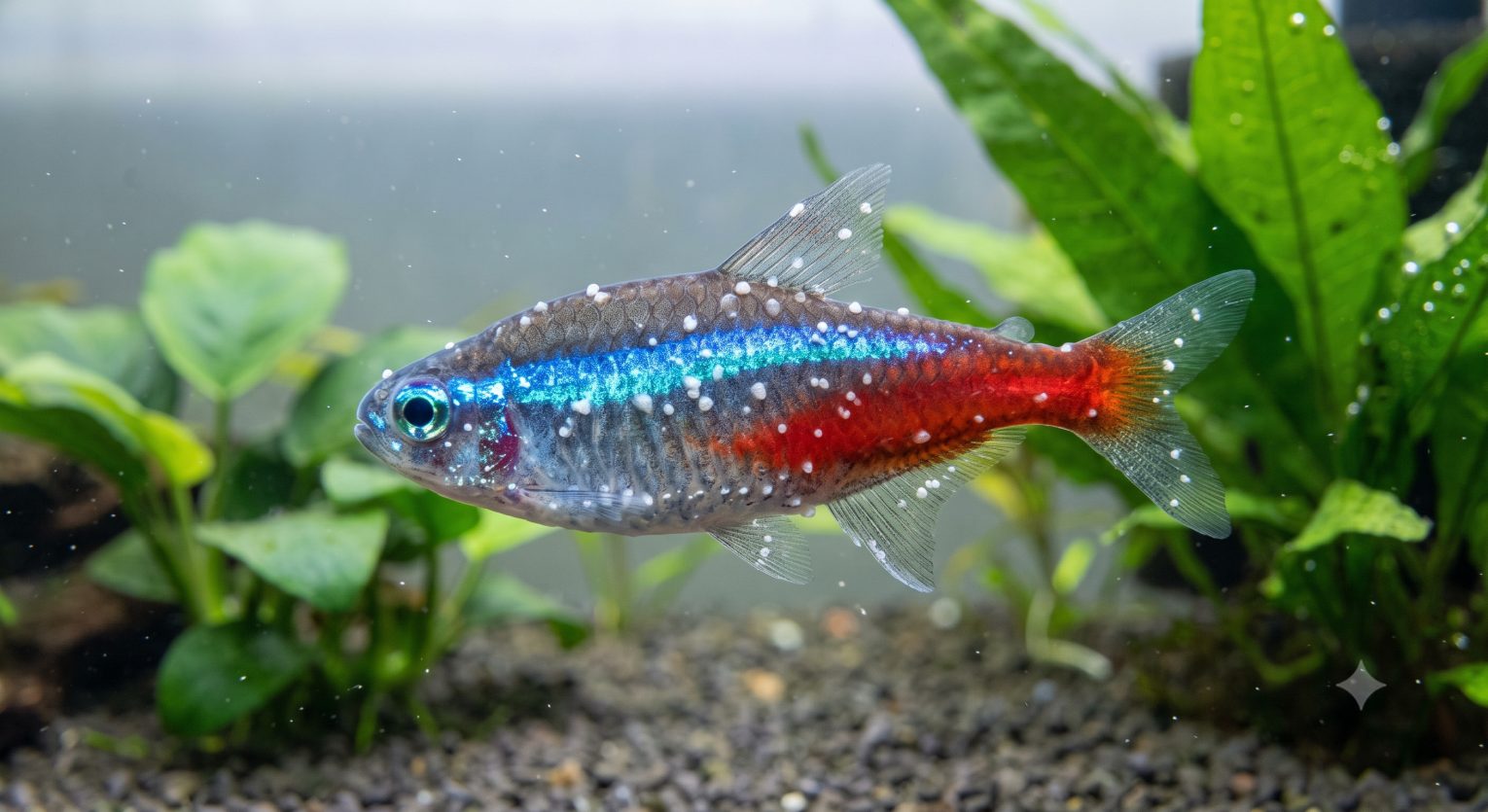
Ich (white spot disease) appears as small white spots resembling grains of salt scattered across a fish’s body and fins, often accompanied by flashing (scraping against decor), clamped fins, and lethargy. Effective treatment combines raised water temperature (82–86°F / 28–30°C), aquarium salt, and a formalin or malachite green-based medication— applied consistently over multiple treatment cycles, not just once symptoms disappear.
The single biggest reason ich treatment fails is stopping too soon. The parasite’s life cycle includes a protected stage on the fish that most treatments can’t reach, meaning visible white spots disappearing doesn’t mean the parasite is gone—it means it has temporarily moved to a stage where your treatment can’t touch it yet.
Disease treatment is one part of a much bigger picture covered in our Fish Care Guide—the complete hub for freshwater aquarium setup and maintenance. Ich outbreaks are frequently triggered by stress from poor water quality or an incomplete nitrogen cycle—see Aquarium Water Quality: pH, Ammonia & Nitrates Guide and How to Cycle an Aquarium if either could be a contributing factor.
(💡 Ich’s telltale sign is small white spots that look like scattered grains of salt or sugar across the body and fins.)
Table of Contents
What Ich Actually Is
Ich (pronounced “ick”, short for Ichthyophthiriasis) is caused by a parasite called Ichthyophthirius multifiliis—a protozoan that affects the skin and gills of freshwater fish. It’s arguably the most common disease diagnosed in home aquariums, in part because the parasite is an obligate pathogen: it cannot survive without a living fish host, so it spreads efficiently wherever fish are stressed and in close contact with each other.
❓How it typically enters a tank:
- New fish added without a quarantine period.
- Shared nets, decorations, or equipment moved between tanks.
- Stress from temperature swings, poor water quality, or an incomplete nitrogen cycle.
📰 Ich is documented by the Merck Veterinary Manual (merckvetmanual.com) as an obligate pathogen of freshwater fish that cannot survive without a living host, and is readily transmitted both through direct contact with infected fish and via contaminated equipment such as nets. The Manual confirms that formalin and copper-based treatments, alongside OTC products commonly containing formalin and malachite green, are the standard treatment approach.
Recognizing the Symptoms
🚨 The telltale sign: Small white spots—about the size of a grain of salt or sugar—scattered across the body, fins, and gills.
❗️Other symptoms, often appearing before or alongside the spots:
- Flashing (fish scraping their body against substrate, decor, or the tank glass).
- Clamped fins held close to the body.
- Lethargy and reduced appetite.
- Labored or rapid breathing, particularly if gills are heavily affected.
- In advanced cases, visible skin irritation or cloudiness.
⚠️ Gill-only infections can be invisible. Some ich outbreaks affect primarily the gills without producing many visible body spots, presenting instead as labored breathing and lethargy alone. Don’t rule out ich just because you don’t see spots.
(🐠 Aquarist’s Note: “By the time you see white spots, the parasite has already been through at least one full reproductive cycle in your tank. Treatment needs to account for that head start— which is exactly why a single dose rarely finishes the job.”—LovingPetsGuide Aquatics Advisor)
The Life Cycle: Why One Treatment Isn’t Enough
Understanding the three-stage life cycle is the single most important thing for successful treatment—skip this, and even the right medication often fails.
🦠 Stage 1 – Trophont (the visible, protected stage): The parasite burrows under the fish’s skin or gill epithelium and feeds, appearing as the white spots you can see. In this stage, it’s physically protected from most water-borne treatments—this is why medication often seems to have no effect on existing visible spots.
🦠 Stage 2 – Tomont (the reproductive stage): After 3–7 days (faster in warmer water), the mature parasite leaves the fish, sinks to the substrate or attaches to decorations, and encysts. Inside this cyst, it divides into hundreds of new offspring called tomites.
🦠 Stage 3 – Theront (the vulnerable, free-swimming stage): The tomites mature into free-swimming theronts that actively search for a new fish host. This is the only stage where medication and salt treatment actually work—but theronts that don’t find a host within roughly 24–48 hours die on their own.
❓What this means practically: Effective treatment isn’t a single dose—it’s sustained treatment across multiple cycles, timed to catch each new wave of theronts as they become vulnerable, while previous generations remain protected on the fish or encysted on the substrate.
📰 The three-stage life cycle of Ichthyophthirius multifiliis—trophont, tomont, and theront—is documented in veterinary parasitology literature, which confirms that only the free-swimming theront stage is vulnerable to treatment, while the trophont stage is physically protected within the fish’s skin and gill epithelium. This life cycle timing is the basis for the Merck Veterinary Manual’s guidance that multiple chemical treatments, with intervals determined by water temperature, are required for successful resolution—recommending daily treatment at warm aquarium temperatures above 79°F (26°C), with three to seven total treatments often necessary.
Treatment: The Combined Approach
🌡️ 1. Raise the Temperature
Gradually raise water temperature to 82–86°F (28–30°C) over several hours, not all at once. Warmer water speeds up the parasite’s life cycle, meaning it reaches the vulnerable theront stage faster and treatment cycles become shorter overall.
⚠️ Confirm your fish species can tolerate this temperature range before raising it—not all species handle sustained warmer water equally well.
🧂 2. Add Aquarium Salt
Aquarium salt (not table salt, which contains anti-caking additives) disrupts the parasite during its vulnerable free-swimming stage.
⚠️ Salt is not safe for every tank. Avoid or significantly reduce salt dosing with scaleless fish species, live plants, and most invertebrates (shrimp, snails)—all of which can be harmed by salt concentrations that are otherwise safe for scaled fish.
💊 3. Apply Medication
A formalin or malachite green-based product remains the standard chemical treatment. Follow product dosing instructions precisely, and continue the full recommended course even after visible spots disappear.
♻️ 4. Repeat Across Multiple Cycles
Continue combined treatment daily (at the warmer temperature range) for the full course indicated on your medication—typically requiring several treatment cycles, not one.
🐾 Aquarium Salt 🐾
🧂 Aquarium-Specific Salt — Never use table salt, which contains additives unsafe for aquariums. Confirm compatibility with any scaleless fish, plants, or invertebrates in your tank before dosing.
🐾 Ich Treatment Medication 🐾
💊 Formalin/Malachite Green Treatments — The standard chemical approach recommended alongside heat and salt. Follow the full labeled treatment course even after spots disappear—stopping early is the most common reason ich returns.
Common Treatment Mistakes
| ❌ Stopping as soon as spots disappear. Visible spots vanishing means the trophonts have left the fish—not that the parasite is gone. Continue the full treatment course to catch the next generation during its vulnerable stage. |
| ❌ Using salt without checking tank inhabitants. Scaleless fish, live plants, and invertebrates can be seriously harmed by salt concentrations that are perfectly safe for scaled fish. Always confirm compatibility first. |
| ❌ Treating only the visibly affected fish. Ich spreads through shared water. Treat the entire tank, not just individual fish showing symptoms. |
| ❌ Skipping quarantine for new fish. New fish introduction is one of the most common ways ich enters an established tank. A 2–4 week quarantine period in a separate tank catches outbreaks before they reach your main aquarium. |
| ❌ Ignoring the underlying stress trigger. Ich frequently follows a stress event—temperature swings, poor water quality, or overcrowding. Treating the parasite without addressing the underlying cause increases the chance of recurrence. See Aquarium Water Quality: pH, Ammonia & Nitrates Guide for ongoing water quality maintenance. |
🐾 Quarantine Tanks & Kits 🐾
🏥 Quarantine Tank Setups — A dedicated quarantine tank for new fish is the single most effective way to prevent ich and other diseases from ever reaching your main aquarium. A 2–4 week observation period catches problems early.
Prevention
| ✔️ Quarantine every new fish. 2–4 weeks in a separate tank before introducing to your main aquarium, regardless of how healthy a new fish looks in the store. |
| ✔️ Don’t share equipment between tanks without disinfecting. Nets, siphons, and decorations can carry the parasite between systems. |
| ✔️ Minimize stress triggers. Stable temperature, good water quality, and appropriate stocking density all reduce the likelihood of an outbreak—see How to Cycle an Aquarium and Aquarium Water Quality for the foundational maintenance that supports this. |
| ✔️ Watch new fish closely during quarantine, particularly for the first 1–2 weeks when stress- triggered outbreaks are most likely to appear. |
Conclusion
Ich is common, but rarely dangerous when caught early and treated correctly—the mistake that turns a manageable outbreak into a recurring problem is almost always stopping treatment too soon. Understanding the parasite’s life cycle explains why: visible spots disappearing is progress, not completion.
Key takeaways:
- ✅ White spots resembling salt grains are the hallmark sign, but gill-only infections can be invisible.
- ✅ Combine raised temperature (82–86°F / 28–30°C), aquarium salt, and medication for best results.
- ✅ Only the free-swimming theront stage is vulnerable to treatment—this is why multiple rounds are necessary.
- ✅ Continue the full treatment course even after spots disappear.
- ✅ Check salt compatibility with scaleless fish, plants, and invertebrates before dosing.
- ✅ Quarantine new fish for 2–4 weeks to prevent outbreaks before they start.
📝 Editor’s Note: Ich pathology and treatment protocol in this guide were verified against the Merck Veterinary Manual (merckvetmanual.com). The three-stage parasite life cycle and its role in treatment timing reflect established veterinary parasitology literature on Ichthyophthirius multifiliis.
👉🏼 Fish Care Guide—complete hub for freshwater aquarium setup and maintenance.
👉🏼 Aquarium Water Quality: pH, Ammonia & Nitrates Guide—the stress triggers behind most disease outbreaks.
👉🏼 How to Cycle an Aquarium: The Nitrogen Cycle Explained—foundational stability that prevents stress-triggered illness.
👉🏼 Best Fish for Beginners: Top 10 Community Tank Picks—species selection for a healthier, more resilient community tank.

🐠 Browse fish fish food, tanks, filters, heaters, decor and everything else your aquarium needs 🐾
(This post contains affiliate links. If you purchase through our links, we may earn a small commission at no extra cost to you. This never influences our editorial opinions.)
FAQ: How to Treat Ich in Fish
How long does it take to cure ich?
A full treatment course typically requires multiple cycles over 1–2 weeks or longer, depending on water temperature and severity. Because only the free- swimming stage is vulnerable to treatment, a single dose is rarely sufficient—continue the complete labeled course even after visible spots disappear.
Is ich contagious to other fish in the tank?
Yes. Ich spreads efficiently through shared water, and by the time spots are visible on one fish, others in the tank have likely already been exposed. Treat the entire tank, not just visibly affected individuals.
Can I use table salt instead of aquarium salt?
No. Table salt contains anti-caking agents and other additives not intended for aquarium use. Always use salt labeled specifically for aquarium purposes.
Is it safe to raise the temperature to treat ich?
Generally yes, within the 82–86°F (28–30°C) range, but confirm your specific fish species can tolerate sustained warmer water first, and raise the temperature gradually rather than all at once to avoid additional stress.
Why do my fish still have ich after one round of medication?
This is extremely common and doesn’t necessarily mean the medication failed. The parasite’s protected stage on the fish is invulnerable to treatment—only the free-swimming stage between hosts can be eliminated. Multiple treatment cycles, timed to water temperature, are typically required for complete resolution.
Can ich kill my fish?
Yes, particularly in cases with heavy gill involvement or in already-stressed or weakened fish. Prompt, correctly sustained treatment significantly improves outcomes—don’t delay starting treatment once symptoms are identified.