
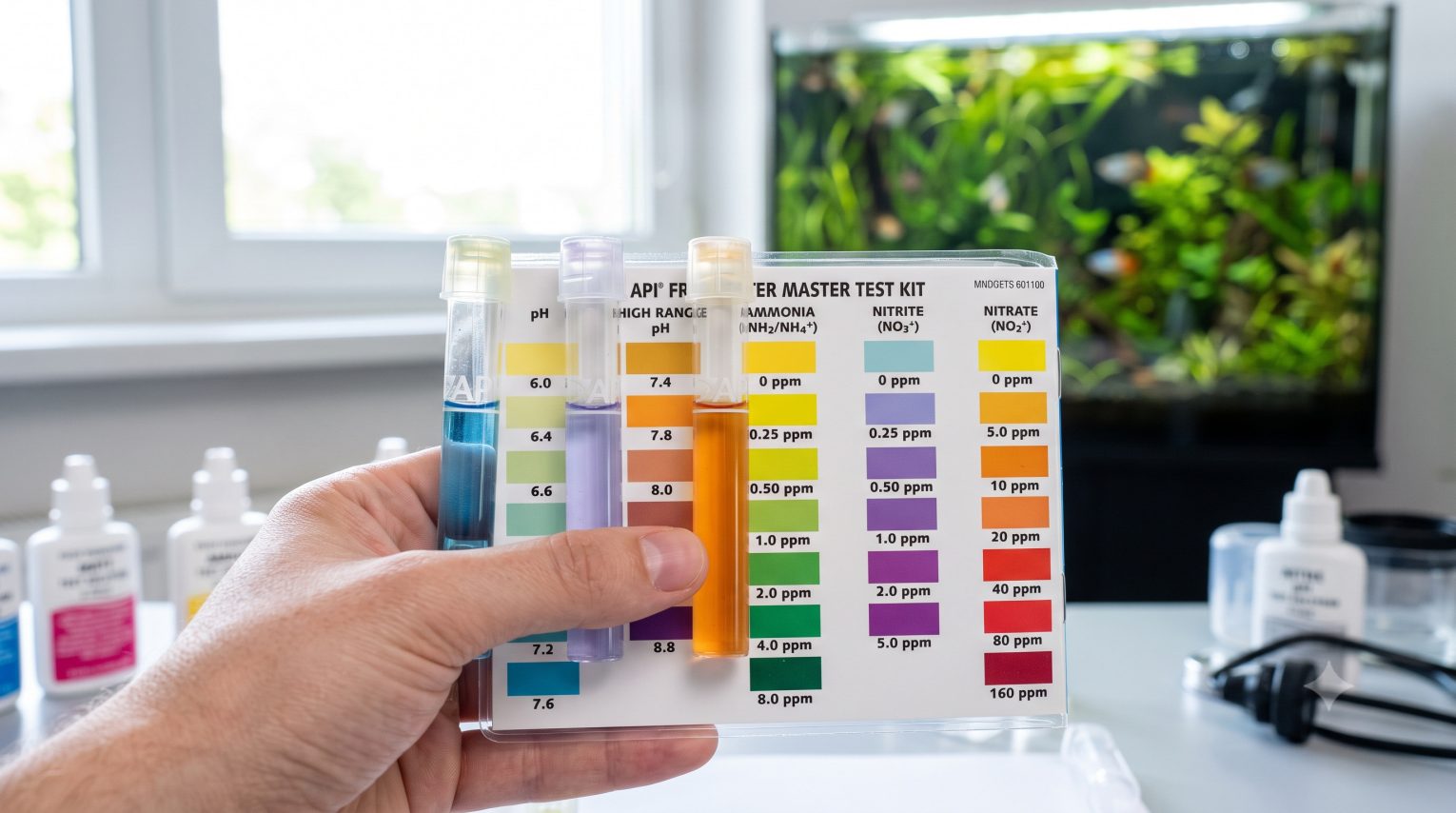
In a healthy, established freshwater aquarium, ammonia and nitrite should both read 0 ppm at all times—any detectable reading signals a real problem. Nitrate is different: it’s the normal end product of the nitrogen cycle and is expected to rise gradually between water changes, generally kept under 20–40 ppm through regular partial water changes. pH should fall in a range appropriate for your fish species, but the single most important principle is stability—a consistent “non-ideal” pH is safer for fish than a “perfect” pH that swings by more than 0.3 units in a day.
This guide assumes your tank has already completed its initial nitrogen cycle—see How to Cycle an Aquarium: The Nitrogen Cycle Explained first if you’re still setting up a new tank. What follows is the ongoing testing routine that keeps an established aquarium stable long-term.
Water quality is one part of a much bigger picture covered in our Fish Care Guide—the complete hub for freshwater aquarium setup and maintenance. Unstable water quality is also a common trigger for disease—see How to Treat Ich in Fish if you’re already seeing symptoms alongside abnormal readings.
(💡 A weekly testing routine catches problems early—before they become visible in fish behavior or health.)
Table of Contents
Why Testing Doesn’t Stop After Cycling
Completing the nitrogen cycle establishes the bacterial colony that processes fish waste—but it doesn’t make ongoing testing unnecessary. Several things can still go wrong in a fully cycled, established tank:
- Overstocking or overfeeding overwhelms the bacterial colony’s capacity❗️
- A dead fish or plant matter decomposing unnoticed spikes ammonia❗️
- Filter media disturbed or replaced incorrectly disrupts the bacterial colony❗️
- Nitrate accumulates gradually and needs active management through water changes—it doesn’t process itself away❗️
🗓️ A weekly testing routine for an established tank is the standard recommendation—daily during the first month after cycling, tapering to weekly once the tank has proven stable.
(🐠 Aquarist’s Note: “Test kits are cheap. Treating a full-blown ammonia spike or disease outbreak after it’s already stressed your fish is expensive and often too late. A five-minute weekly test is the best insurance policy in the hobby.”—LovingPetsGuide Aquatics Advisor)
The Core Parameters and Safe Ranges
| Parameter | Safe Range | What It Means |
|---|---|---|
| Ammonia | 0 ppm | Any reading = active problem |
| Nitrite | 0 ppm | Any reading = active problem |
| Nitrate | Under 20–40 ppm | Manage via water changes |
| pH | Species-appropriate, stable | Stability matters more than the number |
| KH (carbonate hardness) | 4–8 dKH | Buffers pH against swings |
| GH (general hardness) | 4–12 dGH | Affects fish osmoregulation |
Ammonia and Nitrite: Zero Tolerance
In an established, fully cycled tank, both ammonia and nitrite should consistently read 0 ppm. Neither compound accumulates naturally in a healthy system— the bacterial colony processes them continuously. Any detectable reading of either means something is actively wrong, not a normal fluctuation to watch and wait on.
🚨 If ammonia or nitrite appears:
- Perform an immediate partial water change (25–50%)❗️
- Reduce feeding temporarily❗️
- Check for overstocking, a dead fish, or decomposing plant matter❗️
- Confirm your filter media hasn’t been rinsed in tap water or replaced all at once—see How to Cycle an Aquarium for why this matters❗️
Nitrate: The One That’s Supposed to Rise
Unlike ammonia and nitrite, nitrate is the expected, far-less-toxic end product of a functioning nitrogen cycle. It naturally accumulates between water changes and is managed—not eliminated—through your maintenance routine.
General target: Under 20–40 ppm for most community tanks; sensitive species and shrimp benefit from keeping levels toward the lower end of that range.
If nitrate climbs high: Increase water change frequency or volume, reduce feeding, and consider fast-growing live plants, which actively consume nitrate as a nutrient source.
📰 Ammonia toxicity thresholds and the fundamental distinction between ammonia/nitrite (which should remain at zero) versus nitrate (which is managed rather than eliminated) are documented by the University of Florida IFAS Extension (ask.ifas.ufl.edu), the same source confirming the nitrogen cycle’s underlying biochemistry. This distinction is the most commonly misunderstood aspect of water testing among new aquarium owners, who sometimes mistake normal nitrate presence for a cycling failure.
🐾 Freshwater Aquarium Test Kits 🐾
🧪 Liquid Test Kits — A liquid master test kit covering ammonia, nitrite, nitrate, and pH remains the standard for accurate, ongoing water quality monitoring—more reliable than test strips for tracking real trends over time.
pH: Stability Beats “Perfect”
This is the single most misunderstood water quality concept among new aquarium owners—and getting it wrong is one of the most common ways well-meaning owners accidentally harm their own fish.
❕The principle: A stable pH of 7.8 is genuinely safer for fish than a “textbook perfect” pH of 7.0 that swings unpredictably day to day. Most established community fish tolerate a reasonable range of pH values without issue—what stresses them is rapid change, not an imperfect number.
⚠️ Changing pH by more than 0.3 units in a single day is considered stressful to fish. This is why chasing a specific “ideal” pH number with strong chemical adjusters is often more dangerous than simply leaving a stable, slightly-off pH alone.
📊 When pH adjustment genuinely matters: Species with narrow, specific requirements—African cichlids (higher pH, 7.8–8.5) or soft-water species like discus and cardinal tetras (lower pH, 6.0–6.8)—do need their water matched more precisely. For most general community tanks, stability matters more than hitting an exact target.
🐾 pH & Water Chemistry Stabilizers 🐾
⚖️ pH & Water Chemistry Treatments — Helps stabilize pH gradually and correct chronic imbalances, rather than relying on sudden, stressful swings. Pair with regular KH testing to catch instability before it becomes a crash.
KH: The Buffer That Keeps pH Stable
Carbonate hardness (KH) acts as a chemical buffer, resisting the swings that would otherwise send pH crashing. Low KH is the hidden cause behind many “mystery” pH crashes that seem to happen for no reason.
Target range: 4–8 dKH for most community tanks. KH naturally depletes over time as nitrification produces acids—part of why monthly KH testing matters even in an otherwise stable tank.
If KH is low: Crushed coral or a commercial KH buffering product raises carbonate hardness gradually, restoring the buffer that prevents pH instability.
GH: Less Urgent, Still Worth Knowing
General hardness (GH) reflects dissolved calcium and magnesium, affecting how fish regulate their internal fluid balance (osmoregulation). Most community fish tolerate a range of 4–12 dGH without issue; it matters most for specific hardness- sensitive species and breeding.
Testing Frequency Guide
| Tank Stage | Ammonia/Nitrite | Nitrate | pH | KH/GH |
|---|---|---|---|---|
| During cycling | Daily | Daily | Weekly | Once at setup |
| First month established | 2–3× weekly | Weekly | Weekly | Monthly |
| Established, stable | Weekly | Weekly | Weekly | Monthly |
| After any change* | Daily until stable | Weekly | Weekly | — |
*New fish added, medication used, filter maintenance performed, or any fish showing symptoms.
Common Water Quality Mistakes
| ❌ Chasing “perfect” pH with chemical adjusters. Covered in detail above—this frequently causes more harm than the imperfect-but-stable pH it’s meant to fix. |
| ❌ Assuming nitrate presence means something is wrong. Nitrate is the normal, expected end product of a working nitrogen cycle. Its presence at a reasonable level is a sign your tank is functioning correctly, not a problem to eliminate entirely. |
| ❌ Testing only when something seems wrong. By the time visible symptoms appear in fish behavior, water quality has often been off for days. Routine testing catches problems before they become visible. |
| ❌ Ignoring KH until pH crashes. Low KH is frequently the hidden root cause behind sudden pH instability. Monthly KH testing catches this before it becomes an emergency. |
| ❌ Changing too much water too fast to “fix” a reading. A large, sudden water change can itself cause a dangerous parameter swing. Address problems with appropriately sized changes, not overcorrection. |
Conclusion
Water quality isn’t a single number to hit—it’s a connected system where ammonia, nitrite, nitrate, pH, and hardness all influence each other. The habit that matters most isn’t chasing perfect readings; it’s testing consistently enough to catch problems while they’re still small and easy to correct.
Key takeaways:
- ✅ Ammonia and nitrite should always read 0 ppm in an established tank—any reading signals a real problem.
- ✅ Nitrate is expected to rise and is managed via water changes, not eliminated entirely.
- ✅ pH stability matters more than hitting a “perfect” number—avoid swings over 0.3 units per day.
- ✅ KH acts as the buffer that prevents pH crashes; test monthly.
- ✅ Test weekly in an established tank, more frequently after any change or new addition.
- ✅ Never chase pH with strong chemicals without understanding your KH first.
📝 Editor’s Note: Ammonia and nitrite toxicity thresholds, and the nitrogen cycle chemistry underlying nitrate accumulation, were verified against the University of Florida IFAS Extension (ask.ifas.ufl.edu). The pH stability principle—that a stable, non-ideal pH is safer than a fluctuating “perfect” one—reflects strong, consistent consensus across established aquarium hobbyist and water chemistry resources.
👉🏼 Fish Care Guide—complete hub for freshwater aquarium setup and maintenance.
👉🏼 How to Cycle an Aquarium: The Nitrogen Cycle Explained—the foundational process this guide builds on.
👉🏼 How to Treat Ich in Fish: Symptoms & Safe Treatment—when water quality issues trigger disease.
👉🏼 Best Aquarium Filters: HOB, Sponge & Canister Compared—filtration that supports long-term water stability.

🐠 Browse fish fish food, tanks, filters, heaters, decor and everything else your aquarium needs 🐾
(This post contains affiliate links. If you purchase through our links, we may earn a small commission at no extra cost to you. This never influences our editorial opinions.)
FAQ: Aquarium Water Quality
What should ammonia and nitrite read in a healthy tank?
Both should consistently read 0 ppm in an established, fully cycled aquarium. Unlike nitrate, neither compound is expected to be present at any level—any detectable reading indicates an active problem requiring attention.
Is a high nitrate reading dangerous?
Nitrate is far less toxic than ammonia or nitrite, but sustained high levels (generally above 40 ppm) can stress fish and weaken immune function over time. Keep nitrate under roughly 20–40 ppm through regular partial water changes.
Should I try to adjust my tank’s pH to a specific number?
For most general community fish, no—stability matters more than hitting an exact target. Chasing a “perfect” pH with strong chemical adjusters often causes more harm through instability than the imperfect-but-stable pH it’s meant to correct. Species with specific pH needs (African cichlids, discus) are the exception.
How often should I test my aquarium water?
Weekly for ammonia, nitrite, nitrate, and pH in an established tank; monthly for KH and GH. Test more frequently—even daily—after adding new fish, performing filter maintenance, using medication, or if any fish shows signs of illness.
What is KH and why does it matter?
KH (carbonate hardness) buffers pH, preventing the sudden swings that stress fish. Low KH is a common hidden cause of “mystery” pH crashes. Target 4–8 dKH for most community tanks, and test monthly since KH naturally depletes over time.
My readings all look normal but my fish still seem stressed. What am I missing?
Water test kits measure chemical parameters, not every factor affecting fish health—oxygen levels, temperature stability, overcrowding, and disease are common causes of stress that won’t necessarily show up on a standard test. If parameters test normal but symptoms persist, see How to Treat Ich in Fish or consult an aquatic veterinary resource for further diagnosis.