

The best dog food for puppies must meet AAFCO nutritional standards for “growth” or “all life stages,” contain a named animal protein as the first ingredient, and provide adequate DHA for brain and eye development. Top vet-recommended picks include Purina Pro Plan Puppy, Hill’s Science Diet Puppy, and Royal Canin breed-specific puppy formulas — each with strong research backing and consistent real-world results.
Choosing the right puppy food is one of the most impactful decisions a new dog owner makes. The first year of a dog’s life is the most nutritionally demanding — a puppy that doubles, triples, or quadruples their birth weight in the first few months has nutritional needs that no adult formula can adequately meet. This guide covers what to look for, what to avoid, and which formulas consistently deliver results across breed sizes.
Puppy food selection is one chapter in a larger nutritional story. For the full foundation of canine nutrition — from macronutrient requirements to label reading and life-stage transitions — our complete dog nutrition guide covers everything before and after the puppy phase.
Table of Contents
Why Puppy Food Is Not Optional
Puppy food is not a marketing category — it is a nutritional necessity. The differences between puppy and adult formulas are significant enough that feeding adult food to a growing puppy has measurable health consequences.
🐕 What puppy formulas provide that adult formulas do not:
- Higher protein: Minimum 22% protein on dry matter basis (vs 18% for adults) to support rapid muscle and tissue growth.
- Higher fat: Minimum 8% fat for energy density and DHA absorption.
- DHA: Docosahexaenoic acid is critical for brain and retinal development — most adult foods contain minimal DHA.
- Calcium and phosphorus: Formulated in precise ratios for skeletal development — too much or too little causes irreversible bone deformities in growing puppies.
- Higher caloric density: Puppies need more calories per 0.5 kg (1 lb) of body weight than adults.
📊 Large breed vs standard puppy food: This is the most critical distinction in puppy nutrition. Large and giant breed puppies (expected adult weight over 25 kg / 55 lb) must NOT eat standard puppy food. Standard formulas promote rapid growth that causes developmental orthopedic disease (HOD, OCD, hip dysplasia) in large breeds. Large breed puppy formulas control growth rate while still meeting elevated nutritional needs.
👉🏼 For adult nutrition after the puppy phase, our breed size food guide covers size-specific requirements from adult to senior.
(🩺 Vet’s Note: “The most common nutrition mistake I see with large breed puppies is owners feeding a standard puppy food because the bag says ‘puppy.’ A Great Dane puppy eating small breed puppy food is at real risk of joint problems. Always match the formula to the expected adult size, not just the age of the dog”—LovingPetsGuide Veterinary Advisor.)
📰 The connection between excess calcium intake and developmental orthopedic disease in large breed puppies—including hip dysplasia and osteochondrosis (OCD)—is well documented in veterinary nutrition literature, which is why AAFCO sets a distinct, tighter calcium ratio range specifically for large breed growth formulas rather than a single standard across all puppy sizes.
What to Look for in Puppy Food
✅ Non-Negotiables
AAFCO statement for growth or all life stages: Every complete puppy food must state: “complete and balanced nutrition for growth” or “complete and balanced for all life stages.” “For adult maintenance only” — never feed to a puppy as a primary diet.
Named animal protein as the first ingredient: “Deboned Chicken,” “Salmon,” “Beef” — not “poultry meal,” “meat and bone meal,” or “animal digest.”
DHA listed in ingredients or guaranteed analysis: Look for “DHA,” “docosahexaenoic acid,” or “fish oil” explicitly listed. This is your confirmation of brain and eye development support.
Calcium and phosphorus in appropriate range: AAFCO requires Ca:P ratio between 1:1 and 2:1 for puppies. Large breed formulas specifically control calcium levels to prevent excessive bone growth.
No artificial preservatives: Avoid BHA, BHT, and ethoxyquin — choose foods preserved with mixed tocopherols (Vitamin E) or rosemary extract.
❌ Red Flags
- “For all dogs” without AAFCO growth statement.
- Generic protein sources (“poultry,” “fish,” “meat”) without named species.
- No DHA source listed.
- Ingredient splitting (same ingredient listed multiple times under different names).
- Artificial colors or flavors.
👉🏼 For evaluating the brand behind any puppy food, our WSAVA brand checklist gives you the questions that matter.
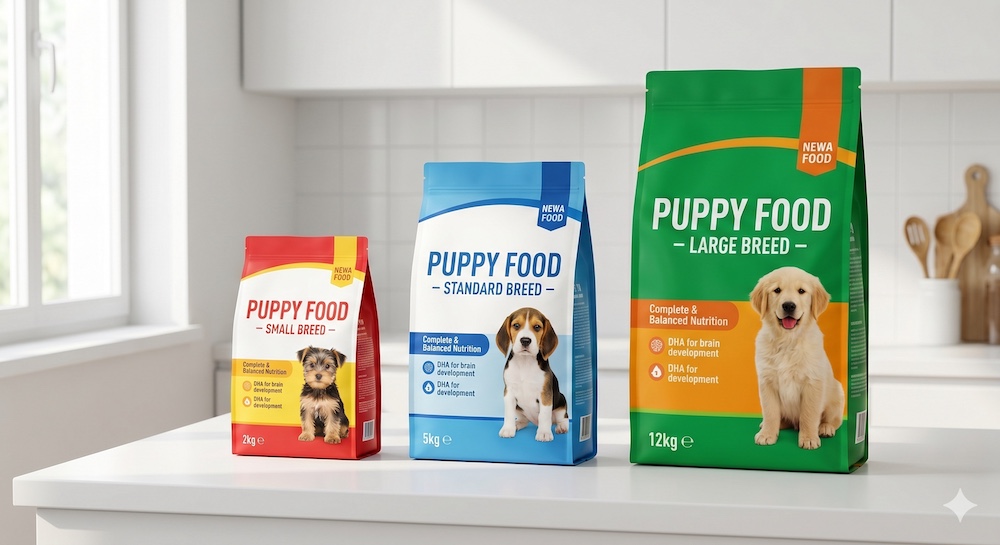
Our Top Picks: Best Puppy Food by Category
These recommendations are based on ingredient quality, AAFCO compliance, DHA content, research backing, and consistent results across thousands of puppies.
(⚠️ Not all puppy formulas are equal — breed size determines which formula is appropriate, not just age.)
(💡 The first year is the most nutritionally demanding of a dog’s entire life—the right formula now shapes their health for decades.)
🥇 Best Overall Puppy Food: Purina Pro Plan Puppy Original Chicken & Rice Formula
Purina Pro Plan Puppy is the most consistently vet-recommended puppy food on the market — backed by more than 400 Purina scientists and real AAFCO feeding trials rather than just formulation to meet standards.
Key features:
- Chicken as first ingredient.
- DHA from fish oil for brain and eye development.
- Live probiotics for digestive health.
- High protein for muscle development.
- Antioxidants for immune system support.
- AAFCO approved for growth.
✅ Vet’s most-recommended puppy brand.
✅ Actual AAFCO feeding trial data.
✅ DHA explicitly included.
✅ Live probiotics — uncommon in puppy food.
✅ Available in multiple breed size formulations.
✅ Consistent formula — no random reformulations.
❌ Higher price than budget options.
❌ Contains chicken (concern for chicken-sensitive puppies).
🏆 Best for: All standard breed puppies — especially those from health-conscious breeders who often recommend this formula specifically.
📰 Purina’s research and development team of over 400 scientists, including nutritionists and veterinarians, is confirmed directly on Purina’s professional-facing resources (proplanvet.com). This scale of dedicated nutritional research is a meaningful differentiator from brands that formulate to meet AAFCO minimums without conducting their own feeding trials.
🥈 Best Science-Backed Formula: Hill’s Science Diet Puppy Original Formula
Hill’s Science Diet Puppy is formulated by board-certified veterinary nutritionists and has decades of clinical use behind it. It is the formula most frequently recommended by veterinarians whose primary concern is scientifically validated nutrition rather than ingredient trend-following.
Key features:
- Chicken meal as first ingredient (concentrated protein source).
- DHA from fish oil.
- Antioxidant blend for immune development.
- Precise calcium levels for bone development.
- No artificial colors, flavors, or preservatives.
- AAFCO approved for growth.
✅ Board-certified nutritionist formulation.
✅ Clinically proven digestibility.
✅ Excellent calcium-phosphorus balance.
✅ Available in small and large breed versions.
✅ Widely available.
❌ “Chicken meal” rather than fresh chicken (not inherently inferior — concentrated protein — but some owners prefer fresh).
❌ Higher price point.
🏆 Best for: Puppies where the owner wants maximum nutritional science backing — particularly recommended by internists and veterinary nutritionists.
🥉 Best Large Breed Formula: Royal Canin Large Breed Puppy
Royal Canin’s breed-specific and size-specific formulas are engineered with a precision that few other brands match. The Large Breed Puppy formula is specifically designed to support controlled growth in puppies expected to reach over 25 kg (55 lb) as adults.
Key features:
- Controlled calcium levels for large breed bone development.
- Adapted energy content to prevent excessive growth rate.
- EPA and DHA for joint and brain development.
- Digestive support with prebiotics.
- Precise protein and fat balance.
- AAFCO approved for growth.
✅ Gold standard for large breed puppy nutrition.
✅ Controlled calcium — the most critical nutrient for large breed puppies.
✅ Breed-specific options available (Labrador, Golden Retriever, German Shepherd).
✅ Extensive research investment.
❌ Ingredient list is less “clean” than Hill’s or Purina.
❌ Contains some controversial by-products.
❌ Most expensive of the three top picks.
🏆 Best for: Large and giant breed puppies (expected adult weight over 25 kg / 55 lb) — Labradors, German Shepherds, Golden Retrievers, Rottweilers, Great Danes, Bernese Mountain Dogs.
💰 Best Budget Pick: Purina ONE Healthy Puppy Formula
For owners who need strong nutritional value without the premium price tag, Purina ONE Healthy Puppy consistently outperforms generic store brands on protein quality, DHA content, and palatability.
Key features:
- Real chicken as first ingredient.
- DHA to support brain and eye development.
- No artificial colors or flavors.
- SmartBlend of high-quality ingredients.
- AAFCO approved for growth.
✅ Real named protein as first ingredient.
✅ DHA included.
✅ Significantly more affordable.
✅ Widely available in most pet stores.
❌ Less precise formulation than Pro Plan or Hill’s.
❌ No live probiotics.
❌ Less research backing than premium options.
🏆 Best for: Budget-conscious owners with healthy puppies and no specific health concerns.
Comparison Table: At a Glance
| Brand | First Protein | DHA | Probiotics | Best For | Rating |
|---|---|---|---|---|---|
| Purina Pro Plan Puppy | Chicken | ✅ Fish oil | ✅ Live | Overall best | ⭐⭐⭐⭐⭐ |
| Hill’s Science Diet Puppy | Chicken meal | ✅ Fish oil | ❌ | Science-backed | ⭐⭐⭐⭐⭐ |
| Royal Canin Large Breed Puppy | Chicken by-product | ✅ EPA+DHA | ❌ | Large breeds | ⭐⭐⭐⭐⭐ |
| Purina ONE Puppy | Chicken | ✅ | ❌ | Budget | ⭐⭐⭐⭐ |
Puppy Feeding Schedule and Portions
How Often to Feed a Puppy
Puppies have small stomachs and high caloric needs — they cannot consume a full day’s calories in one or two sittings.
| Age | Meals Per Day |
|---|---|
| 8–12 weeks | 3–4 meals |
| 3–6 months | 3 meals |
| 6–12 months | 2 meals |
For detailed guidance on frequency and portions at each stage, see our puppy feeding schedule and timing guide.
How Much to Feed
Always start with the feeding guidelines on your specific food’s packaging — these are calculated for that food’s caloric density. Adjust based on your puppy’s body condition, not just age or weight.
General daily caloric needs (approximate):
| Puppy Weight | Daily Calories |
|---|---|
| 2–5 kg (4–11 lb) | 200–400 kcal |
| 5–10 kg (11–22 lb) | 400–700 kcal |
| 10–20 kg (22–44 lb) | 700–1200 kcal |
| 20–30 kg (44–66 lb) | 1200–1800 kcal |
| 30+ kg (66+ lb) | 1800+ kcal |
(Caloric needs vary significantly by breed, growth stage, and activity. Use these as starting points only.)
Body Condition Check for Puppies
Puppies should grow steadily — not rapidly or slowly. Check monthly:
- Healthy: Ribs easily felt, not visible. Waist beginning to appear from about 4–5 months. Active and energetic.
- Underweight: Ribs, spine visible. Increase meal frequency and portions.
- Overweight: Ribs difficult to feel. Rare in young puppies under 5 months — more common post-neuter.
How to Transition to Puppy Food
If you are adopting a puppy already eating a specific food, transition gradually to avoid digestive upset — even if switching to a higher quality formula.
| Day | Previous Food | New Food |
|---|---|---|
| 1–2 | 75% | 25% |
| 3–4 | 50% | 50% |
| 5–6 | 25% | 75% |
| 7+ | 0% | 100% |
Puppies with sensitive stomachs may need 14 days. If vomiting or diarrhea occurs, hold the current ratio for an extra 2–3 days before continuing.
For puppies with digestive sensitivities, see our best dog food for sensitive stomachs which covers options appropriate from puppyhood.
When to Switch to Adult Food
Transitioning too early is one of the most common puppy feeding mistakes.
| Breed Size | Switch to Adult Food |
|---|---|
| Small breeds (<10 kg / 22 lb adult) | 10–12 months |
| Medium breeds (10–25 kg / 22–55 lb adult) | 12 months |
| Large breeds (25–40 kg / 55–88 lb adult) | 12–18 months |
| Giant breeds (40+ kg / 88+ lb adult) | 18–24 months |
When you switch, transition gradually over 7–10 days following the same protocol above.
Conclusion: Invest in the Foundation
Puppy nutrition is the highest-leverage investment a dog owner makes. The bone structure, muscle development, brain architecture, and immune foundation built in the first year are largely irreversible.
A high-quality, AAFCO-approved puppy formula matched to your dog’s expected adult size — fed in appropriate portions at the right frequency — is all your puppy needs. The complexity is in choosing the right category (small breed vs standard vs large breed) and avoiding the common mistake of using adult food to save money.
Key takeaways:
- ✅ Always use puppy-specific or all-life-stages formula — never adult food long-term.
- ✅ Match the formula to expected adult size — not just age.
- ✅ Check for DHA on the label.
- ✅ AAFCO “growth” statement is non-negotiable.
- ✅ Large breed puppies need large breed formula.
- ✅ Feed 3–4 meals daily until 6 months.
- ✅ Transition to adult food at 12–24 months depending on breed size.
📝 Editor’s Note: Purina’s research team size was verified against proplanvet.com. Large breed calcium and developmental orthopedic disease risk reflects established veterinary nutrition consensus. FDA grain-free DCM investigation status reflects the agency’s official communications.
🐾 Raw Paws Pet Food Toppers 🐾
🍛 Raw Paws (Dog Food Toppers)—A practical way to add real meat nutrition and moisture to a dry puppy kibble base without switching to a full raw diet. USDA-inspected, single-ingredient toppers from Indiana farms—no fillers or preservatives. 15% off 1st Auto Ship + 5% off future orders.
👉🏼 Complete Dog Nutrition Guide — the full picture of canine nutrition.
👉🏼 Dog Nutrition Basics — macronutrient requirements explained for every life stage.
👉🏼 Dog Feeding Schedule by Age — exact meal frequency and portions from puppy to senior.
👉🏼 Best Dog Food for Sensitive Stomachs — if your puppy shows signs of digestive sensitivity.

🐕 Browse dog food, treats, toys, health products, supplements, grooming and everything else your dog needs 🐾

🐕 Browse raw dog food, freeze-dried meals, chews, bones and natural treats from Indiana farms 🐾

🐕 Browse science-backed dry dog food, wet food, breed-specific formulas, and veterinary diets for your canin 🐾
(This post contains affiliate links. If you purchase through our links, we may earn a small commission at no extra cost to you. This never influences our editorial opinions.)
FAQ: Best Dog Food for Puppies — Your Questions Answered
At what age can I start feeding my puppy solid food?
Most puppies are fully weaned and eating solid food by 7–8 weeks — the age at which they typically leave their mother and arrive in their new home. If you are hand-raising a puppy under 4 weeks, kitten milk replacer (KMR) or puppy milk replacer is required. Never give cow’s milk — most puppies are lactose intolerant and it causes severe diarrhea and dehydration.
Is grain-free food better for puppies?
No — and it may carry additional risk for large breed puppies. The FDA’s ongoing investigation into grain-free high-legume diets and dilated cardiomyopathy (DCM) in dogs makes grain-inclusive formulas the safer choice unless your puppy has a confirmed grain allergy. High-quality grains like rice and barley are among the most digestible ingredients available and are not allergens for most dogs.
Can I feed my puppy raw food?
Raw diets are not recommended for puppies without expert guidance. Puppies have still-developing immune systems and are significantly more vulnerable to bacterial contamination (Salmonella, Listeria) than adult dogs. If you want to feed raw, consult a board-certified veterinary nutritionist who can formulate a complete and safe recipe — never use generic raw feeding guides from the internet for a growing puppy.
How do I know if my puppy is eating enough?
The most reliable indicators are consistent week-on-week weight gain, a body condition score where ribs are felt but not seen, and consistent energy levels. A puppy that is lethargic, has visible ribs, or gains no weight over two weeks despite eating is not getting enough — increase portions and consult your vet. A puppy that is growing too rapidly or has difficulty feeling their ribs may be getting too much.
Should I free-feed my puppy or use structured meals?
For puppies under 12 weeks, free access to food is appropriate — their caloric needs are constant and they self-regulate well at this age. From 12 weeks onwards, structured meals (3–4 per day) give you control over intake, allow you to monitor appetite changes, and establish a routine that supports potty training. Puppies on a feeding schedule are significantly easier to house-train because meals create predictable digestion timing.
My puppy won’t finish their meals. Should I worry?
Occasional meal skipping in an otherwise healthy, energetic puppy is not a concern. However, using the 15-minute rule helps prevent picky eating from developing — put the bowl down, leave it for 15 minutes, then remove it without offering alternatives. Most puppies learn quickly that meals are on a schedule. A puppy that consistently skips meals and seems lethargic or is losing weight warrants a veterinary check.