
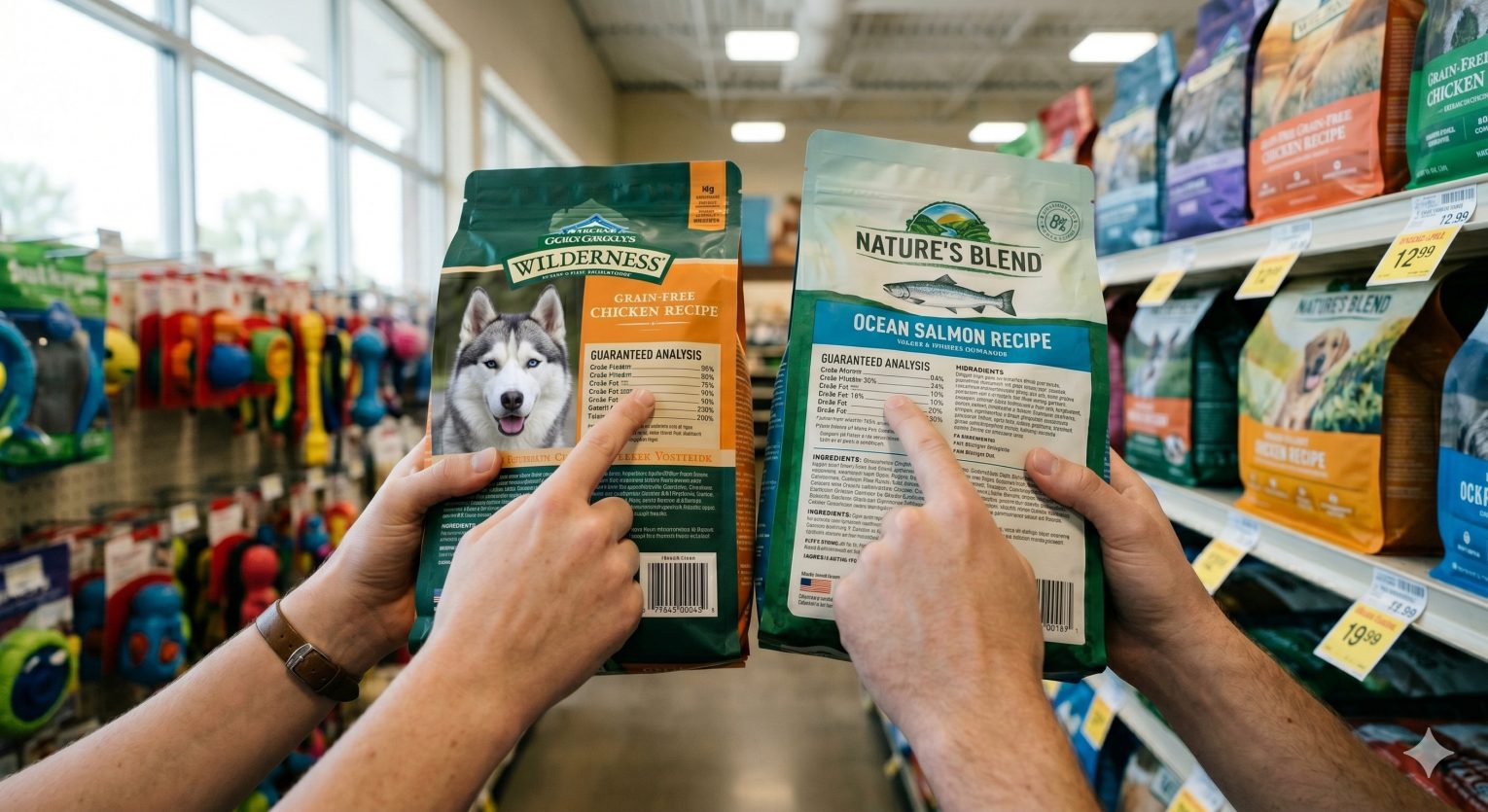
Evaluating dog food brands comes down to five questions recommended by the World Small Animal Veterinary Association (WSAVA): Does the company employ a board-certified veterinary nutritionist? Do they conduct and publish their own research? Do they perform AAFCO feeding trials rather than just formulation? Can they provide a complete nutrient analysis on request? And do they have quality control procedures at every manufacturing stage? Brands that answer yes to all five consistently outperform brands that do not.
The pet food industry is one of the most aggressively marketed food categories in existence. Terms like “natural,” “holistic,” “ancestral,” “biologically appropriate,” and “human-grade” have no regulated definitions and tell you nothing meaningful about nutritional quality. The WSAVA framework cuts through this marketing noise with questions that have objective, verifiable answers.
Knowing how to evaluate a brand is most useful when you understand what your dog actually needs nutritionally. Our dog nutrition guide covers the complete picture of canine macronutrient requirements, life stage feeding, and label reading before you apply the brand evaluation framework in this guide.
Table of Contents
Why Most Dog Food Marketing Is Meaningless
Before applying any evaluation framework, it helps to understand which terms you can safely ignore entirely.
❌ Terms with no regulatory definition in pet food:
- “Natural” — no legal definition.
- “Holistic” — no legal definition.
- “Human-grade” — no enforceable standard.
- “Ancestral diet” — marketing only.
- “Biologically appropriate” — marketing only.
- “Premium” — no nutritional standard.
- “Superfood” — no definition.
- “No fillers” — no definition.
✅ Terms that DO have meaning:
- “Complete and balanced” — AAFCO regulated.
- “AAFCO feeding trial” — food was tested on actual dogs.
- “Board-certified veterinary nutritionist (DACVN)” — specific, verifiable credential.
- Named animal protein in the ingredient list — verifiable.
- Specific nutrient percentages in the guaranteed analysis — measurable.
(🩺 Vet’s Note: “When a client asks me which dog food is best, my first question is always about the brand, not the formula. A mediocre formula from a research-backed brand beats a ‘premium’ formula from a brand with no nutritionist on staff. The brand’s quality infrastructure matters more than any single ingredient claim”—LovingPetsGuide Veterinary Advisor.)
The WSAVA Framework: 5 Big Questions That Matter
The World Small Animal Veterinary Association publishes guidelines for evaluating pet food manufacturers that are used by veterinary nutritionists worldwide. These five questions form the core of their evaluation framework.
🔹 Question 1: Does the company employ a board-certified veterinary nutritionist full-time?
Why this matters: Formulating nutritionally complete diets across multiple life stages requires specialist expertise. A board-certified veterinary nutritionist (Diplomate of the American College of Veterinary Nutrition, DACVN) has completed a veterinary degree plus a residency plus rigorous board examinations.
Many companies hire “animal nutritionists” or “pet nutrition experts” — titles requiring no specific accreditation. The credential to look for is DACVN (US) or DECVCN (European).
How to verify: Call or email the company and ask: “Does your company employ a board-certified veterinary nutritionist (DACVN or equivalent) full-time, involved in formulating your products?”
A reputable company will answer yes clearly. A company that deflects to “team of experts” without specifying credentials is a yellow flag.
Brands known to employ veterinary nutritionists: Hill’s Science Diet ✅ | Purina Pro Plan ✅ | Royal Canin ✅ | Eukanuba ✅ | Iams ✅.
🔹 Question 2: Does the company conduct and publish its own research?
Why this matters: A brand investing in original peer-reviewed research demonstrates scientific commitment that cannot be faked through marketing. Research costs money. Publishing invites scrutiny. Brands that do this are accountable to the scientific community, not just consumers.
How to verify: Search PubMed or Google Scholar for the brand name. Look for peer-reviewed publications in veterinary journals — not company white papers or marketing documents.
Brands with substantial published research: Purina (most prolific globally) | Hill’s (clinical nutrition) | Royal Canin (breed-specific and therapeutic nutrition research).
🔹 Question 3: Does the company use AAFCO feeding trials or just formulation?
Why this matters: Two ways to meet AAFCO standards:
Formulation: Calculate on paper that the recipe contains required nutrients. Guarantees nothing about how nutrients behave after processing, or whether dogs actually absorb them.
Feeding trial: Feed actual food to actual dogs over time and measure health outcomes. Significantly more rigorous — and expensive.
How to check the label:
- “Animal feeding tests using AAFCO procedures substantiate…” → ✅ Feeding trial.
- “Product is formulated to meet the nutritional levels established by AAFCO…” → ⚠️ Formulation only.
Both are legal. Feeding trial data is the gold standard.
🔹 Question 4: Can the company provide a complete nutrient analysis on request?
Why this matters: Labels only show minimum protein, minimum fat, maximum fiber, maximum moisture. They are not required to show calcium, phosphorus, sodium, omega-3 levels, or amino acid profiles.
A confident brand provides this on request. A brand that deflects is not demonstrating appropriate transparency.
How to request: Check the brand’s website — many post full analyses by formula. If not available, contact customer service and ask for the complete guaranteed analysis for your specific product.
🔹 Question 5: Does the company have quality control at every manufacturing stage?
Why this matters: The brands with the best recall track records have rigorous QC — ingredient testing on arrival, in-process testing, finished product testing, and traceability systems.
The contract manufacturing concern: Many smaller “premium” brands do not own manufacturing facilities. Quality control depends on contract manufacturers’ standards, which are harder to verify. Large research-backed brands (Purina, Hill’s, Royal Canin) own most facilities and have the most transparent quality control documentation.
The Label: What to Check First
(💡 Four label checks take 30 seconds and eliminate most poor options before the WSAVA questions even begin.)
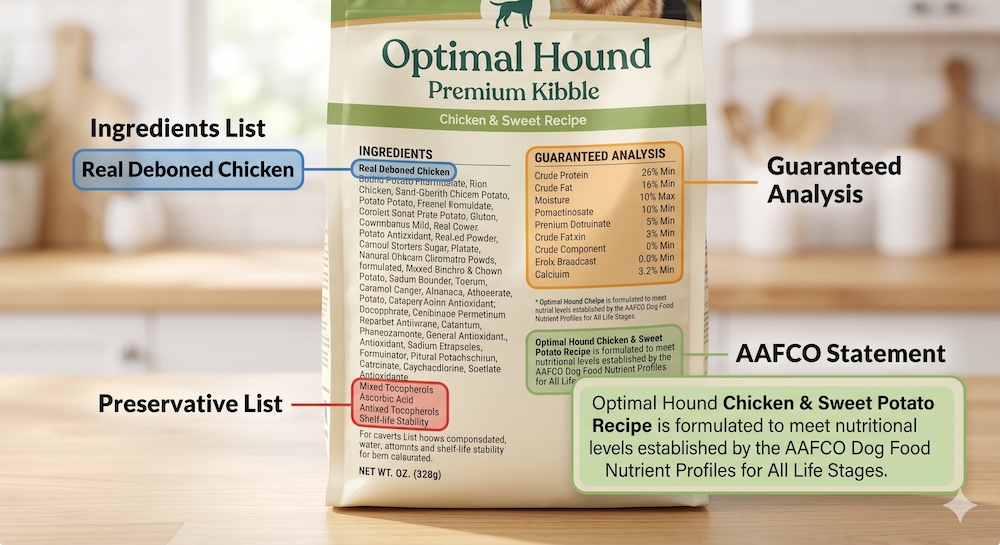
- First ingredient = named animal protein: “Chicken,” “Salmon,” “Beef” — not “poultry,” “fish,” or “meat.”
- AAFCO complete and balanced statement: Must say “complete and balanced nutrition for life stage.” “For supplemental or intermittent feeding only” — not a complete diet.
- Feeding trial vs formulation: On every label — takes 10 seconds to check.
- No artificial preservatives: Avoid BHA, BHT, ethoxyquin. Look for mixed tocopherols (Vitamin E) or rosemary extract.
👉🏼 For a complete guide to reading dog food labels, see our dog nutrition essentials guide.
Red Flags: When to Walk Away
Brand-level red flags:
❌ Cannot confirm a DACVN on staff.
❌ No published peer-reviewed research.
❌ Multiple contamination recalls recently.
❌ Refuses to provide complete nutrient analysis.
❌ Uses only contract manufacturers with no quality control transparency.
Label-level red flags:
❌ Generic protein source as first ingredient.
❌ “For supplemental or intermittent feeding” AAFCO statement.
❌ Artificial preservatives (BHA, BHT, ethoxyquin).
❌ Multiple artificial colors or dyes.
❌ Ingredient splitting — same ingredient appearing multiple times under different names.
Marketing red flags (mean nothing):
⚠️ “Grain-free” without clinical justification.
⚠️ “No by-products” (some by-products are excellent protein sources).
⚠️ “Human-grade” (no enforceable standard).
⚠️ “Raw-inspired” or “ancestral diet”.
⚠️ Celebrity or influencer endorsement.
Dog Food Brands That Meet WSAVA Standards
| Brand | DACVN | Research | Feeding Trials | Nutrient Analysis | Own Facilities |
|---|---|---|---|---|---|
| Purina Pro Plan | ✅ | ✅ Extensive | ✅ | ✅ | ✅ |
| Hill’s Science Diet | ✅ | ✅ Extensive | ✅ | ✅ | ✅ |
| Royal Canin | ✅ | ✅ Substantial | ✅ | ✅ | ✅ |
| Eukanuba | ✅ | ✅ Moderate | ✅ | ✅ | ✅ |
| Iams | ✅ | ✅ Moderate | ✅ | ✅ | ✅ |
📰 Purina’s commitment to research is well-documented. The Purina Institute — the company’s scientific arm — collaborates with leading animal scientists and nutritionists worldwide, and publishes research and educational resources freely available at purinainstitute.com. With over 400 scientists, veterinarians and pet care experts on staff, Purina represents one of the most research-backed brands in the pet food industry.
For specific product picks from these brands by need category, see our best dog food brands guide which applies this framework to the top formulas in every category.
How to Research a Dog Food Brand: Step by Step
Takes less than 15 minutes and tells you more than any ingredient list ever could.
- ✔️ Check the AAFCO statement — feeding trial or formulation?
- ✔️ Search PubMed for brand name — any peer-reviewed publications?
- ✔️ Call or email customer service — does the company employ a full-time DACVN?
- ✔️ Request a complete nutrient analysis for the specific formula you are considering.
- ✔️ Check recall history: FDA U.S. – Recalls & Withdrawals.
Conclusion: Ask Questions, Not Ingredients
The most important shift in dog food evaluation is moving from ingredient-focused (“does it have sweet potato?”) to brand-focused (“does this company have the infrastructure to produce consistent, safe, nutritionally complete food?”).
An impressive ingredient list from a company with no veterinary nutritionist and no feeding trials produces a less reliable food than a straightforward chicken and rice formula from a company with 400 scientists and decades of feeding trial data.
Key takeaways:
- ✅ “Natural,” “holistic,” and “human-grade” have no regulated meaning in pet food.
- ✅ Ask if the company employs a DACVN.
- ✅ Check for published peer-reviewed research.
- ✅ Feeding trial approval > formulation to standards.
- ✅ Request a complete nutrient analysis.
- ✅ Check FDA recall history.
- ✅ Brand infrastructure matters more than individual ingredient claims.
👉🏼 Dog Nutrition Guide — complete canine nutrition before choosing a brand.
👉🏼 Dog Nutrition Basics Guide — label reading and nutrient requirements explained.
👉🏼 Our Top Dog Food Brand Recommendations — top picks from brands that pass the WSAVA framework.
👉🏼 Best Dog Food For Sensitive Stomachs — WSAVA-approved brands for sensitive dogs.
👉🏼 Best Dog Food For Puppies — which brands meet growth stage nutritional standards.

🐕 Browse dog food, treats, toys, health products, supplements, grooming and everything else your dog needs 🐾

🐕 Browse raw dog food, freeze-dried meals, chews, bones and natural treats from Indiana farms 🐾

🐕 Browse science-backed dry dog food, wet food, breed-specific formulas, and veterinary diets for your canin 🐾
(This post contains affiliate links. If you purchase through our links, we may earn a small commission at no extra cost to you. This never influences our editorial opinions.)
FAQ: How to Evaluate Dog Food Brands
What is WSAVA and why should I trust their guidelines?
The World Small Animal Veterinary Association is an international organization representing veterinary professionals across more than 100 countries. Their pet food manufacturer evaluation guidelines were developed by board-certified veterinary nutritionists and are used by veterinarians worldwide as an objective framework for assessing food quality. The guidelines are publicly available and regularly updated.
Does grain-free dog food pass WSAVA standards?
Grain-free status is not part of the WSAVA evaluation framework — the five questions assess company infrastructure and scientific rigor, not individual ingredients. However, many grain-free boutique brands score poorly on WSAVA criteria, and an FDA investigation has identified a potential link between some grain-free high-legume diets and dilated cardiomyopathy (DCM) in dogs. This combination makes most veterinary nutritionists cautious about grain-free diets unless there is a specific confirmed reason for avoiding grains.
Are expensive dog foods always better?
No — price correlates very poorly with nutritional quality. Purina Pro Plan, which consistently scores highest on WSAVA criteria, is modestly priced compared to many boutique brands that score significantly lower. Some of the most expensive pet food brands cannot confirm a veterinary nutritionist on staff. Price reflects marketing spend and ingredient sourcing costs — not the quality of research infrastructure.
Can I trust online dog food rating websites?
Many popular dog food rating sites score food based on ingredient quality as assessed by non-specialists — rewarding impressive ingredient lists and penalizing common ingredients like corn or by-products. These ratings do not assess quality control, research backing, or feeding trial data. Veterinary nutritionists consistently note that ingredient-based ratings are a poor proxy for food quality. Use the WSAVA framework.
My dog has been eating a poorly-rated brand for years and is perfectly healthy. Should I switch?
If your dog is genuinely healthy — ideal weight, good coat, normal digestion — there is no urgent need to switch based on brand rating alone. A dog thriving on a consistently fed diet is evidence of that diet’s suitability for that individual dog. The WSAVA framework helps you choose better when selecting a new food — it is not necessarily a reason to disrupt a working arrangement.
How often should I re-evaluate my dog’s food brand?
Re-evaluate when your dog’s life stage changes, when a health condition is diagnosed, when the brand announces significant formula changes, or if you notice persistent changes in coat quality, digestion, or body condition that last more than 4–6 weeks after other causes are ruled out.