

Dog nutrition basics cover five essential nutrient groups: protein, fat, carbohydrates, vitamins, and minerals. Dogs are omnivores— unlike cats, they can extract nutrients from both animal and plant sources—but high-quality animal protein must still be the foundation of every meal. Adult dogs need a minimum of 18% protein and 5% fat on a dry matter basis, while puppies require at least 22% protein to support growth.
Getting dog nutrition right is simpler than pet food marketing makes it seem. Most healthy dogs thrive on any AAFCO-approved commercial food with a named animal protein as the first ingredient—the complexity lies in understanding what the label is actually telling you and adjusting for your dog’s specific life stage, size, and health status.
These basics are the foundation of a larger picture. For the complete guide to canine nutrition—from food types and label reading to breed-specific considerations and toxic foods—our complete dog nutrition guide covers every aspect of feeding your dog well.
(💡 Dog nutrition doesn’t need to be complicated—understanding five key nutrient groups is all it takes to make confident feeding decisions.)
Table of Contents
Dogs Are Omnivores — What That Actually Means
The most important foundational fact in canine nutrition is that dogs are omnivores — not carnivores. Unlike cats, which are obligate carnivores and cannot survive without animal protein, dogs have evolved alongside humans for thousands of years and developed the metabolic ability to extract nutrition from both meat and plant sources.
This does not mean dogs thrive on a plant-heavy diet — animal protein remains the most bioavailable and complete protein source for dogs. But it does mean that high-quality grains, vegetables, and plant-based nutrients are not harmful and can contribute meaningfully to a balanced diet.
❔Why this matters practically:
- Grain-free is not automatically healthier.
- A balanced diet can include carbohydrates.
- Plant-based ingredients can provide valuable fiber, vitamins, and minerals.
- Dogs do not need a “raw prey” diet to be healthy.
(🩺 Vet’s Note: “Dogs and wolves diverged approximately 15,000 years ago. Modern dogs have significantly more copies of the amylase gene than wolves—a direct adaptation to processing starch. The idea that dogs should eat like wolves is nutritionally misleading”—LovingPetsGuide Veterinary Advisor.)
The 5 Essential Nutrient Groups
1. Protein — The Foundation
Protein provides the amino acids dogs need for muscle development, immune function, enzyme production, and tissue repair. Not all protein is equal — digestibility and amino acid profile matter as much as the total percentage.
✅ AAFCO minimum requirements:
- Adult dogs: 18% protein (dry matter basis).
- Puppies and pregnant/nursing dogs: 22% protein.
❔What to look for: A named animal protein — “Chicken,” “Beef,” “Salmon,” “Turkey” — as the first ingredient. Unnamed sources like “poultry meal” or “meat and bone meal” are lower quality and less consistent.
✅ Key amino acids:
- Taurine: Important for heart health — dogs can synthesize it but some breeds and some diets may not provide enough.
- L-Carnitine: Supports fat metabolism and cardiac function in large breeds.
- Lysine, Methionine, Arginine: Essential amino acids that complete the protein profile.
2. Fat — Energy and Absorption
Fat is the most energy-dense macronutrient — providing 8.5 calories per gram (2.3 oz) compared to 3.5 calories per gram (0.12 oz) for protein and carbohydrates. It is essential for absorbing fat-soluble vitamins (A, D, E, K) and maintaining healthy skin and coat.
✅ AAFCO minimum requirements:
- Adult dogs: 5% fat (dry matter basis).
- Puppies: 8% fat.
✅ Key fatty acids:
- Omega-6 (Linoleic acid): Skin and coat health, immune function — found in chicken fat, sunflower oil.
- Omega-3 (DHA & EPA): Brain development, joint health, inflammation reduction — found in fish oil, salmon, flaxseed.
⚖️ The omega-6 to omega-3 ratio: Most commercial dog foods are heavy in omega-6 and low in omega-3. An imbalanced ratio promotes inflammation. This is why omega-3 supplementation is one of the most consistently beneficial additions to a standard kibble diet.
For our top-rated omega-3 supplement picks, see our best omega-3 supplements for dogs guide.
🐾 Omega-3 Fish Oil Supplements for Dogs 🐾
🐟 Omega-3 Fish Oil (Dog Supplements)—The one supplement most dogs genuinely benefit from regardless of food brand. Corrects the omega-6 to omega-3 imbalance in standard kibble diets—supporting coat quality, joint health, and cognitive function. Chewy carries options from Nordic Naturals, Zesty Paws, Grizzly, and more.
3. Carbohydrates — Energy and Fiber
Dogs do not have a dietary requirement for carbohydrates — their bodies can manufacture glucose from protein and fat. However, carbohydrates serve two valuable functions in commercial dog food: energy provision and digestive fiber.
✅ Good carbohydrate sources:
- Brown rice, white rice — highly digestible, gentle on sensitive stomachs.
- Sweet potato — rich in beta-carotene and fiber.
- Oats — soluble fiber supporting gut health.
- Barley — sustained energy release.
⚠️ Carbohydrates to approach cautiously:
- Corn, wheat, soy — common allergens in sensitive dogs, though not inherently harmful for most dogs.
- High legume content (peas, lentils, potatoes) in grain-free diets — linked to potential cardiac concerns in some breeds (DCM) under ongoing FDA investigation.
❗️How much is too much: Most standard kibbles contain 40–50% carbohydrates on a dry matter basis. High-quality formulas keep this closer to 30–35%. Fresh and wet foods typically contain far less.
4. Vitamins — The Micronutrient Layer
Vitamins regulate nearly every biological process in a dog’s body. AAFCO-approved complete and balanced diets include all required vitamins at appropriate levels — supplementation is generally unnecessary and can be harmful when fat-soluble vitamins (A, D, E, K) accumulate to toxic levels.
🐕 Key vitamins for dogs:
| Vitamin | Function | Primary Sources |
|---|---|---|
| Vitamin A | Vision, immune function, skin | Liver, fish oil |
| Vitamin D | Calcium absorption, bone health | Fish, egg yolk |
| Vitamin E | Antioxidant, immune support | Vegetable oils, seeds |
| Vitamin C | Antioxidant (dogs synthesize own) | Vegetables, fruits |
| B Vitamins | Energy metabolism, nervous system | Meat, whole grains |
(⚠️ Important: Unlike cats, dogs can synthesize Vitamin A from beta-carotene (found in carrots and sweet potatoes). They can also produce Vitamin C endogenously. This gives them significantly more dietary flexibility than cats.)
5. Minerals — The Structural Elements
Minerals build bones, regulate fluid balance, enable nerve transmission, and support hundreds of enzymatic reactions.
⚠️ The most critical mineral ratios:
Calcium and Phosphorus (Ca:P ratio): The relationship between these two minerals is more important than their individual amounts. The ideal Ca:P ratio is 1.2:1 to 1.4:1 for adult dogs — 1.2:1 to 1.5:1 for puppies. Imbalanced ratios cause skeletal deformities, particularly in large and giant breed puppies growing rapidly.
This is why homemade diets without veterinary formulation are risky — getting the Ca:P ratio right requires precise calculation.
✅ Other key minerals:
- Zinc: Skin health, immune function.
- Iron: Oxygen transport, energy.
- Selenium: Antioxidant function (excess is toxic — do not supplement without veterinary guidance).
🐾 Purina Pro Plan Dry Dog Food 🐾
🏆 Purina Pro Plan (Dry) — The most consistently vet-recommended dry dog food on the market. AAFCO feeding trial approved, with live probiotics and named chicken as the first ingredient. Available in formulas for every life stage and breed size.
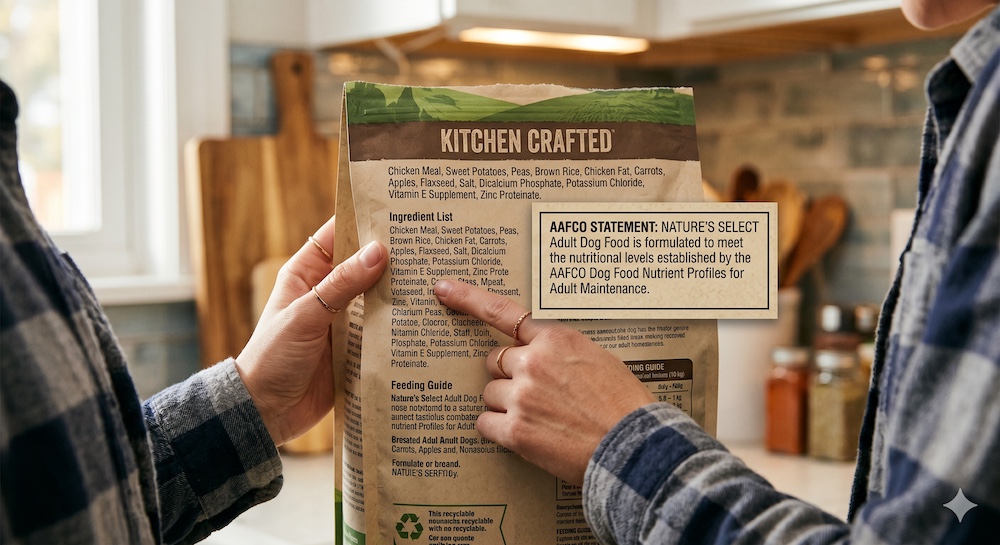
Reading a Dog Food Label: The Essentials
Understanding a label takes the guesswork out of choosing food.
Four things to check on every dog food label — first ingredient, AAFCO statement, guaranteed analysis, and the absence of artificial preservatives.
To evaluate the brand behind the food, our guide to evaluating dog food brands covers the full WSAVA framework.
The 4 Label Checks
✔️ 1. First ingredient = named animal protein: “Deboned Chicken,” “Salmon,” “Beef” — not “poultry,” not “meat meal,” not “animal digest.”
✔️ 2. AAFCO statement: Every complete diet must state: “provides complete and balanced nutrition for life stage” If it says “for supplemental or intermittent feeding” — it is not a complete meal. AAFCO nutritional adequacy statement.
✔️ 3. Guaranteed Analysis: Shows minimum protein and fat, maximum fiber and moisture. To compare wet and dry food fairly, calculate dry matter basis:
Dry matter % = (nutrient % ÷ (100 − moisture%)) × 100A wet food with 9% protein and 78% moisture is actually 41% protein on dry matter basis — significantly higher than it appears.
✔️ 4. No artificial preservatives: Avoid BHA, BHT, and ethoxyquin. Look for natural preservation with mixed tocopherols (Vitamin E) or rosemary extract.
📰 The distinction between “complete and balanced” and “supplemental or intermittent feeding” label statements is defined by AAFCO (aafco.org), whose nutritional adequacy statement requirements determine whether a commercial food can legally serve as a dog’s sole diet or must be paired with other complete nutrition.
Caloric Density: Why It Matters
Two foods with identical protein percentages can have very different caloric densities. A dog eating 2 cups (480 ml) of a 300 kcal/cup food is consuming 600 kcal — very different from 2 cups of a 450 kcal/cup food at 900 kcal.
Average caloric densities:
- Dry kibble: 300–450 kcal per cup (240 ml).
- Wet food: 150–250 kcal per 100g (3.5 oz).
- Fresh food: 100–200 kcal per 100g (3.5 oz).
- Raw food: 150–300 kcal per 100g (3.5 oz).
Always check the kcal/cup or kcal/kg on the packaging and calculate based on your dog’s daily caloric need — not just the volume or weight of food.
For feeding schedule and portion guidance by age, see our dog feeding schedule by age.
Nutrition by Life Stage
A dog’s nutritional requirements change significantly across their lifespan.

Puppies (0–12 Months)
Puppies grow rapidly and have dramatically higher requirements per kilogram (pound) of body weight than adults.
✅ Key requirements:
- Minimum 22% protein (dry matter basis).
- Minimum 8% fat.
- DHA for brain and eye development.
- Precise Ca:P ratio for bone development.
- Large breed puppies need large breed puppy formulas — standard puppy food promotes growth too rapidly and causes joint problems.
Never feed adult food as a primary diet to a puppy — the nutritional gap is significant.

Adult Dogs (1–7 Years)
Maintenance phase — the goal is sustaining healthy weight, muscle mass, and organ function.
✅ Key requirements:
- Minimum 18% protein.
- Minimum 5% fat.
- Caloric intake matched to activity level.
- Avoid free-feeding — structured meals prevent gradual weight gain.
❕ Activity level adjustments:
- Sedentary indoor dog: ~30 kcal per kg (14 kcal per lb) of body weight per day.
- Moderately active dog: ~44 kcal per kg (20 kcal per lb).
- Highly active / working dog: 60–90 kcal per kg (27–41 kcal per lb).
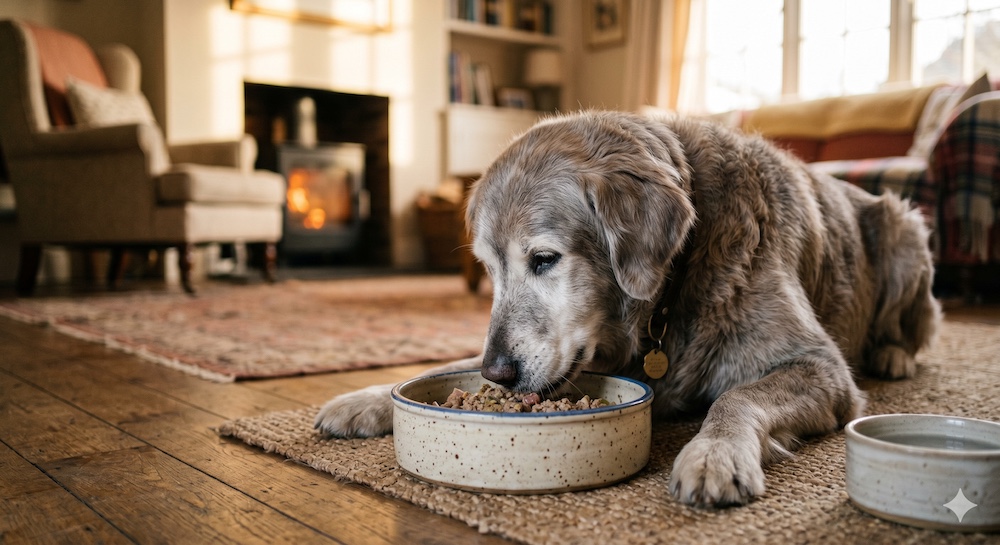
Senior Dogs (7+ Years)
Metabolism slows, digestive efficiency reduces, and health vulnerabilities increase.
✅ Key adjustments:
- More protein, not less — despite common belief, healthy senior dogs need highly digestible protein to prevent sarcopenia (muscle loss). Protein restriction is only for dogs with confirmed kidney disease under veterinary supervision.
- Lower caloric density to prevent obesity.
- Added glucosamine and chondroitin for joint support.
- Omega-3 supplementation for cognitive and joint health.
📰 The shift away from routine protein restriction in healthy senior dogs is documented in AAHA feline and canine life stage guidelines, which distinguish between healthy aging dogs—who benefit from maintained or increased high-quality protein to counter sarcopenia—and dogs with diagnosed kidney disease, where restriction remains appropriate only under direct veterinary supervision.
👉🏼 For breed-size specific caloric requirements, see our dog food by breed size guide.
👉🏼 For our top vet-reviewed puppy food picks, see our best dog food for puppies guide.
👉🏼 For senior-specific supplement recommendations, see our best joint supplements for senior dogs.
Hydration: The Forgotten Nutrient
Water is often called “the sixth nutrient” — and it is as critical as any of the five groups above. Dogs need approximately 66 ml of water per kg (1 fl oz per lb) of body weight per day — more in hot weather or during exercise.
Dehydration signs:
- Dry, sticky gums (healthy gums are moist and pink).
- Skin turgor test: pinch the skin on the back of the neck — it should snap back immediately.
- Lethargy and reduced appetite.
- Dark, concentrated urine.
💧 How to improve hydration:
- Fresh water available at all times.
- Consider a pet water fountain — many dogs drink significantly more from moving water.
- Add wet food or low-sodium bone broth to kibble-based diets.
- Never let dogs drink from stagnant puddles.
For a full breakdown of food types and hydration, see our fresh dog food vs kibble comparison.
🐾 Raw Paws Pet Food Toppers 🐾
🍛 Raw Paws (Dog Food Toppers)—Adding a raw food topper to dry kibble increases moisture intake per meal without a full diet switch. Real meat, no fillers, USDA-inspected—a practical hydration boost for dogs eating primarily dry food. 15% off 1st Auto Ship + 5% off future orders.
Common Dog Nutrition Mistakes
| ❌ Overfeeding: The most common nutritional problem in domestic dogs. Obesity affects approximately 50–60% of pet dogs and significantly shortens lifespan. Use measuring cups or ideally a kitchen scale — never free-pour. |
| ❌ Too many treats: Treats should not exceed 10% of daily caloric intake. High-calorie training treats given throughout the day add up fast — subtract treat calories from the main meal. |
| ❌ Switching foods too quickly: Always transition over 7–10 days minimum: 75% old / 25% new → 50/50 → 25/75 → 100% new. Faster switches cause vomiting, diarrhea, and food aversion. |
| ❌ Assuming grain-free is healthier: Grain-free is a marketing category, not a nutritional upgrade. High-quality grains like rice, barley, and oats are among the most digestible ingredients in dog food. The FDA’s ongoing DCM investigation has identified a potential cardiac risk in some grain-free high-legume diets. Unless your dog has a confirmed grain allergy — grain-inclusive foods are the safer choice. |
| ❌ Supplementing unnecessarily: A dog on a complete and balanced AAFCO-approved diet does not need additional vitamins or minerals. Excess fat-soluble vitamins (A, D, E, K) accumulate to toxic levels. Only supplement under veterinary guidance or when there is a specific identified deficiency. |
| ❌ Home-cooked diets without formulation: Home cooking without a complete recipe from a veterinary nutritionist almost always results in nutritional imbalances — particularly calcium, phosphorus, and key micronutrients. If you want to home cook, consult a board-certified veterinary nutritionist. |
Signs Your Dog’s Diet Is Working
The best measure of nutritional success is your dog’s body — not the marketing on the food bag.
Signs of a well-nourished dog:
✅ Shiny, healthy coat without excessive shedding.
✅ Healthy weight — ribs felt but not visible, visible waist from above.
✅ Consistent energy appropriate for age and breed.
✅ Firm, well-formed stools — not too loose, not too hard.
✅ Clear eyes and healthy gums.
✅ No chronic itching, ear infections, or digestive upset.
Signs the diet may need adjustment:
❌ Dull coat or excessive shedding.
❌ Weight gain or loss without dietary change.
❌ Loose stools more than once a week.
❌ Chronic gas or bloating.
❌ Persistent itching or recurring ear infections.
Conclusion: Simple Principles, Consistent Application
Dog nutrition does not require a biochemistry degree. The fundamentals are straightforward: choose an AAFCO-approved food with a named animal protein as the first ingredient, match the life stage formula to your dog’s age, portion accurately, and ensure fresh water is always available.
The complexity — grain-free debates, raw food claims, supplement marketing — is mostly noise. A well-chosen commercial food consistently fed in the right portions outperforms any faddish dietary approach in real-world outcomes.
Key takeaways:
- ✅ Dogs are omnivores — balanced diets can include plant nutrients.
- ✅ Named animal protein must be the first ingredient.
- ✅ Always check for the AAFCO complete and balanced statement.
- ✅ Protein minimums: 18% adult, 22% puppies.
- ✅ Senior dogs need more digestible protein, not less.
- ✅ Grain-free is not inherently healthier.
- ✅ Overfeeding is the most common mistake.
- ✅ Always transition foods over 7–10 days.
📝 Editor’s Note: AAFCO nutrient profiles and label statement requirements were verified against aafco.org. Senior dog protein guidance reflects current AAHA life stage consensus. The FDA’s grain-free DCM investigation status reflects the agency’s official communications on the subject.
👉🏼 Complete Dog Nutrition Guide — the full picture of canine nutrition in one place.
👉🏼 Dog Feeding Schedule By Age — exact portions and meal frequency for every life stage.
👉🏼 Fresh Dog Food vs Kibble — comparing the most popular food formats.
👉🏼 Best Dog Food for Sensitive Stomachs — when standard nutrition needs adjustment.
👉🏼 Best Omega-3 Supplements for Dogs — the one supplement most dogs actually benefit from.
👉🏼 Best Joint Supplements for Senior Dogs — targeted support for aging dogs.

🐕 Browse dog food, treats, toys, health products, supplements, grooming and everything else your dog needs 🐾

🐕 Browse raw dog food, freeze-dried meals, chews, bones and natural treats from Indiana farms 🐾

🐕 Browse science-backed dry dog food, wet food, breed-specific formulas, and veterinary diets for your canin 🐾
(This post contains affiliate links. If you purchase through our links, we may earn a small commission at no extra cost to you. This never influences our editorial opinions.)
FAQ: Dog Nutrition Basics — Your Questions Answered
What are the most important nutrients for dogs?
The five essential nutrient groups are protein, fat, carbohydrates, vitamins, and minerals— with water as the critical sixth element. Protein is the most important macronutrient, and it must come from a named animal source as the first ingredient. A complete and balanced AAFCO-approved food covers all nutrient requirements when fed according to guidelines for your dog’s life stage.
How do I know if my dog’s food is nutritionally complete?
Look for the AAFCO nutritional adequacy statement on the packaging—it must say “complete and balanced nutrition” for your dog’s specific life stage (growth/puppy, adult maintenance, or all life stages). If the label says “for supplemental or intermittent feeding only,” the food is not nutritionally complete on its own and should not be used as a primary diet.
Do dogs need supplements if they eat good food?
Most dogs eating a high-quality, AAFCO-approved complete diet do not need additional supplements. The exception is omega-3 fatty acids—most kibbles are relatively low in EPA and DHA compared to optimal levels for coat, joint, and cognitive health. A fish oil supplement is the one addition most dogs genuinely benefit from. Always consult your vet before adding any other supplements.
Is grain-free dog food better?
No—not for most dogs. Grain-free diets are a marketing category, not a nutritional upgrade. High-quality grains like rice, barley, and oats are easily digestible and rarely cause allergies. The FDA has identified a potential link between some grain-free high-legume diets and dilated cardiomyopathy (DCM) in dogs. Unless your dog has a confirmed grain allergy diagnosed by an elimination diet, grain-inclusive food from a reputable brand is the safer choice.
How often should I change my dog’s food?
There is no nutritional reason to regularly rotate dog foods. A dog thriving on a consistent diet does not benefit from frequent changes. If you do change foods—for quality, life stage, or health reasons—always transition gradually over 7–10 days to avoid digestive upset. Sudden food changes are one of the most common causes of vomiting and diarrhea in dogs.
What is the most common dog nutrition mistake?
Overfeeding. Canine obesity affects approximately 50–60% of pet dogs and is the most preventable cause of shortened lifespan and reduced quality of life. Most owners significantly underestimate how calorie-dense dog food is, particularly dry kibble. Using a measuring cup or kitchen scale and feeding structured meals rather than free-feeding makes the single biggest practical difference to a dog’s long-term health.