
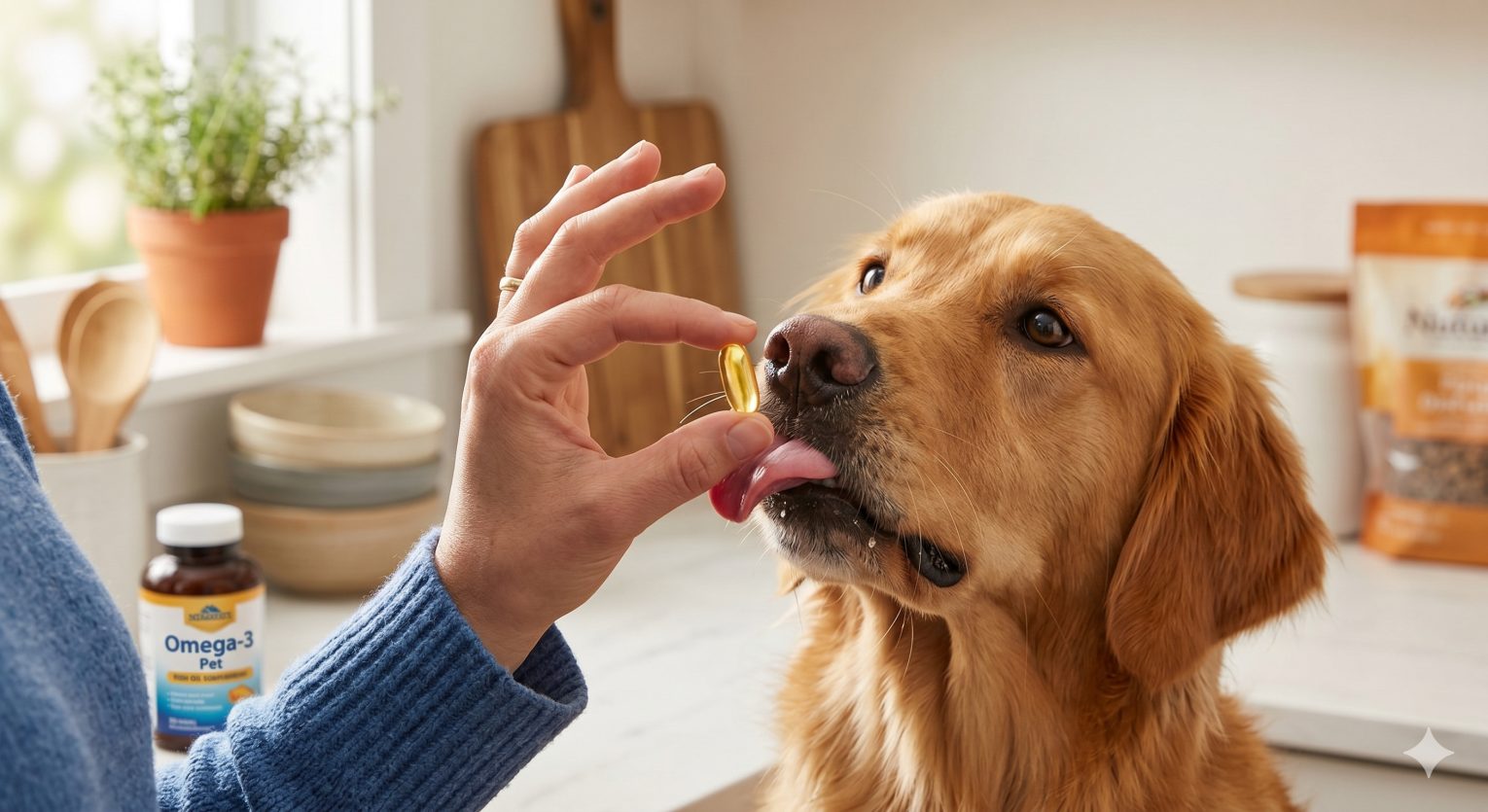
The best omega-3 supplements for dogs contain EPA and DHA from marine sources — fish oil, salmon oil, or algae oil — not flaxseed or plant-based omega-3. Dogs cannot efficiently convert plant-based ALA into the EPA and DHA their bodies actually use. Top picks include Zesty Paws Pure Wild Alaskan Salmon Oil, Nordic Naturals Omega-3 Pet, and Grizzly Omega Health — all third-party tested and consistently recommended by veterinarians.
Omega-3 supplementation is one of the few additions to a standard kibble diet that is genuinely beneficial for most dogs. Most dry dog foods are relatively low in EPA and DHA compared to optimal levels — and the benefits of correcting that gap are well-documented: improved coat condition, reduced inflammation, joint support, cardiac health, and cognitive function in senior dogs.
Omega-3 supplementation makes the most sense in the context of your dog’s overall diet. For the complete picture of canine nutritional needs — including fat requirements, essential fatty acids, and how different food types compare — our dog nutrition guide covers the foundation before adding any supplement.
Table of Contents
Why Most Dogs Need Omega-3 Supplementation
Most commercial dry kibble is relatively deficient in EPA and DHA compared to what research suggests is optimal for canine health. Here is why:
⚖️ The omega-6 to omega-3 imbalance: Modern commercial dog food — particularly dry kibble — is high in omega-6 fatty acids (from chicken fat, sunflower oil, corn oil) and relatively low in omega-3. The ideal dietary omega-6 to omega-3 ratio for dogs is approximately 5:1 to 10:1. Most kibbles have ratios of 15:1 to 30:1 — significantly skewed toward omega-6.
❓Why this matters: Omega-6 and omega-3 fatty acids compete for the same metabolic pathways. When omega-6 dominates, the result is a pro-inflammatory state that contributes to skin problems, joint inflammation, cognitive decline, and cardiac stress.
Correcting this ratio through omega-3 supplementation does not require expensive food changes — a quality fish oil supplement added to any standard kibble diet makes a measurable difference.
🐕 Who benefits most:
- Dogs eating primarily dry kibble.
- Dogs with itchy skin or recurring ear issues.
- Dogs with arthritis or joint disease.
- Senior dogs (cognitive and cardiac support). For the structural cartilage component, pair with our best joint supplements for senior dogs guide.
- Dogs with heart conditions (under vet guidance).
- Puppies (DHA for brain development).
(🩺 Vet’s Note: “Fish oil is the supplement I recommend most consistently across my patients. The evidence for EPA and DHA in canine skin, joint, and cardiac health is strong — and the safety profile is excellent at appropriate doses. It is genuinely one of the few supplements where the benefit outweighs the cost for most dogs”—LovingPetsGuide Veterinary Advisor.)
📰 The imbalanced omega-6 to omega-3 ratio in commercial dry dog food—commonly 15:1 to 30:1 against an ideal range of roughly 5:1 to 10:1—is documented in veterinary nutrition literature as a contributor to chronic low-grade inflammation, since these fatty acids compete for the same metabolic pathways and omega-6 dominance shifts the body toward a pro-inflammatory state.
EPA vs DHA vs ALA: What Your Dog Actually Needs
Not all omega-3 is equal — and the source determines whether your dog actually benefits.
💊 EPA (Eicosapentaenoic acid): The primary anti-inflammatory omega-3. Directly reduces joint inflammation, supports skin barrier function, and benefits cardiac health. Found in fish and marine sources.
💊 DHA (Docosahexaenoic acid): Critical for brain function, retinal health, and nervous system support. Especially important for puppies and senior dogs. Found in fish oil and algae oil.
💊 ALA (Alpha-linolenic acid): The plant-based omega-3 found in flaxseed, chia seeds, and canola oil. Dogs (and humans) can theoretically convert ALA to EPA and DHA — but conversion rates in dogs are very low, estimated at under 10%. This means plant-based omega-3 sources are largely ineffective as a primary omega-3 supplement for dogs.
❕Bottom line: Always choose a supplement with EPA and DHA from marine sources — fish oil, salmon oil, krill oil, or algae oil. Supplements listing only “omega-3” or “flaxseed oil” as the source are not providing meaningful EPA and DHA.
📰 The poor conversion rate of plant-based ALA to usable EPA and DHA in dogs—estimated at under 10%—is documented in comparative veterinary nutrition research, confirming that flaxseed and other plant-based omega-3 sources cannot reliably replace marine-sourced EPA and DHA for dogs, unlike in some other species with more efficient conversion pathways.
What to Look for in an Omega-3 Supplement
✅ Non-Negotiables
✔️ EPA and DHA listed separately with amounts: The label must show specific EPA and DHA quantities — not just “total omega-3.” A supplement listing 1000mg of fish oil with only “omega-3: 300mg” without breaking down EPA and DHA tells you nothing useful.
✔️ Marine source — fish, salmon, krill, or algae: Not flaxseed, not hemp, not plant-based blends.
✔️ Third-party testing or certificate of analysis: Fish oil quality varies enormously. Heavy metal contamination (mercury, lead, arsenic) and oxidation (rancidity) are real concerns. Choose brands that publish third-party purity testing results.
Appropriate form for your dog:
- Liquid oils: Easy to dose, mix into food, and adjust for weight. Best for large dogs.
- Soft gels / capsules: Convenient, precise dosing, good for medium dogs. Can be punctured and squeezed onto food.
- Soft chews: Most palatable but lowest EPA/DHA concentration per serving.
❌ Red Flags
- “Omega-3” without specifying EPA and DHA amounts.
- Flaxseed oil as the only source.
- No third-party testing mentioned.
- Oxidized or rancid smell (fishy beyond normal).
- Artificial colors or sweeteners in soft chews.
- Proprietary blends that obscure actual amounts.
Our Top Picks: Best Omega-3 Supplements for Dogs
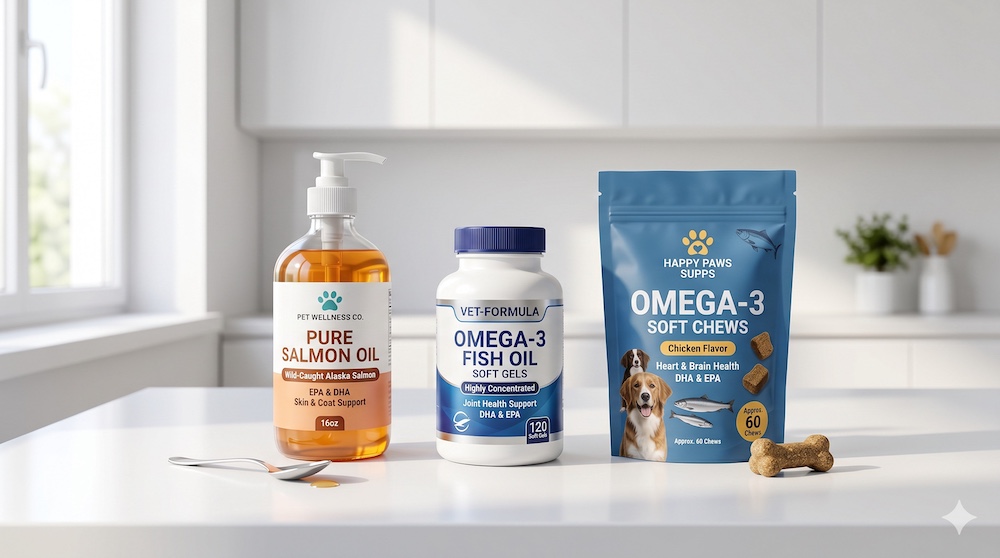
Omega-3 supplements come in three main formats — and the best one is simply the one your dog will take consistently.
Liquid oils mix invisibly into food and allow precise dose adjustment by weight, making them ideal for large breeds. Soft gels offer exact per-capsule dosing and can be punctured and squeezed onto food for dogs that refuse to swallow them whole. Soft chews have the highest acceptance rate but typically the lowest EPA and DHA concentration per serving — always check the label before assuming a chew delivers a therapeutic dose.
(💡 Different formats suit different dogs — liquids offer the best dose control, soft gels offer precision, chews offer maximum palatability.)
🥇 Best Overall: Zesty Paws Pure Wild Alaskan Salmon Oil
Zesty Paws Salmon Oil is the most popular omega-3 supplement for dogs on the market — and for good reason. The liquid format allows precise dose adjustment by weight, it mixes invisibly into food, and the Wild Alaskan source provides high-quality EPA and DHA without the heavy metal concerns of lower-quality fish oil sources.
Key features:
- Wild Alaskan salmon as the source.
- High EPA + DHA concentration per serving.
- Liquid format — easy dose adjustment.
- No additives or artificial ingredients.
- Pump dispenser for mess-free serving.
- Third-party tested.
✅ Wild-caught, sustainable source.
✅ Easy dose adjustment by dog’s weight.
✅ Mixes into food invisibly.
✅ Most dogs accept it readily.
✅ Competitively priced per serving.
❌ Requires refrigeration after opening.
❌ Liquid can be messy if not using pump.
🏆 Best for: Dogs of all sizes — especially large breeds where liquid allows easy dose scaling.
🥈 Best Soft Gel: Nordic Naturals Omega-3 Pet
Nordic Naturals is a premium human omega-3 brand that produces a veterinary-grade pet formula. The Omega-3 Pet soft gels contain highly concentrated EPA and DHA in the triglyceride form — the most bioavailable form of omega-3, offering superior absorption compared to the ethyl ester form found in many lower-cost supplements.
Key features:
- 180mg EPA + 120mg DHA per soft gel.
- Triglyceride form — superior bioavailability.
- Wild-caught, sustainably sourced fish.
- No artificial additives.
- Third-party tested for purity and potency.
- Unflavored — can be punctured and squeezed onto food.
✅ Highest bioavailability (triglyceride form).
✅ Rigorous third-party testing.
✅ Human-grade quality standards.
✅ Precise per-capsule dosing.
✅ No fishy smell — fresh, clean oil.
❌ More expensive per serving.
❌ Capsule size may be large for small dogs.
🏆 Best for: Dogs where bioavailability and purity are the priority — senior dogs, dogs with cardiac conditions, or dogs where maximum EPA/DHA absorption is the goal.
🥉 Best for Picky Dogs: Grizzly Omega Health Salmon + Pollock Oil
Grizzly Omega Health combines wild Alaskan salmon oil with pollock oil — the pollock providing a complementary fatty acid profile that many dogs find more palatable than straight salmon oil. It is a consistently well-reviewed option for dogs that refuse other fish oil products.
Key features:
- Wild Alaskan salmon + pollock combination.
- High EPA and DHA per serving.
- Liquid with pump dispenser.
- No artificial ingredients.
- Third-party tested.
✅ Dual-source oil — enhanced palatability.
✅ Pump dispenser for easy serving.
✅ Well-accepted by picky dogs.
✅ Competitive price.
❌ Not as high EPA/DHA concentration as Nordic Naturals per serving.
❌ Requires refrigeration after opening.
🏆 Best for: Dogs that have refused other fish oil products — the pollock combination has a milder aroma that many finicky dogs prefer.
💰 Best Budget: PetMD Omega-3 Fish Oil Softgels
For owners who want the benefits of omega-3 without premium pricing, PetMD Omega-3 Fish Oil Softgels provide clearly listed EPA and DHA content at a fraction of the cost of premium brands, manufactured in the USA under consistent quality standards.
🔍 What this budget pick gets right:
- USA-manufactured under consistent quality standards.
- EPA and DHA clearly listed as long-chain omega-3s (not just “total fish oil”).
- Simple, reliable dosing guide: one softgel per 9 kg (20 lb) of body weight.
- Widely available, consistently in stock.
Comparison Table
| Brand | Source | Form | EPA+DHA per serving | Third-party | Rating |
|---|---|---|---|---|---|
| Zesty Paws Salmon Oil | Wild Alaskan Salmon | Liquid | High | ✅ | ⭐⭐⭐⭐⭐ |
| Nordic Naturals Omega-3 Pet | Wild Fish | Soft gel | Very High | ✅ | ⭐⭐⭐⭐⭐ |
| Grizzly Omega Health | Salmon + Pollock | Liquid | High | ✅ | ⭐⭐⭐⭐ |
| Budget fish oil | Wild fish | Liquid/Gel | Varies | Check label | ⭐⭐⭐⭐ |
Omega-3 Dosing Guide for Dogs
Dosing omega-3 correctly is critical — too little produces no benefit, too much can cause issues including prolonged bleeding time and GI upset.
General veterinary guidelines for EPA+DHA combined:
| Dog Weight | Daily EPA+DHA (maintenance) | Daily EPA+DHA (therapeutic) |
|---|---|---|
| Up to 5 kg (11 lb) | 250–500 mg | 500–1000 mg |
| 5–15 kg (11–33 lb) | 500–1000 mg | 1000–2000 mg |
| 15–30 kg (33–66 lb) | 1000–2000 mg | 2000–3000 mg |
| 30–45 kg (66–99 lb) | 2000–3000 mg | 3000–4500 mg |
| 45+ kg (99+ lb) | 3000–4000 mg | 4000–6000 mg |
(Therapeutic doses are for dogs with specific conditions — joint disease, skin disease, cardiac conditions. Always consult your vet before using therapeutic doses.)
❔How to calculate from your supplement label: Look for the combined EPA + DHA value per serving (not total omega-3 or total fish oil). Use this number to calculate how many servings match your dog’s weight target.
📊 Example: 25 kg (55 lb) Labrador on maintenance dose = 1000–2000mg EPA+DHA daily. If your supplement has 500mg EPA+DHA per pump → 2–4 pumps per day mixed into food.
How to Give Omega-3 Supplements
| Liquid oil: Add directly to food and mix in. Most dogs consume it without noticing. Start with half the target dose for the first week to allow digestive adjustment. |
| Soft gels: Puncture with a pin and squeeze onto food, or offer whole as a treat — most dogs accept them like treats. |
| Soft chews: Give as treats — but check the EPA/DHA concentration carefully. Many soft chews have lower concentrations than liquid or gel formats. |
| With or without food: Always give with food to improve absorption and reduce the chance of GI upset. |
What Results to Expect and When
| ✔️ Coat and skin (4–8 weeks): The most visibly noticeable benefit. Most owners report a shinier coat and reduced shedding within 4–8 weeks of consistent supplementation. |
| ✔️ Itching and skin inflammation (4–8 weeks): Dogs with skin allergies or chronic itching often show meaningful improvement — though omega-3 addresses inflammation, not the underlying allergen. It works alongside, not instead of, allergen management. |
| ✔️ Joint support (8–12 weeks): Reduced stiffness and improved mobility in dogs with arthritis typically takes 8–12 weeks of consistent supplementation to become noticeable. |
| ✔️ Cognitive support in seniors (ongoing): DHA supports brain health — effects accumulate over months rather than appearing acutely. |
Safety: Is Fish Oil Safe for Dogs?
Fish oil is one of the safest supplements available for dogs — but a few cautions apply.
⚠️ Potential concerns at high doses:
- GI upset (vomiting, loose stools) — start at half dose and increase gradually.
- Prolonged bleeding time — relevant before surgery (stop supplementation 1–2 weeks before any procedure).
- Weight gain — fish oil is calorie-dense at approximately 9 kcal/ml (1 fl oz = 30ml). Account for supplement calories in your dog’s daily intake.
Oxidation (rancidity): Oxidized fish oil does more harm than good — it creates free radicals rather than reducing inflammation. Always store fish oil in the refrigerator after opening and replace after the recommended period. If the oil smells excessively fishy or rancid — discard it.
⚠️ Not recommended without vet guidance:
- Dogs on blood thinners or NSAIDs.
- Dogs with clotting disorders.
- Dogs scheduled for surgery in the next 2 weeks.
Conclusion: One of the Few Supplements Worth It
Omega-3 supplementation from marine sources is one of the genuinely evidence-backed additions to a standard canine diet. The combination of coat, skin, joint, cardiac, and cognitive benefits — at a low cost and excellent safety profile — makes it the first supplement to consider for almost any dog eating primarily dry kibble.
Choose a product with clearly listed EPA and DHA amounts from a marine source, dose appropriately for your dog’s weight, and expect to wait 4–8 weeks for visible results.
Key takeaways:
- ✅ EPA and DHA from marine sources — not plant-based.
- ✅ Check label for specific EPA and DHA amounts.
- ✅ Third-party tested products only.
- ✅ Dose by weight — not by arbitrary serving size.
- ✅ Start at half dose for the first week.
- ✅ Refrigerate after opening.
- ✅ Allow 4–8 weeks for coat/skin results.
📝 Editor’s Note: The omega-6 to omega-3 ratio guidance and ALA conversion rate in dogs reflect established veterinary nutrition research. Dosing ranges were cross-referenced with general veterinary guidelines for EPA+DHA supplementation in canine patients.
👉🏼 Dog Nutrition Guide — the full picture of canine fat requirements and food types.
👉🏼 Our Guide to Dog Nutrition Essentials — where omega-3 fits in the wider nutritional picture.
👉🏼 Best Joint Supplements for Senior Dogs — for dogs needing additional joint support.
👉🏼 Best Dog Food for Sensitive Stomachs — when skin and digestive issues need a dietary approach alongside supplementation.

🐕 Browse dog food, treats, toys, health products, supplements, grooming and everything else your dog needs 🐾

🐕 Browse raw dog food, freeze-dried meals, chews, bones and natural treats from Indiana farms 🐾

🐕 Browse science-backed dry dog food, wet food, breed-specific formulas, and veterinary diets for your canin 🐾
(This post contains affiliate links. If you purchase through our links, we may earn a small commission at no extra cost to you. This never influences our editorial opinions.)
FAQ: Best Omega-3 Supplements for Dogs
Can I give my dog human fish oil capsules?
Yes — human fish oil capsules are generally safe for dogs, provided they contain only fish oil with no added ingredients like xylitol, garlic, or flavorings (check the label carefully). The dosing calculation is the same — base it on the EPA+DHA content per capsule, not the total fish oil amount. Dog-specific products simply offer more convenient dosing formats and flavors designed for dogs.
How long before I see results from fish oil?
Coat and skin improvements are typically the first visible benefit — most owners notice a shinier coat and reduced itching within 4–8 weeks of consistent supplementation. Joint benefits in dogs with arthritis take longer to become noticeable — allow 8–12 weeks of daily supplementation at an appropriate dose.
Is salmon oil better than regular fish oil?
Salmon oil and standard fish oil (from sardines, anchovies, mackerel) offer similar EPA and DHA profiles when properly sourced. Wild Alaskan salmon oil has good consumer recognition and palatability. Sardine/anchovy-based oils are often higher in EPA+DHA concentration per ml and lower in heavy metal risk due to the smaller fish used. Both are appropriate choices — focus on the EPA+DHA content and third-party testing rather than the specific fish species.
Can I give fish oil to a puppy?
Yes — DHA is especially important for puppy brain and eye development. Most high-quality puppy foods already include DHA, but if your puppy’s food lists low DHA content, supplementation is appropriate. Use a puppy-weight-appropriate dose from the table above. Avoid high doses — puppy digestive systems are sensitive.
My dog’s coat hasn’t improved after 2 weeks. Is the supplement not working?
Two weeks is too early to judge. Coat changes require the natural hair growth cycle to complete — this takes 4–8 weeks minimum. If there is no improvement after 8 weeks at an appropriate dose, consider whether the dose is correct for your dog’s weight, whether the supplement has adequate EPA+DHA content, and whether an underlying issue (food allergy, thyroid problem, parasites) is contributing to the coat problem.
Can too much fish oil be harmful?
Yes — at very high doses fish oil can cause GI upset, loose stools, and prolonged bleeding time. The doses in the table above are safe for healthy adult dogs. Always stay within the recommended range and consult your vet before using therapeutic doses for specific conditions. Stop supplementation 1–2 weeks before any planned surgery.