
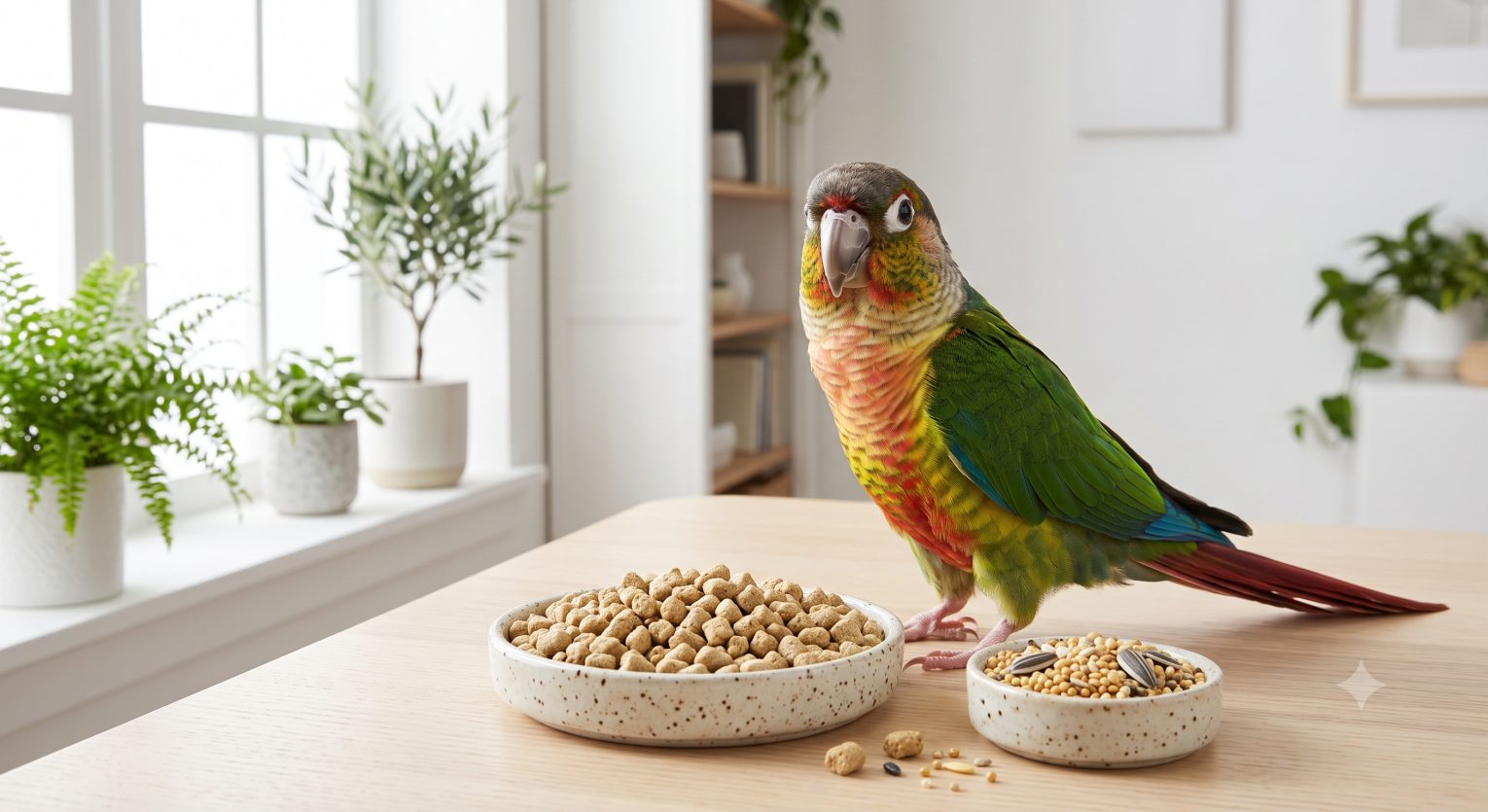
Seeds alone cannot sustain a pet bird long-term. A seed-only diet is high in fat and severely deficient in vitamin A and calcium—two of the most common preventable causes of illness in companion birds. The correct approach is a diet built primarily on formulated pellets (roughly 60–80%), supplemented with fresh vegetables and limited fruit (15–35%), with seeds making up no more than a small treat portion (5% or less).
Seeds were never meant to be a complete diet— in the wild, birds eat seeds seasonally alongside a much wider variety of foods, and even then, mostly when little else is available. In a cage, where seeds are offered daily and endlessly, the nutritional gaps compound over years into serious, often silent disease. This guide explains exactly why seeds fall short, what a correct diet actually looks like, and how to transition a seed-dependent bird safely.
Diet is one of the most important welfare decisions covered in our Bird Care Guide—the complete hub for parrots, budgies, cockatiels, and other pet birds covering diet, taming, cage setup, and health essentials in one place.
(💡 A healthy bird diet is built primarily on pellets, with fresh vegetables daily and seeds limited to an occasional treat—not the reverse.)
Table of Contents
Why Seed-Only Diets Fail Birds
Seed mixes are the most common starter food sold alongside pet birds—and the single most common root cause of preventable illness in companion birds seen by avian veterinarians. Understanding why requires looking at what seeds actually provide nutritionally, and what they don’t.
❔What seeds provide: Concentrated fat and carbohydrate energy, some protein, and a taste birds find highly palatable—often more palatable than the healthier foods they need.
❓What seeds lack:
- Vitamin A — seeds are one of the poorest dietary sources of vitamin A available.
- Calcium — most common seeds have a poor calcium-to-phosphorus ratio (high phosphorus, low calcium).
- A balanced amino acid profile — particularly in sunflower and safflower seeds, two of the most commonly offered seed types.
- Essential vitamins and minerals in the concentrations a complete diet requires.
Sunflower seeds—a staple in most commercial seed mixes—are low in calcium and deficient in several amino acids. Safflower seeds, often marketed as the “healthier” alternative, are actually higher in fat than sunflower seeds despite the perception otherwise.
(🩺 Vet’s Note: “I still see birds today whose entire diet is a colorful seed mix from a pet store—sometimes for years. Owners are often surprised because the packaging says ‘vitamin enriched’ or ‘complete nutrition.’ Vitamins sprayed onto the outside of a seed hull don’t solve the underlying problem: seeds are fundamentally the wrong macronutrient balance for a companion bird’s needs”—LovingPetsGuide Veterinary Advisor.)
📰 The nutritional inadequacy of seed-based diets is extensively documented by the Merck Veterinary Manual (merckvetmanual.com), which confirms that seed diets create imbalanced calcium-to-phosphorus ratios and amino acid deficiencies, and specifically notes that sunflower seeds are low in calcium and deficient in amino acids, while safflower seeds are higher in fat than sunflower seeds despite common marketing claims to the contrary.
The Health Consequences: What Seed-Only Diets Actually Cause
These are not rare or theoretical risks—they are among the most frequently diagnosed conditions in pet birds by avian veterinarians.
⚠️ Hypovitaminosis A (Vitamin A Deficiency)
The single most common nutritional disorder diagnosed in pet birds. Vitamin A is essential for healthy immune function, skin, and the lining of the respiratory and digestive tracts.
🚨 Signs of vitamin A deficiency:
- Nasal discharge, sneezing.
- Swelling around the eyes (periorbital swelling).
- Labored breathing.
- Poor feather quality.
- Increased susceptibility to secondary infections.
❗️Important nuance: Even a 50/50 mix of seeds and pellets can remain vitamin A deficient if portions aren’t properly controlled—because birds will selectively eat the seeds first and leave the pellets, effectively self-selecting back toward a seed-dominant diet.
⚠️ Hepatic Lipidosis (Fatty Liver Disease)
Directly linked to high-fat seed diets combined with limited flight/exercise opportunity in a cage environment. Fat accumulates in the liver, impairing its function over time.
🚨 Signs: Fluffed feathers, lethargy, distended abdomen, labored breathing, overgrown beak (the liver plays a role in normal beak keratin metabolism), and in advanced cases, visible yellow-tinted fat deposits.
⚠️ Calcium Deficiency and Hypocalcemia
Seed-based diets have a poor calcium-to-phosphorus ratio. This is particularly dangerous in African Grey Parrots and cockatiels, which are prone to a specific hypocalcemia syndrome.
🚨 Signs: Tremors, seizures, weakness, soft or pathologic bone fractures, and in breeding females, egg binding.
⚠️ Atherosclerosis
An underdiagnosed but clinically significant consequence of chronic high-fat diets, particularly in larger psittacine species—though veterinary literature confirms all species are considered at risk, not just larger parrots.
📰 These conditions and their dietary link are documented in detail by the University of Illinois College of Veterinary Medicine (vetmed.illinois.edu), which identifies hypovitaminosis A, calcium deficiency with secondary hyperparathyroidism, obesity, hepatic lipidosis, and atherosclerosis as the primary medical conditions linked to poor avian nutrition. VCA Animal Hospitals (vcahospitals.com) separately confirms that diets composed mainly of seeds and peanuts are commonly associated with fatty liver disease in pet birds, and that frequent consumption of processed human foods like pasta, crackers, and bread compounds the risk further.
What Pellets Provide That Seeds Don’t
Formulated pellets are designed to deliver complete, balanced nutrition in every bite—unlike seed mixes, where a bird can pick out only the tastiest pieces and leave the nutritionally important components untouched.
Why pellets solve the selective-eating problem: Every pellet has the same nutritional profile. A bird cannot “cherry-pick” the fatty, palatable parts and skip the vitamins and minerals, the way they can with a mixed seed bowl.
❔What quality pellets provide:
- Balanced vitamin A, D3, and E levels.
- Correct calcium-to-phosphorus ratio.
- Complete amino acid profile.
- Consistent, controlled fat content.
Reputable pellet brands frequently recommended by avian veterinarians include Harrison’s Bird Food, Roudybush, ZuPreem, and Lafeber. Look for plain, non-dyed pellets where possible—flavored and colored pellets contain added sugars and dyes that provide no nutritional benefit and may be poorly tolerated by sensitive species such as Eclectus parrots.
🐾 Formulated Bird Pellets 🐾
🦜 Formulated Pellet Diets—Lafeber and ZuPreem are well-regarded starting points for a complete pelleted diet. Chewy carries a range of pellet brands and sizes—worth browsing to find the right formula and pellet size for your bird’s species.
The Correct Diet Ratio
Based on veterinary nutrition guidance, a healthy adult pet bird’s diet should look approximately like this:
| Component | Target Percentage |
|---|---|
| Formulated pellets | 60–80% |
| Fresh vegetables, limited fruit, whole grains | 15–35% |
| Seeds and nuts (as treats only) | 5% or less |
Fresh foods matter too—not just pellets. Dark leafy greens and orange vegetables provide phytonutrients and enrichment value that pellets alone don’t replicate. Fruit should be offered in smaller amounts than vegetables—it is high in natural sugar and water content and should not dominate the fresh food portion.
For the complete list of safe fruits and vegetables by category, including exact serving guidance, see Safe Fruits & Vegetables for Pet Birds.
⚠️ Avoid diets dominated by fruit specifically. While palatable, excess fruit means excess simple sugar, low protein, and poor calcium content relative to what a bird needs daily.
Species-Specific Considerations
Diet needs are not identical across all pet bird species—body size and metabolism create real differences worth understanding.
🦜 Budgies and Cockatiels (small birds): Smaller species have faster metabolisms and somewhat higher energy demands relative to body size. They can tolerate a slightly higher proportion of high-quality seed than larger parrots, but seeds should still never be the dietary foundation.
🦜 Amazon Parrots: Known for unusually efficient metabolisms, making them prone to obesity and fatty liver disease even from small amounts of high-fat treats. Lean vegetables and high-fiber greens should make up a larger proportion of the fresh food portion for this group.
🦜 African Grey Parrots: Particularly prone to calcium deficiency and hypocalcemia. Calcium-rich food sources and, where appropriate, vitamin D3 exposure through unfiltered sunlight or supplementation (discussed with an avian vet) are especially important for this species.
🦜 Larger Psittacines generally: At higher documented risk of atherosclerosis from chronic high-fat diets—another reason to keep seed and nut treats genuinely occasional rather than a daily staple.
How to Transition From Seeds to Pellets
This is, by a wide margin, the most commonly reported struggle among bird owners—and it deserves patience rather than a rushed approach.
❓Why birds resist pellets: Birds are naturally suspicious of unfamiliar foods (neophobia)—a survival instinct in the wild. Combined with years of conditioning to the taste and texture of seeds, many birds—especially budgies and cockatiels—actively resist pellets at first.
The Gradual Transition Method
Do not simply remove seeds and force the switch. A bird that refuses to eat is a genuine medical emergency—birds have fast metabolisms and can develop serious complications from even short periods of inadequate intake.
Recommended transition timeline:
| Week | Old Food (Seed) | New Food (Pellets) |
|---|---|---|
| 1–2 | 75% | 25% |
| 3–4 | 50% | 50% |
| 5–6 | 25% | 75% |
| 7+ | 0% | 100% |
💡 Practical tips that improve success:
- ✔️ Offer separately, not mixed. Mixing seeds and pellets in the same bowl allows the bird to simply pick out the seeds. Offer them in separate dishes instead.
- ✔️ Limit seed access to timed windows (e.g., 30 minutes morning and evening) rather than leaving seed available all day.
- ✔️ Monitor weight and droppings closely throughout the transition—weigh your bird regularly using a gram scale, and watch for reduced dropping output, which can signal inadequate food intake.
- ✔️ Try warm mash. Grinding pellets and mixing with warm water into a soft mash, with a small amount of favorite seed mixed in, encourages foraging through the mash to reach the seed— exposing the bird to pellet taste and texture along the way.
- ✔️ Present pellets in engaging ways—inside foraging toys, on a play stand, or alongside a favorite fresh food—rather than only in the regular food bowl.
- ✔️ Avoid flavored or dyed pellets as a shortcut—added sugars and dyes create their own long-term problems.
⚠️ Never starve a bird into eating pellets. Withholding all food to force acceptance is dangerous and can trigger the very health crisis you are trying to prevent. If a bird refuses to eat for more than 24 hours during a transition attempt, contact an avian veterinarian immediately.
📰 The gradual transition approach is documented in detail by LafeberVet (lafeber.com/vet), which recommends introducing pellets and seeds in separate dishes, timing seed availability rather than leaving it constantly accessible, and closely monitoring droppings and body weight throughout the process—consistent with guidance published by multiple US avian veterinary hospitals for birds being converted from long-term seed diets.
🐾 Bird Foraging Toys 🐾
🧩 Foraging & Enrichment Toys—One of the most effective ways to present pellets during a diet transition. Hiding pellets inside a foraging toy taps a bird’s natural food-seeking instinct, making the new food more engaging than simply sitting in a bowl.
Common Diet Mistakes
| ❌ Trusting “vitamin fortified” seed mix marketing: Vitamins sprayed onto the outside of seed hulls are largely lost when the bird cracks and discards the hull to reach the kernel inside—the vitamin coating rarely reaches the bird at all. |
| ❌ Mixing seeds and pellets in the same bowl: This allows selective eating to continue indefinitely. Offer separately during transition, and even long-term, keep portions measured rather than free-fed. |
| ❌ Overestimating fruit as a healthy staple: Fruit is a valuable treat, not a dietary foundation—see Safe Fruits & Vegetables for Pet Birds for the correct balance. |
| ❌ Rushing the pellet transition: A forced, too-fast switch risks a bird refusing to eat altogether. Patience over weeks, not days, produces safer and more lasting results. |
| ❌ Ignoring weight monitoring during transition: A kitchen gram scale is the single most useful tool during any diet change—weight loss is often the earliest detectable sign that a transition needs to slow down. |
Conclusion
A seed-only diet is one of the most common, and most preventable, welfare problems in pet birds. The fix is not complicated—but it does require patience, particularly if you’re transitioning an adult bird that has eaten seeds exclusively for years.
Key takeaways:
- ✅ Seeds are high in fat, low in vitamin A and calcium.
- ✅ Even a 50/50 seed-pellet mix can still be vitamin A deficient without portion control.
- ✅ Target ratio: 60–80% pellets, 15–35% fresh foods, 5% or less seeds/treats.
- ✅ Hypovitaminosis A is the most commonly diagnosed avian nutritional disorder.
- ✅ African Greys and cockatiels are especially prone to calcium deficiency.
- ✅ Transition gradually over 6–7 weeks—never force it by withholding all food.
- ✅ Offer seeds and pellets in separate dishes, not mixed together.
📝 Editor’s Note: The health consequences and diet ratios described in this guide were cross-referenced with the Merck Veterinary Manual (merckvetmanual.com), VCA Animal Hospitals (vcahospitals.com), the University of Illinois College of Veterinary Medicine (vetmed.illinois.edu), and LafeberVet (lafeber.com/vet). The seed-to-pellet transition method reflects guidance consistently published across these sources for birds converting from long-term all-seed diets.
👉🏼 Bird Care Guide—complete hub for parrots, budgies, and other pet birds.
👉🏼 Safe Fruits & Vegetables for Pet Birds— complete list with correct serving guidance.
👉🏼 Toxic Foods and Household Dangers for Pet Birds—what to keep out of reach entirely.
👉🏼 Bird Cage Setup Guide—bar spacing, perches, and safety essentials.
👉🏼 How to Tame Your Bird—building trust step by step.

🦜 Browse bird food, cages, perches, toys, supplements and everything else your bird needs 🐾
(This post contains affiliate links. If you purchase through our links, we may earn a small commission at no extra cost to you. This never influences our editorial opinions.)
FAQ: Bird Diet — Seeds vs Pellets
Can I just feed my bird seeds if I add a vitamin supplement?
No. Vitamin supplements added to water or sprayed onto seed hulls do not correct the underlying macronutrient imbalance—seeds are still too high in fat and too low in usable calcium regardless of added vitamins. A formulated pellet diet addresses the whole nutritional profile, not just one missing vitamin.
What percentage of my bird’s diet should be pellets?
Most avian veterinary guidance recommends 60–80% pellets, 15–35% fresh vegetables and limited fruit, and 5% or less seeds and nuts as occasional treats. Exact proportions vary somewhat by species and individual health status— consult an avian vet for a bird with existing health conditions.
Why won’t my bird eat pellets?
Most birds show initial resistance to pellets due to neophobia (fear of new foods) combined with years of conditioning to seed taste and texture. Offer pellets and seeds in separate dishes, limit seed access to timed windows, and be patient—the transition commonly takes 6–7 weeks. Never withhold all food to force acceptance, as this is dangerous.
Is a 50/50 mix of seeds and pellets good enough?
Not necessarily. Even a 50/50 mix can remain vitamin A deficient if portions aren’t controlled, because birds will selectively eat the seeds first, leaving pellets behind. If using a combination approach, portion control and separate dishes matter more than the raw ratio on paper.
How long can a bird go without eating during a diet transition?
Birds have fast metabolisms and cannot safely go without food for long. If a bird refuses to eat at all for more than 24 hours during any diet transition attempt, contact an avian veterinarian immediately—this is a genuine emergency, not something to wait out.
Are colored or flavored pellets bad for my bird?
Flavored and dyed pellets typically contain added sugars and artificial dyes that provide no nutritional benefit and may be poorly tolerated by sensitive species such as Eclectus parrots. Plain, non-dyed formulated pellets from a reputable brand are generally the better choice.