
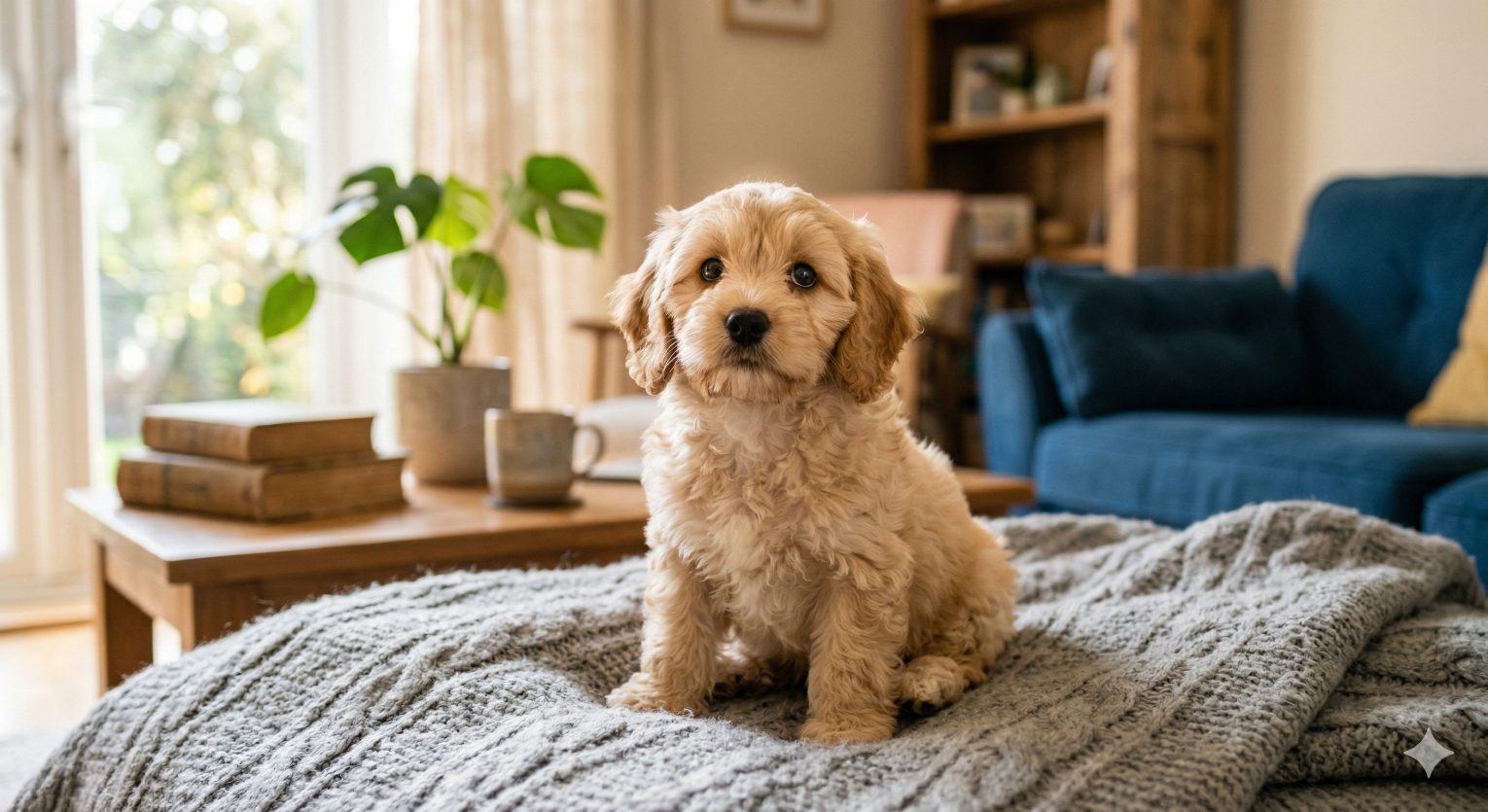
Puppy training 101 starts the moment your new dog walks through the door—not next week, not when they’ve “settled in.” The first 7 days should focus on four things: establishing a safe space, starting a consistent toilet routine, building a positive association with their name, and teaching impulse control through calm, short training sessions.
Most puppy problems that owners face at 6 months—separation anxiety, poor recall, destructive behavior—trace directly back to the foundation (or lack of one) set in the very first week. This day-by-day guide tells you exactly what to do, in what order, and why it matters.
These first 7 days are your foundation. Once your puppy is settled and sleeping through the night, you’ll be ready to move into structured obedience work. Our complete dog training guide covers every stage from basic commands to advanced off-leash reliability—bookmark it for week two onwards.
Table of Contents
Before Your Puppy Arrives: The 3 Things You Must Have Ready
Don’t wait until your puppy is already home to set things up. An unprepared environment on day one creates chaos that takes weeks to undo.
1. A designated safe space: This is a crate, a puppy pen, or a small puppy-proofed room where your puppy sleeps, rests, and spends unsupervised time. It should be set up, lined with a soft blanket, and ideally contain a worn item of your clothing before they arrive. The familiar scent reduces first-night anxiety significantly.
2. An enzymatic cleaner: Buy it before you need it. You will need it on day one. Standard household cleaners don’t break down urine at a molecular level—only enzymatic cleaners eliminate the scent signal that tells your puppy “this is a bathroom spot.”
3. High-value training treats: Small, soft, and smelly. Freeze-dried chicken, liver treats, or small pieces of cheese. Cut them down to pea-sized pieces—you’ll be giving a lot of them this week and you don’t want to overfeed.
For nutrition, see our best puppy food recommendations to ensure their bowl is as well-prepared as their safe space.
🐾 Zuke’s Mini Naturals Puppy Training Treats 🐾
🎯 Zuke’s Mini Naturals (Puppy Training Treats) — Small, soft, and low-calorie—under 3 calories per treat. The right size for the high-repetition training sessions of the first 7 days. Name recognition, sit, and toilet rewards all require frequent rewarding without adding significant calories to a puppy’s daily intake.
(🎓 Trainer’s Note: “The single biggest mistake new puppy owners make is waiting until their puppy is ‘old enough’ to start training. Every interaction in the first week is already training—the question is just whether you’re teaching what you intend to”—LovingPetsGuide Training Advisor.)
📰 The urgency of first-week training is supported by canine developmental research. The AVMA’s literature review on puppy socialization (updated September 2024, available at avma.org) confirms that puppies are most responsive to new experiences between 3 and 14 weeks of age. A puppy arriving home at 8 weeks is already in the middle of this critical window—meaning the first week at home overlaps directly with the period of maximum neurological plasticity. Experiences—positive and negative—during this window form behavioral templates that are significantly harder to modify after 14 weeks.
The Day-by-Day Plan: What to Do Each Day
🐾 Day 1 — Arrival Day: Calm Over Excitement
Your puppy has just left their mother, their littermates, and every familiar smell they have ever known. Their stress levels are extremely high—even if they seem to be handling it well.
What to do:
- ✅ Keep the house calm and quiet—no parties, no crowds of excited visitors.
- ✅ Introduce them to their safe space immediately and make it positive with treats placed inside.
- ✅ Take them straight to their outdoor toilet spot before they even enter the house.
- ✅ Let them explore one room at a time—don’t give free run of the whole house.
- ✅ Keep initial greetings short and gentle.
What NOT to do:
- ❌ Don’t invite 10 friends over to meet them.
- ❌ Don’t let children carry them around constantly—they need to decompress.
- ❌ Don’t start any formal training today—just observe and let them settle.
📰 Puppy sleep requirements—18 to 20 hours per day according to the American Kennel Club (akc.org)—directly explain why the first week’s “calm over excitement” approach matters. Sleep is when brain development, immune system maturation, and muscle growth actually occur; interrupting it for extended play or excitement doesn’t just tire a puppy out, it disrupts a physiological process already in progress.
🐾 Day 2 — Establish the Toilet Routine
Today is the most important practical day of the week. The toilet routine you establish now becomes the foundation of your entire potty training journey.
⏱️ The schedule:
- Outside immediately upon waking.
- Outside 5–10 minutes after every meal.
- Outside after every nap.
- Outside after every play session.
- Outside every 60–90 minutes regardless.
Every single time they go outside, reward them within 3 seconds with a treat and calm, warm praise. No exceptions.
👉🏼 How to Potty Train a Puppy Fast
🐾 Day 3 — Name Recognition: The Gateway Skill
Before you can teach any command, your puppy needs to reliably understand that their name means “look at me right now”.
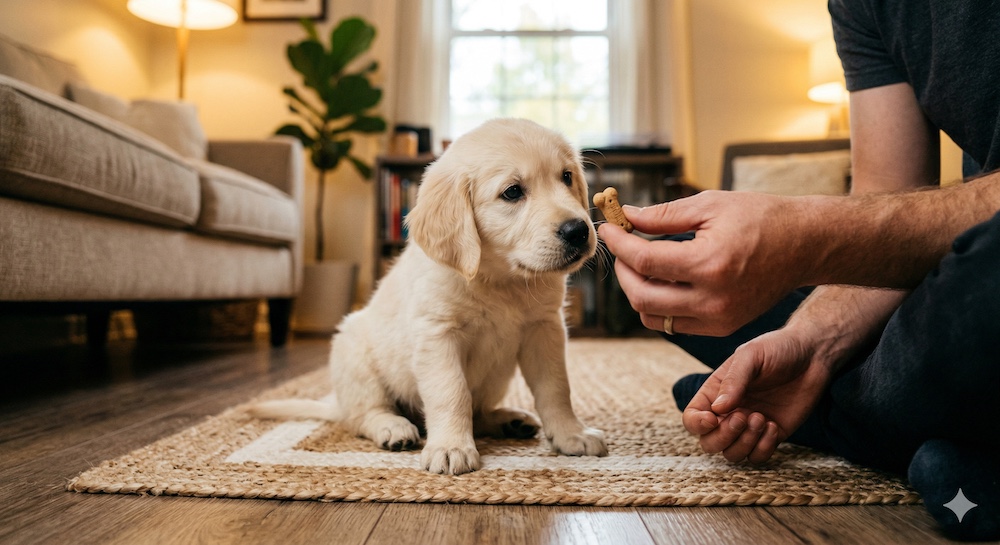
How to build name recognition:
- Say their name once, clearly and cheerfully.
- The moment they look at you—even accidentally—mark it with “Yes!” and give a treat immediately.
- Practice 20–30 repetitions spread through the day in 2–3 minute micro-sessions.
- Never say their name to scold them—their name must always predict something good, or they will learn to ignore it.
By the end of day 3, most puppies will be turning their head toward you reliably when you say their name. That’s your green light for day 4.
📰 The 3-second reward timing window referenced throughout this guide reflects established principles of operant conditioning in canine learning research. The AVSAB 2021 Position Statement on Humane Dog Training, verified at avsab.org/resources/position-statements, confirms that reward-based methods are more effective than aversive alternatives across all training contexts—and that timing precision is the primary variable determining how quickly associations form. A reward delivered 10 seconds after a behavior has zero instructional value for the preceding behavior—the puppy’s brain has already moved on to processing what is happening now.
🐾 Day 4 — Introduce Crate Training
If you haven’t started crate training yet, today is the day. A puppy that is comfortable in their crate by the end of the first week sleeps better, has fewer accidents, and is significantly less destructive.
❔How to introduce the crate positively:
- Never push them in or lock them in without preparation.
- Toss treats inside and let them walk in and out freely—don’t close the door yet.
- Feed their meals inside the crate with the door open.
- Once they walk in voluntarily and seem relaxed, gently close the door for 30 seconds, then open it and reward calmly.
- Build duration gradually—1 minute, then 5, then 15.
Most puppies will cry the first few nights. This is normal. Don’t rush in immediately every time—wait for a brief pause in crying before you go to them, otherwise you teach them that crying brings you back.
Ready to go deeper on crate training? Our crate training a puppy guide covers the full process from first introduction to sleeping through the night.
🐾 MidWest Homes iCrate Double Door Dog Crate 🐾
🏠 MidWest iCrate (Wire Crate with Divider) — Includes a divider panel so you buy for the adult size and reduce the interior while your puppy grows—preventing them from using a corner as a bathroom. Double door design for flexible room placement. The most recommended crate for first-week introduction.
🐾 Day 5 — First Formal Command: Sit
Your puppy is starting to feel settled. They know their name. Now you introduce your very first command.
“Sit” is the correct starting point because it is physically natural—their bottom drops easily when you lure them into position.
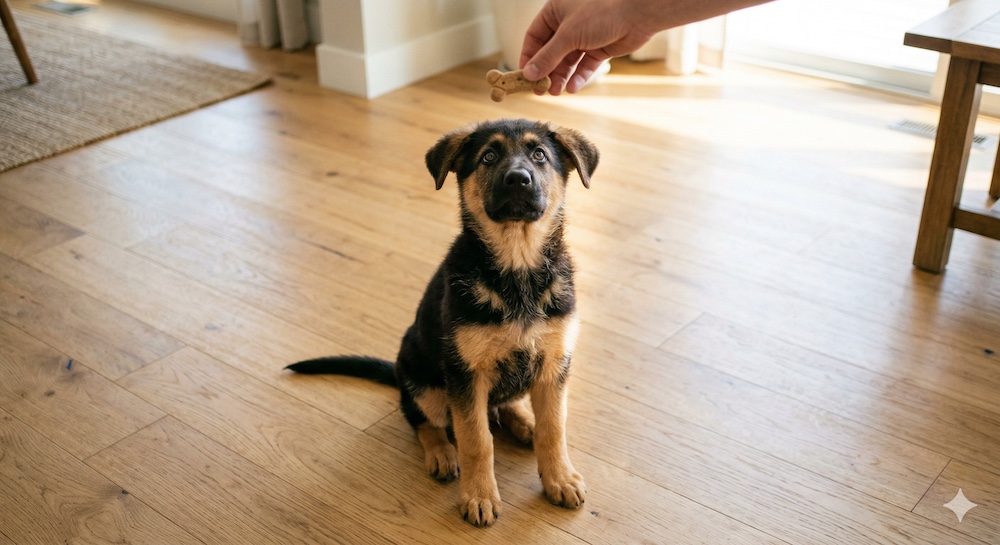
The lure method:
- Hold a treat at your puppy’s nose.
- Slowly move it back over their head.
- Their bottom will drop naturally.
- The moment their bottom touches the floor, say “Yes!” and reward instantly.
- After 10 reliable repetitions, add the word “Sit” just before the movement.
Keep sessions to 3–5 minutes maximum. End every session while your puppy is still succeeding—never train to the point of frustration.
Once your puppy knows Sit, the foundation is set for every command that follows. Our guide to all 7 essential dog commands covers exactly what comes next.
🐾 Day 6 — Bite Inhibition: The Most Urgent Lesson
Puppy biting is normal. Those needle-sharp teeth are not aggression—they are how puppies explored and played with their littermates. But they need to learn quickly that human skin is far more sensitive than a littermate’s thick coat.
❔How to teach bite inhibition:
- When your puppy bites too hard during play, make a sharp, high-pitched yelp and immediately freeze all movement.
- The moment they pause or pull back, calmly resume play.
- If they bite hard again, stand up, turn your back, and remove all attention for 30 seconds.
- Never shout at or physically punish a puppy for biting—it either excites them further or damages trust.
Consistency from every person in the household is critical here. If one person allows rough play, the lesson takes three times as long.
👉🏼 How to Stop Puppy Biting and Nipping
🐾 KONG Puppy Toy 🐾
🧸 KONG Puppy (Teething & Bite Redirect) — Softer rubber formula designed for puppy teeth. Freeze with wet food or peanut butter for cold relief on sore teething gums. The primary redirect tool for puppy biting—when they bite your hand, go still, then redirect immediately to this.
🐾 Day 7 — Consolidate and Assess
Day 7 is not about adding new skills. It is about reinforcing everything from the week and honestly assessing where your puppy is.
Your Day 7 checklist:
- ✅ Does your puppy respond to their name reliably indoors?
- ✅ Are accidents reducing and mostly happening because you missed a toilet trip?
- ✅ Is your puppy entering their crate voluntarily without distress?
- ✅ Can they hold a sit for 3–5 seconds?
- ✅ Are they sleeping in longer stretches at night?
If you can check 3 or more of these—you’ve had a successful first week. If fewer than 3, don’t panic. Simply repeat the week with more consistency before moving forward.
Quick Reference: First 7 Days at a Glance
| Day | Primary Focus | Key Goal |
|---|---|---|
| 1 | Calm arrival | Decompress, no overwhelm |
| 2 | Toilet routine | Outside every 60–90 mins |
| 3 | Name recognition | Responds reliably indoors |
| 4 | Crate introduction | Enters voluntarily |
| 5 | First command: Sit | Reliable with lure |
| 6 | Bite inhibition | Softer mouthing |
| 7 | Consolidate & assess | Review progress |
Conclusion: The First Week Builds Everything That Follows
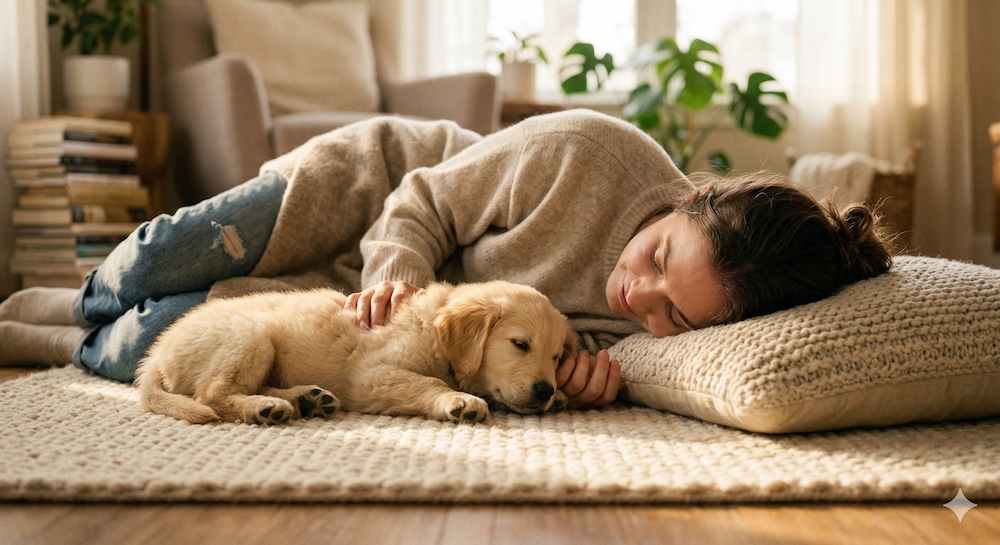
No first week is perfect. Your puppy will have accidents, cry at night, and bite your hands more than you’d like. None of that means you’re failing.
What matters is that you stay consistent, keep your reactions calm, and remember that every positive interaction this week is a deposit into a trust account that pays dividends for the next 15 years.
Week 1 non-negotiables:
- ✅ Safe space established from day one.
- ✅ Toilet routine started on day two.
- ✅ Name recognition built before any command.
- ✅ Crate introduced positively, never forced.
- ✅ First command kept simple—just Sit.
- ✅ Bite inhibition addressed early.
Week two is where the real training begins. Your puppy will be ready—and so will you.
👉🏼 Leash Training: Stop Your Dog Pulling on Walks
📝 Editor’s Note: The developmental timelines in this guide were cross-referenced with the AVMA’s September 2024 literature review on puppy socialization at avma.org and AKC breeder education resources at akc.org. The positive reinforcement principles align with the AVSAB 2021 Position Statement on Humane Dog Training at avsab.org. The enzymatic cleaner recommendation is based on the biochemistry of uric acid degradation— the same principle referenced in our how to potty train a puppy guide.

🐕 Browse dog food, treats, toys, health products, supplements, grooming and everything else your dog needs 🐾

🐕 Browse raw dog food, freeze-dried meals, chews, bones and natural treats from Indiana farms 🐾

🐕 Browse science-backed dry dog food, wet food, breed-specific formulas, and veterinary diets for your canin 🐾
(This post contains affiliate links. If you purchase through our links, we may earn a small commission at no extra cost to you. This never influences our editorial opinions.)
FAQ: First Week With a New Puppy—Your Questions Answered
How do I survive the first night with a new puppy?
Place the crate next to your bed so your puppy can hear and smell you. A warm (not hot) water bottle wrapped in a blanket can mimic littermate warmth. Expect 1–2 wake-ups for toilet trips in the first few nights. Most puppies sleep through by 10–12 weeks with a consistent pre-bed toilet routine.
Should I let my puppy cry it out at night?
Brief periods of crying are normal and acceptable—rushing in every 30 seconds teaches your puppy that crying summons you instantly. However, never ignore prolonged distress. The goal is to wait for a brief pause in crying before responding, so you reward calm rather than crying.
When should I start training a new puppy?
Day one—but keep it simple. The first week is not about formal commands. It’s about name recognition, toilet routines, and crate comfort. Formal obedience training—sit, stay, come — starts naturally in week two when your puppy is settled and sleeping well.
How much sleep does a puppy need in the first week?
A lot. Puppies need 18–20 hours of sleep per day. An overtired puppy becomes bitey, hyperactive, and unable to focus. If your puppy is manic, they almost certainly need a nap—put them in their crate calmly and let them rest.
Is it normal for a puppy to be scared on the first day?
Completely normal. Your puppy has just left everything familiar—their mother, siblings, and home scent. Mild hiding, trembling, or reluctance to eat on day one is expected. Keep the environment calm, don’t force interaction, and most puppies come out of their shell within 24–48 hours.