
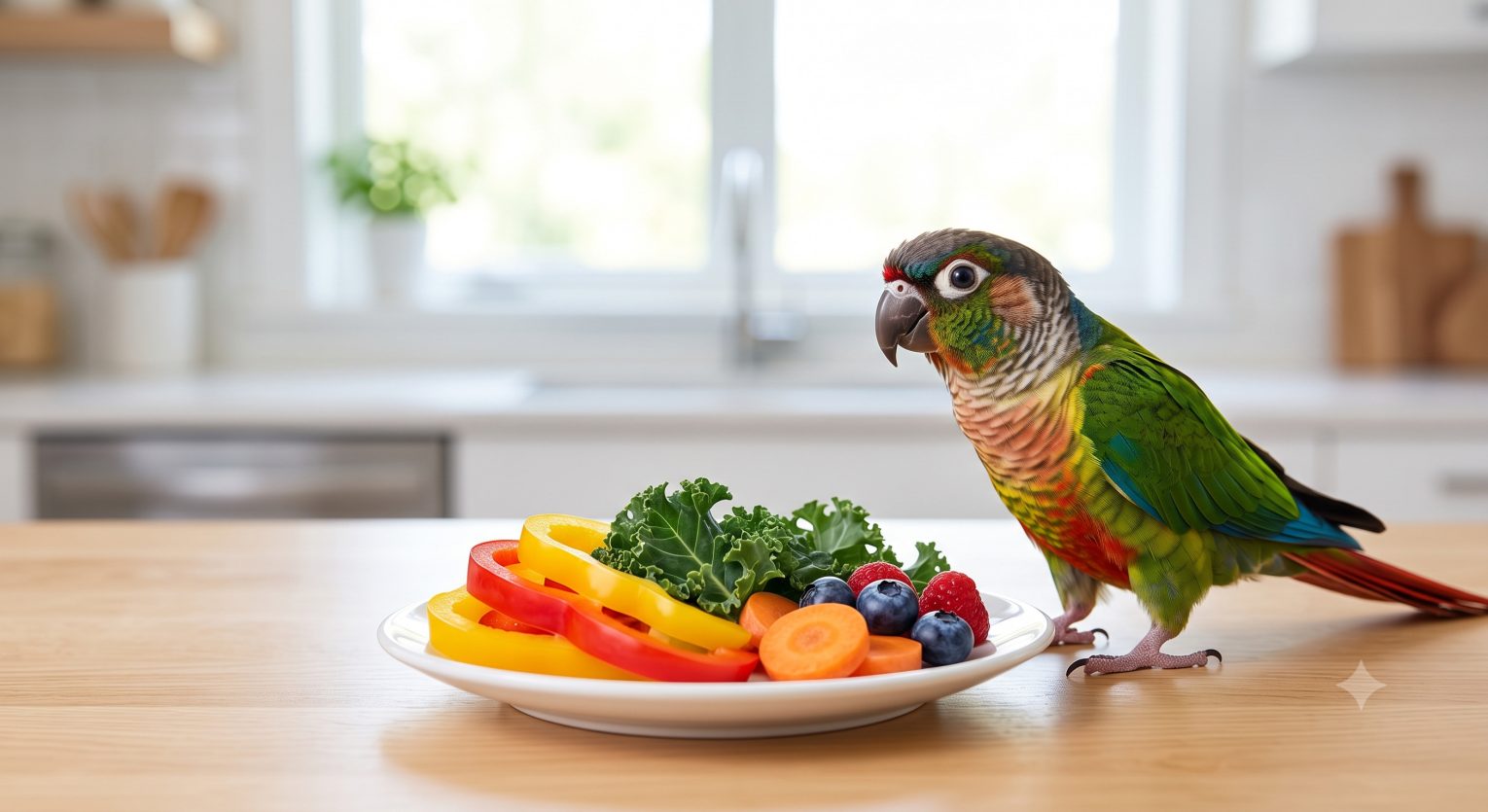
Safe fruits and vegetables for pet birds include bell peppers, leafy greens, carrots, broccoli, berries, apple (no seeds), and banana—all valuable additions to a pellet-based diet. Avocado is the one food that must never be offered under any circumstances: it contains persin, a toxin that can cause fatal heart and respiratory damage in birds within 24–48 hours, with no available antidote.
Fresh produce should make up 15–35% of a healthy bird’s daily diet, alongside a pellet-based foundation—never as a replacement for it. This guide covers exactly which fruits and vegetables are safe, which to avoid entirely, and how to prepare them correctly to avoid choking hazards and pesticide exposure.
This food reference is part of our Bird Care Guide—the complete hub for parrots, budgies, cockatiels, and other pet birds. If your bird is still primarily eating seeds, start with our Why Seeds Aren’t Enough: A Complete Bird Diet Guide first, which covers the correct overall diet ratio this article builds on.
(💡 Fresh produce should complement a pellet-based diet, not replace it—aim for 15–35% of daily intake from fruits and vegetables.)
Table of Contents
How to Use This Guide
Icons used throughout:
- ✅ Safe — can be offered regularly as part of the fresh food portion.
- ⚠️ Limited — safe in small or occasional amounts, not a daily staple.
- ❌ Unsafe / Toxic — never offer, regardless of quantity.
⚠️ Always introduce new foods gradually—offer a small piece and monitor for 24 hours before adding it to the regular rotation. Sudden dietary changes can cause digestive upset even with otherwise safe foods.
The One Absolute Rule: Never Feed Avocado
Before any list of safe foods, one rule matters more than all the others combined: never feed your bird any part of an avocado 🥑, under any circumstances.
❗️Avocado contains persin, a fat-soluble fungicidal toxin found in the flesh, skin, pit, leaves, and bark of the avocado plant. Unlike many food toxins, persin is heat-stable—cooking an avocado does not destroy it or make it safer.
❓What persin does to birds: Symptoms can appear within 15–30 minutes or be delayed up to 30 hours after ingestion, including lethargy, difficulty breathing, inability to perch, ruffled or disorganized plumage, and fluid buildup under the skin. Death from cardiac and respiratory damage can follow within 24–48 hours. There is no antidote for persin poisoning.
⚠️ Budgerigars are especially sensitive—research has established a lethal dose in budgies of approximately 2 grams (0.07 oz) of fresh avocado, an extremely small amount relative to their body size.
🚨 If your bird has eaten any part of an avocado, contact an avian veterinarian or emergency animal clinic immediately, even if no symptoms are yet visible.
📰 Avocado toxicity in birds is extensively documented in veterinary literature. The Merck Veterinary Manual (merckvetmanual.com) confirms that caged birds are notably more susceptible to persin than many other animals, with symptoms including lethargy, dyspnea, and subcutaneous edema. A controlled study published in the Journal of the American Veterinary Medical Association (cited via PubMed, pubmed.ncbi.nlm.nih.gov) administered avocado to budgerigars and canaries and found 6 of 8 budgerigars and 1 of 8 canaries died within 24–47 hours, confirming both the severity and species variability of the toxicity. The Association of Avian Veterinarians (aav.org) and the University of Illinois College of Veterinary Medicine (vetmed.illinois.edu) both list avocado among the most urgent toxic food warnings for pet bird owners.
Safe Vegetables
✅ Excellent everyday choices:
- Bell peppers (all colors)—among the highest vitamin C and vitamin A content of any common vegetable. Seeds are safe but not necessary to include.
- Dark leafy greens—romaine lettuce, dandelion greens, bok choy, arugula. Avoid iceberg lettuce, which offers minimal nutrition.
- Carrots—raw or cooked, an excellent beta-carotene source that supports the vitamin A needs covered in our Why Seeds Aren’t Enough guide.
- Broccoli—florets and stems, raw or lightly steamed.
- Squash and pumpkin—cooked, seeds can be offered separately as a treat.
- Sweet potato—cooked only, never raw (raw sweet potato is difficult to digest).
- Cucumber and zucchini—good hydration value, low nutrient density so best paired with more nutrient-dense vegetables.
- Peas and green beans—fresh or frozen (thawed), a good source of plant protein.
- Corn—fresh corn on the cob in moderation; avoid creamed or heavily processed corn products.
⚠️ Limited amounts:
- Spinach and kale—nutrient-dense but high in oxalates, which can interfere with calcium absorption if fed as a daily staple. Rotate with lower-oxalate greens instead.
- Celery—safe but stringy; cut into short pieces to reduce the risk of the fibrous strings causing digestive tract issues.
Safe Fruits
✅ Good options in moderation:
- Apple—remove seeds and core completely; the flesh is safe and well-liked by most species.
- Banana—soft, easy to eat, but high in sugar relative to other fruits—keep portions small.
- Berries (strawberry, blueberry, raspberry)— excellent antioxidant content, low sugar relative to tropical fruits.
- Melon (cantaloupe, watermelon)—good hydration, remove seeds and rind.
- Mango—remove the pit; flesh is safe and popular with most species.
- Papaya—safe and easily digestible; a good option for birds transitioning onto fresh foods.
- Grapes—unlike dogs, where grapes are highly toxic, grapes are generally considered safe for birds in moderation. Cut in half for smaller species to reduce whole-grape choking risk.
- Citrus (orange, tangerine)—safe in moderation despite the acidity; avoid the peel and pith, which are bitter and less digestible.
⚠️ Fruit as a category: Fruit should make up a smaller proportion of the fresh food portion than vegetables, due to its higher natural sugar content. This matters particularly for species prone to obesity—see the species notes below.
(🩺 Vet’s Note: “One of the most common questions I get is whether grapes are dangerous for birds the way they are for dogs. They aren’t—the toxic mechanism in dogs doesn’t apply to birds. Avocado is the one fruit that deserves that level of caution in this species, not grapes”—LovingPetsGuide Veterinary Advisor.)
🐾 Bird Foraging & Fresh Food Toys 🐾
🥕 Foraging & Skewer Toys—Fresh produce holders and foraging toys let you present fruits and vegetables in an engaging way rather than a plain dish, encouraging natural foraging behavior while your bird eats.
Other Toxic Foods to Avoid Completely
❌ Avocado is the most urgent warning, but several other common foods are also dangerous for birds.
| ❌ Food | ❓Why It’s Dangerous |
|---|---|
| 🥑 Avocado | Persin—cardiac and respiratory toxicity, no antidote |
| 🧅 Onion / 🧄 garlic | Damages red blood cells, causes hemolytic anemia |
| 🍫 Chocolate & caffeine | Theobromine and caffeine are toxic to the avian cardiovascular and nervous system |
| 🧂 High-salt foods | Birds are highly sensitive to sodium; excess causes kidney dysfunction and excessive thirst |
| 🫘 Uncooked dried beans | Contain toxic compounds destroyed only by thorough cooking |
| 🥛 Dairy products | Birds lack the enzymes to digest lactose properly |
| 🍎 Apple seeds / 🍒 fruit pits | Contain cyanogenic compounds; remove before serving |
| 🌱 Rhubarb leaves | High oxalic acid content |
⚠️ If your bird eats any of these foods, contact an avian veterinarian immediately—do not wait for symptoms to appear, particularly with avocado.
For a complete household hazards checklist beyond food—including Teflon fumes and other environmental dangers—see Toxic Foods and Household Dangers for Pet Birds.
Species-Specific Notes
Fresh food needs are broadly similar across pet bird species, but a few differences are worth knowing.
🦜 Amazon Parrots: Prone to obesity due to an unusually efficient metabolism. Prioritize lower-sugar vegetables over fruit, and keep fruit portions especially small for this group.
🦜 Budgies and Cockatiels: Smaller body size means smaller absolute portions—a piece of vegetable the size of your fingernail is often plenty for a single serving.
🦜 African Greys: Benefit from calcium-rich vegetables (broccoli, dark leafy greens) given their known predisposition to calcium deficiency— covered in detail in our Why Seeds Aren’t Enough guide.
🦜 Eclectus Parrots: More sensitive than most species to artificial additives and dyes—always choose plain, unprocessed produce for this species in particular.
Preparation and Serving Tips
✔️ Wash everything thoroughly. Pesticide residue poses a greater relative risk to small birds than to larger animals. Organic produce is preferable where accessible and affordable.
✔️ Cut to an appropriate size. Pieces should be small enough to prevent choking but large enough to encourage the natural chewing and foraging behavior fresh food provides. For very small species, grate harder vegetables like carrot.
✔️ Remove seeds and pits from fruit (apple, cherry, peach, apricot)—these contain cyanogenic compounds in small but real concentrations.
✔️ Don’t leave fresh food sitting too long. Remove uneaten fresh produce after 2–4 hours, particularly in warm rooms, to prevent bacterial growth.
✔️ Introduce new foods one at a time. This makes it easy to identify the cause if a digestive reaction does occur.
📰 General food safety guidance for pet birds— including pesticide washing, seed and pit removal, and timely removal of uneaten fresh food—is consistently reflected across avian veterinary resources including LafeberVet (lafeber.com/vet) and the Association of Avian Veterinarians (aav.org), both of which emphasize that fresh food preparation matters as much as fresh food selection for overall dietary safety.
Conclusion
Fresh fruits and vegetables are a valuable part of a healthy bird diet—but they work alongside a pellet foundation, not instead of it. The single most important thing to remember from this guide is also the simplest: never, under any circumstances, offer avocado in any form.
Key takeaways:
- ✅ Avocado is never safe—no exceptions, no amount is safe.
- ✅ Fresh produce should be 15–35% of total diet, alongside a pellet foundation.
- ✅ Bell peppers, leafy greens, and carrots are excellent everyday choices.
- ✅ Grapes are safe for birds, unlike for dogs.
- ✅ Fruit should be a smaller portion than vegetables due to sugar content.
- ✅ Always remove seeds and pits from fruit before serving.
- ✅ Wash all produce thoroughly to reduce pesticide exposure.
📝 Editor’s Note: Avocado toxicity information in this guide was verified against the Merck Veterinary Manual (merckvetmanual.com), the Association of Avian Veterinarians (aav.org), the University of Illinois College of Veterinary Medicine (vetmed.illinois.edu), and a controlled study published in the Journal of the American Veterinary Medical Association (available via PubMed). General safe food preparation guidance was cross-referenced with LafeberVet (lafeber.com/vet).
👉🏼 Bird Care Guide—complete hub for parrots, budgies, and other pet birds.
👉🏼 Why Seeds Aren’t Enough: A Complete Bird Diet Guide—the correct pellet-to-fresh-food ratio.
👉🏼 Toxic Foods and Household Dangers for Pet Birds—the complete hazards checklist beyond food.
👉🏼 Bird Cage Setup Guide—bar spacing, perches, and safety essentials.
👉🏼 How to Tame Your Bird—building trust step by step.

🦜 Browse bird food, cages, perches, toys, supplements and everything else your bird needs 🐾
(This post contains affiliate links. If you purchase through our links, we may earn a small commission at no extra cost to you. This never influences our editorial opinions.)
FAQ: Safe Fruits and Vegetables for Pet Birds
Can birds eat grapes?
Yes. Unlike dogs, where grapes are highly toxic and can cause kidney failure, grapes are generally considered safe for pet birds in moderation. Cut them in half for smaller species to reduce whole-grape choking risk.
Why is avocado so dangerous for birds specifically?
Avocado contains persin, a fat-soluble toxin that damages heart and respiratory tissue in birds. Caged birds are notably more sensitive to persin than many other animals, and even small amounts can be fatal within 24–48 hours. Cooking does not destroy the toxin, and there is no antidote— prevention is the only reliable protection.
How much fresh food should my bird eat per day?
Fresh vegetables and limited fruit should make up roughly 15–35% of a healthy bird’s total daily diet, with formulated pellets making up the majority (60–80%). Fruit specifically should be a smaller portion than vegetables due to its higher sugar content.
Can birds eat citrus fruit?
Yes, citrus fruits like orange and tangerine are generally safe for birds in moderation, despite their acidity. Avoid the peel and pith, which are bitter and less digestible, and offer the flesh in reasonable portions rather than as a primary food.
Is it safe to feed birds vegetables from my own garden?
Yes, as long as the vegetables themselves are on the safe list and have not been treated with pesticides, herbicides, or fertilizers that aren’t bird-safe. Wash thoroughly regardless of source, and avoid any plants you cannot positively identify as non-toxic.
What should I do if my bird eats avocado by accident?
Contact an avian veterinarian or emergency animal clinic immediately, even if your bird shows no symptoms yet—symptoms can be delayed up to 30 hours after ingestion. Do not wait to see if symptoms develop, and do not attempt home treatment, as there is no antidote for persin poisoning and professional intervention improves survival chances significantly.