
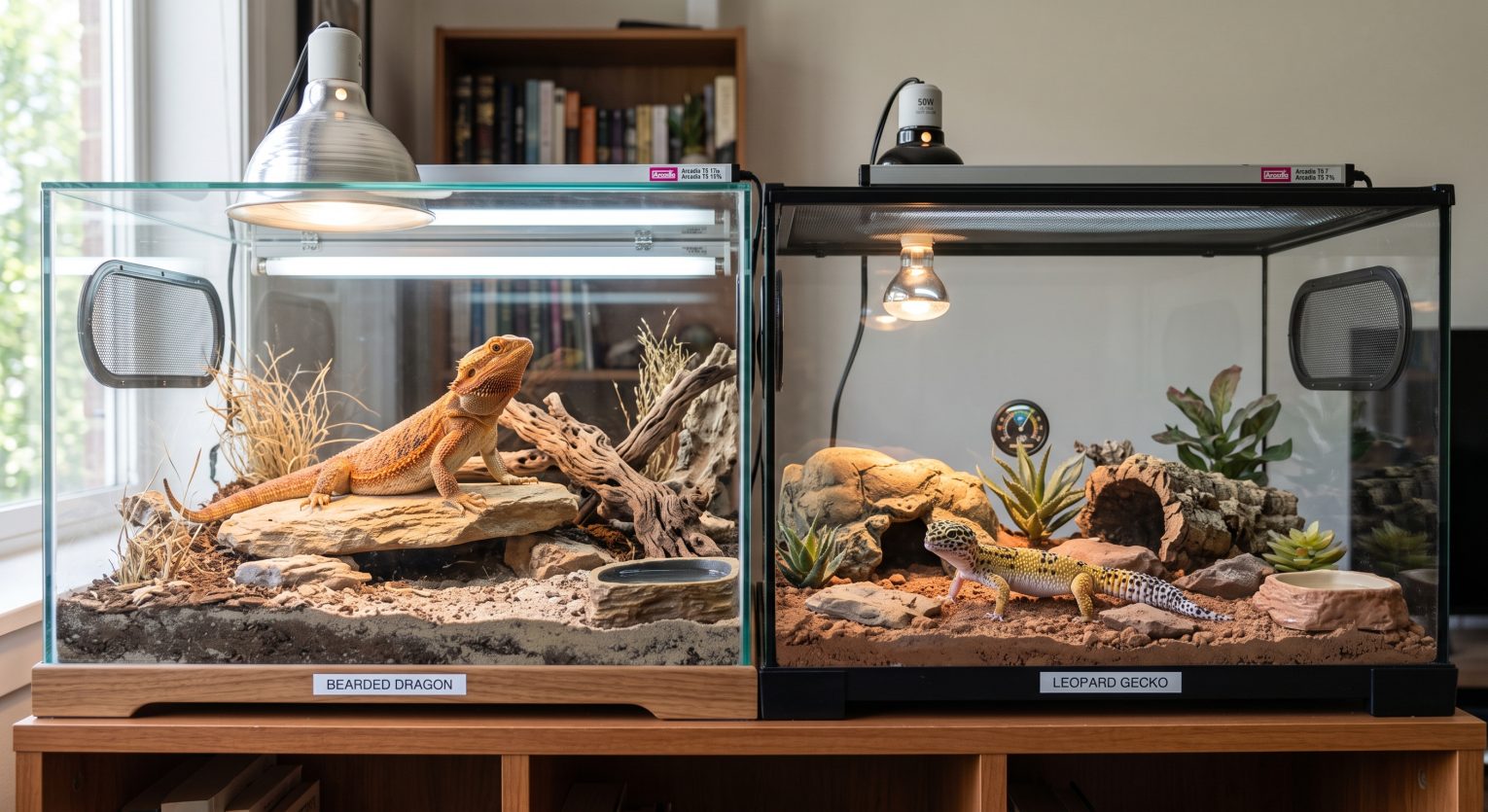
Every pet reptile depends on three systems working correctly together: a temperature gradient matched to the species, UVB lighting matched to how much sun exposure that species evolved with, and a diet with the correct nutrient and calcium-to-phosphorus balance. Getting any one of these wrong—even while the other two are correct—is the root cause of most preventable reptile health problems, particularly metabolic bone disease.
This guide covers the essential foundation across every reptile species discussed in this hub: how to choose a species that matches your experience level, how heat and UVB requirements differ (sometimes dramatically) between species, and the diet and habitat decisions that determine long-term health. Use it as your starting point whether you’re choosing your first reptile or looking for a quick reference across topics.
(💡 “Reptile care” spans genuinely different requirements—a properly researched species match makes every other decision easier.)
Table of Contents
Why Heat and UVB Come First
Before species selection, diet planning, or habitat decorating, two systems determine whether a reptile thrives or slowly declines: temperature gradient and UVB exposure. Both are easy to underestimate, and both cause problems that develop quietly over weeks before becoming visible.
❗️Reptiles are ectothermic. They cannot generate their own body heat and depend entirely on their environment to reach the internal temperature needed for digestion, immune function, and normal activity. Without adequate heat, digestion slows dramatically and appetite drops—a cascading problem that affects everything else in their care.
❗️UVB is a metabolic requirement, not decorative lighting. Most reptiles need UVB exposure to synthesize vitamin D3, which the body then uses to absorb dietary calcium. Without sufficient UVB, even a calcium-rich diet doesn’t get absorbed properly—the mechanism behind metabolic bone disease, the most common preventable health problem covered throughout this hub.
(🦎 Reptile Keeper’s Note: “Every serious health problem I’ve helped troubleshoot traces back to one of these two systems being wrong—usually invisibly wrong, not obviously wrong. A basking bulb that creates a warm room instead of a genuinely hot surface. A UVB tube that still lights up but stopped producing usable UVB months ago. Neither looks broken from a casual glance.”—LovingPetsGuide Reptile Advisor)
📰 The ectothermic dependence on environmental heat for digestion and immune function, and the role of UVB-driven vitamin D3 synthesis in calcium absorption, are documented consistently across the veterinary and academic sources referenced throughout this hub—including UC Davis School of Veterinary Medicine, the Merck Veterinary Manual, and Veterinary Partner (VIN). Both systems failing simultaneously or individually is the most frequently cited root cause of preventable reptile health problems, particularly metabolic bone disease.
How to Prepare Your Home Before Bringing a Reptile Home
Getting the setup right before your reptile arrives prevents the most common early mistakes. Follow these steps in order:
Choose your species before your enclosure
Different species need meaningfully different enclosure shapes and sizes—arboreal species like crested geckos need vertical space, ground-dwelling species like bearded dragons need horizontal floor space. See Best Reptiles for Beginners: Easy Species to Start With for a complete comparison before buying equipment.
Research your species’ Ferguson zone
This determines UVB strength, placement, and distance requirements before you purchase lighting. See UVB Lighting for Reptiles: Which Bulb Does Your Pet Need? for the complete zone system.
Set up the complete enclosure before the animal arrives
Substrate, heat source, UVB, hides, and water dish should all be in place and running for at least 24 hours before introducing your reptile—this lets you confirm temperatures are stable before they matter.
Verify temperatures with a probe thermometer, not a stick-on dial
Measure the actual basking surface temperature directly, not just ambient air—surface temperature is what determines whether your gradient is correctly calibrated.
Stock the correct diet before arrival
Whether insects, prepared powder, or produce, have your species’ correct food source—along with calcium supplementation—ready before day one.
Locate an exotic-experienced veterinarian in advance
Not every vet is trained in reptile medicine. Find and, ideally, register with one before you need one—not during an emergency.
Handle minimally for the first week
Let your reptile settle into its new environment before regular handling begins, reducing stress during the adjustment period.
Choosing Your Species
“Beginner reptile” covers genuinely different care profiles—UVB needs, diet type, and temperature precision all vary meaningfully between commonly recommended species.
| Species | UVB Need | Diet | Best For |
|---|---|---|---|
| 🦎 Leopard Gecko | Low (beneficial) | Strict insectivore | Simplest overall lizard option |
| 🦎 Crested Gecko | Very low/optional | Powdered diet | Simplest diet, vertical space |
| 🦎 Bearded Dragon | High | Omnivore, shifts with age | Daytime interaction, activity |
| 🐍 Corn Snake | Low | Whole prey | Reliable eating, first snake |
❕The gap between marketing and reality matters here. A species labeled “beginner-friendly” in a pet store doesn’t automatically mean minimal effort—it usually means the requirements are more forgiving of small mistakes, not that requirements don’t exist. For the complete comparison including ball pythons and Russian tortoises, see Best Reptiles for Beginners: Easy Species to Start With.
❕Already decided on a species. Jump straight to the complete setup guides: Bearded Dragon Care Guide: Diet, Heat & Habitat or Leopard Gecko Care Guide: The Best Beginner Reptile.
The Three Systems Every Reptile Setup Needs
Regardless of species, correct reptile care comes down to getting three interconnected systems right— understanding how they work together, not just individually, is what separates a thriving reptile from a slowly declining one.
🌡️ Heat: The Thermal Gradient
Every reptile needs a range of temperatures across their enclosure, not a single number—letting them move between warmer and cooler zones to regulate their own body temperature throughout the day.
❓How heat is delivered varies by species. Baskers like bearded dragons need an overhead basking bulb creating an intense, localized hot spot. Ground- dwelling geckos like leopard geckos typically use an under-tank heat mat instead, reflecting how they naturally absorb warmth from sun-heated rock rather than basking openly.
❗️Always measure the actual surface, not the surrounding air. This is the single most common setup error across every species covered in this hub—a basking spot can read “correct” on an ambient thermometer while the actual surface a reptile contacts remains too cool.
🐾 Reptile Heat Mats & Thermostats 🐾
🟧 Under-Tank Heat Mats with Thermostat Control — Always pair a heat mat with a thermostat—never run one directly off the wall outlet, which risks overheating and burns. Essential for ground-dwelling species that don’t rely on overhead basking bulbs.
☀️ UVB: Matched to Natural Sun Exposure
UVB needs are categorized using the Ferguson zone system—a framework built from real measurements of how much sun exposure different species experience in the wild, ranging from shade-dwelling species needing minimal UVB to extreme baskers needing strong, direct exposure.
💡 Bulb strength, placement distance, and mesh or glass barriers all change actual delivery—a correctly rated bulb mounted behind glass provides essentially zero usable UVB regardless of its printed strength. See UVB Lighting for Reptiles: Which Bulb Does Your Pet Need? for the complete zone-by-zone breakdown and safe placement guidance.
🐾 T5 HO UVB Bulbs 🐾
💡 T5 HO UVB Tubes (Various Strengths) — The dietary foundation of correct reptile care starts with correctly matched UVB. Chewy carries strengths from low-output (2.0–5.0) for shade-dwelling species to high-output (10.0–14%) for extreme baskers.
🥣 Diet: Matched to Species and Life Stage
Diet complexity varies dramatically—from strict insectivores with no plant-matter component at any age, to omnivores whose ratio shifts substantially between juvenile and adult, to snakes eating a single whole-prey item on a predictable schedule.
💊 Calcium supplementation works alongside UVB, not instead of it. This is a distinction worth repeating: without adequate UVB, dietary calcium isn’t absorbed effectively regardless of how much supplement is used. Both systems need to function together.
🐾 Calcium & D3 Reptile Supplements 🐾
💊 Phosphorus-Free Calcium Powder — Works alongside UVB exposure, not as a replacement for it. Dust feeder insects or produce according to your species’ specific schedule for consistent, reliable calcium intake.
Preventing Metabolic Bone Disease
Metabolic bone disease (MBD) is the most common preventable health problem in captive reptiles, and it develops directly from the three systems above failing—inadequate UVB, insufficient dietary calcium, or an inverted calcium-to-phosphorus ratio.
❕The mechanism, briefly: chronically low blood calcium triggers the parathyroid gland to pull calcium out of the skeleton to maintain blood levels, causing progressively weaker, softer bones over weeks to months. One of the earliest recognized signs is “rubber jaw”—a lower jaw that should be firm but has become soft and pliable.
❗️This is always a veterinary condition, never a home-treatment situation. Diagnosis requires bloodwork and often X-rays; treatment frequently involves prescription or injectable calcium therapy. What owners can genuinely control is prevention— correct UVB, consistent supplementation, and regular veterinary check-ups.
For the complete mechanism, warning signs, and prevention checklist, see Metabolic Bone Disease in Reptiles: Prevention & Treatment.
Advanced Habitat: Bioactive Setups
Once the fundamentals are established, some owners choose to build a bioactive terrarium—a self- sustaining ecosystem combining live plants and a cleanup crew of isopods and springtails that break down waste naturally, reducing manual cleaning while providing genuine behavioral enrichment.
❗️Contrary to common assumption, bioactive setups work for arid desert species, not just humid tropical ones. The substrate mix and cleanup crew species simply need to match your specific species’ climate needs.
This is genuinely an upgrade, not a baseline requirement—the standard setup covered throughout this hub delivers good welfare on its own. See How to Set Up a Bioactive Terrarium: Arid and Humid Builds Explained if you want to take habitat enrichment further.
What Does Reptile Keeping Actually Cost?
Budget expectations vary significantly by species and setup complexity, but a few reference points help with realistic planning.
💰 Initial setup: A complete enclosure, heating, UVB lighting, substrate, and basic decor typically runs $150–$400 for a standard lizard setup (bearded dragon or leopard gecko), depending on enclosure size and equipment quality. Snake setups can run somewhat lower given simpler lighting needs for low-UVB species.
💵 Ongoing monthly costs: Food (insects or prepared diet), supplements, and occasional bulb replacement typically run $20–$50 monthly, varying by species and feeder insect costs specifically.
💸 The cost trap to avoid: Buying the cheapest available UVB bulb or heat source to save money upfront often costs more over time—inadequate equipment contributes directly to metabolic bone disease and other preventable health problems that carry real veterinary costs.
⭐️ Where spending more genuinely helps: A quality UVB bulb from a reputable brand and a UV index meter to verify your specific setup are the two areas where spending a bit more consistently prevents larger problems down the line.
What Ties Every Section Together
A few principles apply across every species and topic covered in this hub, regardless of which reptile you keep:
| ✅ Surface measurement beats ambient measurement. Whether it’s basking temperature or UVB output, what matters is what actually reaches your reptile at their specific position—not a general reading from elsewhere in the enclosure. |
| ✅ UVB and calcium work together, not separately. Neither system compensates for the other being inadequate. |
| ✅ “Beginner-friendly” means forgiving, not effortless. Every species covered in this hub has real, non-negotiable requirements—the difference is how much margin for small mistakes each species tolerates. |
| ✅ Prevention is always more effective than treatment. This is most starkly true for metabolic bone disease, where some damage that develops before diagnosis never fully resolves even with successful treatment. |
| ✅ Testing and verification beat assumption. A UV meter confirming actual output, a probe thermometer confirming actual surface temperature—direct measurement consistently catches problems that visual assessment alone misses. |
Conclusion
Successful reptile keeping comes down to three interconnected systems—heat, UVB, and diet—working correctly together, matched specifically to your species’ natural needs. Getting these right from the start prevents the overwhelming majority of health problems covered throughout this hub, and species selection based on realistic self-assessment matters as much as any individual care decision.
Complete guides for every topic:
👉🏼 Bearded Dragon Care Guide: Diet, Heat & Habitat—strong-UVB, omnivore species setup.
👉🏼 Leopard Gecko Care Guide: The Best Beginner Reptile—low-UVB, insectivore species setup.
👉🏼 UVB Lighting for Reptiles: Which Bulb Does Your Pet Need?—the complete Ferguson zone and bulb guide.
👉🏼 Metabolic Bone Disease in Reptiles: Prevention & Treatment—recognizing and preventing the most common reptile health problem.
👉🏼 How to Set Up a Bioactive Terrarium: Arid and Humid Builds Explained—an advanced, self- maintaining habitat option.
👉🏼 Best Reptiles for Beginners: Easy Species to Start With—the complete species comparison.

🐍 Browse exotic pet food, terrariums, lighting, heating, supplements and everything else your reptile needs 🐾
(This post contains affiliate links. If you purchase through our links, we may earn a small commission at no extra cost to you. This never influences our editorial opinions.)
FAQ: Exotic Pet Care Guide
What’s the most important thing for a reptile beginner to get right?
Matching UVB and heat setup correctly to your specific species before the animal arrives. Nearly every serious preventable health problem covered throughout this hub—especially metabolic bone disease—traces back to one of these two systems being set up incorrectly, often invisibly so.
Do all reptiles need UVB lighting?
Requirements vary dramatically by species, but no commonly kept reptile is genuinely “UVB-free” in the sense of receiving no benefit from it. Some species need strong, precisely placed UVB; others need only low-level exposure that’s beneficial rather than strictly required for survival—see UVB Lighting for Reptiles for species-specific guidance.
How much does it cost to set up a reptile enclosure?
A standard lizard setup—enclosure, heating, UVB, substrate, and decor—typically runs $150–$400 upfront, with ongoing monthly costs around $20–$50 for food and supplements. Spending slightly more on quality UVB and a verification meter tends to prevent costlier health problems later.
Why does my reptile’s basking spot read the correct temperature but they still seem too cool?
This usually means you’re measuring ambient air temperature rather than the actual basking surface. Use a digital probe thermometer or infrared temperature gun placed directly on the basking platform—surface temperature, not surrounding air, is what determines whether your gradient actually works.
Can I keep more than one reptile in the same enclosure?
Generally not recommended for most commonly kept species covered in this hub. Most solitary reptile species experience resource competition, stress, or outright aggression when housed together, even when the enclosure appears large enough on paper.
How do I know if my reptile is sick?
Watch for reduced appetite, lethargy, changes in stool, visible jaw or limb swelling, or difficulty moving normally. Many reptile health problems progress slowly and quietly—see Metabolic Bone Disease in Reptiles for one of the most common examples of a condition that’s easy to miss early.
Is it better to buy a reptile from a pet store or a breeder?
Both can work, but a specialized breeder often provides more accurate care history, feeding records, and species-specific guidance than a general pet store. Whichever source you choose, ask directly about diet history and any handling experience before bringing the animal home.
Do reptiles recognize their owners?
Most reptiles don’t form attachment the way mammals do, but many do learn to associate their owner with food and safe handling over time, becoming noticeably calmer with consistent, gentle interaction.
What’s the biggest mistake new reptile owners make?
Underestimating UVB and heat requirements—either by trusting a bulb’s printed strength without verifying actual delivery, or by measuring ambient temperature instead of basking surface temperature. Both mistakes are invisible without direct measurement, which is exactly why they’re so common.
Should I get a reptile if I’m not sure I can commit long-term?
Lifespan varies enormously across species covered in this hub—from 10–15 years for bearded dragons to 50+ years for some tortoises. Choose based on realistic long-term planning, not just current interest, since rehoming an established reptile is significantly more stressful for the animal than careful upfront planning.