
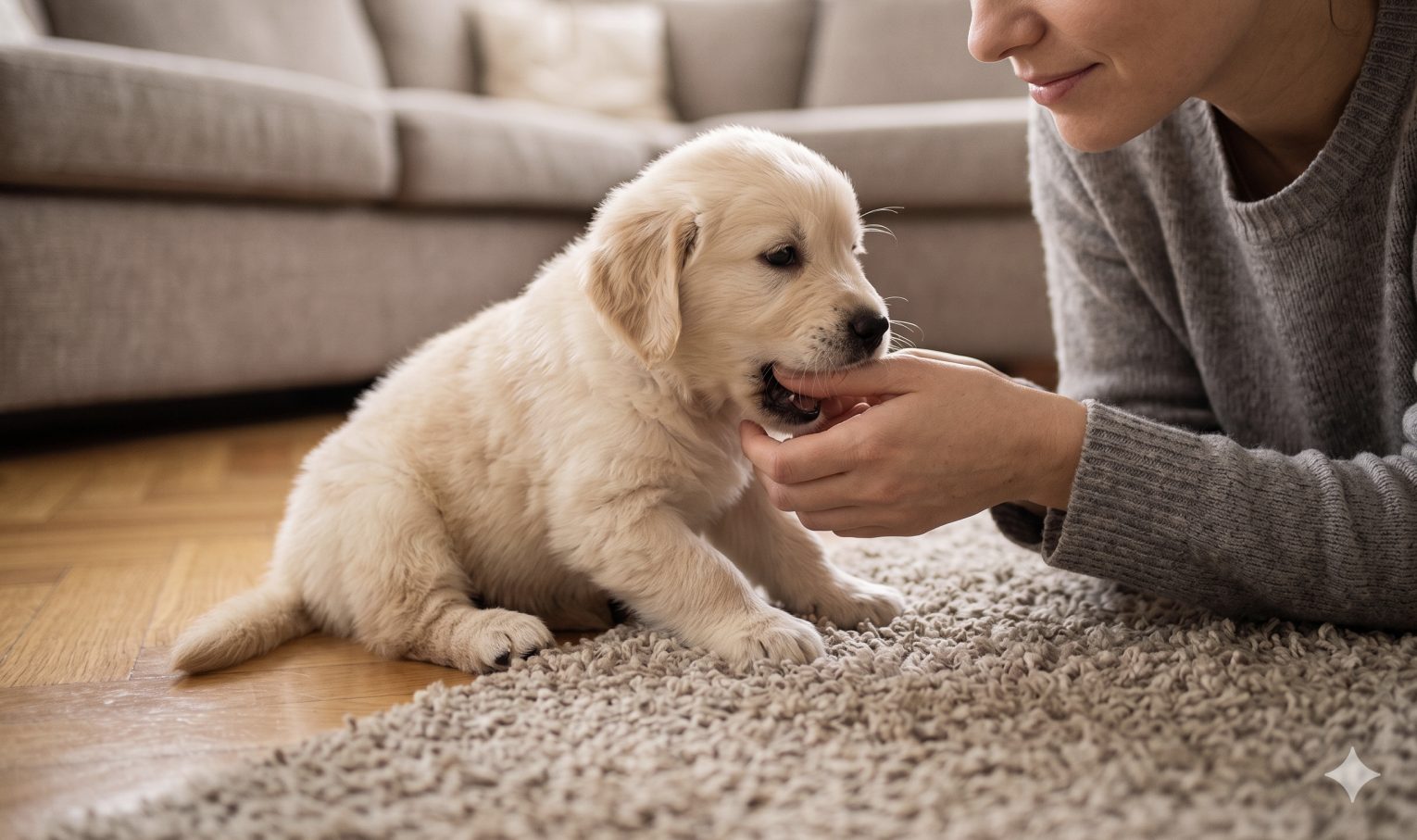
To stop puppy biting and nipping, make a sharp yelp sound the moment teeth touch skin, freeze all movement immediately, and withdraw attention for 30 seconds. Repeat every single time—consistency is everything. Most puppies show significant improvement within 2–3 weeks when every person in the household follows the same rules.
Puppy biting is not aggression. It is how puppies explored and communicated with their littermates for the first weeks of their lives. Your job is not to eliminate the instinct—it is to teach your puppy that human skin is far more sensitive than a littermate’s thick coat.
Bite inhibition is one of the most important early lessons in your puppy’s development—but it is just one piece of the training puzzle. Our complete dog training guide covers every stage from basic commands to fixing behavioral issues as your dog grows.
Table of Contents
Why Puppies Bite—And Why It’s Not Your Fault
Before you can fix the problem, it helps to understand why it is happening. Puppies bite for three distinct reasons, and the solution depends on which one applies.
1. Bite inhibition learning: In the litter, puppies bite each other constantly. When one bites too hard, the other yelps and stops playing. This teaches the biter that too much pressure ends the fun. When a puppy arrives in your home, they simply haven’t learned yet that the same rules apply to humans.
📰 The bite inhibition learning process described here is consistent with canine developmental research. Ian Dunbar’s foundational work on puppy bite inhibition—widely cited in veterinary behavioral literature and referenced in the AVSAB’s position statements at avsab.org/resources/position-statements— established that the window for teaching bite inhibition through social feedback is most effective before 18 weeks of age. After this point, bite pressure habits are significantly more difficult to modify. This is why bite inhibition training starting in the first week at home—not “later when they’re calmer”— produces the fastest and most reliable results.
2. Teething pain: Between 3 and 6 months, puppies lose their 28 baby teeth and grow 42 adult teeth. Their gums are genuinely sore during this period—and chewing and mouthing provides relief. Teething biting feels more frantic and less playful than regular mouthing.
3. Overstimulation: When puppies get overtired or overexcited, their bite pressure increases dramatically. An overtired puppy who won’t stop biting usually needs a nap, not more training.
(🎓 Trainer’s Note: “The mistake most owners make is responding to biting with loud ‘No!’ commands or pushing the puppy away. Both of these responses are social engagement to a puppy—you are literally rewarding the biting with attention. The absence of attention is the only currency that works”—LovingPetsGuide Training Advisor.)
The 3-Step Method That Actually Works
This is the foundation of bite inhibition training. Every person in the household must follow all three steps, every single time, without exception.
✅ Step 1: The Yelp and Freeze
The moment teeth touch skin—even lightly—respond with a sharp, high-pitched yelp. Not a shout, not an angry “ouch.” A genuine, surprised yelp that mimics the sound a littermate would make.
Immediately after the yelp, freeze completely. Stop all movement. Stop talking. Your hand becomes completely still and uninteresting.
Hold this for 3–5 seconds.
✅ Step 2: Withdraw All Attention
If your puppy pauses after the yelp and freeze—calmly resume play. This teaches them that gentle mouthing is acceptable but hard biting ends all fun.
If they bite again immediately after you resume, stand up, turn your back, and remove all attention for 30–60 seconds. Leave the room if necessary. The message is clear: biting makes the fun disappear.
✅ Step 3: Redirect to an Appropriate Outlet
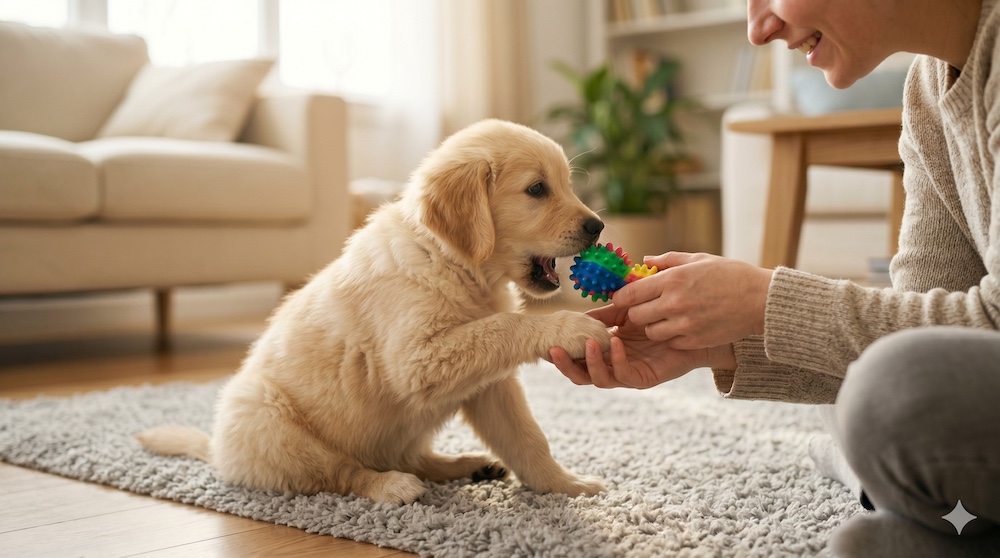
After the time-out, return and immediately offer a chew toy, a tug rope, or a frozen Kong. You are not just punishing the wrong behavior—you are also showing them what they should bite instead.
The redirect is critical. A puppy that bites without an alternative outlet will simply find another target.
Redirection is as important as the correction—always offer an alternative.
🐾 KONG Puppy Toy 🐾
🧸 KONG Puppy (Teething & Redirect Toy) — Softer rubber formula designed for puppy teeth. The go-to redirect toy for bite inhibition training—when teeth touch skin, freeze, withdraw, then offer this. Freeze with wet food or peanut butter for cold relief on teething gums.
What to Do When the Yelp Method Doesn’t Work
Some puppies—especially high-energy, excitable breeds like Labradors, Border Collies, and Terriers—become more excited by the yelp. If your puppy’s biting escalates after you yelp, skip the sound entirely and go straight to the silent withdrawal method.
Silent withdrawal protocol:
- The moment teeth touch skin, say a calm, neutral “Too bad” or simply say nothing.
- Stand up immediately.
- Turn your back and walk out of the room.
- Wait 30 seconds, then return calmly.
- Redirect to a toy before resuming interaction.
The silent version works on the same principle—biting removes all social reward—but without the vocal response that some puppies interpret as play.
The Management Approach: Prevention is Faster Than Correction
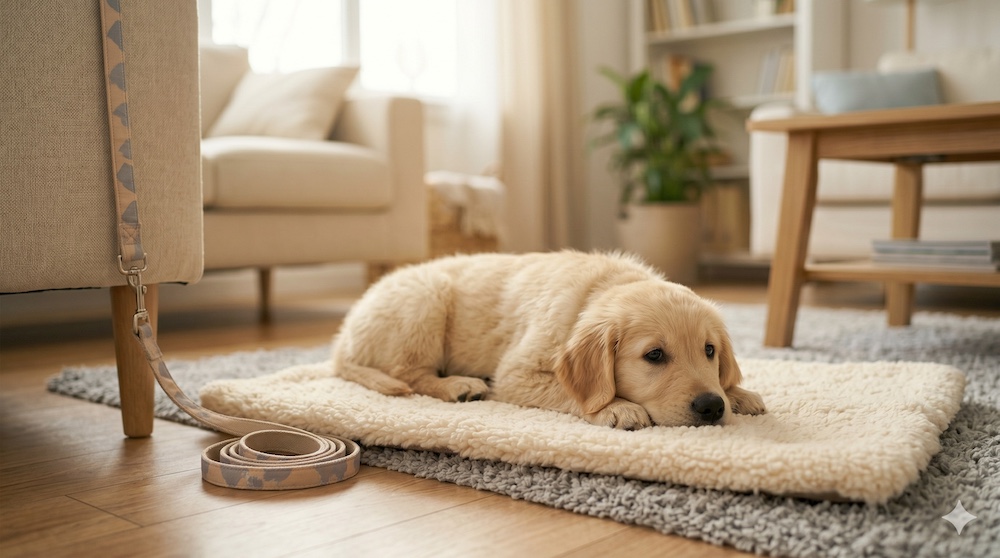
Training works best when paired with smart management. You cannot teach bite inhibition if your puppy is constantly in situations where biting is their only available response.
Management prevents biting opportunities while training teaches the alternative.
Management tools that work:
- Leash inside the house: A light house leash (not attached to anything) gives you the ability to gently guide your puppy away from situations before biting starts—without reaching for them, which triggers more biting.
- Tether training: Attaching your puppy’s leash to a heavy piece of furniture for short periods teaches them to settle calmly without constant access to your hands and feet.
- Baby gates: Controlling access to rooms prevents the “ankle shark” behavior where puppies follow people and bite their feet and ankles.
- Scheduled nap times: An overtired puppy bites harder and more frequently. If your puppy has been awake for 2+ hours and their biting is escalating, they need a crate nap—not more training.
A properly introduced crate is the most effective management tool for biting—it gives your puppy structured rest time and removes the opportunity to practice wrong behavior. Our crate training a puppy guide covers the full introduction.
The Most Common Mistakes That Make Biting Worse
Even well-intentioned owners often accidentally teach their puppies that biting is rewarding. Here are the mistakes to eliminate immediately.
| ❌ Mistake 1: Rough play with hands: Letting puppies mouth and wrestle with bare hands during play—even gently—teaches them that hands are toys. Once that association is formed, it takes significantly longer to undo. Always use a toy as the intermediary between your hands and your puppy’s teeth. Redirecting to appropriate chew toys also prevents destructive chewing habits that can develop later. Our how to stop dog chewing guide covers what to do when the problem persists past puppyhood. |
| ❌ Mistake 2: Inconsistency between household members: If one person allows mouthing and another corrects it, the puppy learns nothing except that the rules change depending on who is in the room. Every single person who interacts with the puppy must follow the same protocol, every single time. This is the number one reason bite inhibition training fails. |
| ❌ Mistake 3: Physical punishment: Tapping the puppy on the nose, holding their mouth closed, or pinning them to the ground are outdated techniques that either excite the puppy further or create fear-based aggression. Neither outcome is useful. These methods damage trust without teaching an alternative behavior. |
| ❌ Mistake 4: Repeating commands: Saying “No bite, no bite, NO BITE” teaches the puppy that there is a verbal warning before consequences arrive—and they learn to ignore the first nine repetitions. One calm response, every time, without narration. |
| ❌ Mistake 5: Waiting it out: Some owners believe the biting will stop on its own as the puppy grows up. While bite pressure naturally reduces with maturity, a puppy that never learned bite inhibition often becomes an adult dog that mouths too hard during play— which is significantly harder to correct later. |
Teething-Specific Biting: What’s Different
Teething biting (3–6 months) requires a slightly different approach because the motivation is physical discomfort, not just play drive.
What works for teething:
- Frozen carrots or frozen wet washcloths provide cold relief on sore gums.
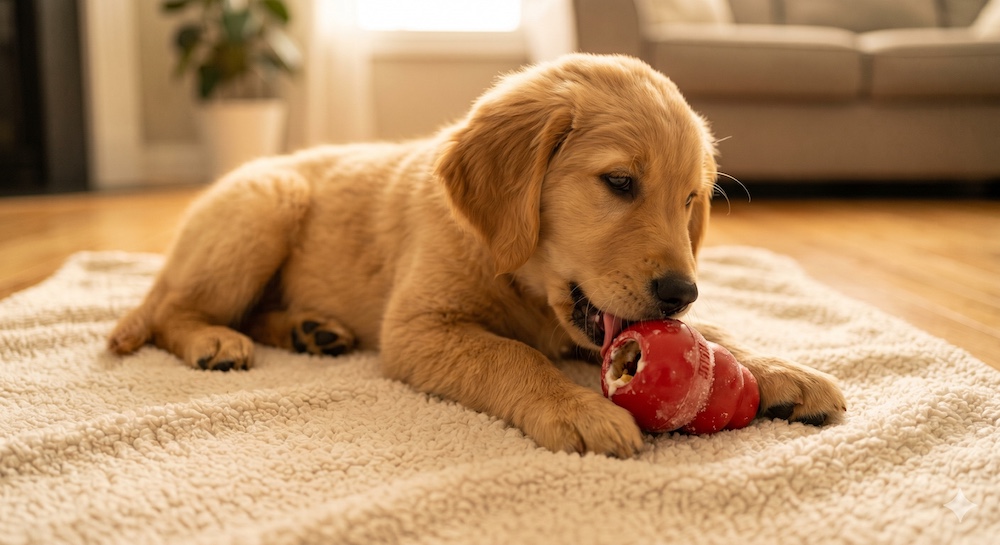
- Frozen Kongs stuffed with wet food are the gold standard—they provide both mental stimulation and gum relief.
- Rubber teething rings designed for puppies (not human baby teethers, which can break apart).
🐾 Nylabone Puppy Chew Toy 🐾
🧸 Nylabone Puppy Chew (Teething Toy) — Textured nylon chew designed specifically for puppy teeth. Satisfies the teething drive without caloric addition. Good for the 3–6 month peak teething phase when puppies seek harder surfaces to bite for gum relief.
What doesn’t work:
- Punishing teething biting the same way as play biting—the puppy is in genuine discomfort and needs an outlet, not just a correction.
(🎓 Trainer’s Note: “During peak teething, I always tell owners to double their management and halve their expectations. Your puppy is not regressing—they are in pain. Give them appropriate outlets and ride it out. By 6 months, the worst is almost always over”—LovingPetsGuide Training Advisor.)
📰 The teething timeline referenced throughout this guide—3 to 6 months for the transition from 28 deciduous (baby) teeth to 42 adult teeth—is documented in standard veterinary dental references including the Merck Veterinary Manual, available at merckvetmanual.com. The eruption sequence typically begins with the incisors at 3–4 months, followed by canine teeth at 4–5 months, and premolars at 4–6 months. Gum sensitivity is highest during active eruption periods—which explains why teething puppies often seek harder objects to bite than they would during normal play mouthing.
When Puppy Biting Becomes a Concern
Most puppy biting is completely normal and resolves with consistent training. But there are specific scenarios that warrant closer attention.
Consult a professional trainer or vet if:
- Your puppy’s biting is accompanied by deep growling, stiff body posture, or hard staring—these are stress signals, not play signals.
- Biting is directed at one specific person or type of person (children, strangers) with disproportionate intensity.
- Your puppy makes no attempt to inhibit bite pressure despite 4+ weeks of consistent training.
- Biting escalates into breaking skin regularly beyond the normal puppy stage.
These scenarios are rare, but they are the difference between a training challenge and a behavioral issue that requires expert guidance.
Understanding your dog’s breed instincts can also explain why some puppies bite harder than others. Our dog training by breed type covers breed-specific thresholds and training adaptations.
📰 Body stillness and stiffness as an early warning signal—preceding growling, snapping, or biting—is documented directly by the American Veterinary Society of Animal Behavior (AVSAB) at avsab.org. Their behavioral guidance notes that a dog holding a stiff, still posture with direct eye contact is often signaling discomfort well before more obvious warning signs appear, and that failing to recognize this early signal is a common reason interactions escalate to growling or biting. This is distinct from the loose, relaxed body language of normal play biting—the distinction described in this section is a recognized behavioral marker, not a subjective judgment call.
Conclusion: Consistency is the Only Shortcut
Bite inhibition is not a trick you teach in a single session. It is a lesson you reinforce dozens of times per day, every day, for several weeks. The good news is that puppies learn fast— when the rules are clear and consistent.
Key takeaways:
- ✅ Yelp and freeze the moment teeth touch skin.
- ✅ Withdraw all attention for 30–60 seconds.
- ✅ Always redirect to an appropriate chew toy.
- ✅ Never use hands as play toys.
- ✅ Every person in the household must be consistent.
- ✅ Manage the environment to reduce biting opportunities.
- ✅ Frozen Kongs are your best friend during teething.
(💡 A frozen Kong is the most effective teething tool—it soothes sore gums and redirects biting simultaneously.)
📝 Editor’s Note: The bite inhibition principles in this guide align with the AVSAB 2021 Position Statement on Humane Dog Training at avsab.org and Ian Dunbar’s documented research on canine bite inhibition—referenced in multiple peer-reviewed veterinary behavioral publications. The teething timeline was cross-referenced with the Merck Veterinary Manual at merckvetmanual.com. The yelp-and-freeze method and silent withdrawal protocol both follow the same operant conditioning principle: removing social reward eliminates the behavior faster than any punishment-based response.
🐾 Zuke’s Mini Naturals Training Treats 🐾
🎯 Zuke’s Mini Naturals (Training Treats) — Pea-sized, under 3 calories per treat. Use these to reward calm, gentle mouthing and successful redirects to a toy—rewarding the right behavior immediately is as important as withdrawing attention for the wrong one.
Ready to tackle the next challenge?
👉🏼 How to Potty Train a Puppy Fast
👉🏼 Leash Training: Stop Your Dog Pulling on Walks

🐕 Browse dog food, treats, toys, health products, supplements, grooming and everything else your dog needs 🐾

🐕 Browse raw dog food, freeze-dried meals, chews, bones and natural treats from Indiana farms 🐾

🐕 Browse science-backed dry dog food, wet food, breed-specific formulas, and veterinary diets for your canin 🐾
(This post contains affiliate links. If you purchase through our links, we may earn a small commission at no extra cost to you. This never influences our editorial opinions.)
FAQ: How to Stop Puppy Biting—Your Questions Answered
At what age do puppies stop biting?
Most puppies significantly reduce biting between 4 and 6 months as adult teeth come in and bite inhibition training takes hold. With consistent training, most owners report a dramatic improvement by 16–20 weeks. Without training, mouthing habits can persist into adulthood—though with less pressure.
Why does my puppy bite me and not other people?
Puppies often bite the person they are most comfortable with—their primary caregiver. This is actually a sign of trust, not disrespect. It means your puppy feels safe enough to play fully with you. Apply the same bite inhibition protocol consistently and the biting will reduce just as it would with anyone else.
Should I scruff my puppy to stop biting?
No. Scruffing—grabbing the loose skin at the back of the neck—is an outdated technique that creates fear and anxiety without teaching an alternative. Modern behavioral science shows that positive withdrawal of attention is significantly more effective and builds a stronger relationship.
My puppy bites harder when I try to stop them. Why?
This usually means one of two things: the puppy is overtired and needs a crate nap, or your response is being interpreted as play. If the yelp method escalates the biting, switch to the silent withdrawal protocol immediately and ensure the puppy gets more scheduled rest.
How do I stop my puppy from biting my ankles and feet?
Ankle biting is a herding instinct in some breeds and a prey-drive behavior in others. Management is key—a light house leash lets you guide them away calmly. When they go for your ankles, stop moving completely (movement triggers the chase), redirect to a drag toy they can chase instead, and reward calm walking beside you with treats.