
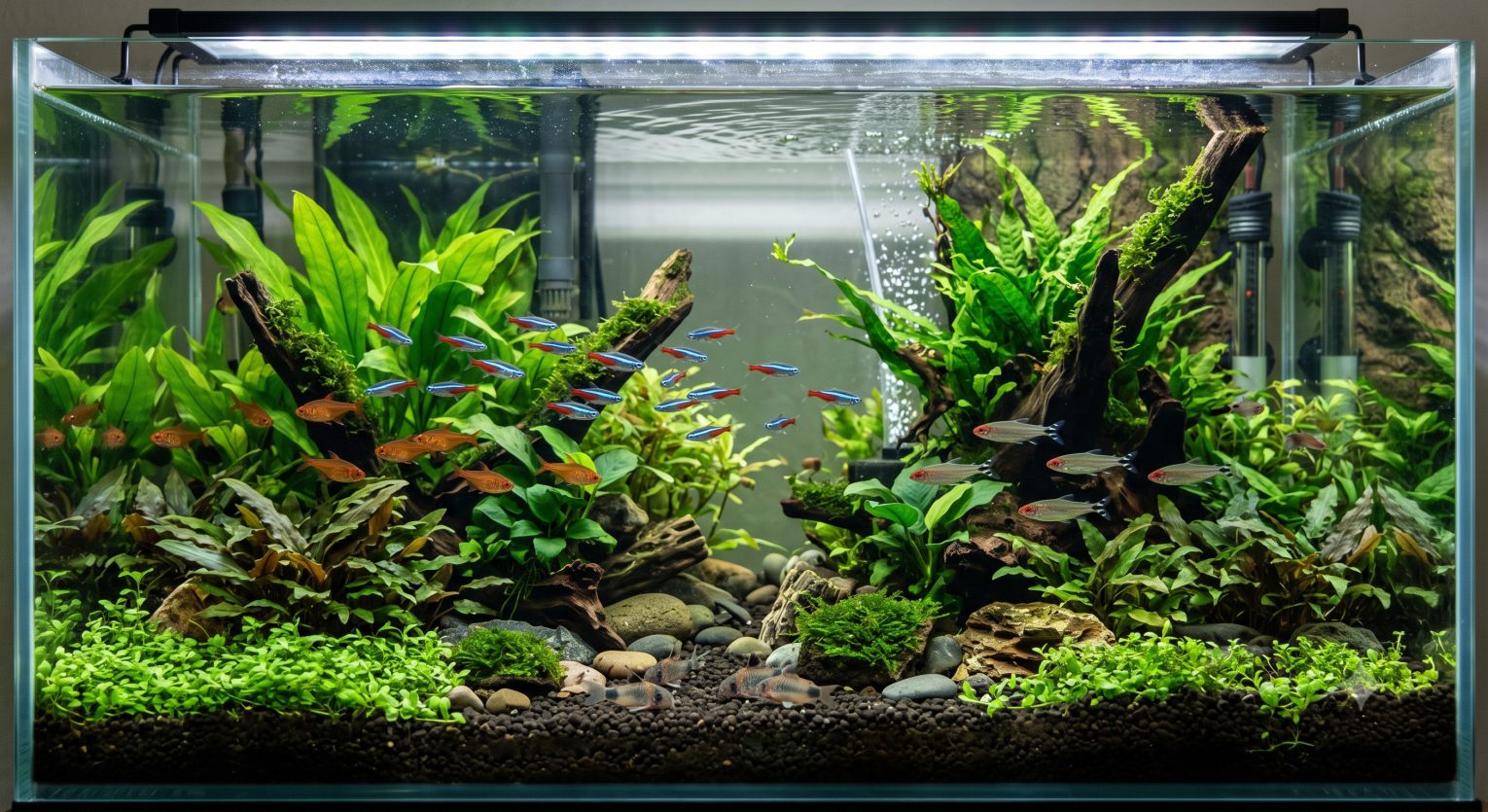
A healthy freshwater aquarium depends on getting four things right, in order: completing the nitrogen cycle before adding any fish, choosing species suited to your tank size and experience level, matching your filter to your tank’s actual bioload, and testing water quality consistently rather than only when something looks wrong. Most new-aquarium problems—including the majority of fish deaths in the first month—trace back to skipping or rushing the very first step.
This guide covers the essential foundation for freshwater aquarium keeping and links to complete guides for cycling, fish selection, disease treatment, water testing, and filtration. Use it as your starting point whether you’re setting up your first tank or looking for a quick reference across topics.
(💡 A stable, thriving aquarium is the result of getting setup order right—cycling first, species selection second, ongoing water care after that.)
Table of Contents
Getting the Order Right
The single biggest predictor of long-term success in this hobby isn’t any individual piece of equipment—it’s doing things in the right sequence. Skipping ahead is the most common reason new aquariums fail in the first few weeks.
📋 The correct order:
- Set up the tank and equipment completely ✔️
- Cycle the tank before adding any fish ✔️
- Choose species suited to your tank size and experience ✔️
- Introduce fish gradually, not all at once ✔️
- Test water quality on an ongoing schedule ✔️
(🐠 Aquarist’s Note: “Almost every ‘my fish died and I don’t know why’ situation I help troubleshoot traces back to one of two things: fish added before cycling finished, or a filter too small for what’s actually in the tank. Both are entirely preventable with the right information before you start.”—LovingPetsGuide Aquatics Advisor)
How to Set Up a New Freshwater Aquarium
Follow these steps in order for the best chance of a stable, thriving tank from day one:
Choose your tank size and filter together
Decide on tank size first, then select a filter rated appropriately for that volume and your planned stocking level—see Best Aquarium Filters: HOB, Sponge & Canister Compared for sizing guidance.
Set up the complete system before adding water
Substrate, decorations, heater, and filter should all be in place before the cycling process begins.
Begin the fishless cycling process
Dose the tank with a pure ammonia source and allow the bacterial colony to establish—typically 4–6 weeks without shortcuts. See How to Cycle an Aquarium: The Nitrogen Cycle Explained for the complete method.
Research and select your fish species
While cycling, use the time to plan your stocking— see Best Fish for Beginners: Top 10 Community Tank Picks for species that tolerate a new tank’s early conditions well, and The Best Tank Mates for Betta Fish if a betta is part of your plan.
Confirm cycling is complete before adding fish
Test for the “double-zero” result—0 ppm ammonia, 0 ppm nitrite, with nitrate present—not just a calendar estimate.
Add fish gradually, not all at once
Introduce a few fish at a time even after cycling, allowing the bacterial colony to adjust to each new addition.
Establish an ongoing water testing routine
Weekly testing catches problems while they’re still small—see Aquarium Water Quality: pH, Ammonia & Nitrates Guide for the complete testing schedule and safe parameter ranges.
🐾 Freshwater Aquarium Test Kits 🐾
🧪 Liquid Test Kits — The single most essential tool for every stage of this guide, from initial cycling through ongoing maintenance. A liquid master test kit covering ammonia, nitrite, nitrate, and pH is the standard for accuracy.
What Size Tank Should You Start With?
| Tank Size | Good For | Filter Type | Difficulty |
|---|---|---|---|
| 5–10 gal (19–38 L) | Betta, shrimp, small nano species | Sponge | Beginner-friendly, low margin for error |
| 10–20 gal (38–76 L) | Standard community (see Best Fish for Beginners) | HOB | Most forgiving starting point |
| 20–40 gal (76–151 L) | Larger community, more species variety | HOB or small canister | More stable, more room for mistakes |
| 40+ gal (151+ L) | Planted aquascapes, heavy bioload species | Canister | Most stable long-term, higher upfront cost |
❕Counterintuitive but true: larger tanks are often more forgiving for beginners than very small ones. A bigger water volume dilutes mistakes—a missed water change or slight overfeeding has less dramatic impact than in a 5-gallon tank.
The Nitrogen Cycle: Your Foundation
Every aquarium runs on the same biological process: ammonia from fish waste is converted by bacteria into nitrite, then into nitrate. Ammonia and nitrite are both highly toxic; nitrate is far less harmful and managed through regular water changes.
Cycling means growing this bacterial colony before adding fish. Skipping this step is the single most common cause of new fish dying within the first few weeks.
For the complete fishless cycling method, including exact ammonia dosing and the “double-zero” test that confirms completion, see How to Cycle an Aquarium: The Nitrogen Cycle Explained.
🐾 Water Conditioners & Dechlorinators 🐾
💧 Water Conditioners — Neutralizes chlorine and chloramine from tap water before it reaches your tank, protecting the bacterial colony your entire nitrogen cycle depends on. Essential for every water change, from day one onward.
Choosing Fish: Species and Compatibility
Not every fish sold as “beginner-friendly” actually deserves that label. The gap between marketing and reality is one of the most common sources of frustration for new aquarium owners.
❔What actually makes a species beginner-suitable:
- Tolerance for minor water parameter fluctuations, especially during and shortly after cycling.
- A peaceful temperament compatible with a mixed community tank.
- An adult size appropriate for a starter tank without requiring an upgrade within months.
🐠 Zebra danios and white cloud mountain minnows consistently meet all three criteria and tolerate a new tank’s early conditions well. Neon tetras and otocinclus, despite their popularity and frequent “easy” labeling, are meaningfully more sensitive to instability and do better in an already-established tank rather than a brand-new setup.
Livebearers deserve a specific mention. 🐠 Guppies, platies, and mollies are genuinely hardy and easy to care for—but they breed readily whenever males and females are kept together. This isn’t a compatibility issue in the traditional sense, but it’s a planning issue new owners frequently overlook until a tank is suddenly overstocked with fry.
For the complete beginner species breakdown, including which popular picks need more patience than their reputation suggests, see Best Fish for Beginners: Top 10 Community Tank Picks.
Considering a betta? 🐠 Bettas occupy a unique position in this hobby—historically sold as solitary fish that can’t have tank mates at all, but the reality is more nuanced. Success depends heavily on the individual fish’s temperament, not just species selection, and tank mates should generally be added before the betta rather than after. See The Best Tank Mates for Betta Fish for what genuinely works—and what to avoid entirely, including the one absolute rule with no individual-temperament exception.
🐾 Community Fish Flakes & Pellets 🐾
🐟 Community Tropical Fish Food — A quality flake or micro-pellet formula covers the nutritional needs of most community species. Feed only what fish consume within 2–3 minutes to protect water quality.
Filtration: Matching the Filter to the Tank
Your filter does three jobs—mechanical, biological, and chemical filtration—and it’s also where the bacterial colony from your nitrogen cycle actually lives.
❕Quick guide:
- Sponge filters — gentlest flow, best for bettas, shrimp, fry, and nano tanks.
- HOB filters — the default choice for most 10–50 gal community tanks.
- Canister filters — best for 40+ gal tanks and heavy bioload species.
For complete sizing rules, flow rate calculations, and species-specific flow considerations, see Best Aquarium Filters: HOB, Sponge & Canister Compared.
Water Quality: The Ongoing Habit
Cycling establishes your tank; testing keeps it stable long-term. In a healthy, established aquarium, ammonia and nitrite should always read 0 ppm—any detectable reading signals a real problem. Nitrate is different: it’s expected to rise gradually and is managed through regular water changes, generally kept under 20–40 ppm.
❕The principle that matters most: pH stability beats a “perfect” number. A stable, non-ideal pH is safer for fish than one that swings by more than 0.3 units in a day.
For the complete testing routine, safe parameter ranges, and what abnormal readings actually mean, see Aquarium Water Quality: pH, Ammonia & Nitrates Guide.
Recognizing and Treating Disease
Ich (white spot disease) is the most common freshwater fish disease, appearing as small white spots resembling grains of salt. Effective treatment combines raised temperature, aquarium salt, and medication—applied consistently across multiple cycles, since only part of the parasite’s life cycle is vulnerable to treatment at any given time.
For complete symptom identification and the correct treatment protocol, see How to Treat Ich in Fish: Symptoms & Safe Treatment.
What Does a Freshwater Aquarium Actually Cost?
Budget expectations vary enormously by tank size, but a few reference points help set realistic planning.
✅ Initial setup (10–20 gal community tank): Tank, filter, heater, substrate, basic decor, and a liquid test kit typically run $80–$200 depending on whether equipment is purchased new or as a second-hand setup.
💰 Ongoing monthly costs: Food, water conditioner, and occasional replacement media generally run $10–$25 monthly for a modestly stocked community tank—one of the more affordable pets to maintain long-term once the initial setup is complete.
❌ The cost trap to avoid: Buying the cheapest available filter or heater to save money upfront often costs more over time through fish loss, replacement purchases, or a tank that never quite stabilizes. Equipment sized correctly for your tank from the start is a better long-term value than undersized equipment purchased twice.
⭐️ Where spending more genuinely helps: A quality liquid test kit and a filter sized appropriately for your bioload are the two areas where spending a bit more consistently pays off in fewer problems down the line—see Best Aquarium Filters: HOB, Sponge & Canister Compared for sizing guidance that avoids both under- and over-spending.
What Ties Every Section Together
A few principles apply across every topic in this guide, regardless of tank size or species:
| ❗️Stability matters more than perfection. Whether it’s pH, temperature, or feeding schedule, consistency protects fish more than chasing an exact “ideal” number. |
| ❗️The filter’s biological media is not optional housekeeping. It’s the physical home of the bacterial colony your entire tank depends on—never rinse it in tap water, and never clean it all at once. |
| ❗️New fish and new equipment both carry risk. Quarantine new fish before adding them to an established tank, and introduce any new equipment or media change gradually rather than all at once. |
| ❗️Testing beats guessing. Whether confirming a cycle is complete or diagnosing why fish seem stressed, an actual test result is always more reliable than time elapsed or visual assessment alone. |
Conclusion
A thriving freshwater aquarium isn’t about owning the most expensive equipment—it’s about following the right sequence: cycle first, choose species that match your tank and experience, filter appropriately for your actual bioload, and test consistently rather than reactively.
Complete guides for every topic:
👉🏼 How to Cycle an Aquarium: The Nitrogen Cycle Explained—the essential first step before any fish.
👉🏼 Best Fish for Beginners: Top 10 Community Tank Picks—species selection for a newly cycled tank.
👉🏼 The Best Tank Mates for Betta Fish—compatible species and what to avoid entirely.
👉🏼 How to Treat Ich in Fish: Symptoms & Safe Treatment—recognizing and treating the most common freshwater disease.
👉🏼 Aquarium Water Quality: pH, Ammonia & Nitrates Guide—the ongoing testing routine that keeps a tank stable.
👉🏼 Best Aquarium Filters: HOB, Sponge & Canister Compared—matching filtration to your tank size and stocking.

🐠 Browse fish fish food, tanks, filters, heaters, decor and everything else your aquarium needs 🐾
(This post contains affiliate links. If you purchase through our links, we may earn a small commission at no extra cost to you. This never influences our editorial opinions.)
FAQ: Fish Care Guide
How long does it take to set up a new aquarium properly?
Budget 4–6 weeks from empty tank to adding fish if following the recommended fishless cycling process without shortcuts. Seeded filter media or a quality bottled bacteria starter can shorten this to roughly one week, but rushing without either method significantly raises the risk of early fish loss.
What’s the single most important thing for a beginner to get right?
Completing the nitrogen cycle before adding any fish. Every other mistake covered in this hub—wrong filter size, poor species choice, disease outbreaks—is more survivable than adding fish to water that hasn’t finished cycling.
Do I need different equipment for different fish species?
Some species have specific needs worth planning around—bettas and shrimp need gentle filtration, goldfish need significantly more filtration capacity than their tank size might suggest, and cold- tolerant species like white cloud mountain minnows don’t require a heater. See the species-specific guides linked throughout this hub for details.
How often should I do water changes?
Most established community tanks benefit from a weekly partial water change of 10–25% of total volume, adjusted based on your nitrate testing results. Heavily stocked tanks typically need more frequent or larger changes.
Can I keep fish without a filter?
Technically possible with extremely light stocking and very frequent water changes, but a filter is considered essential for the vast majority of setups—it houses the bacterial colony that makes the nitrogen cycle function continuously rather than requiring constant manual intervention.
What’s the most common mistake new aquarium owners make?
Adding fish too soon—either before cycling completes, or all at once rather than gradually. Both overwhelm the bacterial colony’s capacity and are responsible for the majority of new-aquarium fish deaths covered throughout this guide.
How much does it cost to set up a freshwater aquarium?
A 10–20 gallon community setup with tank, filter, heater, substrate, basic decor, and a test kit typically runs $80–$200 upfront, with ongoing monthly costs around $10–$25 for food and consumables. Spending slightly more on a correctly sized filter and a quality test kit tends to save money over time by preventing problems.
Do I need live plants in my aquarium?
No, live plants aren’t required, though they offer real benefits—they help consume nitrate, provide natural hiding spots that reduce fish stress, and many beginner-friendly species (like anubias or java fern) tolerate low light and minimal care. A healthy tank is entirely achievable with artificial decor alone if live plants aren’t part of your plan.
Can I mix fish from different sections of this guide in one tank?
Generally yes, as long as species have compatible temperament, similar water parameter needs, and your tank size accommodates everyone’s minimum requirements. The main exceptions are species with specific incompatibilities—like housing a betta with fin-nipping species, or mixing cold-tolerant and strictly tropical fish in the same setup.
Is it normal for water to look cloudy after setting up a new tank?
Yes, mild cloudiness (often called a “bacterial bloom”) is common in the first 1–2 weeks of cycling as bacteria populations establish and fluctuate. This typically clears on its own. Persistent or worsening cloudiness after the first few weeks warrants checking your water parameters rather than waiting it out.